Where to Buy Black Beauty: Best Editions and Buyer's Guide
Anna Sewell’s Black Beauty (1877) is one of the top ten bestselling novels of all time, with an estimated fifty to sixty million copies sold worldwide. Yet paradoxically, it is also one of the most frequently mutilated and poorly served classics in modern publishing. Because the book became categorized in the early 20th century as a children’s pony story, countless commercial publishers have aggressively abridged, simplified, and sanitized Sewell’s original text.
Millions of readers who believe they know Black Beauty have actually read watered-down adaptations that cut out Sewell’s searing critiques of Victorian labor exploitation, the horrific descriptions of cavalry slaughter in the Crimean War, and her detailed medical explanations of the bearing rein.
Whether you are seeking the complete 1877 original text, a lavishly illustrated heirloom volume, or an illuminated annotated digital edition, this buyer’s guide breaks down the best available editions of Black Beauty.
| Edition / Publisher | Text Integrity | Annotations & Notes | Illustrations Included | Best Suited For |
|---|---|---|---|---|
| DodaBooks Annotated Edition | 100% Complete Unabridged 1877 Text | Exhaustive equine, harness, and Victorian social footnotes | Decoded historical harness diagrams | Adult readers, students, and serious literature lovers |
| Oxford World’s Classics | Definitive Academic Paperback | Scholarly introduction, harness glossary, and chronology | Selected vintage frontispieces | University literature students and purists |
| Penguin Classics | Complete Unabridged Text | Informative critical introduction by Adrienne Gavin | Minimal text ornaments | General readers seeking a dependable physical paperback |
| Vintage Illustrated (Cecil Aldin / Kemp-Welch) | Complete Historical Text | None (Appreciative introductions) | Lavish color plates by celebrated equine artists | Collectors and gift-givers seeking heirloom physical hardcovers |
| Children’s Mass-Market Paperbacks (Scholastic / Puffin) | Heavily Abridged (often 30–50% cut) | None | Modern cartoon line drawings | Young elementary school children (Ages 7–10 only) |
| Project Gutenberg (Free Public Domain) | Raw Unverified OCR | Zero annotations or historical guidance | None | Budget readers willing to tolerate raw formatting |
⚠️ The Abridgment Trap: What Most Editions Cut Out
When Anna Sewell wrote Black Beauty between 1871 and 1877 from her invalid’s bed in Old Catton, Norfolk, she explicitly stated that she was not writing a children’s bedtime story. Her stated purpose was to induce kindness, sympathy, and an understanding treatment of horses among adult grooms, cab drivers, carters, and the aristocratic masters who employed them.
When choosing an edition of Black Beauty, you must beware the widespread abridgment trap. Cheap supermarket paperbacks and modern children’s editions routinely excise up to 40% of the book, targeting the very chapters that make Sewell’s work a Victorian masterpiece:
- Chapter 34: “An Old War Horse”: The veteran cavalry horse Captain’s harrowing account of the Charge of the Light Brigade in the Crimean War, detailing horses disemboweled by cannon fire, is almost universally censored in children’s printings.
- Chapter 36: “The Sunday Cab”: Jerry Barker’s profound theological and social debate on why working-class laborers and draft animals require a mandatory day of physical rest.
- Chapter 39: “Seedy Sam”: The heartbreaking account of a London cab driver forced to work sixteen hours a day because greedy fleet-owners demand crushing daily rental fees.
- Harness Mechanics: Crucial technical discussions regarding curb bits, blinkers, bearing reins, and foot-grooming that formed the core of Sewell’s animal welfare campaign.
If your copy does not contain all forty-nine chapters, you are not reading Anna Sewell’s Black Beauty; you are reading an anonymous publisher’s editorial summary.
📚 Detailed Breakdown of the Best Editions
1. The DodaBooks Annotated Digital Edition (Recommended)
The DodaBooks Annotated Edition was created specifically to restore Anna Sewell’s novel to its rightful place as an adult Victorian social reform landmark.
While modern readers love the narrative, 19th-century equine vocabulary can be deeply confusing. What is a “bearing rein” versus a “martingale”? How did a “four-wheeled cab” differ from a “hansom”? Why did scarred knees ruin a horse’s monetary value? The DodaBooks edition solves these questions by providing concise, non-intrusive annotations directly on the digital page.
Why Choose DodaBooks:
- Textual Authenticity: Faithfully reproduces all 49 chapters of the original November 1877 Jarrold & Sons first edition without a single cut.
- Rich Contextual Footnotes: Over 250 footnotes explaining Victorian carriage culture, cab licensing laws, the real-life models for John Manly and Jerry Barker, and Quaker social ethics.
- Illustrated Harness Diagrams: Clear descriptions of 19th-century harness components so you understand exactly how the bearing rein suffocated horses.
- 100% DRM-Free Freedom: Delivered in pristine EPUB format, allowing you to read on Kindle, Apple Books, Kobo, Android, or PC with lifetime personal ownership.
Read Anna Sewell's complete 49 chapters with comprehensive Victorian footnotes and DRM-free ownership.
📖 Get the Annotated Edition at DodaBooks →2. Oxford World’s Classics
Edited by Adrienne E. Gavin—the world’s foremost academic biographer of Anna Sewell—the Oxford World’s Classics edition is the finest scholarly physical print available.
Gavin’s introduction is a tour de force of literary biography, detailing Sewell’s debilitating childhood ankle injury, her mother Mary Wright Sewell’s famous Quaker poetry, and the political aftermath of the novel’s publication. The volume includes an exhaustive chronology of Victorian animal welfare legislation, a detailed bibliography, and extensive explanatory notes.
- Strengths: Authoritative 1877 text; world-class academic introduction by Adrienne Gavin; excellent glossary of equine terminology.
- Drawbacks: Notes are grouped at the back of the book, requiring constant flipping; standard paperback typography.
3. Vintage Illustrated Editions: Cecil Aldin & Lucy Kemp-Welch
For collectors who treasure physical book design and classic equine art, two vintage illustrated editions stand supreme:
- The Cecil Aldin Edition (1912): Renowned British animal artist Cecil Aldin created eighteen breathtaking watercolor plates and numerous charcoal drawings. Aldin captures the physical grace of working horses and the foggy, gas-lit atmosphere of Victorian London with peerless artistry.
- The Lucy Kemp-Welch Edition (1915): Lucy Kemp-Welch was Britain’s premier equine painter (famous for her painting Colt Hunting in the New Forest). Her illustrated edition features twenty-four full-color plates that depict the musculature, gait, and emotional expressiveness of horses with astonishing anatomical precision.
Both editions are frequently reprinted in collector’s hardcovers (such as the Everyman’s Library Children’s Classics or Folio Society editions). While more expensive, they make magnificent gifts.
4. Penguin Classics
The Penguin Classics edition is a dependable, widely available physical paperback. It preserves the full 49-chapter text and provides a thoughtful introduction that examines Sewell’s use of anthropomorphism as an empathetic tool for social reform.
- Strengths: Inexpensive; widely stocked in high street bookstores; includes essential historical notes.
- Drawbacks: Modern mass-market printing uses pulp paper that yellows over time; does not include the historic illustrations of Aldin or Kemp-Welch.
5. Free Project Gutenberg & Digital Scans (What to Watch Out For)
Black Beauty is in the public domain and widely available on free digital repository websites like Project Gutenberg. While free reading is appealing, volunteer digital scans carry notable drawbacks:
- Zero Explanatory Context: Without footnotes, modern readers miss the crucial social and legal distinctions between a job-horse, a private carriage horse, and a four-wheeler.
- Unchecked Scanned Errors: Volunteer OCR often introduces subtle typos, especially with archaic punctuation and dialect dialogue in London cabbie conversations.
- No Harness Illustrations: The mechanical operation of the bearing rein remains an abstract mystery without explanatory diagrams.
🎯 Buyer’s Checklist: How to Pick Your Edition
Choose DodaBooks If:
You read on digital devices (Kindle, Kobo, iPad) and want instant on-page footnotes, complete text, and 100% DRM-free files.
Choose Oxford If:
You are a university student, literature instructor, or Victorian history researcher needing Adrienne Gavin's academic apparatus.
Choose Aldin or Kemp-Welch If:
You want a gorgeous, full-color heirloom hardcover to display on a bookshelf or gift to an equestrian lover.
Avoid Children's Abridgments:
Never purchase copies under 200 pages or editions labeled "Adapted for Young Readers" unless buying for a 7-year-old.
Verify Chapter 34:
Open the book to Chapter 34 ("An Old War Horse"). If it does not contain Captain's Crimean War charge, the edition is censored.
Avoid Closed Ecosystems:
Choose DRM-free editions that ensure you actually own your book and can transfer it across all your phones, tablets, and e-readers.
❓ Frequently Asked Questions
How can I tell if a copy of Black Beauty is abridged?
Check the table of contents. An unabridged edition contains exactly **forty-nine chapters** divided into **four parts**. If the book has fewer than 49 chapters, or if Chapter 34 ("An Old War Horse") and Chapter 39 ("Seedy Sam") are missing, the text has been cut.
How much did Anna Sewell earn from the publication of Black Beauty?
Tragically, Anna Sewell sold the complete copyright of *Black Beauty* to London publisher Jarrold & Sons for a single flat payment of **£20** (roughly $2,500 in modern purchasing power). She never received a single penny in royalties, despite the book becoming one of the most profitable bestsellers in global publishing history.
What is the best illustrated edition for children and collectors?
The editions illustrated by **Lucy Kemp-Welch (1915)** and **Cecil Aldin (1912)** are widely considered the gold standard of equine illustration. Both artists were master painters of horses who captured the anatomy and atmosphere of Victorian England with stunning fidelity.
Why is Black Beauty often mistakenly called a children's book?
Because the story features an animal narrator and a happy resolution in a green meadow, 20th-century publishers began packaging the novel as a children's book. However, Sewell explicitly wrote the book for adult grooms, cab drivers, and horse owners to combat systemic animal cruelty.
Can I read the DodaBooks edition on my Kindle?
Yes! The DodaBooks Annotated Edition is delivered as a DRM-free EPUB file that can be loaded onto your Kindle in seconds using Amazon’s free Send to Kindle service, or read directly on any Kobo, Apple Books, or Android device.
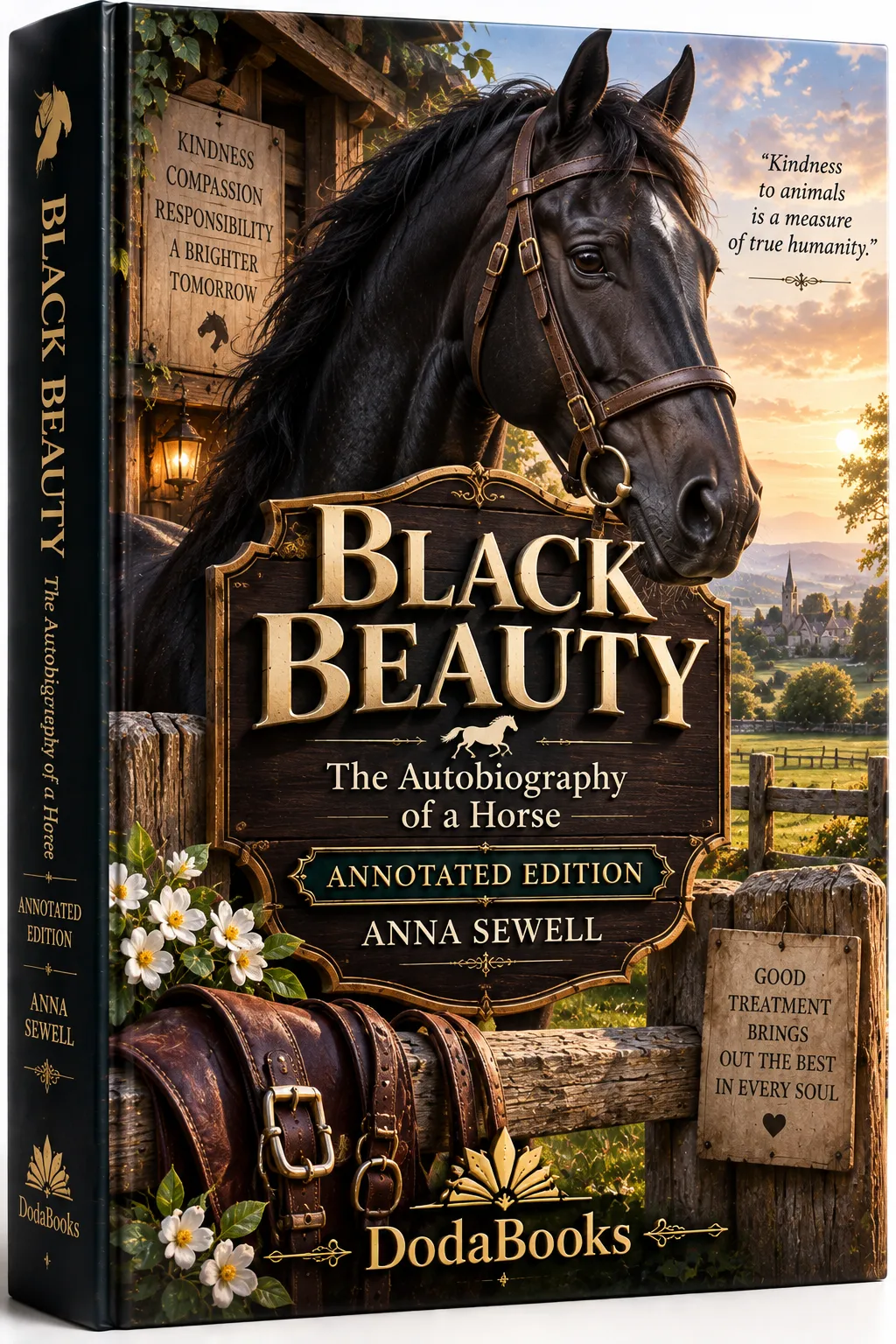
🐎 Read Anna Sewell’s Masterpiece in Its True Form
Experience the complete, unabridged story that changed the conscience of the world. The DodaBooks Annotated Edition of Black Beauty delivers:
- ✅ Complete Unabridged 1877 Text — All 49 chapters in their authentic Victorian prose
- 📜 Over 250 Detailed Footnotes — Decoded equine terms, London cab economics, and historical reforms
- ✒️ Designed for Digital Readers — Beautiful typography, clean chapter links, and responsive tables
- 🔒 100% DRM-Free Ownership — Yours permanently across Kindle, iPad, Kobo, and Android
- 📥 Instant Download — Immediate delivery in pristine EPUB format