Where to Buy A Journey into the Interior of the Earth: Best Editions & Translations Guide
Choosing an edition of Jules Verne’s 1864 masterpiece A Journey into the Interior of the Earth (Voyage au centre de la Terre) is far more dangerous than most readers realize. Unlike nineteenth-century English classics like Mary Shelley’s Frankenstein or Bram Stoker’s Dracula—where the author’s original English prose is fixed—Verne was a French author whose work fell victim to some of the most scandalous, careless, and destructive translations in the history of commercial publishing.
If you casually download a free public-domain ebook or grab a cheap reprint off a bookstore rack, there is a very high probability you are reading an anonymous Victorian butcher job. In these corrupted editions, Verne’s original German characters were stripped of their identities (Professor Otto Lidenbrock was renamed “Professor Hardwigg,” Axel was turned into “Harry”), up to twenty-five percent of Verne’s pioneering geological and paleontological science was arbitrarily deleted, and entire conversations were rewritten to sound like schoolboy adventure serials.
This comprehensive guide exposes the history of Verne’s English translations, highlights which editions to strictly avoid, and ranks the finest modern, faithful editions available today.
| Edition / Publisher | Translation Quality | Text Integrity | Character Names | Annotations & Notes | Best For |
|---|---|---|---|---|---|
| DodaBooks Annotated Edition | ★★★★★ (Exceptional) | 100% Unabridged (44 Chapters) | Restored (Lidenbrock, Axel, Hans) | Comprehensive Geological & Historical Footnotes | Serious readers, students, digital collectors |
| Oxford World’s Classics | ★★★★★ (Scholarly) | 100% Unabridged | Restored | Dense academic endnotes and critical essay | University seminars and literary scholars |
| Penguin Classics | ★★★★☆ (Strong) | 100% Unabridged | Restored | Helpful introduction and general notes | Casual classic readers seeking paperback |
| Victorian Public Domain Reprints | ★☆☆☆☆ (Severe Butcherings) | Abridged (15–25% text deleted) | Corrupted (“Hardwigg”, “Harry”) | None or obsolete Victorian footnotes | Strictly avoid; ruins Verne’s scientific genius |
⚠️ The Victorian Translation Scandal: Why Cheap Reprints Ruin Verne
The 1871 Malleson and 1877 Ward Lock Disasters
To understand why so many English readers historically dismissed Jules Verne as a superficial writer of juvenile adventure tales, one must examine the Victorian translation market of the 1870s. When Verne’s novels became sensational bestsellers across continental Europe, British publishers rushed into print with unauthorized, shoddy translations produced at breakneck speed.
The most notorious offender was the anonymous 1871 translation published by Griffith & Farran, frequently associated with Frederick Amadeus Malleson. The translator held utter contempt for Verne’s careful research and scientific rigor. Looking upon Verne’s detailed disquisitions on mineralogy, the central heat theory, and paleontology as boring technical jargon, the translator simply hacked them out of the manuscript.
Worse still was the aggressive Anglicization of the characters:
- Professor Otto Lidenbrock was rechristened “Professor Hardwigg”.
- His German nephew Axel was renamed “Harry”.
- Axel’s fiancée Graüben became “Gretchen”.
- The authentic scientific atmosphere of the Johannaeum in Hamburg was stripped of its continental cultural richness.
In 1877, Ward Lock & Co. issued another version that similarly mangled the text, altering Verne’s chapter divisions and inserting pious Victorian moralizing where Verne had written hard-headed scientific debates.
The Tragedy of the Public Domain
Because these mangled 1870s translations were out of copyright by the early twentieth century, they became the default source texts for virtually every cheap paperback reprint house, budget school edition, and early Project Gutenberg digital upload.
For over a century, generations of English-speaking readers grew up believing Jules Verne wrote clunky, juvenile stories about a “Professor Hardwigg” hitting rocks in a cave. In reality, Verne’s original French prose was sharp, intellectually sophisticated, rich in irony, and steeped in cutting-edge debates between uniformitarianism and catastrophism. Reading an abridged Victorian translation is like watching a low-resolution bootleg of a cinematic epic with twenty minutes of crucial plot scenes removed.
🏆 The Definitive Editions: Ranked for Discerning Readers
1. DodaBooks Annotated Edition (Top Digital Pick)
For readers who want the complete, authentic text paired with modern reader support, the DodaBooks Annotated Edition is the gold standard.
- Authentic Text Integrity: Uses the definitive unabridged 44-chapter text, fully restoring Verne’s authentic character names (Professor Otto Lidenbrock, Axel, Hans Bjelke, and Graüben).
- Geological & Paleontological Footnotes: Verne’s novel is filled with references to nineteenth-century scientific discoveries—such as Sir Humphry Davy’s chemical theories, Charles Lyell’s strata classifications, Ruhmkorff electric induction lamps, and the anatomical oddities of Ichthyosaurus and Plesiosaurus. DodaBooks provides contextual annotations that illuminate these references without cluttering the reading flow.
- Flawless Digital Typography: Built specifically for modern e-readers, avoiding the terrible OCR scanning errors, missing paragraph breaks, and mangled tables found in generic public-domain downloads.
- 100% DRM-Free Freedom: Delivered in pristine standard EPUB format, allowing you to read on Kindle, Kobo, iPad, Android, or desktop without proprietary hardware locks or expiry dates.
2. Oxford World’s Classics (Translated by William Butcher)
Dr. William Butcher is widely recognized as one of the world’s foremost English-language Verne scholars. His translation for Oxford World’s Classics represented a watershed moment in Verne studies.
- Pros: Butcher translated directly from Verne’s original French manuscripts, correcting hundreds of translation errors that had survived for over a century. His critical apparatus includes an extensive introduction, detailed scientific appendices, and explanatory notes explaining Verne’s geographical research on Iceland.
- Cons: Oxford’s typography can feel somewhat academic and dense, with smaller font sizes in print. The digital editions are frequently locked behind vendor DRM.
3. Penguin Classics (Translated by Robert Baldick / Frank Wynne)
Penguin Classics offers two distinct modern translations. The classic mid-century translation by Robert Baldick was a major improvement over Victorian versions, while Frank Wynne’s newer translation brings a lively, modern rhythm to the prose.
- Pros: Highly readable, natural modern English that flows easily during action sequences. Excellent physical paperback binding with Penguin’s iconic design.
- Cons: Fewer scientific annotations than the Oxford or DodaBooks editions. Explanatory footnotes are kept to a minimum, leaving modern readers to look up obscure 19th-century geological terms on their own.
📊 Feature-by-Feature Edition Comparison
| Feature | DodaBooks Annotated | Oxford World’s Classics | Penguin Classics | Standard Free Reprints |
|---|---|---|---|---|
| Text Completeness | 100% Unabridged (44 Ch.) | 100% Unabridged (44 Ch.) | 100% Unabridged (44 Ch.) | Often Abridged (~35–38 Ch.) |
| Character Names | Lidenbrock & Axel | Lidenbrock & Axel | Lidenbrock & Axel | “Hardwigg” & “Harry” |
| Scientific Annotations | Extensive Contextual Notes | Dense Academic Endnotes | Basic Literary Notes | None or Obsolete |
| Digital Formatting | Hand-crafted EPUB | Standard Publisher EPUB | Standard Publisher EPUB | Broken OCR Scans |
| DRM-Free | Yes (100% Open EPUB) | No (Amazon/Kobo DRM) | No (Amazon/Kobo DRM) | Yes (Raw Text) |
| Best Suited For | Digital Readers & Students | Academic Researchers | Casual Paperback Readers | Avoid Entirely |
🔍 The 5-Point Buyer’s Checklist: How to Spot a Bad Edition
Before you spend money on any edition of A Journey into the Interior of the Earth, verify these five critical details:
- Check Chapter 1 for Character Names: Open the preview or first chapter. If the professor is named “Professor Hardwigg” or the narrator is named “Harry,” close the book immediately. You are looking at a mutilated Victorian translation. If the names are Professor Otto Lidenbrock and Axel, the text is modern and authentic.
- Verify the Chapter Count: Verne’s definitive novel contains 44 chapters. Abridged editions frequently condense the book into 35, 38, or 40 chapters by merging scenes and deleting scientific debates.
- Inspect the Opening Runes: Chapter 3 should feature the famous runic cryptogram of Arne Saknussemm. High-quality editions properly format the runic characters and Latin decipherment. Cheap OCR scans frequently replace the runes with garbled typographic symbols.
- Examine the Footnote Density: Verne’s characters discuss Ruhmkorff lamps, Silurian trilobites, Devonian fish, and basalt formations. A quality edition must provide explanatory footnotes explaining these nineteenth-century concepts to modern readers.
- Check Digital Typography & DRM: If buying an ebook, ensure it is DRM-free so that you permanently own the file across all your devices. Hand-crafted CSS typography ensures readable tables, blockquotes, and glance boxes.
For a complete breakdown of the characters and their symbolic roles in the story, see our guide to A Journey into the Interior of the Earth Characters Explained.
❓ Frequently Asked Questions
Why is the novel sometimes titled "A Journey to the Center of the Earth"?
Verne's original French title is Voyage au centre de la Terre. Early English translations translated this literally as A Journey to the Centre of the Earth (or Center in American orthography). However, nineteenth-century authorized editions also bore the title A Journey into the Interior of the Earth. Both titles refer to the exact same work, but editions titled A Journey into the Interior of the Earth often reflect modern restored scholarship.
Are all free Project Gutenberg editions of Jules Verne bad?
Most early Project Gutenberg uploads of Verne rely on expired 1870s public-domain translations because modern copyright law protects post-1923 translations. Consequently, Gutenberg's primary text of this novel features the Anglicized "Professor Hardwigg" and truncated scientific chapters. While free, it delivers an inferior literary experience that does not reflect Verne's true writing.
What are Ruhmkorff lamps and why are they so important in the book?
A Ruhmkorff lamp (or induction coil lamp) was a revolutionary 19th-century portable electric light powered by a Bunsen battery. Verne equipped his explorers with these electric lamps rather than torches or gas lanterns because torches would consume subterranean oxygen or ignite explosive marsh gas (firedamp). High-quality annotated editions explain the science behind this historical technology.
Is it worth reading the novel if I've already seen the movie adaptations?
Yes, absolutely. Hollywood film adaptations (such as the 1959 classic starring James Mason or the 2008 adaptation starring Brendan Fraser) treat the novel as pure action-adventure fantasy, introducing romantic subplots and Hollywood monsters. Verne's original novel is far more intellectually satisfying, grounded in authentic nineteenth-century geology, paleontology, and psychological suspense.
Why should I purchase the DodaBooks Annotated Edition over other digital versions?
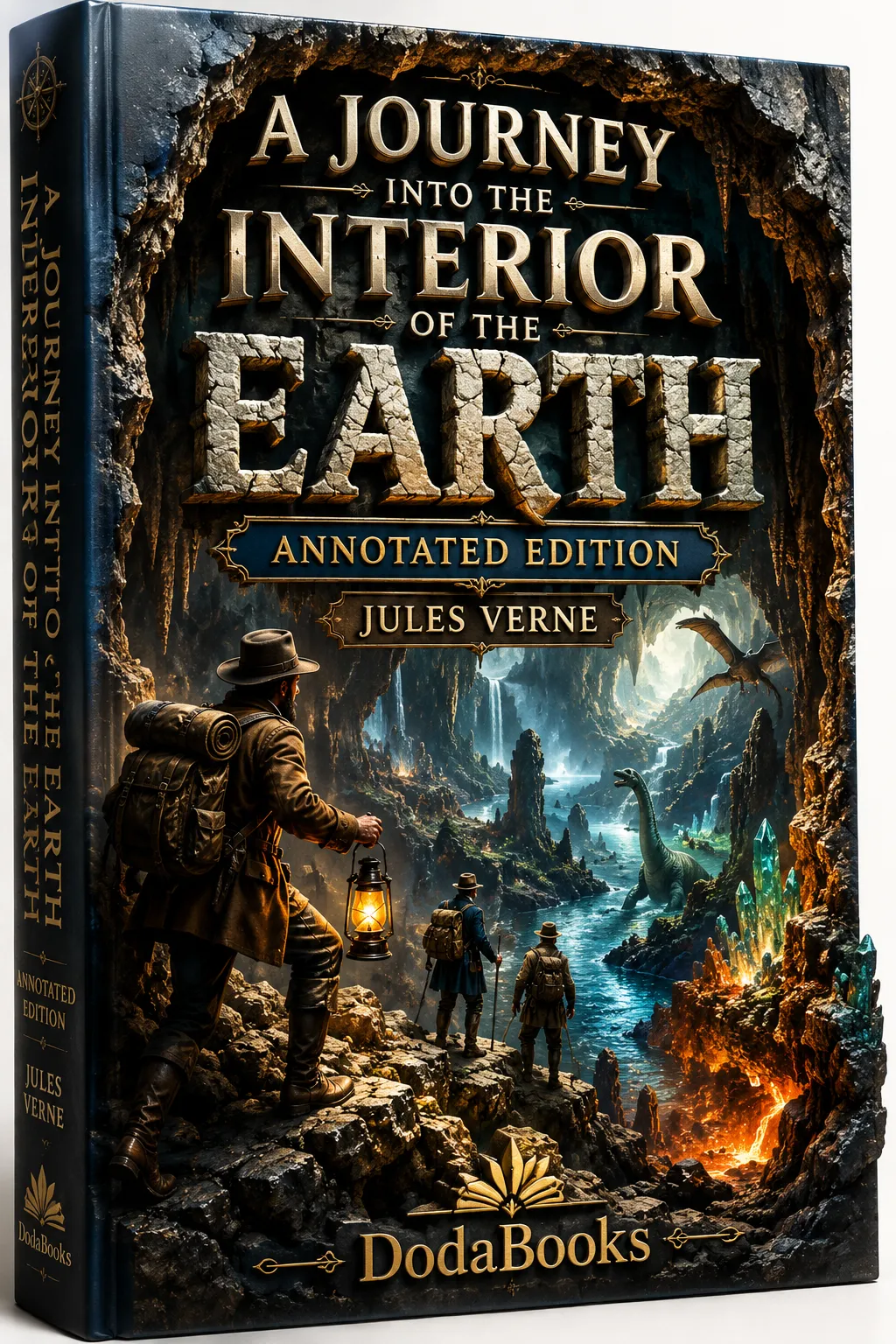
The DodaBooks Annotated Edition is specifically formatted for modern readers. It combines the complete unabridged text with Verne's original nomenclature, hundreds of helpful contextual annotations on geology and history, beautiful reading typography, and 100% DRM-free open EPUB ownership.
🌋 Read Verne the Way He Was Meant to Be Read
Don’t settle for mutilated Victorian translations or broken OCR scans. The DodaBooks Annotated Edition of A Journey into the Interior of the Earth features:
- ✅ Complete Unabridged 44-Chapter Text — Authentic Lidenbrock and Axel nomenclature
- 📜 Geological & Paleontological Annotations — Explaining prehistoric monsters, deep time, and 19th-century science
- ✒️ Pristine Digital Typography — Formatted cleanly for reading pleasure
- 🔒 100% DRM-Free Open Ownership — Keep your EPUB forever on Kindle, Kobo, or Apple Books
- 📥 Instant Direct Download — Start reading within seconds of ordering