Where to Buy A Doll's House: Best Editions & Translation Guide
Few plays in the history of world theatre have exerted as explosive an impact on literature, society, and politics as Henrik Ibsen’s 1879 masterpiece A Doll’s House (Et dukkehjem). Whether you are a student preparing for a literature seminar, a theatre professional analyzing stagecraft, or a classic literature lover seeking to experience Nora Helmer’s revolutionary awakening, choosing the right edition is crucial.
Because Ibsen wrote in Dano-Norwegian, English readers depend entirely on translations. Early Victorian English translations notoriously sanitized Ibsen’s dialogue, softening Nora’s sharp rebellion to appease polite bourgeois sensibilities. Furthermore, many modern budget editions omit crucial theatrical and historical context—such as the real-life Laura Kieler scandal that inspired the plot, 19th-century Norwegian married women’s property laws, and the infamous German alternative ending that Ibsen was coerced into writing.
This comprehensive buying guide compares the finest translations and editions available today, highlighting which versions provide the greatest literary integrity, contextual value, and reading pleasure.
| Edition / Publisher | Translation Quality | Legal & Historical Notes | Theatrical Material | DRM Status | Best For |
|---|---|---|---|---|---|
| DodaBooks Annotated Edition | ★★★★★ (Exceptional) | Comprehensive Footnotes on Victorian Legal Codes | Includes Full Text of German Alternate Ending | 100% DRM-Free EPUB | Students, digital collectors, serious readers |
| Oxford World’s Classics (McFarlane) | ★★★★★ (Scholarly) | Scholarly Endnotes and Detailed Introduction | Textual variants and performance history | Retail DRM (Kindle/Kobo) | Academic researchers and university courses |
| Penguin Classics (Meyer / Fjelde) | ★★★★☆ (Strong) | Basic Contextual Endnotes | Introductory critical essay | Retail DRM | General readers seeking physical paperback |
| Dover Thrift Editions | ★★☆☆☆ (Barebones) | None or Negligible | None; bare public-domain script | DRM-Free / Varies | Budget readers needing cheap paper script |
🔍 Why Translation Matters for Henrik Ibsen
Escaping the Victorian Censorship Trap
When A Doll’s House first reached English readers in the late 1880s, British publishers and theatrical managers were terrified of its radical message. Early translators (such as Henrietta Frances Lord and early stage adaptations like Henry Arthur Jones’s butchered Breaking a Butterfly) altered dialogue, made Torvald more sympathetic, and attempted to turn Nora into a remorseful sinner.
Even William Archer’s groundbreaking 1890 translation—which first introduced Ibsen’s authentic text to the English-speaking world—occasionally suffered from stiff, archaic Victorian phrasing that obscured the crisp, colloquial realism of Ibsen’s original Norwegian. In Ibsen’s Scandinavian dialogue, characters speak like real people in a drawing room: their sentences are fragmented, full of subtext, hesitations, and biting irony.
When choosing an edition today, it is essential to select a modern, faithful translation that preserves Ibsen’s natural cadence without adding dated Victorian filler.
🏆 The Definitive Editions: Ranked and Reviewed
1. DodaBooks Annotated Edition (Top Digital Pick)
For readers who want the complete dramatic text enriched with deep historical and theatrical context, the DodaBooks Annotated Edition is the gold standard.
- Authoritative Text Integrity: Features the complete, unabridged 3-act drama in a crisp, highly readable modern English translation that captures every nuance of Ibsen’s psychological realism.
- Victorian Legal & Social Annotations: Unpacks the precise legal mechanisms of 1870s Scandinavia—explaining why a married woman was legally prohibited from signing a loan, how promissory notes functioned, and why Krogstad’s blackmail posed such a catastrophic threat to Torvald’s career.
- The German Alternative Ending Included: Provides the complete historical text of the notorious alternate ending Ibsen was forced to write for German theaters, accompanied by critical commentary explaining why Ibsen denounced it as a “barbaric outrage.”
- 100% DRM-Free EPUB: Delivered in open standard EPUB format, allowing you to read on Kindle, Kobo, iPad, reMarkable, or Android without proprietary software locks.
2. Oxford World’s Classics (Translated by James McFarlane)
The late James McFarlane was the preeminent British Ibsen scholar of the twentieth century and general editor of The Oxford Ibsen.
- Pros: McFarlane’s translation is meticulously accurate and widely respected in academia. The volume includes an extensive scholarly introduction, detailed chronology of Ibsen’s life, and explanatory notes detailing the evolution of the draft manuscripts.
- Cons: The formatting is dense and academic, with notes placed at the very back of the volume rather than inline, requiring readers to constantly flip back and forth. Digital versions are restricted by Amazon/Kobo DRM.
3. Penguin Classics (Translated by Michael Meyer / Rolf Fjelde)
Penguin Classics offers distinguished translations by Michael Meyer (in the UK) and Rolf Fjelde (in the US).
- Pros: Both Meyer and Fjelde were accomplished theatre professionals who translated with the stage in mind. The dialogue flows naturally and reads exceptionally well when spoken aloud.
- Cons: Penguin editions are aimed at general readers and contain fewer annotations regarding the legal and financial specifics of the period. Readers looking for deep study notes will find the commentary somewhat brief.
4. Dover Thrift Editions
Dover offers an ultra-budget paperback reprint of early public-domain translations.
- Pros: Inexpensive physical price point (often under $5).
- Cons: Contains an outdated Victorian translation with archaic syntax. Offers zero explanatory notes, zero historical context, and no analysis of the tarantella or the alternate ending. Strictly a budget utility option for readers who only need a throwaway paper script.
📊 Feature Comparison Matrix
| Feature | DodaBooks Annotated | Oxford World’s Classics | Penguin Classics | Dover Thrift |
|---|---|---|---|---|
| Text Completeness | 100% Unabridged (3 Acts) | 100% Unabridged (3 Acts) | 100% Unabridged (3 Acts) | 100% Unabridged |
| German Alternate Ending | Full Text Included | Critical Summary | Excerpted in Intro | Excluded |
| Historical & Legal Notes | Extensive Contextual Notes | Dense Academic Endnotes | Basic Literary Notes | None |
| Typography & Layout | Optimized E-Reader Layout | Standard Book Layout | Standard Book Layout | Basic Print Typesetting |
| DRM-Free Freedom | Yes (100% Open EPUB) | No (Vendor DRM) | No (Vendor DRM) | Varies |
| Best For | E-Readers, Students, Collectors | University Seminars | Casual Paperback Readers | Barebones Utility |
🎯 5 Crucial Factors to Check Before Buying
- Verify the Inclusion of the Alternate Ending: In 1880, German actress Hedwig Niemann-Raabe refused to perform Nora’s abandonment of her children, forcing Ibsen to write an alternate ending where Nora collapses in tears before her children’s bedroom. Any serious study edition should include the full text of this alternate scene to illustrate how Victorian society attempted to censor Ibsen’s radical vision.
- Check for Legal and Financial Footnotes: Without an understanding of 19th-century Scandinavian banking laws, married women’s property acts, and the severity of forgery penalties, Nora’s panic can seem exaggerated to modern readers. Ensure your edition explains these historical realities.
- Inspect the Dialogue Rhythm: Read a sample of the opening dialogue between Nora and Torvald. If Torvald’s pet names sound ridiculously archaic or Nora’s speech feels stiff and wooden, look for a more fluid modern translation.
- Examine the Stage Directions: Ibsen was a master director who meticulously noted character movements, lighting cues, and prop handling (such as Nora’s macaroons, the Christmas tree candles, and Dr. Rank’s cigars). Ensure the stage directions are intact and cleanly typeset.
- Ensure DRM-Free Digital Ownership: If buying an ebook, choose a vendor that provides DRM-free files so that your copy remains permanently accessible across all your e-readers and tablets without proprietary vendor locks.
For a comprehensive scene-by-scene analysis of the play, explore our A Doll’s House Act-by-Act Summary.
❓ Frequently Asked Questions
Why is the play titled "A Doll's House" instead of "A Doll House"?
The original Norwegian title is Et dukkehjem. In Scandinavian languages, hjem means "home" rather than merely a physical building. William Archer translated it into English as A Doll's House in 1890, which became the standard title across Britain and the Commonwealth. Some American translations use A Doll House to emphasize that the entire household—including Torvald—is an artificial toy world.
What was the real scandal that inspired Ibsen to write A Doll's House?
The play was inspired by Laura Kieler, a young Norwegian novelist and friend of Ibsen. When her husband contracted tuberculosis, Laura secretly borrowed money via a forged promissory note to finance a cure in Italy. When her husband discovered the forgery, he cruelly repudiated her, had her committed to a mental asylum, and took away her children. Horrified by her ordeal, Ibsen wrote A Doll's House to expose the brutal treatment of women under the law.
Can I read A Doll's House comfortably as a play script?
Yes, absolutely. Unlike Shakespeare, whose poetic blank verse requires decoding Early Modern syntax, Ibsen wrote in realistic, conversational prose. The play reads like a modern psychological thriller and can be comfortably finished in 2 to 3 hours. For study guidance, see our Reading Difficulty Guide.
Why did Ibsen refuse to call himself a feminist?
In an 1898 speech to the Norwegian Association for Women's Rights, Ibsen famously stated: "I must disclaim the honor of having consciously worked for the women's rights movement... To me it has appeared as the problem of human beings in general." While Ibsen saw his play as a universal drama about the struggle of any individual to achieve spiritual autonomy, its critique of patriarchal marriage remains a cornerstone of feminist literature.
Why should I choose the DodaBooks edition over free online versions?
Free digital versions online almost always feature expired 1890s Victorian translations that are stiff, archaic, and unannotated. The DodaBooks Annotated Edition provides a fluent, modern translation, rich annotations on legal history and stagecraft, the complete text of the German alternate ending, and 100% DRM-free open EPUB ownership.
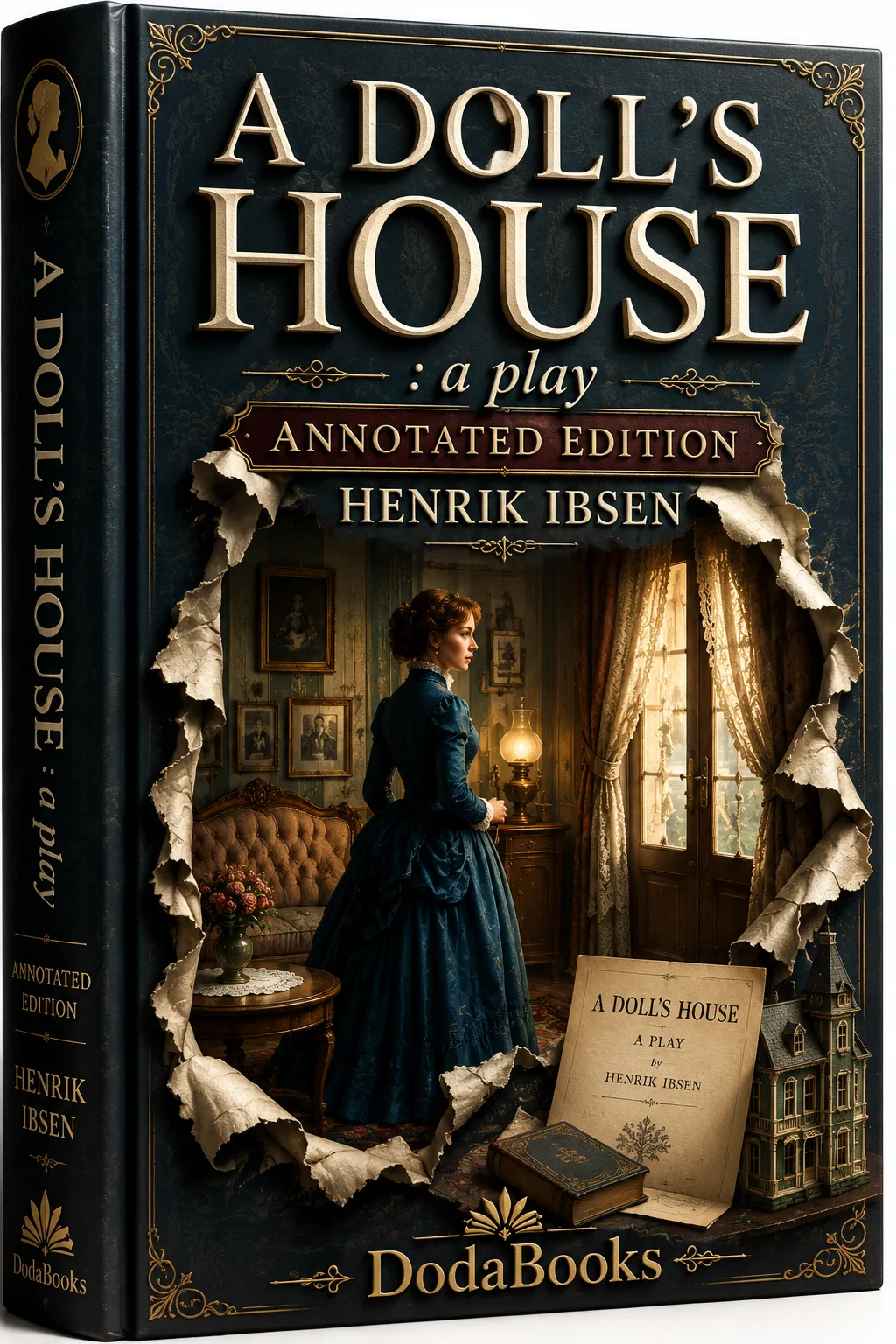
🚪 Invest in the Definitive Edition of Ibsen’s Masterpiece
Read Henrik Ibsen’s revolutionary drama in an edition designed for deep understanding and reading pleasure. The DodaBooks Annotated Edition delivers:
- ✅ Complete Unabridged 3-Act Drama — Fresh, fluent modern translation
- 📜 Legal & Historical Annotations — Explaining Victorian marriage laws, forgery, and the Laura Kieler scandal
- 🎭 Complete German Alternate Ending — The full historical text of Ibsen’s coerced alternate finale
- 🔒 100% DRM-Free Ownership — Yours permanently across Kindle, Kobo, and Apple Books
- 📥 Instant EPUB Delivery — Start reading within seconds of purchase