Under the Witches’ Moon
Nathan Gallizier’s Sinuous, Sumptuous Tale of Tenth-Century Papal Splendor, Feudal Treachery, and Forbidden Passion Beneath the Sabine Hills
In the vibrant golden age of American historical romance before the Great War, few novelists approached the Italian past with the sensory opulence, dramatic intensity, and erudite medieval atmosphere of Nathan Gallizier (1866–1925). Published in 1917 with lush decorative illustrations by The Page Company, Under the Witches’ Moon: A Romantic Tale of Mediaeval Rome stands as the crowning jewel in Gallizier’s cycle of Italian historical romances.
Set in the tenth century—the tumultuous era of the Saeculum Obscurum, when rival Roman barons, German Holy Roman Emperors, and corrupt patrician dynasties vied for mastery over the Holy See—the novel plunges the reader into a world of intoxicating beauty and deadly political menace. Amidst marble ruins choked with ivy, subterranean catacombs, and sun-drenched vineyards beneath the Alban Mount, Gallizier orchestrates a high-stakes drama of chivalry, witchcraft accusations, and tragic love.
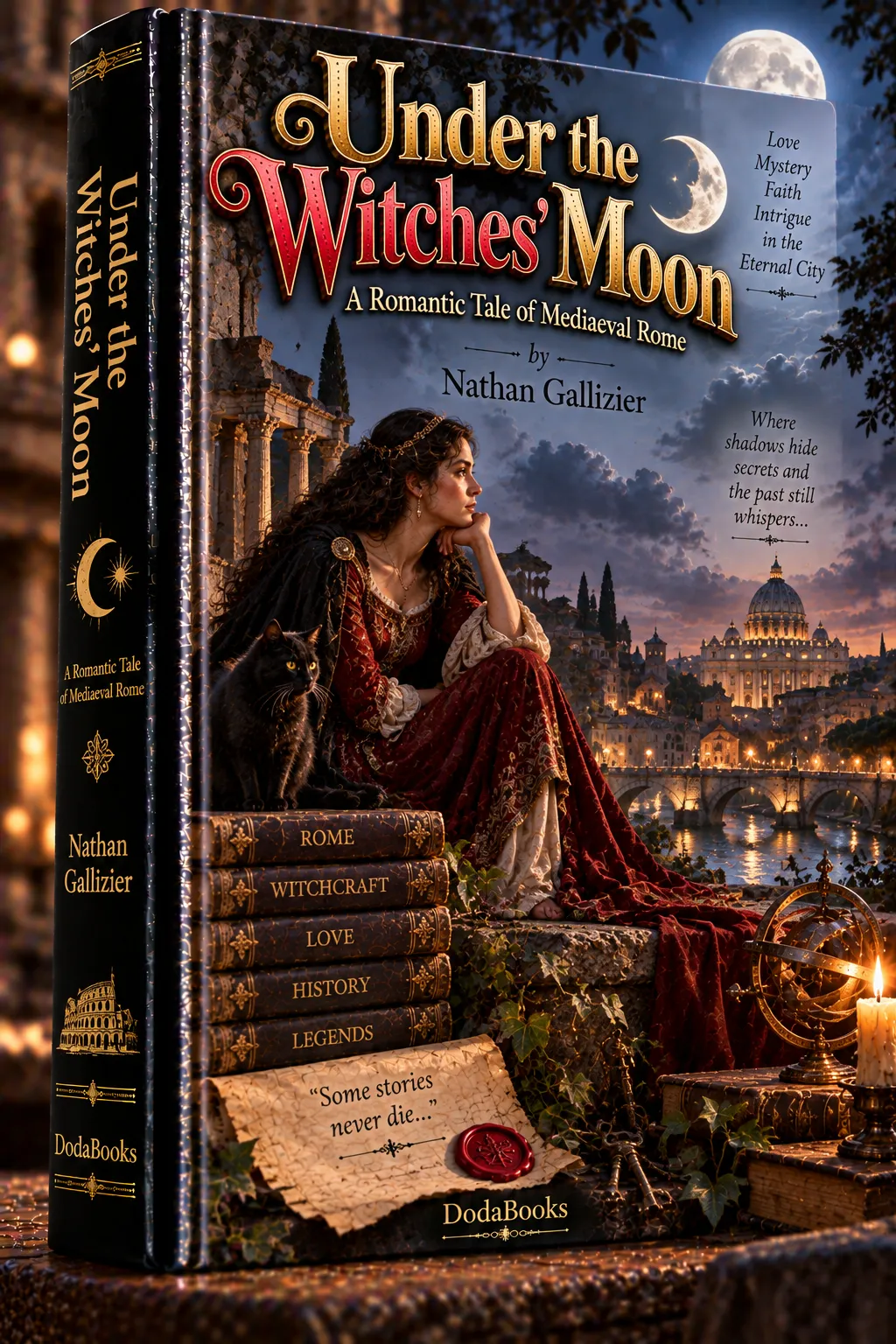
Step into the Shadow of the Eternal City
Read Nathan Gallizier's sumptuous masterpiece in an annotated edition exploring tenth-century Roman baronage, medieval folklore, and the Crescentii and Theophylact dynasties.
Get Under the Witches' MoonThe dark grandeur of Italian despotic power similarly animates Marjorie Bowen’s renaissance thriller.
Gallizier’s exploration of medieval Italian court intrigue and spiritual crisis reaches its peak in The Hill of Venus.
The Web of Feudal Passion: Tristan and the Lady of San Angelo
The narrative centers on Tristan of Ingelheim, a noble Frankish knight who arrives in Rome on a diplomatic mission for the German imperial court. Expecting to find the pious, holy capital of Western Christendom, Tristan is stunned to discover a city consumed by pagan superstition, decadent luxury, and ruthless patrician power struggles.
Tristan’s fate becomes irrevocably entangled with:
- The Lady Violante: A patrician noblewoman of ethereal beauty and fierce intellect, trapped in the political machinations of Rome’s ruling dynasties.
- The Barons of the Campagna: Feudal warlords operating from fortified ancient ruins—the Colosseum, the Mausoleum of Augustus, and the Castle of Sant’Angelo—who hold the papacy hostage to their private ambitions.
- The Accusation of Sorcery: When an eclipse darkens the Sabine skies and a mysterious plague touches the Tiber, sinister clerical factions accuse Violante of witchcraft, alleging that she practices forbidden pagan rites beneath the “Witches’ Moon” in the haunted olive groves of Tusculum.
Gallizier’s Sensory Gothic Prose: Rome in the Dark Ages
What distinguishes Gallizier from standard costume romances is the extraordinary sensory richness of his prose style. He writes with the decadent, color-saturated palette of the late Pre-Raphaelites and French Parnassians:
“The Tiber coiled through the ruined arches like a yellow serpent slumbering under the autumn moon. From the cypress-crowned heights of the Aventine drifted the heavy perfume of dying myrtle, mingled with the bitter scent of incense from crypts where forgotten saints lay shrouded in purple and gold.”
Gallizier reconstructs tenth-century Rome not as a pristine classical museum, but as a living palimpsest of antiquity, barbarian invasions, and early Christian mysticism. The characters move through marble forums where peasant goatherds graze flocks among half-buried Corinthian columns, and where ancient statues of Roman gods are secretly worshipped or feared as pagan demons.
Rare Historical Setting
A thrilling, meticulously researched exploration of 10th-century Rome—an era rarely depicted in historical fiction, marked by feudal turbulence and the Crescentii family.
Decadent Gothic Atmosphere
Lush, sensory prose capturing medieval catacombs, midnight sorcery trials, ruined pagan temples, and the eerie mists of the Roman Campagna.
Epic Chivalric Action
Broadsword duels along the Tiber bridges, night assaults on feudal fortress ruins, and dramatic escapes through secret subterranean Roman vaults.
Scholarly Historical Notes
Footnotes explaining medieval papal history, feudal Roman topography, Ottonian imperial politics, and Gallizier's place in early 20th-century romanticism.
The Crescentii Dynasty and the Architecture of Baronial Tyranny
To appreciate the political realism that anchors Gallizier’s romantic plot, one must examine the historical reality of tenth-century Rome’s ruling dynasties. Following the disintegration of Charlemagne’s empire, Rome fell into an era of brutal local warlordism. Chief among these baronial families was the house of Crescentius (the Crescentii), whose fortified strongholds turned the sacred monuments of classical antiquity into private military redoubts.
Gallizier depicts this militarized cityscape with architectural accuracy:
- The Fortress of Sant’Angelo: Originally built as the imperial mausoleum of Emperor Hadrian, the massive circular stone monument was transformed by the Crescentii into an impregnable citadel controlling the Tiber crossings. Gallizier sets several of his most suspenseful scenes within its spiraling ramps, vaulted torture chambers, and parapets overlooking the Vatican meadows.
- The Desecration of Classical Monuments: The novel documents how the marble temples of the Roman Forum were stripped of columns to reinforce private baronial battlements, while ancient aqueducts were severed, reducing the city’s populace to drinking the muddy, disease-ridden waters of the Tiber.
- The Puppet Popes: Gallizier shows how adolescent pontiffs were installed and deposed at the whim of the Roman senatrixes and warlords. This historical corruption creates the novel’s dark moral backdrop, against which Tristan and Violante’s pure chivalric devotion shines in brilliant contrast.
The Medieval Aesthetic of the Page Company Editions
A distinctive element of Gallizier’s literary legacy was the lavish material presentation of his novels by The Page Company of Boston. In the early twentieth century, The Page Company was renowned for producing deluxe “gift book” editions of romantic historical novels, featuring full-color frontispieces, decorated endpapers, and embossed gold-leaf cloth covers.
For Under the Witches’ Moon, the publisher commissioned celebrated illustrator The decorative artist and painter to create dramatic color plates depicting Tristan in Frankish armor, Violante praying in Roman crypts, and moonlit swordfights along the Tiber. This visual splendor reinforced Gallizier’s literary philosophy: that historical romance should be an all-encompassing aesthetic experience that transports the reader bodily into the color, danger, and passion of a bygone civilization.
Pagan Survivals and Medieval Witchcraft
A core thematic fascination of Under the Witches’ Moon is the persistence of pre-Christian Roman folk beliefs beneath the veneer of medieval Catholicism. Gallizier spent years in European archives researching the folklore of the Roman Campagna.
He shows how ordinary Roman peasants and patricians alike still whispered invocations to Diana Nemorensis at Lake Nemi, consulted herbal sorceresses in the Alban hills, and read omens in the flight of birds over the Capitoline. When the corrupt clerical faction targets Violante, they weaponize these lingering pagan customs, transforming harmless rustic folklore into capital charges of demonic heresy. Tristan’s struggle to defend her becomes a battle not only of swords, but of reason and chivalric devotion against superstition and religious tyranny.
Experience Nathan Gallizier's Medieval Epic
Read the definitive edition of Under the Witches' Moon formatted for modern digital readers with comprehensive historical annotations and topological guides.
Get Under the Witches' MoonNathan Gallizier and the Tradition of American Medievalism
Born in Milan and educated in Germany before emigrating to the United States and settling in Cincinnati, Ohio, Nathan Gallizier occupied a unique position in American literature. He brought authentic continental European historical erudition to the energetic pacing of American adventure fiction.
His cycle of Italian romances—including The Sorceress of Rome, The Court of Lucifer, and The Hill of Venus—earned him a devoted following among readers who loved the historical depth of Sir Walter Scott combined with the dark, gothic intensity of Alexandre Dumas and Rafael Sabatini.
Why Under the Witches' Moon Transcends Escapist Romance
Beyond its thrilling plot twists and chivalric romance, Gallizier's novel provides an astonishingly erudite window into the Dark Ages of the Italian peninsula. It is an indispensable treat for lovers of medieval history, gothic fiction, and classic adventure.
The Annotations in the DodaBooks Edition
The DodaBooks curated edition provides an indispensable reading companion:
- Map of Medieval Rome: Explanations of medieval landmarks, including the Leonine City, Castel Sant’Angelo, and the fortified towers of the Roman barons.
- Dynastic Notes: Historical context on the German Holy Roman Empire’s Ottonian dynasty and its complex relationship with the Roman papacy.
- Glossary of Latin & Medieval Italian Terms: Defining feudal titles, liturgical terms, and medieval armaments.
Download the Complete Novel Today
Step into the shadowed halls of medieval Rome and experience Nathan Gallizier's masterpiece in an impeccably formatted digital edition.
Download the Edition NowFrequently Asked Questions
Who was Nathan Gallizier?
Nathan Gallizier (1866–1925) was an American historical novelist born in Italy and educated in Germany. He was celebrated for his richly researched, dramatic historical romances set in medieval Rome and Renaissance Italy.
What is the historical setting of Under the Witches' Moon?
The novel is set in 10th-century Rome during the 'Saeculum Obscurum,' a period when the papacy was contested by violent local baronial dynasties such as the Crescentii and Theophylacts, caught between German imperial interventions and local feudal rivalries.
What role does witchcraft play in the novel?
Witchcraft serves as both an atmospheric element (reflecting ancient pagan survivals and folklore in the Roman Campagna) and a major plot device, as political rivals use false accusations of witchcraft and sorcery to persecute the noble heroine Violante.
How does Gallizier's style compare to other historical novelists?
Gallizier writes with a lush, decadent sensory style reminiscent of the Pre-Raphaelites, combining the meticulous archival accuracy of Sir Walter Scott with the thrilling romantic melodrama of Rafael Sabatini.
Where can I get the complete annotated ebook?
The complete digital edition is available for immediate download at DodaBooks at https://dodabooks.com/ebook/under-the-witches-moon-a-romantic-tale-of-mediaeval-rome-by-nathan-gallizier/.