Twenty Years After Characters: D'Artagnan, Athos, Porthos & Aramis Explained
When Alexandre Dumas published Twenty Years After in 1845, he accomplished one of the rarest feats in world literature: crafting a sequel that was psychologically richer, more morally nuanced, and dramatically darker than its legendary predecessor.
In The Three Musketeers, D’Artagnan and his three friends were young, reckless, and invincible, united by adolescent camaraderie and unthinking loyalty to the King. But in Twenty Years After, two decades of time have taken their toll. The characters are now in their forties—weathered by age, disillusionment, financial realities, and divergent political convictions.
D’Artagnan has grown pragmatic and cynical; Athos has transformed into a grave, saintly father raising his noble son; Porthos has accumulated vast wealth but yearns for aristocratic recognition; and Aramis has donned the cassock of an abbé while secretly orchestrating revolutions.
This comprehensive guide analyzes the evolution, psychological motivations, and symbolic roles of the Four Musketeers and the memorable supporting figures—including the young Raoul de Bragelonne, the scheming Cardinal Mazarin, and the terrifying avenger Mordaunt.
| Character | Social Station in 1648 | Core Ambition | Political Allegiance | Defining Narrative Moment |
|---|---|---|---|---|
| D’Artagnan | Lieutenant of Musketeers | Military promotion and personal fortune | Cardinal Mazarin & Regency | Rescuing his friends and kidnapping Mazarin in his nightshirt at Rueil |
| Athos (Comte de la Fère) | Retired landed nobleman | Raising Raoul; preserving chivalric honor | The Fronde & King Charles I | Standing beneath the scaffold at Whitehall; slaying Mordaunt in the sea |
| Porthos (M. du Vallon) | Immensely wealthy seigneur | Attaining a hereditary noble barony | Cardinal Mazarin & Regency | Smashing through castle doors and holding Mazarin hostage until he signs |
| Aramis (Abbé d’Herblay) | Jesuit cleric and churchman | Political influence and clerical power | The Fronde & King Charles I | Conspiring with Madame de Longueville and dueling D’Artagnan in the dark |
| Raoul (Vicomte de Bragelonne) | Athos’s son / Young officer | Serving France with flawless chivalric virtue | Royal Army (Duc d’Enghien) | Exemplifying the pure chivalric ideals of the old French nobility |
| Mordaunt | Cromwell’s envoy / Milady’s son | Avenging his mother by slaying her six judges | Puritan Commonwealth | Murdering his uncle Lord de Winter and beheading King Charles I |
🗡️ D’Artagnan: The Aging Gascon and Pragmatic Realist
From Hot-Headed Youth to Cynical Veteran
In The Three Musketeers, the eighteen-year-old Gascon was an impulsive, hot-tempered duelist ready to challenge anyone who looked sideways at his yellow pony. Twenty years later, D’Artagnan is a forty-year-old soldier whose fiery youthful idealism has been tempered by two decades of unrewarded routine.
Despite his legendary bravery at La Rochelle, D’Artagnan remains stuck at the rank of Lieutenant. While his comrades retired to wealth and country estates, D’Artagnan has stayed in the army, lodging in modest Paris quarters, scraping by on irregular soldier’s pay, and watching mediocre sycophants win royal favors.
D’Artagnan has developed a sharp, pragmatic streak:
“At twenty, one fights for glory, for a smile, for a ribbon; at forty, one fights for money, for a captaincy, for a home.”
          [ D'ARTAGNAN'S PSYCHOLOGICAL EVOLUTION ]

      THE THREE MUSKETEERS (Age 20)           TWENTY YEARS AFTER (Age 40)
+---------------------------------------+  +---------------------------------------+
| • Hot-headed, impulsive Gascon        |  | • Shrewd, pragmatic tactician         |
| • Fights for romance & glory          |  | • Fights for pension & promotion      |
| • Blind devotion to the Crown         |  | • Cynical observer of politics        |
| • Follows Athos's moral lead          |  | • Master strategist and leader of Four|
+---------------------------------------+  +---------------------------------------+
The Ultimate Mastermind
Yet D’Artagnan’s cynical exterior conceals the same fiercely loyal heart. When Mazarin attempts to manipulate him, D’Artagnan proves that he is far more than an ordinary sword-for-hire: he is a master strategist who outwits both Cardinal Mazarin and the French court.
His greatest moment occurs in Part IV. When Mazarin imprisons him at Rueil, D’Artagnan does not despair. He discovers the Cardinal’s secret treasure vault, kidnaps the Prime Minister of France in his nightshirt, and forces the Cardinal to sign concessions for all four friends. By earning his long-delayed Captaincy of the King’s Musketeers, D’Artagnan proves that brains, patience, and unbreakable loyalty will ultimately triumph over aristocratic corruption.
🕊️ Athos (Comte de la Fère): The Chivalric Patriarch
The Transition from Melancholy to Fatherhood
Of all the musketeers, Athos has undergone the most profound spiritual transformation. In his youth, Athos was a dark, brooding figure who drank heavily to drown the agony of his betrayal by Milady de Winter.
In Twenty Years After, Athos has given up the bottle and laid aside his rapier. Living quietly on his estate near Blois as the Comte de la Fère, he has found redemption through fatherhood. He has dedicated his life to raising his adopted ward, Raoul (the Vicomte de Bragelonne), who is secretly Athos’s natural son by the Duchesse de Chevreuse.
Athos has evolved into the novel’s undisputed moral conscience:
- He represents the dying feudal ideal of the chivalric French gentleman—grave, dignified, incorruptible, and compassionate.
- When D’Artagnan visits him to recruit him for Mazarin, Athos gently refuses, choosing to align with the Fronde because he cannot support a foreign minister who oppresses the French people.
                  [ ATHOS: THE REDEMPTION OF FATHERHOOD ]

               Tragic Youth (Milady de Winter Betrayal)
                                  |
                                  v
                      Alcoholism & Cynical Despair
                                  |
                                  v
                 Birth of Raoul (Vicomte de Bragelonne)
                                  |
                                  v
                Transformation into Noble Moral Patriarch
                                  |
                                  v
            Martyr of Royalist Honor at Whitehall Scaffold
Standing Beneath the Scaffold
Athos’s tragic chivalry reaches its peak in England. His devotion to the doomed King Charles I is not based on political convenience, but on an ancient sacred belief in the divine right of kings.
When Charles I is condemned, Athos hides beneath the executioner’s platform at Whitehall, catching the falling blood of his martyred king. When Mordaunt attempts to drown him in the icy sea, Athos’s final act of self-defense—plunging his dagger into the avenger’s heart—is undertaken not with malice, but with profound sorrow, finally closing the dark chapter of Milady de Winter.
🏰 Porthos (Monsieur du Vallon): The Gentle Giant
Wealth Without Distinction
In his youth, Porthos was a vain, flamboyant giant who strutted through Paris wearing gold-embroidered baldrics and boasting of wealthy duchesses. Twenty years later, Porthos has actually achieved the wealth he once faked: he married his rich procureuse (Madame Coquenard), inherited four magnificent estates (including the great estate of Pierrefonds), and enjoys a lifestyle of hunting, fine wines, and culinary luxury.
Yet Porthos is plagued by a deep social insecurity: he is not a nobleman. His snobbish provincial neighbors mock his bourgeois origins, and Porthos desperately yearns for a hereditary title of nobility:
“I have plenty of money, D’Artagnan; I have four châteaux, six forests, and eight thousand sheep; but I am only Monsieur du Vallon. I want to be a Baron!”
       [ PORTHOS: THE ANATOMY OF A GENTLE GIANT ]
+-------------------------------------------------------------+
| Physical Dimension: Colossal strength; can shatter doors,   |
| lift carriages, and snap iron chains with bare hands        |
+-------------------------------------------------------------+
                               |
                               v
+-------------------------------------------------------------+
| Intellectual Dimension: Simple-minded, easily bewildered by |
| subtle political conspiracies; relies totally on D'Artagnan |
+-------------------------------------------------------------+
                               |
                               v
+-------------------------------------------------------------+
| Emotional Dimension: Immensely generous, sweet-tempered,    |
| and fiercely loyal; would lay down his life for his friends |
+-------------------------------------------------------------+
Loyalty and Strength
While Porthos provides much of the novel’s delightful comedic relief—such as his hilarious bewilderment over French parliamentary politics and his enormous appetite—he remains a terrifying force of nature in battle. Whether smashing down fortified prison gates, holding off Cromwellian cavalry, or lifting Cardinal Mazarin out of his bed like a child, Porthos’s strength is legendary.
When D’Artagnan delivers him his royal letters patent making him the Baron du Vallon de Bracieux de Pierrefonds, Porthos’s pure, childlike joy is one of the most heartwarming moments in Dumas’s fiction.
⛪ Aramis (Abbé d’Herblay): The Machiavellian Churchman
Cassock and Rapier
In The Three Musketeers, Aramis was constantly torn between his religious vocation and his love of military adventure, repeatedly threatening to enter the church whenever his romantic affairs went sour.
In Twenty Years After, Aramis has officially become an ordained priest and an Abbé at the convent of Noisy. Yet beneath his holy cassock, Aramis is more secular and dangerous than ever before:
- He is an ambitious political schemer, acting as a key mastermind of the Fronde rebellion.
- He maintains a passionate, dangerous romantic relationship with Madame de Longueville, the charismatic leader of the rebel nobles.
- He combines Jesuit intellectual subtlety with deadly swordsmanship.
                  [ THE DUAL IDENTITY OF ARAMIS ]

               +-------------------+-------------------+
               |                                       |
               v                                       v
    [ THE CLERICAL MASK ]                    [ THE INWARD SCHEMER ]
Ordained Abbé at Noisy;                  Secret mastermind of the Fronde;
quotes Latin scriptures;                 lover of Madame de Longueville;
displays pious serenity.                 ruthless political conspirator.
The Most Complex Musketeer
Aramis is the most morally ambiguous of the four companions. While Athos acts from pure honor and Porthos from simple loyalty, Aramis always plays a hidden game of high-stakes chess.
When D’Artagnan confronts him at Noisy, Aramis conceals his rebel sympathies behind polite ecclesiastical smiles. Later, when the four clash on the Place Royale, Aramis is the most reluctant to reconcile, calculating the political consequences of peace. Yet when the call comes to rescue King Charles I in England, Aramis proves that his courage and chivalric pride remain as brilliant and lethal as ever.
👑 The Supporting Cast: New Generation and Dark Nemesis
       [ THE NEXT GENERATION & THE NEMESIS ]
+-------------------------------------------------------------+
| RAOUL (Vicomte de Bragelonne)  VS.  MORDAUNT                |
| (Athos's Son)                       (Milady de Winter's Son)|
+-------------------------------------------------------------+
| • Embodiment of chivalry            | • Embodiment of hatred|
| • Fights for honor and duty         | • Fights for blood ven|
| • Respectful, pure, and brave       | • Ruthless, fanatical |
| • The future hope of France         | • The ghost of the pas|
+-------------------------------------------------------------+
Raoul, Vicomte de Bragelonne
Raoul is introduced as a fifteen-year-old youth of extraordinary grace, modesty, and courage. Raised under Athos’s strict moral tutelage, Raoul represents the ideal of the perfect chivalric knight.
Entering the royal army under the command of the brilliant young Duc d’Enghien (later the Grand Condé), Raoul distinguishes himself at the historic Battle of Lens. His gentle demeanor and selfless bravery contrast sharply with the cynical, mercenary world of 1648, paving the way for his central role in the final novel of the trilogy.
Mordaunt: The Demonic Avenger
If Milady de Winter was a masterpiece of cold, calculating seduction, her twenty-three-year-old son Mordaunt is a creature of pure, unadulterated venom.
Raised in neglect and deprived of his rightful titles by King Charles I, Mordaunt joins Cromwell’s Puritan forces not out of religious conviction, but to acquire the power and authority needed to execute his blood feud:
- He has tracked down the identities of the six men who judged his mother at Armentières.
- He is utterly fearless, fanatical, and devoid of human warmth.
- When he secretly volunteers to be the masked executioner of King Charles I, he strikes a blow against both the monarchy and the musketeers who tried to save it.
Mordaunt’s terrifying final scene—dragging Athos down into the icy English Channel before being stabbed to death—marks the exorcism of the dark curse that had haunted the musketeers for twenty years.
Cardinal Mazarin
Cardinal Jules Mazarin succeeds Cardinal Richelieu as Prime Minister of France, but Dumas emphasizes the stark contrast between the two men:
- Richelieu: A towering, aristocratic statesman who was feared, revered, and governed with majestic authority.
- Mazarin: A crafty, penny-pinching Italian diplomat who governs through deceit, petty bribes, and fiscal extortion.
Mazarin’s cowardly, miserly nature makes him the perfect comic foil for D’Artagnan and Porthos. When the musketeers hold him hostage at Rueil, Mazarin’s terror reveals that behind his grand robes, he is merely an insecure politician easily brought to heel by four resolute swordsmen.
📊 The Four Musketeers Across Time: 1628 vs. 1648
| Dimension | D’Artagnan | Athos | Porthos | Aramis |
|---|---|---|---|---|
| Age in 1648 | 40 years old | 48 years old | 46 years old | 44 years old |
| Rank / Station | Lieutenant of Musketeers | Comte de la Fère | Seigneur du Vallon | Abbé d’Herblay |
| Personal Wealth | Modest (military pay) | Substantial estate | Staggering riches | Wealthy benefice |
| Weapon Style | Rapid, technical Gascon rapier | Dignified, fatal classical thrust | Colossal power and two-handed blow | Elegant, deceptive wrist action |
| 1648 Allegiance | Regency / Cardinal Mazarin | The Fronde / Stuart Royalists | Regency / Cardinal Mazarin | The Fronde / Stuart Royalists |
| Ultimate Reward | Captain of the Musketeers | Honor & commissions for Raoul | Hereditary Barony | General amnesty & Fronde wins |
❓ Frequently Asked Questions
Why were the Four Musketeers on opposite sides of the Fronde?
When Cardinal Richelieu died, the four friends went their separate ways. D'Artagnan remained an active soldier in the service of the Crown and Cardinal Mazarin, recruiting Porthos with the promise of a royal barony. Meanwhile, Athos and Aramis sympathized with the traditional French nobility and the oppressed Parisian populace, who viewed Mazarin as a corrupt foreign tyrant. Their different life paths naturally led them into opposing political factions before their brotherhood reunited them.
Is Raoul really Athos's biological son?
Yes. Although Athos initially introduces Raoul as his "adopted ward" to protect his reputation and the honor of the boy's mother, Dumas reveals that Raoul is Athos's natural son by Marie de Rohan, the celebrated Duchesse de Chevreuse, born from a secret romantic encounter years earlier.
How does Mordaunt discover that Athos and his friends killed Milady?
Mordaunt discovers his mother's fate by tracking down the executioner of Lille, who had carried out the secret sentence at Armentières. Before murdering the executioner in his cottage, Mordaunt forces the dying man to reveal the names and descriptions of all six judges who participated in Milady's trial.
What happens to the four friends at the end of Twenty Years After?
After successfully kidnapping Cardinal Mazarin and forcing him to grant their demands, the four friends achieve their goals: D'Artagnan is promoted to Captain of the Musketeers, Porthos becomes a Baron, Athos secures noble military commissions for his son Raoul, and Aramis obtains political amnesties for the Fronde. Having reconciled and reaffirmed their eternal bond, they return peacefully to their respective estates.
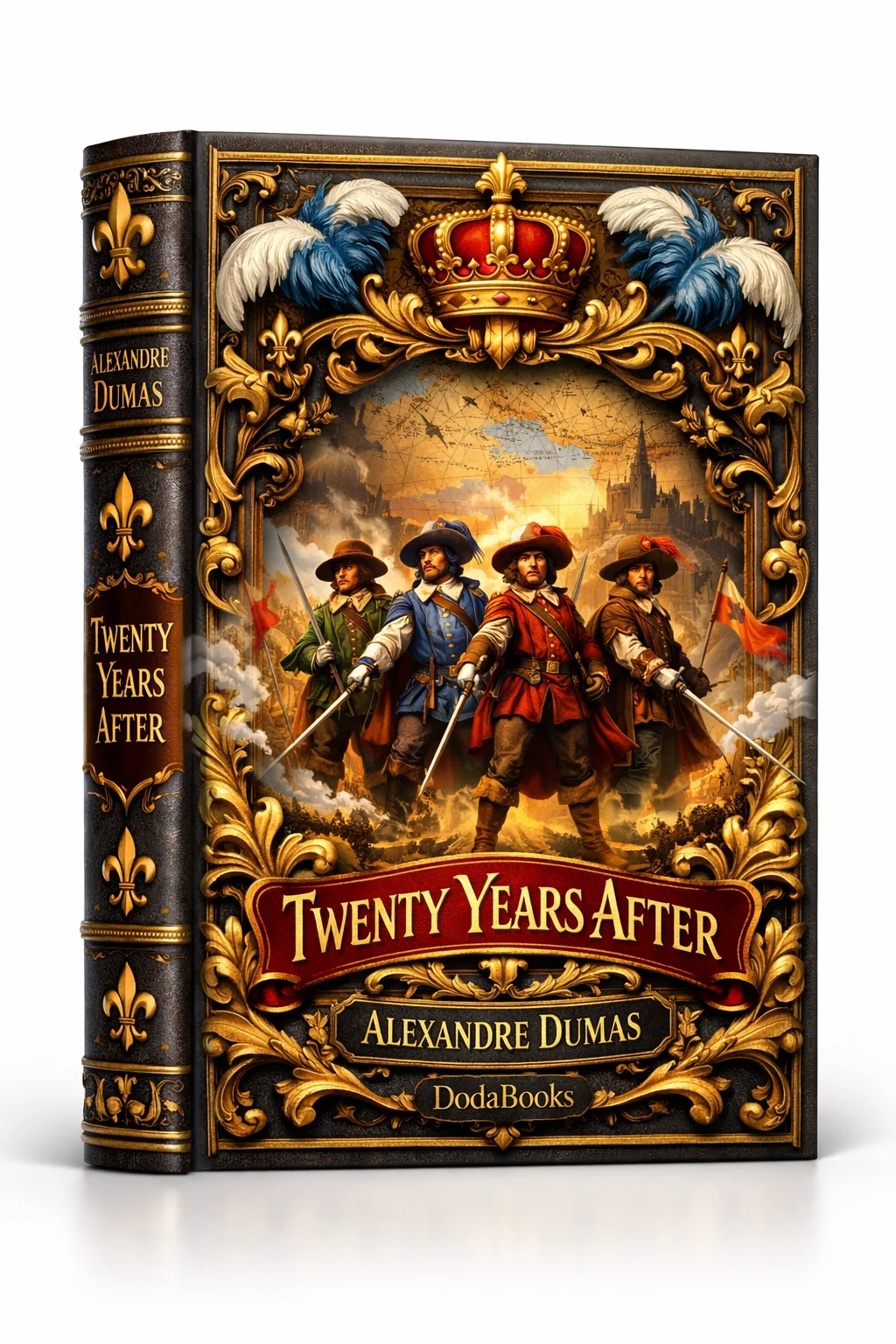
⚔️ Relive the Epic Adventures of the Mature Musketeers
Follow D’Artagnan, Athos, Porthos, and Aramis through their greatest trials with the complete, unabridged digital edition of Twenty Years After from DodaBooks:
- 📖 Complete 90 Chapters Uncut — Experience every subtle nuance of Dumas’s psychological sequel
- 💡 Exhaustive Historical Notes — Explaining French court intrigues, the Fronde, and the English Civil War
- 📱 Designed for Modern Screens — Flawless formatting engineered for Kindle, Kobo, iPad, and Android
- 🔓 100% DRM-Free — Download immediately and keep your digital book forever
👉 Get the Annotated Edition of Twenty Years After at DodaBooks →