Twenty-Five Ghost Stories Summary: Complete Story-by-Story Guide (W. Bob Holland)
Compiled by American editor W. Bob Holland and published in New York in 1904 by the J. S. Ogilvie Publishing Company, Twenty-Five Ghost Stories captures supernatural fiction at its historical turning point. Bridging the gaslit gloom of high Victorian ghost lore with the brisk, psychological anxiety of early twentieth-century pulp magazines, this eclectic anthology preserves twenty-five uncanny tales of spectral vengeance, haunted inns, cursed limbs, psychical investigations, and railroad phantoms.
Unlike single-author collections, Holland’s volume deliberately pairs world-renowned literary giants—such as Edgar Allan Poe, Guy de Maupassant, and Sabine Baring-Gould—with anonymous and pseudonymous reportage from period periodicals (“A Constabulary Officer,” “A Spinster,” “A Sportsman,” “A Witness”). The result is a vibrant, terrifying panorama of how ordinary people and master storytellers conceived of the veil between the living and the dead at the dawn of the twentieth century.
This comprehensive story-by-story breakdown examines all twenty-five selections, analyzing their plots, spectral motifs, narrative structures, and historical context.
| # | Story Title | Author / Attributed Byline | Core Spectral Motif |
|---|---|---|---|
| 1 | The Black Cat | Edgar Allan Poe | Demonic feline revenant; psychological guilt; domestic terror. |
| 2 | The Flayed Hand | Guy de Maupassant | Severed, reanimated sorcerer’s hand; occult curse; physical strangulation. |
| 3 | The Vengeance of a Tree | Eleanor F. Lewis | Arboreal curse; animated nature avenging desecration. |
| 4 | The Parlor-Car Ghost | “A Lady” | Railway transit phantom; modern technology meeting the supernatural. |
| 5 | The Ghost of Buckstown Inn | Arnold M. Anderson | Classic wayside inn haunting; murdered peddler; buried wealth. |
| 6 | The Burglar’s Ghost | “A Constabulary Officer” | Spectral law enforcement; post-mortem retribution for criminal acts. |
| 7 | A Phantom Toe | Anonymous | Comic-macabre amputated body part searching for its buried mate. |
| 8 | Mrs. Davenport’s Ghost | Frederick F. Schrader | Society ghost; psychic premonitions; high-society spiritualism. |
| 9 | The Phantom Woman | Anonymous | The classic Victorian white lady; warning of impending death. |
| 10 | The Phantom Hag | Ascribed to Guy de Maupassant | Parasitic nocturnal terror; ancestral curse; psychological horror. |
| 11 | From the Tomb | Guy de Maupassant | Premature burial and physical return of the deceased beloved. |
| 12 | Sandy’s Ghost | “A Witness” | Scottish highland phantom; ancestral fidelity; omens of doom. |
| 13 | The Ghosts of Red Creek | S. T. | Frontier haunting; tragic settler violence; restless river spirits. |
| 14 | The Spectre Bride | Elia W. Peattie (Anon.) | Romantic tragedy; drowned maiden returning on the wedding night. |
| 15 | How He Caught the Ghost | Anonymous | Skeptical investigation; rationalist trap unmasking a spectral hoax. |
| 16 | Grand-Dame’s Ghost Story | C. D. | Oral fireside folklore; intergenerational family curse. |
| 17 | A Fight with a Ghost | Q. E. D. | Physical combat between a mortal traveler and a tangible apparition. |
| 18 | Colonel Halifax’s Ghost Story | S. Baring-Gould | Aristocratic club-room tale; Welsh hunting phantom and cursed hall. |
| 19 | The Ghost of the Count | “A Spinster” | European aristocratic haunting; unfulfilled romance beyond the grave. |
| 20 | The Old Mansion | “A Sportsman” | Decaying colonial estate; cursed hunting lodge; midnight footsteps. |
| 21 | A Misfit Ghost | Anonymous | Whimsical satirical haunting; misplaced phantom haunting the wrong family. |
| 22 | An Unbidden Guest | Anonymous (From a Letter) | Epistolary ghost story; spectral wedding crasher and broken promises. |
| 23 | The Dead Woman’s Photograph | Anonymous | Early spirit photography; the camera revealing what human eyes miss. |
| 24 | The Ghost of a Live Man | “A Traveller” | Bilocation / the Doppelgänger; psychic astral projection before death. |
| 25 | The Ghost of Washington | Anonymous | Patriotic American apparition; spectral Founding Father warning the nation. |
🕯️ Tales 1–5: Psychological Horrors & Transitory Phantoms
1. “The Black Cat” (Edgar Allan Poe)
Holland opens his collection with Edgar Allan Poe’s 1843 masterpiece of psychological dread. The unnamed narrator, ruined by alcoholism and morbid perversity, hangs his beloved black cat, Pluto. Shortly after, his house burns to the ground, leaving a solitary plaster wall bearing the bas-relief impression of a gigantic hanged feline.
When he adopts a second one-eyed black cat featuring a white patch resembling a gallows, the narrator’s sanity completely disintegrates. In an alcoholic rage, he attempts to kill the cat with an axe; when his wife intervenes, he murders her and immures her corpse inside the cellar wall. When the police search the cellar, a blood-curdling screech reveals the corpse—with the demon cat perched upon her rotting head. Poe’s inclusion establishes the theme that the most terrifying ghosts are those birthed by human guilt.
2. “The Flayed Hand” (La Main d’écorché, Guy de Maupassant)
An early macabre triumph by French master Guy de Maupassant. A reckless young medical student, Pierre, purchases the dried, flayed hand of an 18th-century criminal from an eccentric collector. Pierre uses the severed limb as a morbid door-bell pull in his Parisian apartment.
That night, an icy, supernatural presence invades his bedroom. The following morning, Pierre is found semi-strangled on the floor, his throat bearing the bruised impressions of skeletal fingers, while the mummified hand has vanished. Driven into violent madness, Pierre dies months later. During his burial in a provincial churchyard, the gravediggers uncover an ancient skeleton missing its right hand—beside which lies the dried severed limb.
THE PHYSICAL HAUNTING VS. THE PSYCHICAL HAUNTING
┌─────────────────────────────────────────────────────────────┐
│ TANGIBLE / BODILY HORROR:                                   │
│ "The Flayed Hand" ──► Severed limb chokes its owner         │
│ "A Phantom Toe"   ──► Missing amputated digit searches tomb │
├─────────────────────────────────────────────────────────────┤
│ PSYCHOLOGICAL / SPECTRAL GUILT:                             │
│ "The Black Cat"   ──► Guilt projected onto a demon animal   │
│ "From the Tomb"   ──► Grief dissolving the boundary of death│
└─────────────────────────────────────────────────────────────┘
3. “The Vengeance of a Tree” (Eleanor F. Lewis)
A striking, unusual tale of botanical supernatural vengeance. An arrogant land speculator chops down a majestic, centuries-old sacred oak despite the desperate pleas of local elders. The felled timber is used to construct the master bedroom and rafters of his new homestead. From the night he moves in, the house is besieged by creaking, groaning, and ghostly rustling. In the climax, the structural beams of the felled tree appear to bend and snap with deliberate fury, collapsing the roof upon the speculator in a triumph of natural vengeance.
4. “The Parlor-Car Ghost” (By “A Lady”)
One of the earliest “technological” ghost stories in American literature. Written from the perspective of an observant female traveler aboard an overnight express train, the narrator watches an enigmatic, melancholy passenger in the velvet-upholstered parlor car. As the train races through the midnight darkness, the mysterious passenger passes through locked compartment doors, vanishing into thin air. The tale reflects the era’s fascination with how modern industrial inventions—steam locomotives and iron railways—intersected with age-old spiritualism.
5. “The Ghost of Buckstown Inn” (Arnold M. Anderson)
A classic American Gothic wayside inn story. A weary traveler seeks shelter during a driving thunderstorm at an old tavern in Buckstown, Pennsylvania. Assigned to a remote chamber rumored to be haunted, the traveler is awakened at midnight by the sound of dragging footsteps and a spectral figure digging furiously into the floorboards beneath the rug. The apparition is revealed to be the ghost of a peddler murdered thirty years prior by the inn’s founding landlord, doomed to re-enact the search for his stolen gold.
🏚️ Tales 6–12: Severed Limbs, French Mysteries & Regional Lore
6. “The Burglar’s Ghost” (By “A Constabulary Officer”)
Narrated with the dry, factual cadence of a veteran lawman, this tale recounts an investigation into a serial housebreaker who fell to his death from a manor roof. Weeks after the criminal’s burial, local constables on night patrol repeatedly encounter a spectral figure in a burglar’s mask silently jimmying the shutter of the very house where he met his end. The story explores the concept that violent or sinful deaths trap spirits in an unending loop of their final criminal acts.
7. “A Phantom Toe” (Anonymous)
A macabre dark-comedy tale centered on an eccentric military veteran whose big toe was amputated after a cannonball strike. Long after the amputation, the veteran suffers phantom-limb sensations so intense that he hallucinates the severed toe hopping across his carpet. Upon hiring an investigator to disinter the amputated digit from its military cemetery plot, he discovers that a heavy stone had rolled onto the burial box. Once relocated and consecrated, the phantom toe finally rests in peace.
8. “Mrs. Davenport’s Ghost” (Frederick F. Schrader)
Set against the backdrop of late-Victorian drawing-room spiritualism and high-society séances. A skeptical young lawyer attends a gathering where a clairvoyant medium channels the apparition of a prominent society matron, Mrs. Davenport. The apparition reveals the existence of a forged codicil to a disputed family estate. When the lawyer investigates the family vault and safe deposit box, the spectral instructions prove chillingly accurate.
9. “The Phantom Woman” (Anonymous)
An atmospheric tale of a “White Lady” apparition who haunts an English river bridge. Every seven years, on the anniversary of her tragic drowning after being abandoned by her aristocratic lover, the weeping specter appears to travelers who cross the water at midnight. The narrator, crossing the bridge on horseback, experiences the freezing spectral mist passing through his body, leaving his hair permanently gray.
10. “The Phantom Hag” (Ascribed to Guy de Maupassant)
A harrowing psychological nightmare closely related in theme to Maupassant’s celebrated masterpiece The Horla. An aristocratic narrator residing in an ancient Norman château is visited nightly by an invisible, suffocating hag who perches upon his chest, draining his life-breath and vital heat. The story explores the boundary between clinical sleep paralysis and demonic parasitical vampirism.
THE SPECTRUM OF HAUNTINGS IN THE 1904 ANTHOLOGY
Spectral Comedy ◄────────────────────────────────────────► Abject Cosmic Dread
"A Misfit Ghost"   "The Parlor-Car"   "The Dead Woman"      "The Phantom Hag"
(Wrong Address)     (Railway Train)    (Spirit Photo)        (Parasitic Entity)
11. “From the Tomb” (De la tombe, Guy de Maupassant)
A morbid exploration of obsessive romantic grief. A devastated widower spends his nights weeping over the grave of his young bride. Unable to accept her death, he dreams that she calls to him from the earth. In a fever of macabre delirium, he digs up her coffin by moonlight, prying open the lid to gaze upon her face. Maupassant masterfully blurs the line between a genuine supernatural manifestation and the necrophilic hallucinations of a broken mind.
12. “Sandy’s Ghost” (By “A Witness”)
A Scottish folk tale set in the windswept Highlands. Sandy, a loyal old shepherd, perishes in a blinding blizzard while attempting to rescue his master’s flock from a mountain ravine. Months later, during another severe storm, the master loses his way in the mountains and is guided safely through the treacherous crags by Sandy’s radiant, floating form.
⚔️ Tales 13–19: Frontier Horrors, Phantom Brides & Combat
13. “The Ghosts of Red Creek” (S. T.)
An American Western ghost story set along the frontier trail of Red Creek, Colorado. A party of prospectors camp near a shallow creek where an immigrant wagon train was massacred decades earlier. As midnight falls, the campfire turns blue, and the sounds of rifle cracks, screaming horses, and spectral wagon wheels echo across the valley in a haunting auditory reenactment.
14. “The Spectre Bride” (Anonymous / Elia W. Peattie)
Authored by American Midwestern writer Elia W. Peattie, this chilling romantic tragedy centers on a young maiden named Mary who drowns in a lake on the eve of her wedding. Her devastated groom refuses to accept her loss. On what should have been their wedding night, an icy, drenched figure in a sodden white veil glides into his chamber, wrapping her weed-tangled arms around him. In the morning, the groom is found dead in bed, his face frozen in ecstatic peace, smelling of deep lake water.
15. “How He Caught the Ghost” (Anonymous)
A delightful satirical entry in the tradition of ghost-busting and hoax-exposure. A pompous rural village is terrorized by a towering, white-sheeted specter that haunts the churchyard at night. A skeptical young city engineer sets a series of invisible tripwires connected to buckets of indelible blue dye and a bear trap. The next morning, the village magistrate is discovered limping through the square, his trousers soaked in unmistakable blue ink.
16. “Grand-Dame’s Ghost Story” (C. D.)
Written in the warm, nostalgic cadence of an oral fireside tradition, an elderly grandmother recounts to her gathered grandchildren an experience from her girlhood in rural England. She describes sleeping in a guest bedroom where the reflection in the antique dressing mirror showed an empty room—except for a shadowy gentleman in eighteenth-century powdered wig and lace cravat standing directly behind her shoulder.
17. “A Fight with a Ghost” (Q. E. D.)
An astonishingly physical supernatural confrontation. An athletic traveler staying at a remote Bavarian mountain inn is attacked in the middle of the night by a tangible, muscular specter that attempts to throttle him. Unlike ethereal ghosts that pass harmlessly through matter, this spirit possesses superhuman physical density and freezing, ice-hard strength. The narrator engages in an agonizing hand-to-hand wrestling match until dawn’s first light dissolves the entity back into vapor.
18. “Colonel Halifax’s Ghost Story” (Sabine Baring-Gould)
Written by the prolific English antiquarian and folklorist Sabine Baring-Gould. Colonel Halifax recounts to his fellow officers a haunting at a remote Welsh hunting estate. While staying at the hall, the Colonel hears the frenzied baying of hounds and witnesses the spectral replay of an 18th-century duel fought between two brothers over an inheritance. Baring-Gould enriches the story with authentic Celtic folklore, heraldic history, and architectural detail.
19. “The Ghost of the Count” (By “A Spinster”)
A delicate, poignant Continental ghost romance. An English spinster touring the châteaux of the Loire Valley encounters a courtly, sorrowful French gentleman who escorts her through the private gardens, conversing with elegant charm. Upon inquiring about the charming gentleman with the château’s caretaker, she is shown a portrait of the Count of Montmirail—who was guillotined during the French Revolution in 1793.
📷 Tales 20–25: Spirit Photography, Doppelgängers & Patriotism
20. “The Old Mansion” (By “A Sportsman”)
A hunting party in Virginia takes refuge in a decaying, antebellum plantation mansion long abandoned to brambles and decay. As the men gather around the stone hearth, the sound of an invisible harpsichord echoes through the empty ballroom, followed by the soft rustle of silk skirts and the smell of ancient rosewater.
21. “A Misfit Ghost” (Anonymous)
A humorous, whimsical satire on supernatural conventions. An ancient, aristocratic ghost rattling chains and moaning in agony arrives to haunt an apartment building in modern New York. Unfortunately, the ghost has been given the wrong street address by the Astral Bureau of Hauntings. Instead of terrorizing an English duke in a drafty castle, he finds himself in the cramped parlor of an irate German butcher who threatens him with a meat cleaver, forcing the bewildered phantom to consult his ethereal directory.
22. “An Unbidden Guest” (Anonymous / From a Letter)
Told in the intimate epistolary form through a personal letter between sisters. During a festive Christmas house party in rural Hampshire, an unexpected guest in outdated mourning clothes sits quietly at the far end of the banquet table. None of the hosts recall inviting him, yet no one can summon the courage to address him. When the toast to absent friends is made, the guest rises, bows solemnly, and dissolves before thirty horrified witnesses.
23. “The Dead Woman’s Photograph” (Anonymous)
Capturing the turn-of-the-century craze for spirit photography. A grieving young man has a portrait photograph taken of himself seated in a commercial photographer’s studio. When the glass-plate negative is developed in the chemical darkroom, a transparent, glowing image of his deceased fiancée appears draped over his shoulder, holding a white lily. The story explores the uncanny belief that early photographic technology could capture spectral wavelengths invisible to the human eye.
24. “The Ghost of a Live Man” (By “A Traveller”)
A compelling exploration of bilocation and the psychic doppelgänger. A merchant sailing home across the Atlantic wakes in his cabin to see his brother—who is alive and well in London—standing at the foot of his bunk, weeping and pointing to a pocket watch stopped at 3:15. Upon reaching port, the merchant discovers that at that precise hour, his brother had suffered a severe carriage accident and had fallen into a deep coma, his psychic astral projection seeking out his kin across thousands of miles of ocean.
25. “The Ghost of Washington” (Anonymous)
The anthology concludes on a uniquely American, patriotic note. During a national crisis on the eve of the Civil War, a sentry guarding the Potomac River near Mount Vernon sees a towering, stately figure on a white horse, wearing Continental Army uniform and a three-cornered hat. The spirit of George Washington raises his hand in silent benediction, warning the sentry of impending conflict and reminding the nation of its sacred founding bond.
❓ Frequently Asked Questions
Who was W. Bob Holland?
W. Bob Holland was an American editor and writer active in New York around the turn of the twentieth century. He compiled Twenty-Five Ghost Stories in 1904 for J. S. Ogilvie, an established publisher of popular fiction, detective anthologies, and paperback railway literature.
Which famous authors are included in the anthology?
The collection features bona fide literary legends including Edgar Allan Poe ("The Black Cat"), Guy de Maupassant ("The Flayed Hand", "From the Tomb"), Sabine Baring-Gould ("Colonel Halifax's Ghost Story"), and Elia W. Peattie ("The Spectre Bride").
Why are so many stories in the anthology anonymous or pseudonymous?
In the 19th and early 20th centuries, ghost stories were often presented in popular periodicals as "true" personal accounts or eyewitness testimonies to enhance their realism and eerie effect. By using bylines like "A Constabulary Officer" or "A Spinster," editors invited readers to treat the hauntings as authentic psychical phenomena rather than mere fiction.
How does this anthology differ from Victorian British ghost collections?
While classic British anthologies focus almost exclusively on English country houses, ancient abbeys, and churchyards, Holland's anthology includes distinctly American settings—such as Pennsylvania wayside inns, Colorado frontier creek-beds, modern New York tenements, parlor cars, and even George Washington at Mount Vernon.
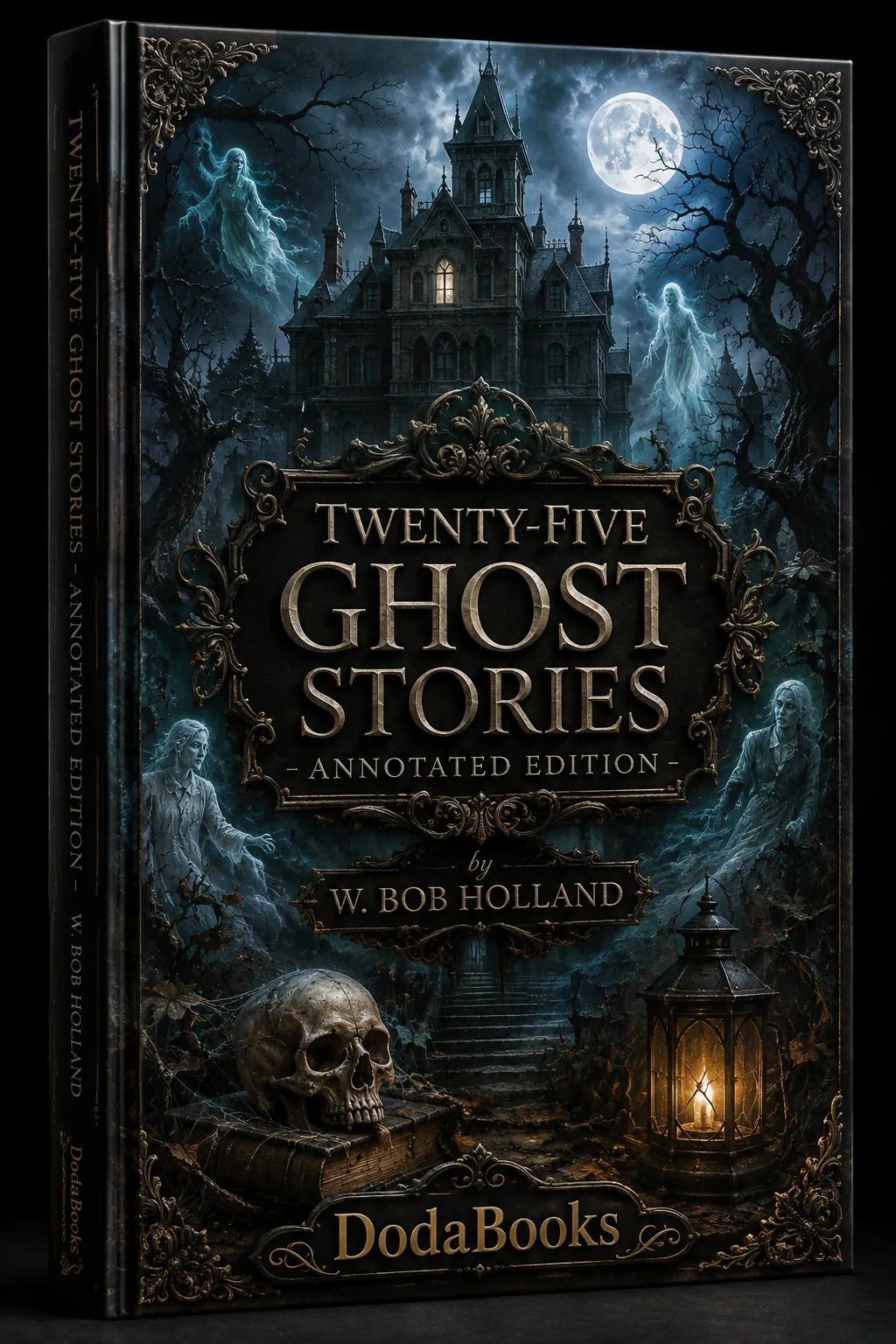
📖 Experience All 25 Supernatural Classics Uncut
Delve into the complete, beautifully formatted digital edition of Twenty-Five Ghost Stories from DodaBooks:
- 🕯️ All 25 Complete Tales — Uncut and restored from the original 1904 J. S. Ogilvie first edition
- 💡 Exhaustive Contextual Annotations — Explaining Victorian spiritualism, folklore, and period idioms
- 📱 Pristine Dark-Mode Typography — Tailored for immersive midnight reading on Kindle, Kobo, and iPad
- 🔓 100% DRM-Free — Download once, read forever without device restrictions
👉 Get the Annotated Edition of Twenty-Five Ghost Stories at DodaBooks →