Twenty-Five Ghost Stories Characters & Apparitions Explained (W. Bob Holland)
Supernatural fiction of the late Victorian and Edwardian eras is often discussed in terms of atmosphere, crumbling architecture, and fog-drenched streets. Yet the true engine of any enduring ghost story is the relationship between the apparition and the living witness.
In W. Bob Holland’s landmark 1904 anthology Twenty-Five Ghost Stories, this relationship is remarkably varied. Rather than presenting a monotonous parade of clanking chains and white sheets, the collection traverses an astonishing taxonomy of the uncanny: from the demonic animal revenants of Edgar Allan Poe and the severed, strangling limbs of Guy de Maupassant, to living psychic doppelgängers, romantic drowned brides, and satirical spectral misfits.
This comprehensive guide analyzes the primary spectral archetypes, psychological witnesses, and entity classifications found across all twenty-five tales, examining how early twentieth-century writers constructed fear, guilt, and the supernatural.
| Spectral Archetype | Representative Stories | Essential Entity Attributes | Psychological & Thematic Function |
|---|---|---|---|
| The Retributive Revenant | The Flayed Hand, The Burglar’s Ghost, The Vengeance of a Tree | Physical, vengeful, tangible; often seeks recovered limbs or punishment for desecration. | Enforces cosmic moral justice; material punishment for human greed or violence. |
| The Guilt-Bred Projection | The Black Cat, From the Tomb | Domestic, obsessive; may be psychological hallucination or demonic reality. | Embodies unacknowledged moral degradation, alcoholism, and unresolved grief. |
| The Parasitic Night-Entity | The Phantom Hag | Suffocating, nocturnal, weight-bearing; drains life-force and psychic heat. | Pre-modern manifestation of sleep paralysis; terror of physical violation in sleep. |
| The Technological / Transit Phantom | The Parlor-Car Ghost | Modern, quiet, detached; travels aboard steam engines or public conveyances. | Juxtaposes modern industrial progress with timeless spiritual restlessness. |
| The Living Specter (Doppelgänger) | The Ghost of a Live Man | Astral projection, bilocation; appears at the moment of trauma or impending death. | Reflects late-Victorian psychical research into telepathy and crisis apparitions. |
| The Mourning / Romantic Bride | The Spectre Bride, The Dead Woman’s Photograph | Ethereal, weeping, watery; bound by broken wedding vows or eternal devotion. | Explores the Victorian cult of mourning, lost youth, and romantic grief. |
| The Tangible Physical Combatant | A Fight with a Ghost | Muscular, freezing, aggressive; possesses physical density and bone-crushing strength. | Subverts the ethereal ghost trope into a visceral, hand-to-hand fight for survival. |
| The Regional / Frontier Echo | The Ghost of Buckstown Inn, The Ghosts of Red Creek | Environmental re-enactment; tied to historic massacres or wayside murders. | Commemorates violent historical trauma etched permanently into the landscape. |
🐾 1. The Retributive Revenant & Severed Entities
TYPES OF REVENANT MANIFESTATION
┌────────────────────────────────────────────────────────┐
│ THE CORPOREAL OBJECT:                                  │
│ "The Flayed Hand" ──► Mummified limb acts autonomously │
│ "A Phantom Toe"   ──► Missing appendage seeks rest     │
├────────────────────────────────────────────────────────┤
│ THE NATURE REVENANT:                                   │
│ "The Vengeance of a Tree" ──► Timber crushes builder   │
└────────────────────────────────────────────────────────┘
One of the most terrifying archetypes in Holland’s anthology is the Retributive Revenant—a ghost that does not merely float or moan, but physically interacts with the mortal world to exact retribution or reclaim stolen property.
Pierre and the Sorcerer’s Hand (“The Flayed Hand”)
In Guy de Maupassant’s macabre tale, the entity is not a complete phantom, but a mummified, flayed human hand originally belonging to an executed 18th-century sorcerer. When the student Pierre treats this grisly relic as a novelty door-pull, he commits an act of profanation.
The entity operates with terrifying physical tangibility:
- It leaves physical impressions of skeletal thumbs and fingers bruised deep into Pierre’s throat.
- It moves independently across Paris, vanishing from his apartment and traveling miles to reunite with its buried skeleton in a rural churchyard.
- Maupassant uses the severed limb to challenge scientific rationalism: a medical student who dissects corpses daily is destroyed by an impossible remnant of medieval sorcery.
The Avenging Oak (“The Vengeance of a Tree”)
In Eleanor F. Lewis’s story, the revenant is non-human. An ancient sacred oak, chopped down by an arrogant real estate speculator, retains its vital consciousness even after being sawed into ceiling beams and floor joists. The entity acts as a living botanical curse, waiting patiently until the speculator sleeps beneath its rafters before collapsing the house upon him. It represents an early environmental haunting, warning that nature cannot be violated with impunity.
🐈 2. The Guilt-Bred Manifestation & The Demonic Animal
The Narrator and Pluto (“The Black Cat”)
In Edgar Allan Poe’s foundational opening story, the apparition takes the form of an animal—first the beloved pet cat Pluto, and later a second one-eyed feline bearing a gallows-shaped white patch on its chest.
Poe masterfully refuses to tell the reader whether the second cat is an ordinary stray misinterpreted by a diseased mind or a genuine supernatural demon sent to punish the narrator:
- Perverseness as Catalyst: The narrator describes “the spirit of PERVERSENESS”—the innate human impulse to commit evil simply because it is forbidden—as the true origin of his doom.
- The Bas-Relief Wall: After his house burns down, the image of the hanged cat embedded in the bedroom plaster wall serves as a permanent, physical indictment of his hidden crime.
- The Cry from the Tomb: The cat’s unearthly scream from within the sealed cellar wall demonstrates that the entity’s ultimate purpose is not merely to torment the murderer in private, but to force his confession before the public authorities.
POE'S PSYCHOLOGY OF GUILT
Alcoholic Perversity ──► Cruelty to Animal ──► Murder of Wife ──► Spectral Exposure
(Moral Collapse)          (Hanging Pluto)      (Cellar Axe)        (Cat's Screech)
🚂 3. The Modern Transit & Technological Phantoms
Victorian ghost stories frequently took place in medieval castles, ruined abbeys, or drafty Tudor manors. By 1904, however, writers were increasingly fascinated by how ghosts adapted to modern industrial technology.
The Enigmatic Passenger (“The Parlor-Car Ghost”)
In this subtle, atmospheric tale by “A Lady,” the haunting occurs not in an ancestral home, but aboard a luxury Pullman parlor car racing down an iron railway line at sixty miles per hour.
- The Modernity of the Setting: Velvet swivel chairs, electric bell pushes, brass fittings, and soot-streaked plate-glass windows replace the candle-lit hallways of traditional Gothic literature.
- The Entity’s Behavior: The specter is quiet, dignified, and melancholy, dressed in fashionable traveling clothes. It glides silently through locked mahogany doors, illustrating that modern machinery provides no sanctuary from spiritual grief.
The Ghost on the Glass Negative (“The Dead Woman’s Photograph”)
Spirit photography, pioneered by William H. Mumler in the 1860s and popularized across Europe and America, suggested that the camera’s chemical eye could perceive spiritual frequencies invisible to the naked human eye. In this tale, the entity does not appear to the living man directly; she appears only when silver halide crystals react on the photographer’s glass plate, framing technology as an occult gateway between life and death.
👥 4. The Doppelgänger & Crisis Apparition
One of the most theoretically sophisticated concepts explored in the anthology is bilocation—the projection of a living person’s spirit across vast physical distances during moments of acute trauma, coma, or mortal crisis.
THE CRISIS APPARITION (TELEPATHIC BILOCATION)
London, England:                        Mid-Atlantic Ocean:
Brother suffers carriage accident ────► Astral projection appears in cabin
Watch stops at 3:15                     Watch points to 3:15
(Mortal Body in Coma)                   (Psychic Spirit Seen by Kinsman)
The Bedside Brother (“The Ghost of a Live Man”)
In “The Ghost of a Live Man,” the phantom is explicitly not dead. While crossing the Atlantic, a ship passenger is visited by the weeping, translucent form of his brother, who holds out a pocket watch stopped at 3:15. When the traveler reaches England, he learns that his brother did not die; he suffered a severe concussion at that precise moment and lay in a coma, yearning desperately for his absent brother.
This archetype reflects the serious psychical investigations conducted by the Society for Psychical Research (SPR) in London and New York in the late 19th century (led by Henry Sidgwick, Edmund Gurney, and Frederic W. H. Myers). In their monumental 1886 study Phantasms of the Living, the SPR cataloged hundreds of authenticated cases of telepathic crisis apparitions, proving that Holland’s readers viewed such tales not as crude fairy tales, but as cutting-edge psychical science.
👰 5. The Tragic Bride & The Cult of Mourning
Victorian culture was obsessed with death, mourning, and the tragic loss of youthful innocence. The “Spectre Bride” represents an enduring romantic archetype: the young woman who dies on the threshold of marriage and returns to claim her vows beyond the grave.
Mary and Her Drowned Veil (“The Spectre Bride”)
Authored by Elia W. Peattie, “The Spectre Bride” presents a tragic, poetic figure:
- Water Imagery: Drowned on her wedding eve in a cold inland lake, the bride’s ghost brings the sensory reality of the water with her into the bedchamber: dripping lake weeds, sodden white satin, and the cold smell of deep mud.
- The Deadly Embrace: Unlike malevolent demons, the ghost of the bride does not seek to terrorize; she seeks union. Her embrace is so intensely cold that it extinguishes the groom’s mortal life, drawing him into the peaceful sleep of the grave.
🤼 6. The Tangible Combatant & Muscular Spirits
While the dominant cultural image of the Victorian ghost is an ethereal mist, Holland includes tales where the spirit is physically dense, brutal, and capable of inflicting lethal bodily trauma.
The Bavarian Brawler (“A Fight with a Ghost”)
In this remarkable story by “Q. E. D.”, the entity attacks an athletic traveler in a remote mountain inn. The confrontation is described not in spiritual terms, but in the language of a bare-knuckle prize fight:
- Muscular Density: The ghost has heavy, iron-hard fists, freezing skin that burns like dry ice, and a weight that physically pins the narrator to the wooden floor.
- The Battle for Breath: The narrator does not pray or perform an exorcism; he counter-punches, wrestles, and applies choking holds, desperately surviving minute by minute until dawn. This subversion of ghost lore anticipates twentieth-century physical horror and survival fiction.
🎭 7. The Satirical & Misplaced Phantom
Finally, Holland’s anthology demonstrates that the ghost story by 1904 was mature enough to laugh at its own tropes.
The Bewildered Aristocrat (“A Misfit Ghost”)
In “A Misfit Ghost,” an ancient, chain-clanking English aristocratic ghost is accidentally assigned to a noisy, cramped immigrant tenement in lower Manhattan.
- Instead of terrifying an awe-struck descendant in a hereditary library, the ghost encounters an aggressive German butcher who demands to know who let a vagrant in without paying rent.
- The ghost’s frustration at being misunderstood by modern urbanites highlights the growing cultural divergence between Old World feudal superstition and New World industrial pragmatism.
❓ Frequently Asked Questions
What is a "crisis apparition"?
A crisis apparition is a ghost of a living person that appears to distant friends or family members at the precise moment that person experiences severe trauma, a life-threatening accident, or the threshold of death. In late Victorian psychical research, these were believed to be caused by intense telepathic broadcasts.
How do Maupassant's ghosts differ from British Victorian ghosts?
While British Victorian ghosts are typically bound to historical locations, churchyards, or family lineage, Guy de Maupassant's French supernatural entities are intensely psychological, morbid, and biological—featuring severed limbs, sleep paralysis demons, and decaying physical corpses.
Why was spirit photography so popular in early 20th-century fiction?
Spirit photography bridged the gap between modern technology and ancient spiritualism. Victorians believed the camera lens was an objective scientific instrument that could register ultraviolet wavelengths and spiritual frequencies that human optical nerves were too weak to perceive.
What role does guilt play in the apparitions of this anthology?
In stories like "The Black Cat," "The Burglar's Ghost," and "The Ghost of Buckstown Inn," the apparition does not appear at random; it is summoned directly by the moral guilt of the living witness, serving as an externalized, undeniable manifestation of a suppressed conscience.
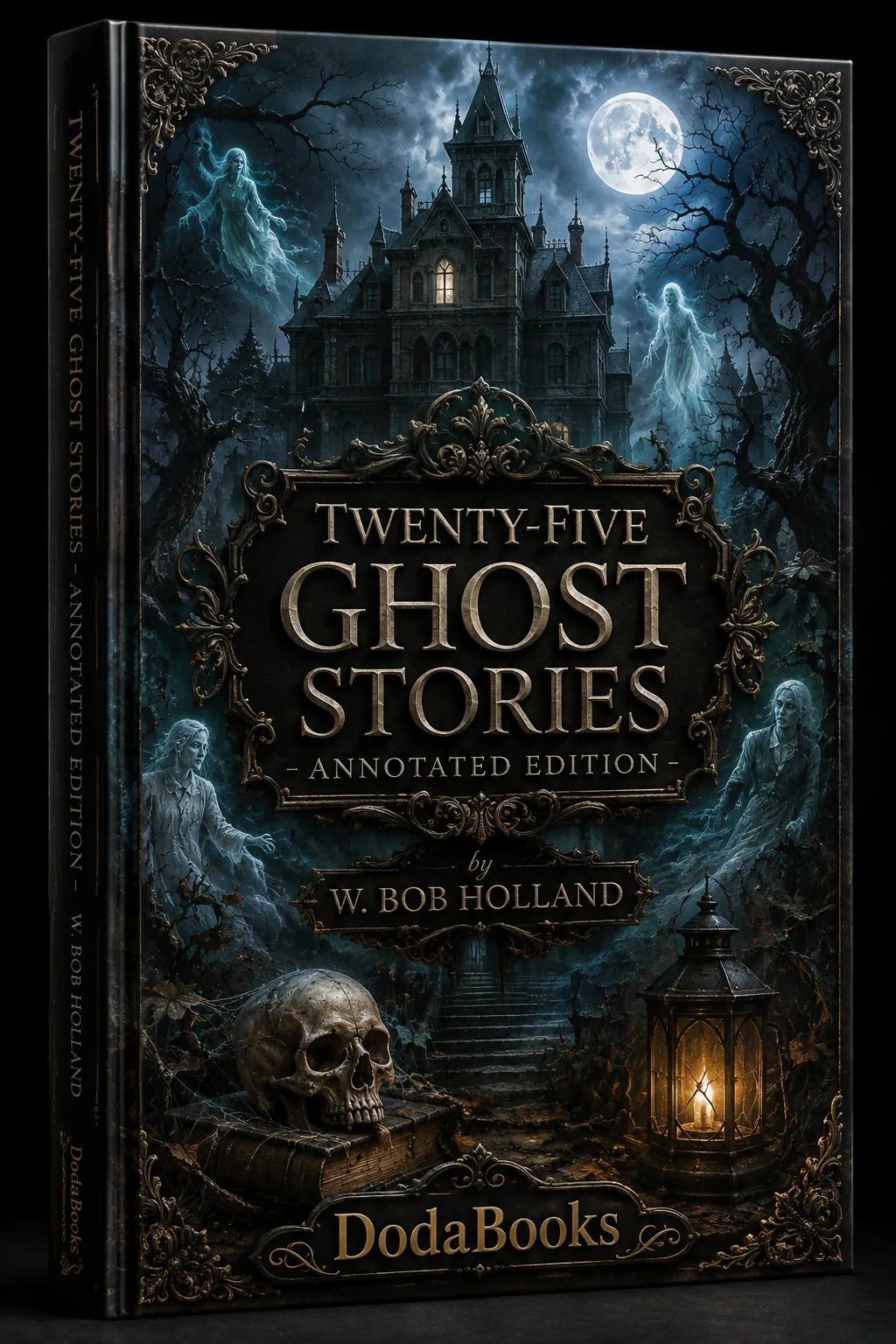
📖 Delve Deep into the Supernatural Golden Age
Explore the chilling entities, folklore, and psychical lore of Twenty-Five Ghost Stories with the definitive annotated edition from DodaBooks:
- 🕯️ All 25 Complete Unabridged Tales — With author biographies and publication histories
- 💡 Exhaustive Psychical & Folklore Annotations — Explaining Victorian spiritualism, crisis apparitions, and séances
- 📱 Engineered for Late-Night Reading — High-contrast dark-mode typography and seamless chapter navigation
- 🔓 100% DRM-Free — Read on Kindle, Kobo, iPad, or Android with complete freedom
👉 Get the Annotated Edition of Twenty-Five Ghost Stories at DodaBooks →