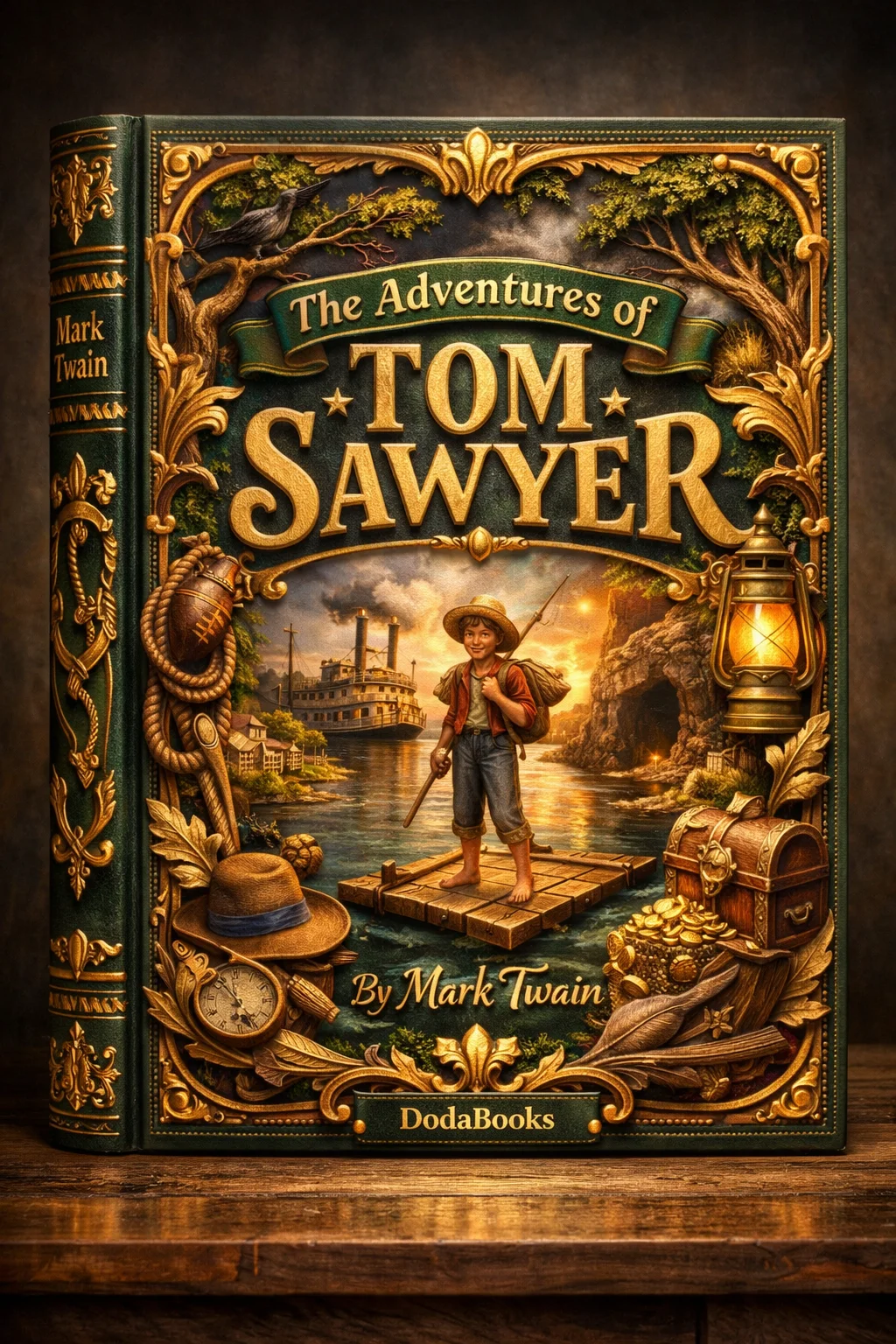
The Adventures of Tom Sawyer (1876) is one of the most beloved works of American literature. Set in the fictional town of St. Petersburg, Missouri, along the Mississippi River, it captures the freedom and folly of childhood with unmatched humor and heart.
🎣
The Adventures of Tom Sawyer
Mark Twain's timeless classic of boyhood adventure along the Mississippi. Tom Sawyer talks his way into and out of trouble, witnesses a murder, finds hidden treasure, and gets lost in a cave — all while outwitting every adult in town.
| Author | Mark Twain (Samuel Clemens) |
| Published | 1876 |
| Genre | Adventure, bildungsroman, comedy |
| Chapters | 35 |
| Setting | St. Petersburg, Missouri — the Mississippi River |
| Significance | One of the most beloved works of American literature |
🎣 The Story
Tom Sawyer is a master negotiator who convinces his friends to whitewash a fence, a romantic who gets engaged to Becky Thatcher in the space of an afternoon, and an adventurer who runs away to an island with Huckleberry Finn. But when he and Huck witness Injun Joe murder Dr. Robinson in the graveyard, their games turn deadly serious.
The novel takes readers through a series of unforgettable episodes: the schoolyard fight, the picnic at McDougal’s Cave where Tom and Becky get lost for days, and the thrilling discovery of Injun Joe’s hidden treasure. Twain weaves together comedy and suspense, creating a story that works on every level.
📖 Literary Significance
The Adventures of Tom Sawyer was Twain’s first novel written entirely on his own (after the collaborative The Gilded Age), and it established him as a major American novelist. The book was a commercial success from the start and has never been out of print.
The novel is remarkable for its authentic portrayal of childhood. Twain captures the way children think, speak, and play with unprecedented realism. Tom is no paragon of virtue — he is selfish, mischievous, and imaginative, and his moral growth over the course of the story feels earned rather than forced. The novel’s humor is timeless, and its suspense sequences — particularly the cave episode — are masterfully constructed.
✨ What Makes the DodaBooks Edition Special
This edition presents Twain’s classic in a clean, distraction-free format.
Zero Distractions
No ads, no license pages — just the complete text, clean and uninterrupted.
Smart Typography
Curly quotes, em-dashes, proper ellipsis — typeset with care for a premium reading experience.
Chapter Navigation
Full table of contents with navigation to each of the 35 chapters — easily jump between them.
Cleaned & Polished
All Gutenberg boilerplate stripped, consistent formatting throughout the text.
No DRM
You own your copy — read on any device, anytime, forever.
Instant Download
EPUB format included, delivered instantly after purchase.
🎣 The Story, In Detail
Twain arranged the novel not as one continuous plot but as a string of famous set-pieces, each complete enough to stand alone while building toward the whole. It opens with Tom’s punishment — whitewashing Aunt Polly’s fence — which he brilliantly turns into a spectacle his friends pay to perform for him. From there the novel moves through a quarrel and a mock engagement with Becky Thatcher, a schoolroom mishap with the teacher’s prized book, and a midnight trip to the graveyard.
That graveyard visit is the hinge of the book. Tom and Huck, armed with their superstitions and a dead cat intended to cure warts, witness the murder of Dr. Robinson by Injun Joe and the framing of a harmless drunkard named Muff Potter. The boys swear a blood oath of silence, and Tom’s guilty conscience clashes with his fear of the killer. The middle of the novel balances these darker threads against classic boyhood adventure — the island escapade, where Tom, Huck, and Joe Harper spend days playing pirates while the town mourns them as drowned, and the comic moment when Tom sneaks home to witness his own funeral. The story reaches its climax in McDougal’s Cave, where Tom and Becky are lost for days and Tom stumbles on both an escape route and, at last, the location of Injun Joe’s treasure.
🏛️ Historical & Cultural Context
Understanding where Twain drew his material makes the book far richer. The fictional town of St. Petersburg is a thinly disguised version of Hannibal, Missouri, where Samuel Clemens spent his own boyhood in the 1840s, and Tom, Huck, and the other characters are built from real people he knew. The Mississippi River setting is not decoration — it is the source of the novel’s sense of freedom, the highway of boyhood imagination that runs throughout Twain’s work. If you want to follow that thread to its most personal expression, our guide to Life on the Mississippi covers the memoir Twain later wrote from his years as a riverboat pilot.
It is also worth knowing that while Tom Sawyer is remembered as a light-hearted boys’ book, it is set in a slave-holding society, and its world is far less innocent than it first appears. Twain records the casual racism of the period faithfully, including the period’s language and the character of Injun Joe, whose depiction reflects the prejudices of Twain’s time rather than a fair or sympathetic treatment. Modern readers and teachers should be ready to discuss this with context and honesty — it is part of the book’s historical texture and a reminder of how much the “golden age” of boyhood adventure quietly leaves out.
👦 Key Characters
Tom Sawyer is the book’s engine — clever, selfish, imaginative, and gradually stirred by conscience into real moral growth. Huckleberry Finn, the town outcast who lives free of adult rules, is Tom’s foil and the novel’s sharpest critique of civilization. Becky Thatcher represents the taming pull of romance that Tom alternately courts and resists. Aunt Polly is Tom’s loving guardian, forever exasperated but never truly stern. And Injun Joe, the shadowy villain, provides the novel with its danger — a figure of pure menace who makes the boys’ games suddenly, frighteningly real.
🔥 Themes to Watch
The central tension in Tom Sawyer is between freedom and civilization. Tom lives in a world of rules — school, church, chores, the expectations of adults — and his adventures are a running escape from them. The island and the cave represent freedom and danger in turn, while his return to town and his eventual decision to behave responsibly hint at the price of growing up. Alongside this, the novel is threaded with superstition and boyish ritual — the wart-curing cat, the blood oath, the charms and omens — which Twain records with affectionate comedy.
There is also a quieter moral arc. Tom begins as a troublemaker who thinks mainly of himself, but over the course of the book he risks his life to clear Muff Potter, comforts Becky in the cave, and finally shares out the treasure. The adventures that seem like pure mischief turn out to be the training ground for courage and loyalty. This is what lifts Tom Sawyer above simple comedy — it is a book about how play, danger, and responsibility shape a child into someone worth being.
📖 Why It Still Matters
Tom Sawyer matters because it gave American literature a new kind of hero: a real, flawed, recognizably human boy rather than a sentimental model child. Twain’s comic voice — warm, wry, and quietly subversive — and his refusal to moralize made the book feel startlingly modern in 1876, and it has never really dated. It also matters as the doorway to Twain’s greater work: the same boy, voiced now by Huck himself, carries the darker and more profound sequel that remains one of the most studied novels in American literature. For anyone beginning with Twain, Tom Sawyer is the natural, joyful place to start.
🎓 How to Read It
Because the novel is episodic, it rewards a relaxed, chapter-by-chapter pace — the ideal weekend read at the book’s modest length. On a first reading, enjoy the comedy and the adventure without overthinking. Read the graveyard and cave sequences for suspense, and note how deliberately Twain shifts tone between them. On a second reading, look for the satire: Twain is quietly mocking adult pretension, religious hypocrisy, and the sentimental conventions of the boys’ adventure genre even as he delights in them. That double voice — sincere delight alongside gentle mockery — is the signature of Twain at his best and the reason the book rewards revisiting.
❓ Frequently Asked Questions
Is this a children's book?
It is a book about childhood that works for all ages. Children love the adventures and humor; adults appreciate the satire, the moral complexity, and Twain’s masterful prose.
How is Tom Sawyer different from Huckleberry Finn?
Tom Sawyer is lighter and more episodic, a series of adventures seen from a safe distance. Adventures of Huckleberry Finn, narrated by Huck himself, is darker and more profound, exploring racism and freedom. Both are masterpieces, but they are very different books.
How long does it take to read?
At 233 pages across 35 short chapters, most readers finish in 5-7 hours. It is a perfect weekend read.
Is Huckleberry Finn a sequel to this book?
Not exactly. It features the same boy and the same town, and it follows Tom’s story in spirit, but Adventures of Huckleberry Finn is narrated by Huck in his own voice and takes him on an entirely new journey down the river. Many readers treat Tom Sawyer as an ideal warm-up for the richer, darker sequel.
How true to real life is the book?
Very true in spirit. The town of St. Petersburg is modeled closely on Hannibal, Missouri, where Twain grew up, and most of the characters were based on real people he knew — including a real runaway boy who inspired Huck. Twain mixed these memories with tall tales and fiction, but the texture of boyhood in 1840s river-town America is authentic.
Should I worry about the book's treatment of race and Injun Joe?
It is worth reading with context. The book reflects the language and attitudes of its 1876 American setting, and the depiction of Injun Joe is a product of its time rather than a fair portrait. Teachers and modern readers often use the novel as an opportunity to discuss how Twain later confronted these very issues far more directly in Huckleberry Finn.
📚 Related Articles
🎣 Read the American Classic
The Adventures of Tom Sawyer is one of the most beloved works of American literature — a timeless story of boyhood, friendship, and adventure along the Mississippi. The DodaBooks edition presents Twain’s classic in a clean, distraction-free format:
- ✅ Complete 35-chapter text — every word of the classic
- ✒️ Smart typography — curly quotes, em-dashes, proper ellipsis
- 📜 Full table of contents with chapter navigation
- 🔒 DRM-free — read on any device, anytime
- 📥 Instant download — EPUB format