Three Sevens Summary by Chapter: Perley Poore Sheehan's Prison Mystery Breakdown
Published in 1924 during the vibrant dawn of American pulp and mystery fiction, Perley Poore Sheehan’s Three Sevens: A Detective Story is an electrifying hybrid of penitentiary realism, acoustic puzzle engineering, and hardboiled detective investigation. Moving far beyond the gentlemanly parlor mysteries popular in the early 1920s, Sheehan—a veteran globe-trotting journalist and premier Hollywood scenarist who penned the screenplay for Lon Chaney’s 1923 cinematic triumph The Hunchback of Notre Dame—crafted a fast-paced, visceral novel that predated modern escape classics like The Shawshank Redemption and Escape from Alcatraz.
The novel follows the harrowing ordeal of Craig, known within the cold limestone corridors of the state penitentiary merely as “Number 777.” Wrongfully convicted of a high-stakes financial embezzlement and bank robbery executed by an elusive criminal syndicate, Craig is sentenced to ten years of soul-crushing hard labor. Targeted by sadistic guards and thrown into the pitch-black solitary punishment cell (“the cooler”), Craig’s spirit teeters on the brink of collapse until an unexpected companion—a stray black cat—slips through an air grating, unlocking a daring path to freedom through the prison’s acoustic infrastructure.
This comprehensive chapter-by-chapter guide analyzes the four major narrative phases of Three Sevens, detailing Craig’s acoustic deductions, the mechanics of his midnight wall escape, his underground fugitive investigation, and the dramatic confrontation that exposes the real perpetrators.
| Narrative Phase | Chapters | Primary Setting | Core Plot Milestones & Themes |
|---|---|---|---|
| Phase I: The Cooler & The Cat | Chapters 1–5 | Solitary Punishment Ward (“The Cooler”) | Craig’s unjust isolation; psychological breakdown; arrival of the stray cat; acoustic mapping of ceiling air ducts. |
| Phase II: The Midnight Escape | Chapters 6–10 | Steam Flues, Prison Roof & Perimeter Wall | Tool fabrication; navigation of scalding pipe conduits; dodging perimeter searchlights; the river dive in a midnight storm. |
| Phase III: The Hunted Fugitive | Chapters 11–15 | Countryside, Rail Yards & Metropolis | Evading bloodhounds; railroad hopping; underground underworld hideouts; establishing a disguise and secret base. |
| Phase IV: The Syndicate & Exoneration | Chapters 16–20 | Urban Financial District & Syndicate Dens | Clue gathering; trailing the bank cashier; unmasking the criminal mastermind; clearing the name of Convict 777. |
📖 Chapter-by-Chapter Summary
Phase I: The Punishment Ward & The Whispering Cell (Chapters 1–5)
Chapter 1: The Dark Cell
The novel opens inside the grim depths of the state penitentiary’s disciplinary dungeon, colloquially known among convicts as “the cooler.” Craig—prisoner Number 777—has been cast into total darkness following a confrontation with Captain Vance, a notoriously corrupt and brutal prison guard officer. Craig had stepped in to shield a frail, elderly inmate from an unprovoked beating in the jute mill. Stripped of his boots, jacket, and bedding, Craig sits on the frozen flagstones in total sensory deprivation. Sheehan vividly depicts the psychological horror of absolute isolation, where the ticking of an inmate’s pulse sounds like a sledgehammer against stone and the mind threatens to devour itself.
THE EVOLUTION OF NUMBER 777:
┌─────────────────────────────────────────────────────────────┐
│ 🔒 Condemned Inmate: Stripped of identity in "The Cooler"   │
├─────────────────────────────────────────────────────────────┤
│ 🐱 The Visitor: Stray cat reveals acoustic ceiling flue     │
├─────────────────────────────────────────────────────────────┤
│ 📐 Master Builder: Tapping stones to map structural pipes   │
├─────────────────────────────────────────────────────────────┤
│ ⚡ Escaped Convict: Midnight river dive through gunfire     │
├─────────────────────────────────────────────────────────────┤
│ 🔍 Fugitive Detective: Hunting the syndicate to clear name   │
└─────────────────────────────────────────────────────────────┘
Chapter 2: The Visitor in the Dark
As the endless hours grind away, Craig’s hearing becomes hyper-acute. Suddenly, he hears a faint rustling high above his head, followed by the soft thud of padded paws landing upon the concrete floor. Reaching out into the void, his hands touch warm fur: a stray black cat has somehow navigated the labyrinthine ventilation shafts of the ancient nineteenth-century prison building. Craig shares his meager crust of punishment bread with the animal, naming it “Puck.” The emotional contact reignites Craig’s will to survive, pulling him back from the precipice of madness.
Chapter 3: The Architecture of Sound
Craig observes that Puck regularly vanishes through an iron exhaust grate positioned ten feet above the floor near the ceiling arch. Realizing that the cat must be entering from the outside world or an unmonitored attic space, Craig begins testing the acoustic properties of his cell. By rhythmically tapping a small iron buckle from his trouser waistband against the mortar seams, he listens for variations in echo and vibration. He deduces that the wall behind his cell does not abut solid earth, as the warden claims, but rather an abandoned conduit corridor housing dormant heating flues and drainage mains.
Chapter 4: Vance’s Ultimatum
Captain Vance enters the cell with a lantern, demanding that Craig sign a false confession acknowledging guilt in the original bank embezzlement scheme in exchange for a transfer back to the general prison population. Craig realizes that powerful external figures—men connected to the bank’s corrupt board of directors—have paid Vance to ensure Craig either admits guilt (legally protecting the real thieves) or perishes under prison disciplinary abuse. Craig defiantly refuses, defying the guard captain. Enraged, Vance sentences Craig to another seven days in the cooler, unwittingly granting him the unbroken solitude needed to prepare his escape.
Chapter 5: Forging the Key
Working in the dark during the long night intervals between guard patrol rounds, Craig utilizes the sharpened edge of his iron buckle and a loosened hinge screw to pry away the rusted iron screws securing the ceiling ventilation grating. Puck returns multiple times, carrying traces of red brick dust and cobwebs on his coat, confirming that the flue leads into the loft of the older, disused nineteenth-century wing of the penitentiary. Craig constructs a crude ascending harness from woven strips of his prison shirt, preparing for his ascent into the ceiling.
Phase II: The Acoustic Blueprint & The Midnight Break (Chapters 6–10)
Chapter 6: Into the Flue
On a night when heavy rain begins pelting the exterior of the prison, creating ambient white noise that masks scraping sounds, Craig launches his escape. He wedges himself upward through the narrow ventilation shaft, squeezing through inches of clearance. The air inside the shaft is thick with decades of soot and dust, threatening to suffocate him. After an agonizing twenty-minute crawl, Craig emerges onto the cedar floorboards of the abandoned prison attic, directly beneath the slate roof rafters.
Chapter 7: The Steam Conduit Labyrinth
From the attic, Craig must descend through a utility shaft carrying live high-pressure steam pipes that service the prison laundry and boiler room. The heat is suffocating, and the pipes radiate blistering temperatures. Relying on his acoustic calculations, Craig wraps his hands in torn rags to navigate the iron rungs of the pipe support ladders. Sheehan ratchets up the tension as a sudden hiss of venting steam nearly knocks Craig off the ladder into the darkness below. Overcoming vertigo and physical exhaustion, Craig reaches the lower utility basement adjacent to the prison’s outer yard.
Chapter 8: The Shadow on the Wall
Craig peers through an exterior drainage grille into the prison quadrangle. Powerful arc searchlights sweep the gravel grounds in overlapping arcs, while armed guards patrol the parapets of the thirty-foot stone perimeter wall. A massive thunderstorm strikes, sending blinding sheets of rain across the yard and rattling the tin roofs. Craig recognizes that this tempest is his only window of opportunity: the roar of the thunder muffles peripheral noise, while the driving rain severely impairs the vision of the watchtower marksmen.
THE MIDNIGHT JAILBREAK ROUTE:
[Solitary "Cooler"] ➔ [Ventilation Duct] ➔ [Attic Rafters] ➔ [Steam Conduit Shaft] ➔ [Drainage Grille] ➔ [Perimeter Wall Top] ➔ [River Dive]
Chapter 9: The Leap from the Parapet
Slipping out through the loosened drainage bars, Craig crawls across the slick mud of the prison yard, staying beneath the blind angle of the searchlight beam. Reaching the base of the perimeter wall near the old water tower, he utilizes an abandoned iron grounding cable to shin up the masonry to the stone coping of the parapet. Just as he reaches the summit, a sudden flash of lightning illuminates his silhouette. A watchtower sentry shouts an alarm; rifle shots shatter the masonry beside Craig’s head. Without hesitating, Craig hurls himself off the thirty-foot wall into the swollen, roaring currents of the Black River churning below.
Chapter 10: Down the Churning Current
Plunging deep into the icy, turbulent river, Craig narrowly escapes the volley of bullets striking the water surface. Surfacing hundreds of yards downstream, swept along by the raging current, he grabs hold of a drifting tree branch. The prison sirens begin wailing across the valley—three short blasts followed by three long pulses: the dreaded signal announcing the escape of Number 777. Exhausted, battered, but miraculously alive and free, Craig drags himself ashore miles downstream into a dark pine forest.
Phase III: The Hunted Fugitive (Chapters 11–15)
Chapter 11: The Bloodhound Manhunt
Dawn breaks over the sodden countryside. Craig hears the distant baying of bloodhounds and the shouts of state police posse units combing the riverbanks. He immediately takes countermeasures, wading through shallow swamp creeks and rubbing his skin and torn clothes with wild cedar needles and pungent swamp onion to disrupt the dogs’ scent tracking. He locates an isolated barn, where he buries his stamped prison garb beneath a mound of hay and secures a set of faded denim work overalls and an old wool cap left behind by a farm laborer.
Chapter 12: Hopping the Midnight Freight
Realizing that the surrounding counties are locked down by police roadblocks, Craig makes his way to an industrial railroad junction. Evading railroad yard bulls armed with clubs and revolvers, he executes a daring leap onto a moving eastbound freight train bound for the industrial metropolis. Concealed inside a boxcar loaded with raw lumber, Craig finally allows his battered body to rest, reflecting on the grim reality ahead: running from the law is futile unless he can dismantle the criminal conspiracy that framed him for the First National Bank robbery.
Chapter 13: The Urban Jungle
Arriving in the smoke-choked freight yards of the city, Craig blends into the bustling crowds of factory workers, laborers, and dockworkers. Sheehan paints a gritty, atmospheric portrait of the 1920s American industrial metropolis: noisy elevated electric trains, flashing neon saloon signs, bustling newsboys shouting headlines about the “Audacious Escape of Three Sevens,” and plainclothes detectives lurking on street corners. Craig establishes a temporary refuge in a dilapidated boarding house in the warehouse district, adopting the alias “Jim Clark.”
DUAL FORCES IN CONFLICT:
┌───────────────────────────────┐       ┌───────────────────────────────┐
│     THE LEGAL LAW ENFORCEMENT │  vs.  │   THE UNDERGROUND DETECTIVE   │
│ • State Prison Posse & Hounds │       │ • Craig (Convict 777)         │
│ • City Detective Bureaus      │       │ • Acoustic & Deductive Mind   │
│ • Corrupt Wardens & Vance     │       │ • Fighting for Honor & Truth  │
└───────────────────────────────┘       └───────────────────────────────┘
Chapter 14: Contacting the Past
Craig risks making secret contact with Mary Leslie, the daughter of his former employer and the only person who had consistently proclaimed his innocence during his trial. Meeting her secretly in the shadows of an urban botanical conservatory, Craig discovers that the bank’s former head cashier, Stephen Halloway—the chief prosecution witness who had sworn Craig was the sole possessor of the vault keys—has suddenly retired in opulence, living in an exclusive suburban mansion despite having earned a modest clerk’s salary.
Chapter 15: Trailing the Cashier
Craig begins a methodical surveillance operation on Halloway. Shadowing the nervous former cashier through the city’s financial district, Craig observes him holding surreptitious meetings with known underworld brokers and shady stock jobbers in private dining clubs. Craig deduces that Halloway did not act alone: he was the inside man for a sophisticated organized syndicate that orchestrated the bank robbery, using Craig’s position as assistant teller as the convenient fall guy.
Phase IV: The Syndicate & Exoneration (Chapters 16–20)
Chapter 16: The Underworld Safehouse
Following Halloway to a discreet townhouse near the waterfront, Craig infiltrates the premises through a rear fire escape. Concealing himself inside an adjoining dumbwaiter shaft, Craig’s acute auditory training in the prison cooler once again proves decisive: he eavesdrops on an urgent argument between Halloway and “Mr. King,” the shadowy mastermind behind the syndicate. Halloway is panicked by Craig’s escape, terrified that the former convict will trace the stolen securities before they can be liquidated through foreign exchange accounts in London.
Chapter 17: The Stolen Ledger
Craig learns that the conclusive evidence of the conspiracy—including the counterfeit ledger, duplicate vault keys, and signed payoff receipts from Captain Vance—is locked inside a concealed wall safe within the townhouse study. After the conspirators depart to finalize their shipping arrangements, Craig picks the lock of the French doors. Utilizing his sharp mechanical instincts and a carpenter’s stethoscope found in the tool room, Craig cracks the combination of the antique tumbler safe, securing the original ledger that proves the robbery was committed hours before Craig even entered the bank on the day of the heist.
THE PATHWAY TO JUSTICE:
[Surveillance of Halloway] ➔ [Infiltration of Waterfront Townhouse] ➔ [Safe Cracking via Stethoscope] ➔ [Police District Attorney Ambush] ➔ [Exoneration]
Chapter 18: The Ambush in the Dark
Before Craig can exit the townhouse, Captain Vance and two armed syndicate enforcers return unexpectedly. Vance has been hired by the syndicate to assassinate Craig on sight, allowing the prison authorities to claim that the fugitive was killed while resisting arrest. A fierce, close-quarters gun battle erupts through the darkened hallway. Craig uses his intimate knowledge of spatial shadows and acoustics to outmaneuver the gunmen, disarming the enforcers and subduing the treacherous Captain Vance after a brutal hand-to-hand fight.
Chapter 19: The District Attorney’s Chamber
Rather than fleeing into the night with the stolen evidence, Craig executes his most daring move: he takes Captain Vance at gunpoint and marches him directly into the private residence of District Attorney Matthewson, accompanied by Mary Leslie and the retrieved ledger. Confronted with the documented proof of the syndicate’s bribes, duplicate keys, and Vance’s signed complicity receipts, the District Attorney realizes that the state has perpetrated a catastrophic miscarriage of justice against Convict 777.
Chapter 20: The Restoration of Honor
The final chapter provides a swift and satisfying resolution. Police arrest Halloway and the remaining members of the bank syndicate as they attempt to board a transatlantic steamer. The Governor signs an immediate executive pardon and full exoneration for Craig, legally erasing the criminal record of Number 777. Standing outside the courthouse in the clean morning sunlight alongside Mary Leslie, Craig watches the city bustle forward, having transformed an unjust prison sentence into a triumphant demonstration of human intellect, resilience, and unyielding honor.
🔑 Key Literary & Dramatic Themes
1. The Panopticon vs. Acoustic Reason
Throughout Three Sevens, Sheehan contrasts the crushing, mechanical oppression of the modern penal panopticon with the liberating power of human sensory observation. The prison authorities believe that sensory deprivation will break Craig’s sanity. Instead, the total darkness hones his hearing to near-supernatural acuity. Craig’s ability to map invisible flues, pipe joints, and wall thicknesses by acoustic reverberation demonstrates that human intellect can outmaneuver the most imposing physical fortresses.
2. The Cat as an Emblem of Unconquerable Instinct
The appearance of Puck the stray cat in Chapter 2 serves both as an essential plot catalyst and as a potent literary symbol. While the stone prison represents rigid institutional confinement and artificial human cruelty, the cat represents untamed nature, curiosity, and instinctive freedom. By observing the cat’s navigation of the hidden vents, Craig aligns himself with the natural instinct for liberty, finding his salvation through a simple act of shared compassion.
3. The Convict as Detective
Three Sevens inverts the standard detective fiction formula. Rather than following an official police detective or an eccentric private investigator who works comfortably within the law, Sheehan casts an outlaw—an escaped convict with a price on his head—as the puzzle solver. To survive, Craig must hunt his persecutors while being hunted himself, making the investigation twice as perilous and infinitely more compelling than conventional whodunits.
❓ Frequently Asked Questions
Why is the novel titled Three Sevens?
The title refers to the prison identification number assigned to the protagonist, Craig, who is known throughout the state penitentiary as 'Convict Number 777.' The number symbolizes the complete erasure of his civilian identity under the brutal penal system.
How does Craig escape from solitary confinement?
Craig utilizes the acoustic echo of tapped masonry and observes the entry path of a stray cat to locate an unmapped ventilation duct above his cell. He unfastens the grating with a modified buckle, crawls through abandoned attic lofts, climbs down a scalding steam pipe shaft, and leaps from the outer wall into the swollen Black River during a midnight thunderstorm.
Who is the main villain in Three Sevens?
The primary antagonist is a corrupt financial syndicate led by the bank's cashier Stephen Halloway and an underworld mastermind, who conspired with prison guard Captain Vance to frame Craig for a massive bank robbery and have him silenced in solitary confinement.
Was Three Sevens adapted into a movie?
Yes. Even before its 1924 hardcover release, Perley Poore Sheehan's story was adapted into a celebrated 1921 silent film produced by Jesse D. Hampton, starring silent film star Antonio Moreno as Craig.
What makes the DodaBooks edition of Three Sevens unique?
The DodaBooks Annotated Edition includes comprehensive historical annotations explaining 1920s American penal systems, vintage underworld argot, silent cinema adaptations, and restored typography formatted for modern e-readers.
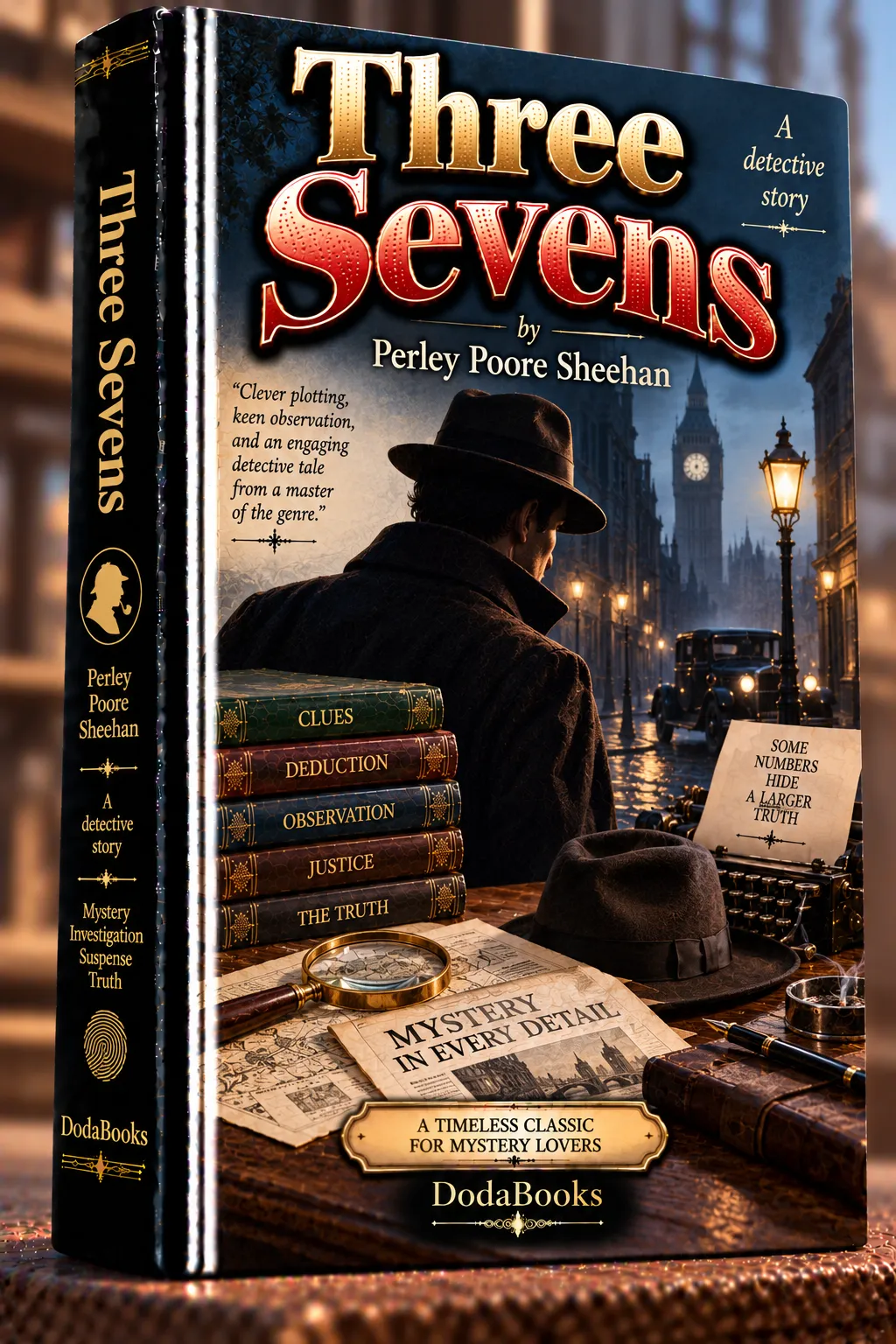
🔓 Crack the Prison Walls with Convict 777
Read Perley Poore Sheehan’s electrifying 1924 prison mystery classic with the digital care, typography, and historical notes it deserves:
- 🔓 100% DRM-Free — EPUB & PDF formats compatible with Kindle, Apple Books, Kobo, and Android
- 💡 Over 100 Contextual Footnotes — Direct explanations for 1920s prison history, convict slang, and silent cinema
- 📱 Designed for Modern Screens — Balanced typography and crisp formatting for e-readers, tablets, and phones
- 💰 Permanent Ownership — Only $2.99; yours to download, keep, and read forever