Three Millions! Summary by Chapter: Oliver Optic's Gilded Age Satire Breakdown
Published in Boston in 1872 by Lee and Shepard, William Taylor Adams’ novel—writing under his celebrated pen name Oliver Optic—entitled Three Millions! or, The Way of the World is one of the sharpest, most entertaining satires of sudden wealth and moral corruption produced in post-Civil War America. While contemporary audiences primarily knew Oliver Optic as the beloved author of nautical adventures and moral formation stories for young boys, Three Millions! represents a deliberate, mature, and biting comedy of manners aimed directly at the adult anxieties of the Gilded Age.
Set against the backdrop of rapid post-war industrialization, California gold speculation, and mushrooming consumerism, the novel explores what happens when an ordinary, pious New England village household is suddenly catapulted into the stratosphere of the super-rich. When news arrives that eccentric, long-forgotten “Uncle John” has died in California leaving an astounding consolidated estate of three million dollars, the quiet village of Poppleton Point becomes an arena of wild social climbing, domestic paranoia, scheming suitors, and predatory financial wolves.
This comprehensive chapter-by-chapter guide breaks down the four distinct dramatic acts of Three Millions!, detailing the Penniman family’s transformation, the comic absurdities of their newfound grandeur, Uncle John’s ingenious moral test, and the heartwarming restoration of true values.
| Dramatic Act | Chapters Covered | Core Setting | Major Narrative Milestones & Themes |
|---|---|---|---|
| Act I: The California Legacy | Chapters 1–6 | Poppleton Point Village | Modest village life; debt anxieties; the legal telegram announcing the $3,000,000 inheritance; initial shock. |
| Act II: The Gilded Delusion | Chapters 7–12 | The Penniman Homestead & Boston | Severing village ties; hiring Parisian tutors; the arrival of flattering suitors, distant cousins, and Wall Street stock-jobbers. |
| Act III: The Disguised Traveler | Chapters 13–18 | Poppleton Point & Local Inn | Arrival of a ragged, destitute old traveler claiming kinship; the family’s haughty rejection vs. true compassionate charity. |
| Act IV: The Unmasking & True Gold | Chapters 19–24 | The Manor & Probate Assembly | Uncle John reveals his identity; exposure of the fortune hunters; distributing the true wealth; lessons in republican virtue. |
📖 Chapter-by-Chapter Summary
Act I: Contentment at Poppleton Point & The California Bombshell (Chapters 1–6)
Chapter 1: The Kitchen at Poppleton Point
The novel opens in the modest, spotless kitchen of Silas Penniman in the coastal village of Poppleton Point, Massachusetts. Silas, a hardworking, honorable village builder and mechanic, sits with his wife Prudence and their daughters, Bessie and Laura, balancing the household accounts. While the family enjoys deep domestic affection, good health, and respected standing in the local church, they face ongoing financial anxieties: a mortgage on their modest house is coming due, and winter coal bills loom. Silas preaches contentment with honest labor, reminding his children that integrity is far more precious than gold.
THE PENNIMAN FAMILY FORTUNE TRAJECTORY:
┌─────────────────────────────────────────────────────────────┐
│ 🏡 Honest Poverty: Frugality, family love & mortgage dread  │
├─────────────────────────────────────────────────────────────┤
│ 📜 The Telegram: $3,000,000 California gold estate arrives   │
├─────────────────────────────────────────────────────────────┤
│ 🎩 The Nouveau-Riche Trap: Silk dresses, snobbery & suitors │
├─────────────────────────────────────────────────────────────┤
│ 🧥 The Ragged Visitor: A destitute traveler tests charity   │
├─────────────────────────────────────────────────────────────┤
│ 💎 The Moral Awakening: True gold lies in love and honor    │
└─────────────────────────────────────────────────────────────┘
Chapter 2: The Letter from San Francisco
The morning routine is interrupted by the arrival of the village postmaster carrying a registered legal letter bearing California stamps. The letter, drafted by a prominent San Francisco probate firm, informs Silas that his eccentric bachelor brother, John Penniman—who vanished during the 1849 California Gold Rush thirty years earlier and was long presumed dead—has passed away. Having struck legendary veins in the Sierra Nevada and reinvested in Central Pacific railroad bonds and San Francisco real estate, Uncle John has left a consolidated estate evaluated at the astronomical sum of $3,000,000 (equivalent to over seventy million dollars in modern purchasing power).
Chapter 3: The Golden Shockwave
The news spreads through Poppleton Point like wildfire. Silas is stunned into silence, struggling to comprehend a sum so vast that the annual interest alone exceeds the entire tax revenue of the township. Prudence, however, immediately begins recalculating their social position. Within hours, neighbors who previously treated the Pennimans as simple village peers arrive under the guise of offering congratulations, but their eyes wander across the modest parlor, calculating how the family’s new wealth might be tapped.
Chapter 4: The Vultures Take Flight
Before legal confirmation has even been formalized by the Boston probate courts, a swarm of distant relatives, long-lost acquaintances, and financial promoters descends upon the Penniman cottage. Distant cousins from Vermont and Rhode Island who had not exchanged a greeting in twenty years suddenly arrive with tearful memories of “dear Uncle Silas.” Investment agents offering worthless gold mine certificates and patent-medicine syndicates crowd the front porch, eager to help the family “invest their surplus capital.”
Chapter 5: Prudence’s Grand Ambitions
Prudence Penniman decides that their modest clapboard home is no longer fit for millionaires. She commands Silas to put away his carpenter tools and declares that their days of kitchen labor are permanently over. Over Silas’s gentle protests, Prudence travels to Boston to order lavish silk wardrobes, imported carriage horses, and expensive velvet upholstery, eager to prove that the Pennimans belong in the topmost tier of American high society.
Chapter 6: The Suitors Arrive
With the daughters Laura and Bessie now recognized as heiresses to a multi-million-dollar fortune, fashionable young men from Boston and New York suddenly discover business that brings them to Poppleton Point. Among them is the polished, smooth-talking “Colonel” Frank Chetwynde, who boasts of Virginia aristocratic lineage and high Wall Street connections. While Laura is flattered by Chetwynde’s elegant compliments and French phrases, the grounded, sensible younger daughter Bessie remains skeptical of his theatrical flattery.
Act II: The Nouveau-Riche Delusion & The Vulture Swarm (Chapters 7–12)
Chapter 7: The Transformed Homestead
Silas Penniman’s quiet village cottage is overhauled into an extravagant, chaotic mansion. Italian plasterers, French decorators, and landscape gardeners turn the neat vegetable gardens into ostentatious fountains and gravel carriage drives. Silas feels like an alien in his own home, wandering awkwardly through gilded drawing rooms where he is terrified of stepping on imported Aubusson carpets.
THE DIALECTIC OF GILDED WEALTH:
[Quiet Republican Simplicity]  vs.  [Pretentious Parisian Grandeur]
       (Silas & Bessie)                     (Prudence & Laura)
              │                                     │
              ▼                                     ▼
     Moral Peace & Clarity                 Anxiety, Snobbery & Flattery
Chapter 8: The Way of the World
Oliver Optic leans heavily into biting social satire as Prudence Penniman hires a French tutor and social etiquette governess to teach the family proper aristocratic diction. The resulting dinner parties are comic disasters: Prudence attempts to use high-society French phrases, only to confuse culinary terms with barnyard vocabulary, while Silas mortifies his wife by offering extra helpings of boiled potatoes to fashionable Boston guests with genuine New England hospitality.
Chapter 9: The Snub of Old Friends
The toxic effects of sudden wealth begin tearing at the moral fabric of the family. When Mrs. Higgins, a lifelong neighbor who had nursed the Penniman children through scarlet fever, comes to call, Prudence instructs the hired Irish maid to inform her that “Mrs. Penniman is not at home to village callers.” Silas is deeply pained by this cruelty, recognizing that wealth is hardening his wife’s heart and severing the warm communal bonds that defined their happiest years.
Chapter 10: Chetwynde’s Financial Scheme
Colonel Chetwynde makes his move. Claiming to possess insider information regarding a massive transcontinental railroad merger, he approaches Silas with an urgent investment proposition: by fronting $200,000 in immediate cash against the incoming California legacy, Silas can secure a controlling interest that will yield millions in dividends. While Laura urges her father to accept Chetwynde’s offer, Silas hesitates, trusting his builder’s instinct that fortunes constructed overnight on paper are built on sand.
Chapter 11: The Domestic Rift
For the first time in thirty years of marriage, an open quarrel erupts between Silas and Prudence. Prudence accuses Silas of having “no ambition,” calling him a plodding country mechanic who lacks the vision to move in fashionable circles. Laura takes her mother’s side, captivated by Chetwynde’s romantic promises of a winter townhouse on Boston’s Beacon Hill and a grand tour of Europe. Only Bessie stands beside her father, affirming that quiet peace and honest self-respect are worth more than high-society vanity.
Chapter 12: The Wall Street Wire
A telegram arrives from New York alerting Silas that rumors of Uncle John’s estate have caused wild fluctuations in California mining shares. Unscrupulous stock jobbers are actively circulating forged letters claiming that John Penniman died with massive outstanding liabilities, attempting to panic Silas into selling his probate rights for a fraction of their value. Silas realizes that the world of high finance is a ruthless predator pit where the innocent are devoured without mercy.
Act III: The Disguised Traveler & The Moral Test (Chapters 13–18)
Chapter 13: The Stranger on the Highway
On a bitter, rain-lashed November evening, an old man wearing a threadbare, mud-splattered overcoat and carrying a battered tin lantern walks into Poppleton Point. His boots are worn through, his beard is gray and unkempt, and he walks with a noticeable limp. Calling himself “John Thompson,” the old traveler stops at the local tavern, inquiring about the Penniman family and listening quietly to the villagers’ gossip regarding their astounding three-million-dollar inheritance.
THE MORAL TEST OF THE DISGUISED TRAVELER:
[The Tramp at the Door] ➔ [Prudence & Laura: Disgust & Eviction]
                         ➔ [Silas & Bessie: Warm Food & Shelter]
                         ➔ [The True Identity Revealed]
Chapter 14: Turned Away from the Gilded Gate
The old traveler makes his way up the gravel drive of the newly renovated Penniman mansion and knocks on the kitchen door, asking for a warm bowl of broth and shelter from the freezing sleet. Prudence and Laura happen to be in the conservatory admiring imported orchids. Spotting the ragged tramp, Prudence is scandalized:
“What impertinence! A common beggar coming to the front grounds of a million-dollar estate! Send him to the town poorhouse at once, or call the constable!”
Laura turns away in disgust, complaining that the sight of the dirty tramp has ruined her evening.
Chapter 15: The Barn of Refuge
Silas and Bessie, returning from the village church, discover the shivering old man being driven away by the hired servants. Horrified by his family’s callousness, Silas intervenes immediately. Taking the old traveler by the arm, Silas leads him into the heated tack room of the barn, wraps him in a warm wool blanket, and orders Bessie to fetch a hot beef stew, bread, and coffee. Bessie serves the traveler with tender, unfeigned respect, washing his blistered feet and listening attentively to his stories of the California trails.
Chapter 16: The Traveler’s Questions
Sitting beside the stove, the old traveler questions Silas closely about how the three-million-dollar inheritance has changed his life. Silas answers with profound honesty:
“To tell you the plain truth, friend, the three millions have brought us more heartache in three months than thirty years of hard labor ever did. My wife has lost her sweet peace; my elder daughter is dazzled by a smooth scoundrel; and our old neighbors look at us with cold suspicion. If I could trade the gold to have our humble, loving home back as it was, I would sign the papers tonight.”
The old traveler watches Silas and Bessie with tears glistening in his eyes, whispering softly, “Then there is still true gold in Poppleton Point.”
Chapter 17: Chetwynde’s Ultimatums
The following morning, Colonel Chetwynde arrives at the estate in high agitation. He demands that Laura finalize their engagement and insists that Silas sign power-of-attorney documents transferring control of the California bonds to his brokerage syndicate before the evening mail train departs. Sensing that Chetwynde is attempting to execute a financial swindle before the probate court verifies the estate, Bessie begs her sister to wait. Laura angrily accuses Bessie of trying to sabotage her chance at becoming a high-society countess.
Chapter 18: The Gathering in the Great Parlor
The old traveler, still wearing his patched coat, walks boldly into the grand drawing room where Prudence, Laura, Chetwynde, and the family lawyer are assembled. Prudence shrieks in outrage, ordering the servants to throw the vagrant into the road. But the old man raises his hand with an authority so commanding that the room falls instantly silent.
Act IV: The Unmasking, Exposure & Redemption (Chapters 19–24)
Chapter 19: The Revelation of Uncle John
Throwing back his ragged overcoat, the old traveler pulls a thick bundle of verified parchment documents from his vest pocket. He turns to Silas and smiles:
“Silas, my boy, look at me closely. Don’t you recognize the brother who gave you his pocketknife when we parted thirty years ago?”
Silas gasps: the old “tramp” is none other than Uncle John Penniman himself! He never died in California; having amassed his vast fortune, he arranged the false death announcement and traveled east in disguise to test whether his surviving kin had preserved their republican virtues or whether the mere rumor of gold would poison their souls.
THE JUDGMENT OF UNCLE JOHN:
┌───────────────────────────────┬───────────────────────────────┐
│ THE VAIN & CALLOUS            │ THE VIRTUOUS & FAITHFUL       │
├───────────────────────────────┼───────────────────────────────┤
│ • Prudence & Laura            │ • Silas & Bessie              │
│ • Ordered the tramp evicted   │ • Welcomed the beggar inside  │
│ • Sinned through pride/greed  │ • Washed his feet & fed him   │
│ • Humiliated and disinherited │ • Awarded true stewardship    │
└───────────────────────────────┴───────────────────────────────┘
Chapter 20: The Vultures Exposed
Uncle John wastes no time settling accounts. Turning upon Colonel Chetwynde, Uncle John exposes him as a notorious New York confidence trickster whose “Virginia plantation” is an outright fiction and whose brokerage firm is wanted for mail fraud by the federal postal inspectors. Chetwynde turns pale, snatches his hat, and flees the house before the village constable can be summoned. Laura collapses into tears of mortification, realizing that her “aristocratic suitor” was courting her fictitious millions, not herself.
Chapter 21: The Disinheritance of Vanity
Uncle John convenes the family for the reading of his actual, legally binding will. Addressing Prudence and Laura, he delivers a blistering rebuke of their social pretensions and cruel rejection of their old neighbors:
“You had a paradise of love and contentment in this cottage, and you threw it into the gutter to ape the vices of Parisian snobs. You turned away an old, freezing man from your door because his coat was torn. The woman who despises the poor will never be trusted with my gold.”
Uncle John announces that not one dollar of the three millions will be placed in the hands of Prudence or Laura for frivolous luxury.
Chapter 22: The True Stewardship
Instead, Uncle John places the vast fortune into a perpetual charitable trust and family stewardship governed jointly by Silas and Bessie. Recognizing their incorruptible integrity, Uncle John tasks them with using the fortune for constructive, honorable works:
- Establishing a technical institute and library in Poppleton Point for working-class youth.
- Paying off the mortgages of struggling village farmers and fishermen.
- Funding hospitals and orphanages throughout New England.
- Providing Silas with ample capital to expand his honest building enterprise without ever taking predatory profits.
Chapter 23: The Restoration of Prudence
Devastated by public shame and humbled by Uncle John’s rebuke, Prudence experiences a profound moral transformation. Shedding her ridiculous French gowns and dismissing her social tutors, she goes in tears to the cottage of Mrs. Higgins, begging her old friend’s forgiveness for her snobbery. Laura, having learned the bitter lesson of Chetwynde’s deceit, renounces high-society vanity and finds genuine happiness in teaching village children and courting an honest, hardworking local mechanic.
Chapter 24: The Way of the World
The novel concludes with a joyful gathering in the Penniman home. The gaudy imported furnishings have been removed, replaced once again by the warm, clean simplicity of New England domestic comfort. Silas, Prudence, Bessie, Laura, and Uncle John sit together around the kitchen table, their bonds forged anew in humility and mutual respect. Oliver Optic leaves the reader with an enduring moral lesson: the “way of the world” may worship unearned gold and empty titles, but the only true wealth on earth is a clear conscience, honest labor, and unselfish love.
🔑 Major Literary Themes & Gilded Age Satire
1. The Alchemy of Sudden Wealth
In Three Millions!, Oliver Optic anticipates the core theme of Mark Twain’s The Gilded Age: that unearned fortunes act as a moral solvent. The mere expectation of money dissolves lifelong friendships, turns humble wives into haughty tyrants, and invites a swarm of predatory confidence men into rural communities. Optic demonstrates that wealth does not alter human nature; it merely magnifies whatever vices or virtues already reside within the heart.
2. Disguised Virtue and the Biblical Test
Uncle John’s arrival in rags directly invokes ancient folklore and biblical parables (the testing of Abraham, the stranger at the gate, Christ in the guise of the poor). By testing his family through the crucible of charity rather than legal inquiry, Uncle John separates the superficial worshippers of mammon from those whose hearts remain grounded in genuine Christian compassion.
3. The Dignity of American Labor vs. European Pretension
Throughout the narrative, Optic champions the traditional Jeffersonian and Jacksonian ideal of the honest American producer—the builder, the carpenter, the farmer—over the idle consumerism of European aristocracy. Silas Penniman’s rough, calloused hands are portrayed as infinitely more noble than Colonel Chetwynde’s manicured, swindling fingers, reinforcing the republican ethos of nineteenth-century America.
❓ Frequently Asked Questions
Who was Oliver Optic?
Oliver Optic was the famous pseudonym of William Taylor Adams (1822–1897), a celebrated American author, educator, and Boston politician who published over a hundred popular novels focusing on moral character, youth adventure, and social satire.
How much would three million dollars in 1872 be worth today?
In 1872, three million dollars represented an incomprehensibly vast fortune. Adjusted for inflation, economic purchasing power, and relative share of GDP, $3,000,000 in 1872 is equivalent to between $75,000,000 and $150,000,000 in modern purchasing value.
Did Uncle John really die in California?
No. Uncle John faked his death with the assistance of his San Francisco lawyers as an elaborate psychological experiment, allowing him to return to Poppleton Point in disguise to test his family's genuine character before bestowing his estate.
What is the meaning of the subtitle 'The Way of the World'?
The subtitle is an ironic reference to the cynical, opportunistic behaviors of society—where people flatter the rich, despise the poor, and compromise their principles for gold. Optic exposes this worldly cynicism to champion honest labor and moral integrity.
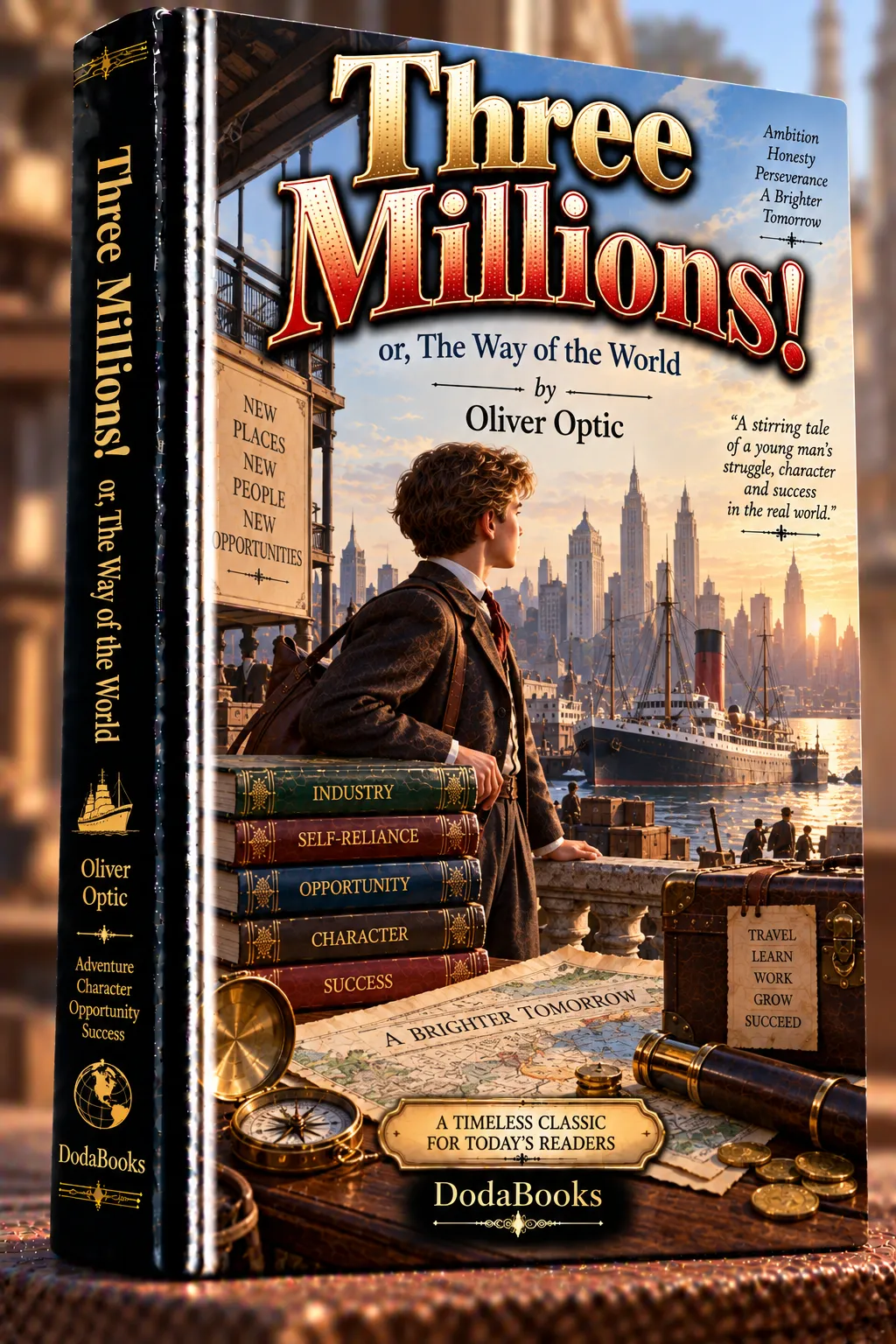
What makes the DodaBooks edition of Three Millions! unique?
The DodaBooks Annotated Gilded Age Edition includes comprehensive historical annotations explaining 19th-century probate procedures, Gold Rush mining fortunes, New England dialects, and currency valuations, formatted cleanly for all modern e-reading devices.
💰 Discover What Staggering Wealth Does to the Human Heart
Read Oliver Optic’s biting 1872 social satire with the digital care, typography, and historical apparatus it deserves:
- 🔓 100% DRM-Free — EPUB & PDF formats compatible with Kindle, Apple Books, Kobo, and Android
- 💡 Over 100 Contextual Footnotes — Direct explanations for Gilded Age economics, probate laws, and Yankee idioms
- 📱 Designed for Modern Screens — Balanced typography and clean formatting for tablets, e-readers, and phones
- 💰 Affordable & Permanent — Only $2.99; yours to download, keep, and read forever
👉 Buy the Annotated Edition of Three Millions! at DodaBooks →