Three Millions! or, The Way of the World
Oliver Optic’s Biting 1872 Anatomy of Sudden Fortune, Human Hypocrisy, and Gilded Age Vanity
In post-Civil War America, the explosion of transcontinental railroads, industrial trusts, and Wall Street speculation birthed a cultural obsession that Mark Twain and Charles Dudley Warner christened “The Gilded Age.” Few contemporary authors observed the moral convulsions of this era with sharper, more entertaining irony than William Taylor Adams, writing under his beloved pseudonym Oliver Optic.
While modern readers remember Oliver Optic primarily as a creator of moral adventure stories for boys, his 1872 novel Three Millions! or, The Way of the World represents a deliberate, mature, and cutting social satire aimed directly at adult society. It tackles an ancient philosophical question made urgently modern by Gilded Age capitalism: What happens to human character when an ordinary, church-going family is suddenly handed an incomprehensible fortune of three million dollars?
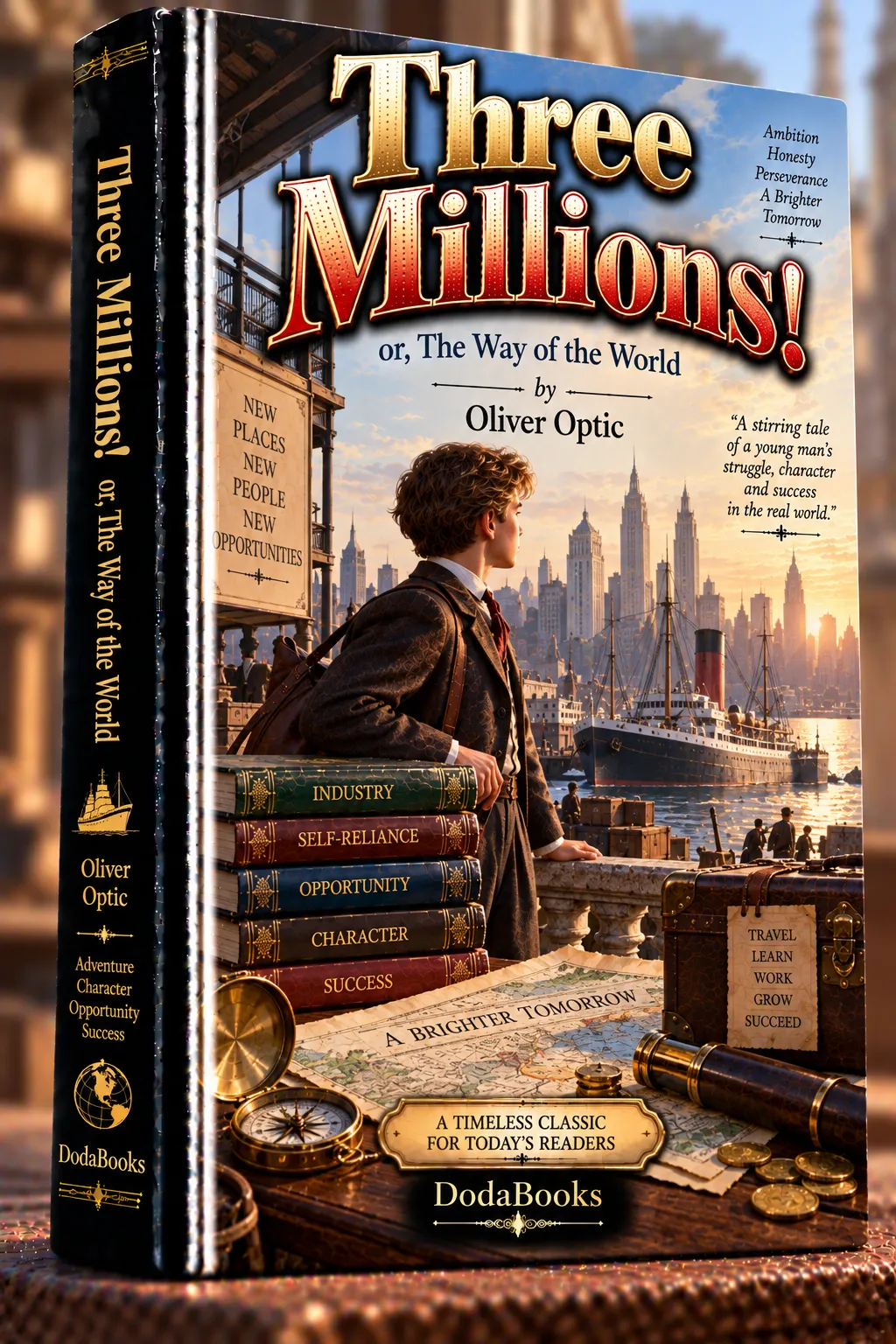
See What Staggering Wealth Does to the Human Heart
Read Oliver Optic's 1872 social satire with comprehensive annotations detailing 19th-century probate laws, New England village economies, and Gilded Age fortunes.
Get Three Millions! on DodaBooksThis tradition of moral testing and character formation through active youth is carried forward into collegiate athletics in Ralph Henry Barbour’s football classic.
The Catalyst: Uncle John’s Astounding Legacy
The story unfolds in the quiet, respectable coastal village of Poppleton Point, New England. The Penniman household is the very model of modest republican virtue: pious, frugal, hardworking, and perpetually anxious about mortgage payments and winter grocery bills.
Everything shatters when news arrives from California: eccentric, long-forgotten “Uncle John,” who departed thirty years earlier for the California gold fields, has died, leaving a consolidated estate in mining stocks, railway bonds, and San Francisco real estate valued at the astronomical sum of three million dollars (equivalent to well over seventy million dollars today).
Optic wastes no time exposing the comical, horrifying speed with which basic human decency evaporates in the presence of extreme money. Before the estate has even cleared probate:
- Modest village friendships are severed because neighbors suddenly appear “socially inferior.”
- Modest wardrobes are trashed in favor of imported Parisian silks that the family does not know how to wear.
- Scheming distant cousins, unctuous investment promoters, and flattering aristocrats descend on Poppleton Point like circling buzzards.
- Simple domestic affection is replaced by paranoid suspicion, as every family member begins calculating their legal share against the others.
The Penniman Transformation Arc:
[Contented Frugality at Poppleton Point] ➔ [California Legacy Bombshell] ➔ [Social Snobbery & Family Warfare] ➔ [The Trap of the Gold Speculator] ➔ [The Awakening]
Oliver Optic’s Psychological Comedy: The “Nouveau Riche”
What elevates Three Millions! above mere moralizing is Optic’s sharp comic ear for dialogue and behavior. Having spent decades as an educator and municipal politician in Boston, Optic knew the exact psychological mannerisms of the American middle class.
The matriarch of the family, suddenly believing herself destined for high society, hires an aristocratic French tutor and attempts to purge the home of provincial New England mannerisms, resulting in uproarious conversational blunders. Meanwhile, suitors who previously ignored the Penniman daughters now arrive in velvet waistcoats, professing undying devotion to their “spiritual qualities” while nervously glancing toward the family lawyer’s office.
Optic captures the tragic irony of wealth in early consumerist America: having spent their entire lives dreaming of what they would do with freedom from labor, the family discovers that sudden wealth brings not leisure, but exhausting social anxieties, vulnerability to financial predators, and an empty, hollow soul.
Biting Gilded Age Satire
A witty, uncompromising anatomy of American social mobility, showing the hilarious and tragic follies of sudden unearned millions.
19th-Century Probate Drama
Authentic period details of California Gold Rush estates, missing wills, New York bond syndicates, and rural estate litigation.
Sharp Middle-Class Dialogue
Optic’s celebrated ear for authentic Yankee vernacular, capturing rural New England dialect and comic pretentious high-society affectations.
Annotated Historical Context
Comprehensive footnotes explaining currency values, Gold Rush economics, and the Post-Civil War consumer revolution.
The Cultural Significance of “The Way of the World”
The subtitle of the novel—The Way of the World—is William Taylor Adams’ deliberate nod to William Congreve’s famous Restoration comedy of manners. Yet where Congreve satirized the cynical intrigues of London aristocrats, Optic adapts the trope to democratic America, demonstrating that the worship of the “Almighty Dollar” corrupts small-town democracies just as completely as ancient monarchies.
In Optic’s philosophical vision, money itself is neither holy nor evil; it acts simply as an amplifier of character. Men of petty vanities become tyrannical monsters; women of quiet integrity are tested in the fire of temptation. The resolution of the novel delivers both hilarious comeuppance for the flatterers and a heartfelt redemption that affirms the enduring value of honest labor, modest expectations, and sincere family love.
To explore how sudden wealth and financial power shaped American society from contrasting perspectives, compare this novel with our companions to Henry Clews’ Fifty Years in Wall Street Guide and Edwin Lefèvre’s Reminiscences of a Stock Operator Guide.
Rediscover Oliver Optic's Sparkling Adult Satire
Read the definitive digital edition of Three Millions! on DodaBooks. Complete with period financial glossaries, historical essays, and flawless digital typography.
Purchase Three Millions! on DodaBooksWhy Read the DodaBooks Annotated Edition of Three Millions?
Because Optic wrote during the immediate aftermath of the Civil War, his narrative features numerous references to greenback currency fluctuations, California mining titles, and Victorian domestic etiquette that modern readers may miss.
The DodaBooks Annotated Edition delivers:
- Historical Monetary Calculations: Translating 1872 dollar values, bond coupons, and gold specie rates into modern purchasing power equivalents.
- Glossary of 19th-Century Yankee Vernacular: Defining regional New England expressions and period legal terminology surrounding probate and wills.
- Biographical Introduction to Oliver Optic: Detailing William Taylor Adams’ dual life as Boston educator, state politician, and prolific magazine editor.
- Flawless Formatting for Modern Readers: Clean chapter divisions, responsive typography, and comfortable line spacing optimized for Kindle, iPad, Kobo, and smartphones.
The Social Architecture of Post-Civil War Greed
What gives Three Millions! its biting contemporary resonance is Optic’s forensic analysis of consumer status competition. Prior to the Industrial Revolution, American small-town life was anchored by strict Puritan and republican norms where ostentatious displays of luxury were viewed with deep civic suspicion. The post-Civil War boom abruptly shattered these communal bonds, replacing them with a frantic race for external status markers.
Optic illustrates this through the tragicomic deterioration of family relations within the Penniman household. Brother turns against brother over speculative stock options; sisters scrutinize each other’s jewelry with envious malice; and long-standing debts of gratitude toward humble neighbors are discarded the moment those neighbors cease to serve social ambitions. Optic’s satire cuts deeply because it exposes how wealth creates an optical illusion of security while actually multiplying emotional vulnerability.
Optic's Sociological Dynamic:
[Puritan Village Cohesion] ➔ [The Influx of Unearned Capital] ➔ [Anxious Status Competition] ➔ [Moral & Domestic Alienation]
By contrasting this hollow consumer madness with the grounded common sense of those few characters who refuse to worship the legacy, Optic delivers a timeless moral sermon disguised as a sparkling comedy. He reminds us that money without character is a curse that impoverishes the soul far more effectively than poverty ever could.
The enduring brilliance of Oliver Optic’s social satire lies in its uncanny psychological accuracy. More than a century after its publication, Three Millions! reads like a preview of modern lotto winners, tech billionaires, and sudden heirs whose lives unravel when staggering capital collides with fragile human character. It remains one of the sharpest, most entertaining American cautionary tales of the Gilded Age.
To step back into the earlier, Federal-era Manhattan of Bowling Green during the War of 1812, read our companion to The Belle of Bowling Green Guide.
Frequently Asked Questions
Who was Oliver Optic?
Oliver Optic was the famous pen name of William Taylor Adams (1822–1897), a beloved American author, educator, and editor who published over a hundred books capturing 19th-century American life and character.
Is Three Millions! a children's book or an adult novel?
While Oliver Optic is best known for boy adventure stories, Three Millions! was specifically written as a mature social satire for adult readers, exposing the hypocrisy, snobbery, and greed unleashed by sudden family wealth.
How much was three million dollars worth in 1872?
In 1872, three million dollars was an almost unimaginable fortune, equivalent to well over $70 million today in purchasing power, and representing a colossal industrial empire in the post-Civil War era.
What is the central moral theme of the story?
The central theme is that sudden unearned wealth corrupts human relationships, breeds empty social pretension, and attracts swindlers, proving that genuine happiness is rooted in modest living, character, and honest work.
Where can I download the complete annotated digital edition?
You can purchase and immediately download the DodaBooks annotated edition directly from the DodaBooks online bookstore for all modern e-reading devices.