Thoughts of Marcus Aurelius Antoninus
The Private Spiritual Journal of Rome's Philosopher-Emperor in George Long's Classic Translation
There is no text in ancient literature quite like the private notebooks of Marcus Aurelius Antoninus. Known historically as the Meditations and traditionally titled in English as The Thoughts of Marcus Aurelius Antoninus, this work was never intended for publication, public praise, or academic debate. It was composed by the ruler of the Roman Empire between 170 and 180 AD, penned by flickering candlelight in military tents along the frozen Danubian frontier during the brutal Marcomannic Wars.
Surrounded by political treachery, devastating plague, and the relentless burdens of imperial governance, Marcus Aurelius wrote to himself as a form of spiritual therapy. Drawing upon the profound teachings of Epictetus and the Late Stoic school, he examined his own shortcomings, calmed his anxieties, and continually reminded himself of his core duties: to maintain emotional tranquility, practice virtue without complaint, accept the inevitability of death, and treat all human beings as members of a common cosmic city.
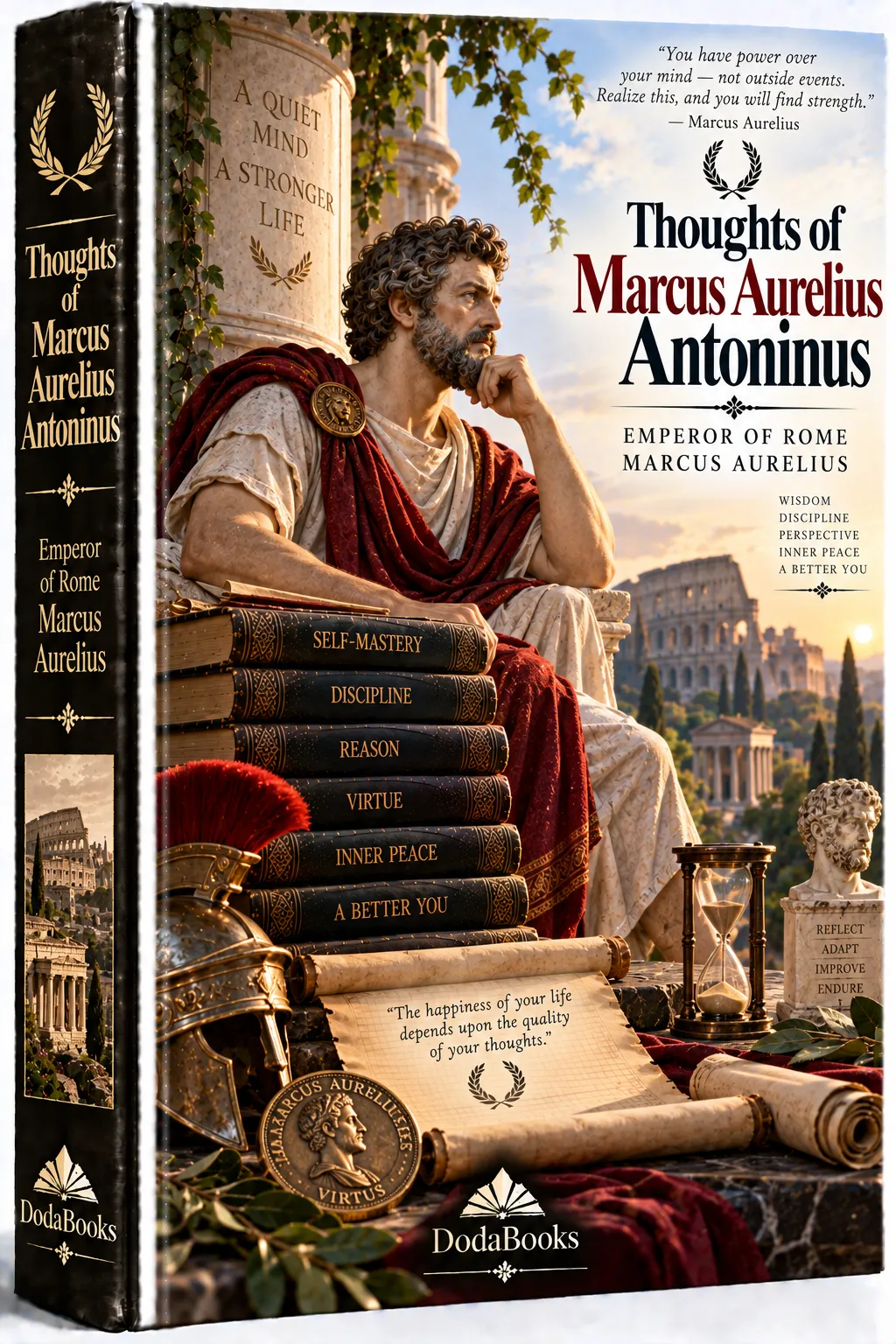
Access the Mind of Rome's Greatest Philosopher-Emperor
Read George Long's authoritative translation of Marcus Aurelius' Thoughts, enriched with scholarly commentary on Stoic physics, Roman history, and practical daily exercises.
Get Thoughts of Marcus AureliusThe Core Philosophy of Late Stoicism
To understand Marcus Aurelius, one must understand the three classical disciplines of Late Stoicism, articulated by Epictetus and practiced daily by the Emperor:
1. The Discipline of Desire (Acceptance of Fate / Amor Fati)
The Stoic recognizes that external events—health, wealth, political reputation, and the actions of others—are not within our direct control (ta ouk eph’ hemin). What is within our control is our own moral intention, our judgment, and our character. Marcus constantly reminds himself to embrace whatever fate brings, seeing every obstacle as material for practicing virtue:
“The impediment to action advances action. What stands in the way becomes the way.”
2. The Discipline of Assent (Control of Judgment)
External events cannot hurt the soul; only our opinions about those events can disturb us. When confronted by betrayal or hardship, Marcus urges himself to suspend automatic emotional reactions:
“Wipe out the judgment, and you are saved. Who then hinders you from wiping it out?”
3. The Discipline of Action (Duty to Fellow Humans)
Despite the dark selfishness he encountered daily among Roman senators and conquered tribes, Marcus refused misanthropy. He viewed humanity as limbs of a single organism, designed by nature for mutual cooperation:
“When you wake up in the morning, tell yourself: The people I deal with today will be meddling, ungrateful, arrogant, dishonest, jealous, and surly. They are like this because they cannot distinguish good from evil. But I have seen the beauty of good, and the ugliness of evil… We were born to work together like hands, feet, or the two rows of teeth.”
The Stoic Daily Operating System:
[External Disruption/Insult] ➔ [Suspend Emotional Assent] ➔ [Refocus on Internal Virtue] ➔ [Execute Duty with Kindness]
The Significance of the George Long Translation
While dozens of translations of Marcus Aurelius exist, the 1862 translation by classical scholar George Long holds a revered position in English literary and philosophical history. Long was not merely a translator; he was a serious classical jurist and philosopher who provided the Victorian world with its first rigorous, philologically exact rendering of the Emperor’s difficult Greek prose.
Long’s introduction and scholarly essays—which are fully included in the DodaBooks edition—remain essential reading. Long carefully distinguishes Stoic ethics from Christian theology, defends Marcus against historical slanders regarding the persecution of early Christians, and demonstrates how Stoic reason provides an unshakeable foundation for human dignity in times of political turmoil.
Matthew Arnold famously praised Long’s translation, noting that Long succeeded in capturing the severe, noble, and melancholy cadence of Marcus’s original inner voice.
Complete Twelve Books
All twelve books of the Emperor's private journal preserved in complete, unexpurgated form with full classical chapter divisions.
George Long's Classical Essays
Includes Long's comprehensive 60-page treatise on the philosophy of Antoninus, classical Stoic cosmology, and Roman legal context.
Historical Frontier Context
Explanatory notes detailing the Antonine Plague, the rebellion of Avidius Cassius, and the grim realities of the Marcomannic frontier wars.
Daily Practical Exercises
Marginal guides highlighting Marcus's daily mental exercises: the view from above, memento mori, and negative visualization.
Memento Mori and The View from Above
Two recurring mental exercises dominate The Thoughts of Marcus Aurelius:
Memento Mori: The Cosmic Transience of All Things
Marcus lived through the devastating Antonine Plague, which decimated millions across the Roman Empire. Rather than fleeing from thoughts of mortality, he looked directly at it. He lists the great emperors who came before him—Augustus, Hadrian, Antoninus Pius—noting that their palaces, triumphs, and funeral monuments have vanished into dust:
“Time is a river, a violent current of events, glimpsed once and already carried past us, and another follows and is gone.” By realizing that death may claim us at any moment, all petty grievances, vanity, and anxieties evaporate, leaving only the urgent duty to live honorably in the present moment.
The View from Above
When overwhelmed by the pettiness of Rome, Marcus imagined looking down upon the Earth from the heavens. From this celestial vantage point, armies look like ants scrambling over a dirt clod, borders dissolve into meaningless scratches, and human disputes shrink to their true microscopic scale. This perspective allowed the ruler of the Western world to govern with equanimity, patience, and profound humility.
To explore how ancient philosophical virtue and classical reflection evolved into Renaissance thought, read our companions to Francis Bacon’s Essays Guide and Friedrich Nietzsche’s radical re-evaluation of morality in Beyond Good and Evil Guide.
Build Mental Resilience with Ancient Stoic Wisdom
Read the definitive digital edition of The Thoughts of Marcus Aurelius Antoninus on DodaBooks. Features George Long's scholarly essays, Greek glossaries, and clean e-reader layout.
Purchase Thoughts of Marcus Aurelius on DodaBooksWhy Read the DodaBooks Edition of Marcus Aurelius?
Because Marcus wrote his journal in concise, highly compressed Koine Greek for his own eyes, reading modern translations without commentary often leaves readers missing the underlying Stoic technical terminology (hegemonikon, logos, tonos, apatheia).
The DodaBooks Annotated Edition provides:
- Classical Stoic Glossaries: Clear explanations of core Greek concepts such as Logos (universal reason), Prohairesis (moral choice), and Ataraxia (tranquility).
- Complete George Long Apparatus: Retaining all of Long’s insightful cross-references to Epictetus, Seneca, and Cicero.
- Historical Timeline of the Antonine Dynasty: Contextualizing Marcus’s co-rule with Lucius Verus, his beloved tutor Fronto, and his troubled son Commodus.
- Flawless Digital Typography: Designed with elegant margins, clear paragraph spacing, and distraction-free formatting across iPad, Kindle, Kobo, and smartphones.
The Inner Citadel and the Freedom of the Mind
The central metaphor of Marcus Aurelius’ philosophy is the concept of the Inner Citadel (akropolis). In Book IV of the Thoughts, Marcus writes:
“Nowhere can a man find a quieter or more untroubled retreat than in his own soul, especially if he has within himself the kind of thoughts which, when he contemplates them, immediately afford him complete tranquility.”
Marcus envisioned the rational mind as an unbreachable spiritual fortress within the human consciousness. Foreign armies might ravage the empire’s borders, political rivals might slander his name, and disease might weaken his physical body, but none of these external events could cross the threshold of the Inner Citadel unless he granted them permission through his own emotional reactions.
Architecture of the Stoic Citadel:
[External Turmoil & Chaos] ➔ [Boundary of the Rational Soul] ➔ [Unassailable Internal Calm & Virtue]
By maintaining this sovereign sanctuary of reason, Marcus preserved his emotional sanity amidst the crushing pressures of ruling millions. His private journal teaches us that true freedom is not external circumstance, wealth, or power, but the inward mastery of our own desires and judgments.
Frequently Asked Questions
Why are the Meditations sometimes titled 'Thoughts of Marcus Aurelius'?
Marcus gave no title to his private journal. When classical scholar George Long published his seminal 1862 English translation, he titled it 'The Thoughts of the Emperor M. Aurelius Antoninus,' establishing the title used throughout 19th- and 20th-century literature.
Where was Marcus Aurelius when he wrote these thoughts?
Marcus wrote most of the journal between 170 and 180 AD while stationed at military outposts along the Danube (including Carnuntum and Sirmium) during the brutal Marcomannic Wars against Germanic tribes.
What is the difference between Marcus Aurelius and Epictetus?
Epictetus was a Greek slave who became a famous philosophical teacher, emphasizing practical street-level discipline. Marcus Aurelius was an emperor who read Epictetus' discourses and applied them to manage the immense burdens of imperial power.
Did Marcus Aurelius persecute early Christians?
While regional persecutions occurred during his reign under existing Roman legal codes (such as the martyrs of Lyon in 177 AD), historical evidence indicates Marcus did not actively initiate or prioritize religious persecutions, viewing Christians primarily through imperial administrative legalism.
Where can I purchase the George Long translation on DodaBooks?
The complete annotated George Long edition is available directly from DodaBooks, optimized with complete introductory essays and smooth e-reader formatting.
Related Articles
Readers exploring ancient spiritual memoirs, inner detachment from wealth, and radical simplicity will also be moved by Paul Sabatier’s Life of St. Francis of Assisi Guide.