Thelma: Marie Corelli’s Epic of Nordic Purity and London Society
Outselling her contemporaries Arthur Conan Doyle and Thomas Hardy, Victorian literary phenomenon Marie Corelli crafted in *Thelma* an unforgettable romantic masterpiece contrasting the pristine grandeur of Norwegian fjords with the corrupt, cynical salons of high-society London.
At the apex of the late Victorian era, few novelists captured the popular imagination with the sensational intensity, lush prose, and moral fervor of Marie Corelli (Mary Mackay, 1855–1924). Published in 1887 in three volumes, Thelma: A Norwegian Princess cemented Corelli’s status as the most commercially successful novelist of her generation. Championed by prime ministers, royalty (including Queen Victoria and the Prince of Wales), and millions of avid readers across the British Empire, Thelma remains a cultural touchstone of Victorian romantic idealism.
The novel dramatizes the clash between two irreconcilable worlds: the unspoiled, mythical wilderness of northern Norway—steeped in Norse mythology, midnight suns, and uncorrupted virtue—and the artificial, gossiping, materialistic drawing rooms of Mayfair in London. Readers exploring our distinguished Victorian literature collection will discover in Thelma not only a sweeping romance of profound emotional power, but also a fierce, surprisingly modern critique of patriarchal hypocrisy, social snobbery, and media gossip.
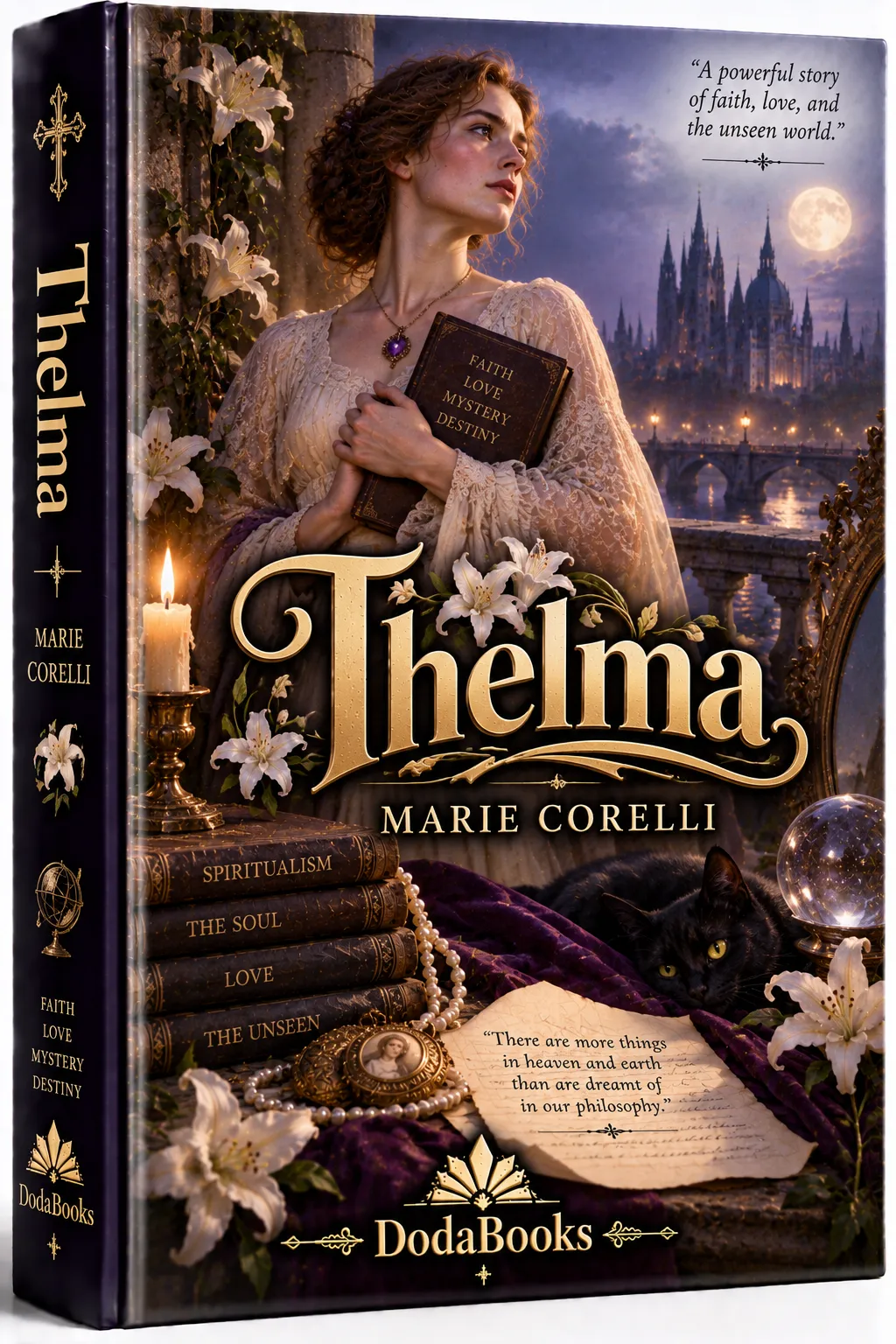
Read the Definitive Annotated Edition
Experience Marie Corelli's timeless romantic classic with explanatory notes on Scandinavian folklore, Victorian social customs, and an insightful literary essay on Corelli's cultural impact.
Get the Annotated eBookPlot Synopsis: From the Land of the Midnight Sun to Mayfair
The novel begins against the sublime, rugged backdrop of the Altenfjord in the remote north of Norway. Sir Philip Errington, a handsome, wealthy English baronet and yacht owner, has sailed north seeking refuge from the shallow cynicism and matchmaking mothers of London society. There he encounters Thelma Güldmar, the daughter of Olaf Güldmar, an ancient, proud Norwegian bonde (yeoman chieftain) who fiercely adheres to the pagan worship of Odin and Thor while rejecting modern industrial civilization.
Thelma, reared in complete isolation from the corruptions of the modern world, possesses not only extraordinary physical beauty with her flaxen hair and sea-blue eyes, but an incorruptible innocence, natural intellect, and boundless kindness. Philip falls deeply and irrevocably in love. Despite the dark prophecies of Sigurd, a half-mad mystic dwarf who reveres Thelma as an angelic queen, Philip wins Olaf Güldmar’s blessing and marries the “Norwegian Princess,” bearing his bride back to his ancestral estate in England and into the glittering whirl of London society.
                    THE MORAL POLARITY OF THELMA

        THE NORWEGIAN FJORDS                    THE LONDON DRAWING ROOMS
     ┌──────────────────────────────┐        ┌──────────────────────────────┐
     │ Altenfjord & Midnight Sun    │        │ Mayfair & Rotten Row         │
     │ Pagan Honor & Norse Lore     │ ─────► │ Materialism, Vanity & Sloth  │
     │ Thelma: Purity, Faith, Truth │        │ Lady Winsleigh: Malice & Plot│
     └──────────────────────────────┘        └──────────────┬───────────────┘
                                                            │
                                                            ▼
                                              THE CRUCIBLE OF BETRAYAL
                                              (Forged Letters & Near-Death)
                                                            │
                                                            ▼
                                              REDEMPTION & RETURN TO NATURE
In London, Thelma becomes an overnight sensation, worshipped for her natural grace and unvarnished honesty. However, her sudden ascendancy ignites venomous jealousy among the jaded denizens of high society. The malicious Lady Winsleigh, aided by the unscrupulous clergyman Mr. Dyceworthy and the spiteful Clara Neville, concocts a vicious web of slander, insinuating that Philip has grown ashamed of his rustic bride and is conducting an affair. Devastated and believing she is freeing the husband she loves, Thelma flees London in secret, returning broken-hearted to her native Norwegian snows in a dramatic race against death, misunderstanding, and emotional despair.
Major Characters: Ideals and Corruptions
Marie Corelli constructed her narrative around stark moral contrasts that gave her Victorian parables immense populist resonance:
- Thelma Güldmar: The romantic heroine par excellence. Reared in harmony with sublime nature, Thelma represents unpolluted female integrity. Her innocence is not naive helplessness; rather, it is a spiritual resilience that exposes the moral rot of sophisticated society.
- Sir Philip Errington: The noble English baronet whose genuine love for Thelma redeems him from the languid cynicism of his aristocratic peers. His tragic flaw is his failure to perceive the lethal venom of high-society gossip until it nearly destroys his home.
- Olaf Güldmar: Thelma’s towering, white-bearded father. Revering his Viking ancestors, Olaf despises modern industrial greed and religious hypocrisy. His tragic end—demanding a traditional pagan ship-burial amidst the flaming sea—forms one of the most cinematic set pieces in Victorian fiction.
- Lady Winsleigh (Violet): The archetype of the bored, envious society aristocrat. Having failed to entrap Sir Philip herself, she cannot endure the spectacle of genuine love and orchestrates Thelma’s ruin through forged notes and poisonous innuendo.
- The Reverend Mr. Dyceworthy: A grotesque, hypocritical clergyman whose external religious pieties mask avarice, gluttony, and lust. Corelli used Dyceworthy to deliver some of her most scathing satires of conventional ecclesiastical fraud.
- Sigurd: The deformed, poetic dwarf whose unrequited devotion to Thelma channels the ancient Nordic folklore of skalds and nature spirits.
Core Themes: Romantic Anti-Modernism and Social Critique
1. The Conflict Between Nature and Civilized Artifice
At the heart of Thelma lies a passionate Romantic philosophy inherited from Jean-Jacques Rousseau and William Wordsworth. The Altenfjord is presented as a terrestrial Eden where human beings live in moral clarity because they are close to the elemental power of sea, mountain, and sky. In contrast, London is depicted as a spiritual wasteland choked by soot, materialistic vanity, and shallow social rituals.
2. The Cruelty of Social Gossip and High-Society Hypocrisy
Corelli was famous for her biting antipathy toward the London literary establishment and fashionable aristocracy. In Thelma, she anatomizes the toxic culture of society drawing rooms, where reputations are casually shredded over tea, and where genuine emotion is mocked as unsophisticated vulgarity. In this respect, Corelli’s social satire shares an intriguing moral intensity with Anthony Trollope’s Barsetshire chronicles, where village and city gossip regularly threatens innocent domestic peace.
                      CORELLI'S ALLEGORICAL SPECTRUM

          The Altenfjord Sanctuary             Mayfair Society Crucible
     ┌───────────────────────────────┐   ┌───────────────────────────────┐
     │ Sublime Fjords & Midnight Sun │   │ Smoggy Ballrooms & Gossip     │
     │ Viking Loyalty & Sincerity    │   │ Forgery, Jealousy, Adultery   │
     │ Spiritual Dignity & Freedom   │   │ Material Greed & Status Games │
     └───────────────────────────────┘   └───────────────────────────────┘
                     ▲                                   ▲
                     └─────────────────┬─────────────────┘
                                       ▼
                         The Ultimate Victory of Faith:
                       Thelma's Return to the Fjord Light
3. Pagan Honor vs. Institutional Religious Hypocrisy
In the contrasting characters of the pagan chieftain Olaf Güldmar and the outwardly devout Christian minister Mr. Dyceworthy, Corelli launched a daring critique of Victorian orthodoxy. Olaf, though untamed and unbaptized, lives by an uncompromising code of truth, honor, and reverence for creation. Dyceworthy, despite his biblical quotations, is a venal predator. Corelli argued that true spirituality is found in moral conduct and authentic love rather than formal dogmatic subscription.
Comparative Context: Victorian Romance and Modern Realism
To understand Thelma within nineteenth-century literary history, consider how Corelli’s romantic idealism contrasts with the psychological and political texts of her era:
| Work & Author | Setting & Milieu | Central Focus | Style & Philosophy |
|---|---|---|---|
| Thelma (Marie Corelli) | Norway & London (1887) | Fjord innocence vs. London high-society malice | Lush, sensational, Romantic, moral allegory |
| The Small House at Allington (Anthony Trollope) | Barsetshire & London (1864) | Jilted love, social ambition, quiet heartbreak | Gentle realism, psychological nuance, domestic wit |
| The Amazing Marriage (George Meredith) | Welsh Alps & England (1895) | Rash marriage, stubborn hubris, female agency | Aphoristic, complex psychological realism |
| The Red Lily (Anatole France) | Paris & Florence (1894) | Salon politics, aesthetics, destructive jealousy | Fin-de-siècle skepticism, elegant French irony |
While realistic authors like Anthony Trollope and George Meredith examined the nuanced, ambiguous compromises of domestic life, Marie Corelli offered an unapologetic, widescreen moral epic. Her prose was designed to evoke weeping, indignation, and spiritual elevation. Furthermore, whereas French contemporaries like Anatole France dissected the cynical, self-destructive torment of salon romance, Corelli reaffirmed the transcendent triumph of pure love.
Experience the Victorian Romantic Bestseller
Immerse yourself in the unforgettable story of Thelma Güldmar with comprehensive annotations on Norse mythology, Victorian social rituals, and Victorian literary culture.
Read The Annotated EditionWhy Marie Corelli Still Captivates Readers
While modernist literary critics in the early twentieth century often dismissed Corelli’s unabashed emotionalism, contemporary readers and cultural historians have rediscovered the remarkable power of her storytelling. Corelli possessed a rare genius for narrative velocity, immersive atmospheric description, and vivid emotional resonance. Her descriptions of the Norwegian fjords bathed in the eerie, golden illumination of the midnight sun remain among the most lyrical landscape passages in Victorian literature.
Thelma is more than an escapist romance; it is a resonant fable about staying true to one’s conscience in a world dominated by superficial appearances, shallow trends, and moral cowardice. In our own era of social media posturing and digital cynicism, Thelma Güldmar’s unyielding honesty and love of the natural world feel remarkably fresh, inspiring, and deeply necessary.
Frequently Asked Questions
Who was Marie Corelli and how popular was she in the Victorian era?
Marie Corelli (pen name of Mary Mackay, 1855–1924) was one of the most successful and widely read novelists of the late Victorian and Edwardian eras. Her books routinely outsold the combined sales of competitors such as H.G. Wells, Arthur Conan Doyle, and Rudyard Kipling. Her works were passionately admired by Queen Victoria, Gladstone, and Oscar Wilde, making her a towering pop-cultural phenomenon of her time.
What inspired Marie Corelli to set the novel in Norway?
Corelli was fascinated by Scandinavian mythology, the dramatic sublime landscapes of Norwegian fjords, and the myth of the midnight sun. She saw Norway as an unspoiled, spiritual sanctuary untouched by the smog, greed, and moral decadence of industrialized Britain, providing the perfect symbolic contrast for her allegorical romance.
Why did high-society London reject or conspire against Thelma?
Thelma's genuine innocence, unadorned beauty, and absolute honesty directly exposed the artificiality and moral corruption of London society. Aristocratic women like Lady Winsleigh felt threatened by Thelma's instant popularity and moral superiority, while suitors who valued money and social titles could not comprehend a woman whose values could not be bought.
What is the significance of Olaf Güldmar's pagan beliefs?
Olaf Güldmar represents the heroic, uncompromising moral virtues of ancient Norse culture—loyalty, courage, truthfulness, and reverence for nature. By contrasting Olaf's noble paganism with the grotesque hypocrisy of the Christian minister Mr. Dyceworthy, Corelli attacked the empty moral posturing of Victorian institutional religion.
What enhancements does the DodaBooks annotated edition offer?
The DodaBooks annotated edition provides comprehensive notes on Victorian high-society etiquette and class structures, detailed glossaries of Norse mythological terms and Norwegian geography, biographical insights into Marie Corelli's fascinating literary career, and analytical commentaries on late-nineteenth-century romance tropes. You can explore and download the definitive annotated edition directly from DodaBooks at https://dodabooks.com/ebook/thelma-by-marie-corelli/.
Related Victorian and Classic Literary Studies
Explore further Victorian masterpieces, domestic dramas, and psychological fiction in our collection: