The Yeoman Adventurer follows Oliver Wheatman, a young yeoman of Staffordshire, whose quiet life is upended when he rescues the beautiful Margaret Waynflete from capture by dragoons — thrusting him into the heart of the Jacobite rebellion of 1745.
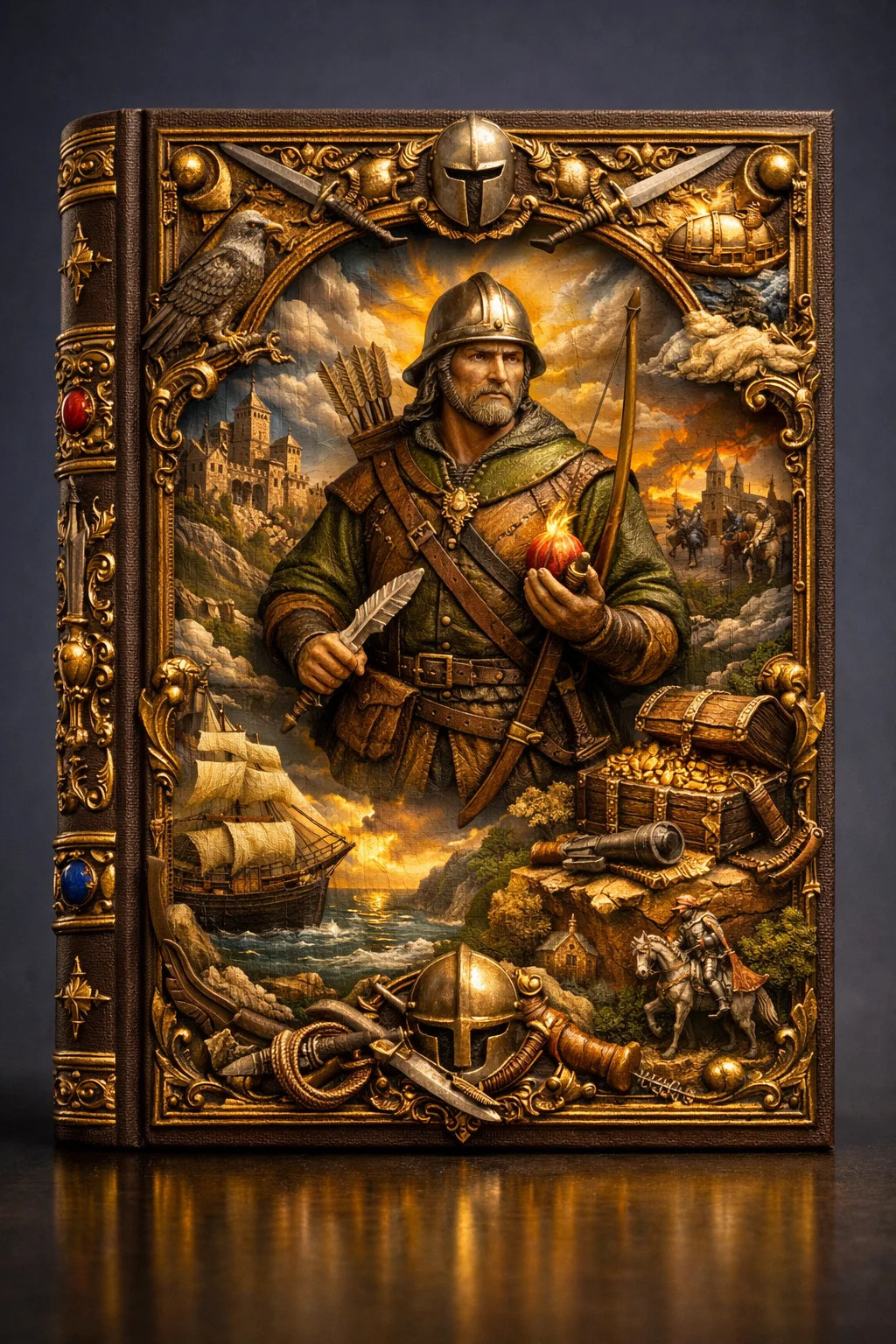
⚔️
The Yeoman Adventurer
A swashbuckling historical adventure set during the Jacobite rebellion of 1745 — when a young Staffordshire yeoman hooks a thirty-pound pike and finds himself swept into a world of danger, romance, and high-stakes intrigue.
| Author | George W. Gough |
| Published | Early 20th century |
| Genre | Historical adventure, romance |
| Chapters | 27 |
| Setting | Staffordshire, England, 1745 — the Jacobite rebellion |
| Style | In the tradition of Robert Louis Stevenson and Sir Walter Scott |
⚔️ The Story
Oliver Wheatman lives a quiet life as a yeoman farmer’s son in Staffordshire, until a chance encounter changes everything. Fishing on a riverbank, he hooks an enormous thirty-pound pike — but when he tries to land it, he finds himself entangled with a far more dangerous prize: Margaret Waynflete, a young woman fleeing from a troop of dragoons.
Oliver rescues Margaret, but her father — a seasoned mercenary — has been arrested as a Jacobite spy. To save her family, Oliver must navigate a world of secret loyalties, daring escapes, and the brutal politics of the 1745 rebellion. His journey takes him from the English countryside to the presence of Bonnie Prince Charlie himself, testing his courage, his honor, and his heart.
What follows is a masterful blend of historical detail and ripping adventure — sword fights, narrow escapes, hidden identities, and a romance that unfolds against the backdrop of a rebellion that nearly toppled the British throne.
📖 Literary Significance
George W. Gough wrote in the great tradition of Stevenson (Kidnapped, Treasure Island) and Scott (Waverley, Rob Roy) — historical adventures that use real events as the canvas for personal stories of courage and transformation. The Yeoman Adventurer is a prime example of this beloved genre.
The Jacobite rising of 1745 provides rich material: Bonnie Prince Charlie’s dramatic march from the Highlands to within 120 miles of London, the Battle of Culloden, and the brutal aftermath that saw the clan system destroyed forever. Gough weaves these real events into Oliver’s personal journey, creating a novel that is both thrilling and historically grounded.
✨ What Makes the DodaBooks Edition Special
This edition brings Gough’s classic adventure back to life in a clean, distraction-free format.
Zero Distractions
No ads, no license pages — just the complete text, clean and uninterrupted.
Smart Typography
Curly quotes, em-dashes, proper ellipsis — typeset with care for a premium reading experience.
Chapter Navigation
Full table of contents with navigation to each of the 27 chapters — easily jump between them.
Cleaned & Polished
All Gutenberg boilerplate stripped, consistent formatting throughout the text.
No DRM
You own your copy — read on any device, anytime, forever.
Instant Download
EPUB format included, delivered instantly after purchase.
🏛️ Historical Context: The Jacobite Rising of 1745
To appreciate what Oliver Wheatman is swept into, it helps to know what “Jacobite” means — and why it mattered enormously in 1745. The Jacobites were supporters of the Stuart dynasty, which had been removed from the British throne in 1688. For decades they plotted to restore a Stuart king, and in the summer of 1745 Charles Edward Stuart — the young and charismatic figure history remembers as Bonnie Prince Charlie — landed in Scotland and raised an army to claim the crown his grandfather had lost.
Charles’s campaign was a genuine national crisis. He marched his Highland army south through England, reaching Derby, little more than a hundred miles from London, before the government’s forces and a lack of support forced a retreat back to Scotland. The rebellion was finally crushed at the Battle of Culloden in April 1746 — the last pitched battle fought on British soil — and the aftermath was brutal, with the clan system dismantled and the Highlands ruthlessly suppressed. Gough sets Oliver’s personal adventure against exactly this backdrop, so the danger he faces is real, not invented: an ordinary English yeoman caught between two loyalties in a conflict that could have cost him everything.
🔥 Themes and What to Watch For
The novel is built on a classic adventure formula, but Gough adds a distinctly moral weight to it. Honour is the central concern — Oliver is repeatedly offered easy paths out of danger, and again and again chooses the harder, more honourable road. Loyalty operates on two levels: loyalty to a cause (the Jacobite rebellion) and loyalty to a person (the woman he rescues, and the family placed in danger because of him). And beneath the sword fights lies a quieter theme of identity — Oliver begins as a modest farmer’s son and must discover who he is when his world turns upside down, a pattern readers will recognise from the great adventure novels of the same tradition.
Because the story moves quickly and packs in many named characters on both sides of the conflict, it is worth paying attention to which side each new figure is on — motives are not always stated outright, and Gough enjoys keeping the reader guessing. The short, chapter-driven structure means the story is best read with momentum; resist the urge to slow down, and let the swift scenes carry you the way they were designed to.
📖 Why It Still Matters
The Yeoman Adventurer survives because it belongs to a beloved genre that has never lost its appeal: the historical adventure in which an ordinary person is thrown into extraordinary events. Gough draws directly on the tradition of Robert Louis Stevenson and Sir Walter Scott, and if you enjoy those authors you will recognise their fingerprints everywhere — the plucky young hero, the high-stakes chase, the romance that complicates everything. If you have already enjoyed Stevenson’s Scottish adventure Kidnapped, our guide to Catriona — its sequel, set in the same unsettled 18th-century Scotland — makes an excellent companion read.
Gough’s storytelling is also admirably grounded: the rebellion of 1745 really happened as he describes it, and he uses its real events and geography to give his fictional characters a vivid stage. That combination of genuine history and ripping adventure is precisely why readers keep coming back to the genre, and for fans of the wider historical adventure canon, Under the Red Dragon, James Grant’s Crimean War novel, offers a similarly thrilling blend of real conflict and personal romance.
❓ Frequently Asked Questions
Is this a romance or an adventure novel?
Both. The romance between Oliver and Margaret is central to the plot, but the novel is primarily a historical adventure. Gough balances sword fights and escapes with genuine emotional stakes, much like Stevenson in Kidnapped or Scott in Waverley.
What was the Jacobite rebellion of 1745?
The last major attempt by the Stuart dynasty to reclaim the British throne. Charles Edward Stuart — “Bonnie Prince Charlie” — landed in Scotland, raised an army, and marched into England before being forced to retreat. The rebellion ended at the Battle of Culloden in 1746, the last battle fought on British soil.
Who is George W. Gough?
A British author of historical adventure novels active in the early 20th century. The Yeoman Adventurer is his best-known work, praised for its vivid historical detail and its Stevenson-esque storytelling.
How long does it take to read?
At 417 pages across 27 chapters, most readers finish in 9-13 hours. The short, action-packed chapters make it easy to read in bursts — “just one more chapter” is a common experience.
Is this novel about real historical events?
Yes. The Jacobite rebellion of 1745, Bonnie Prince Charlie’s march into England, and the Battle of Culloden are all historically real. Gough weaves his fictional characters and a romance into this genuine historical crisis.
Is this suitable for readers new to historical adventure?
Absolutely. Gough’s style is swift and accessible, closer to a modern thriller than to dense historical fiction. The short chapters and clear plotting make it an easy entry point to the genre — much like Stevenson’s Kidnapped.
What should I read if I enjoy The Yeoman Adventurer?
Fans of this style tend to love Robert Louis Stevenson’s Kidnapped and its sequel Catriona, Dumas’s The Count of Monte Cristo, and James Grant’s Under the Red Dragon — all historical adventures with the same blend of action and romance.
📚 Related Articles
⚔️ Read the Swashbuckling Adventure
The Yeoman Adventurer is a classic historical adventure in the tradition of Stevenson and Scott — sword fights, romance, and a young hero tested by fire. The DodaBooks edition presents Gough’s novel in a clean, distraction-free format:
- ✅ Complete 27-chapter text — every word of the classic novel
- ✒️ Smart typography — curly quotes, em-dashes, proper ellipsis
- 📜 Full table of contents with chapter navigation
- 🔒 DRM-free — read on any device, anytime
- 📥 Instant download — EPUB format