The Yellow Crayon: Oppenheim’s Conspiracy of Aristocrats
Before modern conspiracy thrillers dominated popular culture, E. Phillips Oppenheim published *The Yellow Crayon* (1903)—a dazzling, high-society mystery uncovering a clandestine global league of nobles using lethal marks in yellow crayon to manipulate kings, empires, and lovers.
At the turn of the twentieth century, as European monarchies engaged in feverish diplomatic maneuvering and subterranean spycraft, E. Phillips Oppenheim (1866–1946) captured the imaginations of readers on both sides of the Atlantic with his sophisticated tales of international intrigue. Published in 1903, The Yellow Crayon represents one of the crowning achievements of his beloved “Mr. Sabin” series—a narrative that blends high-society romance, royal dynastic plots, and the sinister mechanics of an all-powerful secret society.
The novel marks the return of Mr. Sabin (the pseudonym of the Duke de Souspennier), an enigmatic, brilliant French aristocrat who has retired from world-shaking conspiracies to live quietly on his English country estate with his beautiful, devoted wife, Lucille (Princess of Bourbon). However, their tranquil Eden is shattered when Lucille receives a fateful summons—a single line drawn in yellow crayon across a private letter. Readers exploring our distinguished collection of classic mystery and spy fiction will discover in The Yellow Crayon a masterclass in Edwardian elegance, suspense, and conspiratorial dread.
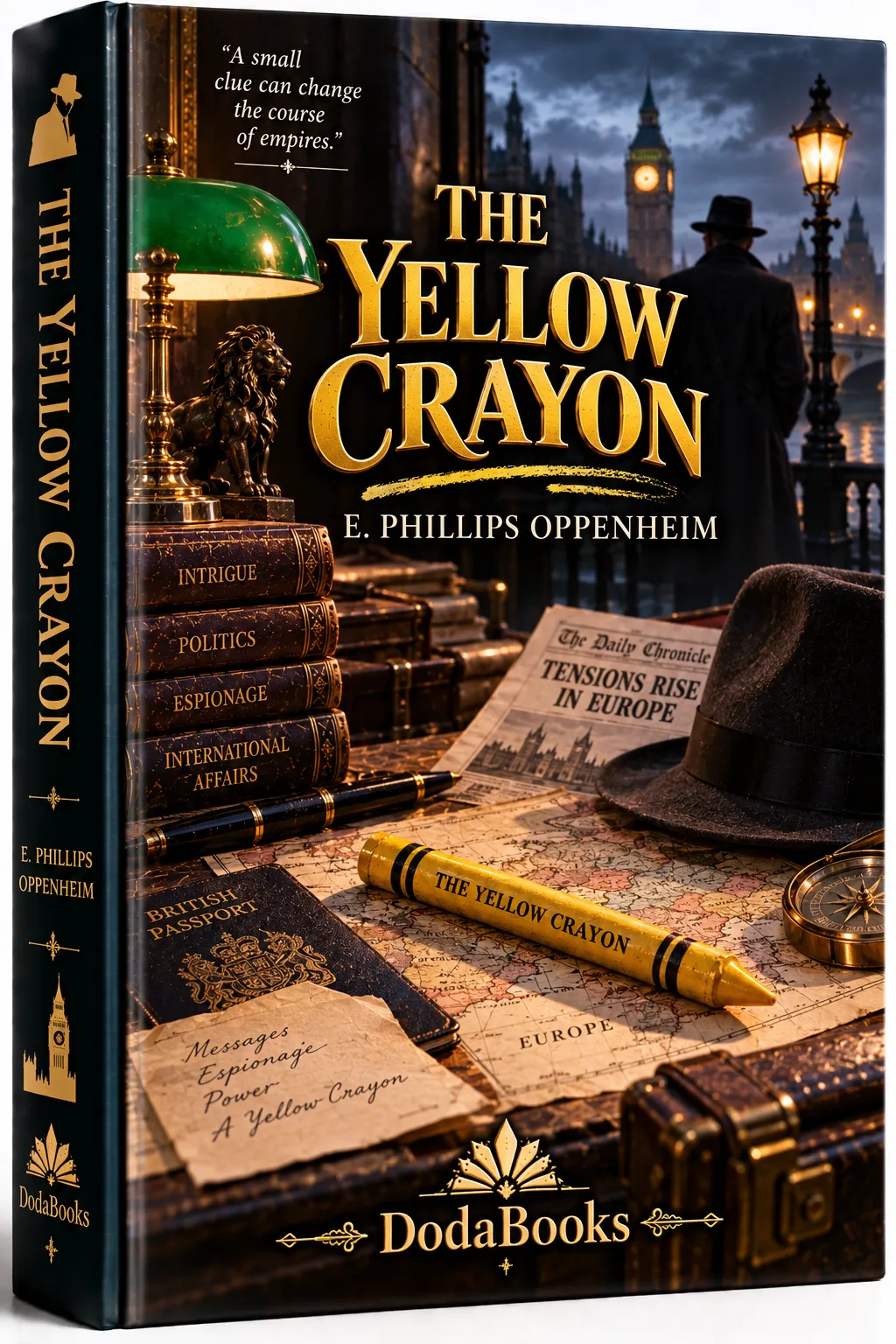
Read the Definitive Annotated Edition
Experience E. Phillips Oppenheim's Edwardian espionage classic with comprehensive historical commentary on European secret societies, diplomatic salons, and royal politics.
Get the Annotated eBookPlot Architecture: The Summons of the Secret Order
The narrative begins on the peaceful country estate of Mr. Sabin, who has abandoned his former life of international espionage to cultivate orchids and enjoy the devoted companionship of his wife, Lucille.
Their domestic happiness is brutally disrupted by the arrival of a mysterious social caller and an innocent-looking card marked with a bold stroke of yellow crayon. To the uninitiated, it appears as a trivial scribble; to Lucille, it is an irrevocable death warrant and an inescapable command of absolute obedience.
                    THE LABYRINTH OF THE YELLOW CRAYON

       THE RETIRED GENTLEMAN                       THE SHADOW BROTHERHOOD
    ┌───────────────────────────┐               ┌───────────────────────────┐
    │ Mr. Sabin (Souspennier)   │               │ Order of the Yellow Crayon│
    │ Brilliant, aging diplomat │ ◄───────────► │ Aristocratic vigilantes   │
    │ Dedicated to protecting   │               │ Absolute global dominion  │
    │ his wife Lucille          │               │ Inescapable yellow mark   │
    └─────────────┬─────────────┘               └─────────────┬─────────────┘
                  │                                           │
                  ▼                                           ▼
       CHESS MATCH IN MAYFAIR & VIENNA ──► Unmasking the Secret Grand Council
       A Husband's War Against an Empire   The Ultimate Triumph of Personal Love
Lucille vanishes from their home overnight, leaving behind a grief-stricken note declaring that she must fulfill an oath made before their marriage. Refusing to surrender the woman he loves, Mr. Sabin dons his former mantle as the most cunning political chess player in Europe. He journeys to London, infiltrating the exclusive clubs of Pall Mall, diplomatic embassies, and aristocratic salons to unmask the shadowy syndicate known as the Order of the Yellow Crayon.
The Order of the Yellow Crayon: Aristocratic Vigilantism
Oppenheim devised in the Order of the Yellow Crayon one of the most chilling and fascinating secret societies in early mystery fiction. Founded in the mid-nineteenth century by high-ranking European aristocrats, the Order was conceived not as an anarchist bomb cabal, but as its exact opposite: a reactionary, transnational league dedicated to protecting the nobility from socialism, radical democracy, and vulgar commercial exploitation.
Members were bound by terrifying oaths of secrecy and mutual assistance:
- The Signal: A message marked with a yellow crayon was an imperative command that superseded all laws, family ties, and national loyalties. Refusal to obey meant immediate assassination.
- The Corruption of the Ideal: Over decades, the noble founding principles of the Order were corrupted by ambitious, unprincipled leaders who used its lethal network for personal blackmail, private vendettas, and geopolitical manipulation.
- The Target: Mr. Sabin discovers that Lucille was bound to the Order in her youth, and that the current corrupt Grand Council is using her royal heritage as a pawn to destabilize European alliances.
Just as Emma Goldman analyzed the institutional violence of the modern state and Bourrienne witnessed the autocracy of Napoleon, Oppenheim exposed how unelected, aristocratic cabals wield hidden power behind the gilded curtains of European diplomacy.
Key Characters: Adventurers, Princesses, and Conspirators
E. Phillips Oppenheim populated The Yellow Crayon with an unforgettable cast of Edwardian figures:
- Mr. Sabin (Duke de Souspennier): The supreme gentleman-conspirator. Aging, physically lame, and dependent on a cane, Sabatini’s hero relies entirely on psychological supremacy, razor-sharp wit, and an encyclopedic knowledge of human weakness. He fights not for an empire or a king, but for his private hearth.
- Lucille (Princess of Bourbon): The devoted, regal heroine. Bound by ancient oaths of honor, Lucille’s anguish between her sacred promise to the Order and her love for her husband provides the emotional core of the novel.
- Prince Boris of Saxe-Leopold: The charismatic, dangerous head of the Yellow Crayon. Brilliant and ruthless, Boris represents the decadent aristocracy willing to destroy nations to satisfy personal ambition.
- Lady Carey: A sophisticated, fashionable London society hostess whose drawing rooms serve as the covert clearinghouse for diplomatic secrets and yellow crayon marks.
- Denzil: Mr. Sabin’s loyal, resourceful valet and bodyguard, who executes daring reconnaissance missions through London’s fog-shrouded streets.
Major Themes in Oppenheim’s Conspiracy Thriller
1. The Vulnerability of the Individual to Secret Power
The central anxiety running through The Yellow Crayon is the terrifying helplessness of the individual when targeted by an invisible, omnipotent organization. The Order operates within banks, embassies, hotel staffs, and Scotland Yard; a traveler can be poisoned on a train or kidnapped from a private carriage without a single witness. Oppenheim captures the psychological claustrophobia of modern paranoia decades before Kafka or Eric Ambler.
2. High Society as a Masquerade of Deception
In Oppenheim’s universe, civilization is a fragile veneer masking ruthless predatory struggle. The glittering ballrooms of Mayfair, the opera boxes of Covent Garden, and diplomatic banquets in Vienna are not polite gatherings, but camouflaged battlegrounds where casual remarks carry lethal implications. This forensic dissection of aristocratic social hypocrisy shares an intellectual kinship with the court memoirs of Saint-Simon at Versailles.
                      THE DUAL IDENTITY OF EDWARDIAN SOCIETY

          The Gilded Façade                     The Underworld Reality
     ┌───────────────────────────────┐   ┌───────────────────────────────┐
     │ Mayfair ballrooms & tea       │   │ Shadowy assassination orders  │
     │ Aristocratic titles & manners │   │ Blackmail of royal houses     │
     │ Polite diplomatic neutrality  │   │ Secret societies wielding arms│
     └───────────────────────────────┘   └───────────────────────────────┘
                     ▲                                   ▲
                     └─────────────────┬─────────────────┘
                                       ▼
                       The Triumph of Individual Will:
                       Mr. Sabin Outmaneuvers the Order
3. The Supremacy of Personal Love Over Dynastic Loyalty
While the Order demands that Lucille sacrifice her personal happiness for royal politics, Mr. Sabin represents the triumph of individual romantic devotion. He proves that the genuine love between two sovereign souls is more resilient than all the secret oaths, inherited titles, and conspiratorial leagues in Europe.
Comparative Literary Context
To contextualize The Yellow Crayon within classic suspense, detective fiction, and adventure literature, consider these parallels:
| Work & Author | Setting | Genre | Central Conflict |
|---|---|---|---|
| The Yellow Crayon (E. Phillips Oppenheim) | London & Europe (1903) | Secret Society Thriller | Mr. Sabin vs. aristocratic global conspiracy |
| The Zeppelin’s Passenger (E. Phillips Oppenheim) | WWI Norfolk Coast (1918) | WWI Espionage Novel | British Naval intelligence vs. German spy |
| The Red Seal (Natalie Sumner Lincoln) | Washington D.C. (1920) | Locked-Room Detective | Forensic poison mystery, stolen diplomatic wills |
| Memoirs of Napoleon Bonaparte (Bourrienne) | Napoleonic Europe (1779–1815) | Historical Memoir | Imperial ambition, secret cabinets, European conquest |
Where Oppenheim’s later wartime thriller The Zeppelin’s Passenger focused on the direct military tension of the First World War, The Yellow Crayon explored the glamorous, decadent Edwardian prelude where secret treaties and private leagues held sway. And alongside American locked-room mysteries like Natalie Sumner Lincoln’s The Red Seal, Oppenheim pioneered the use of symbolic color marks and intercepted documents as the core drivers of suspense.
Unmask the Order of the Yellow Crayon
Read E. Phillips Oppenheim's legendary Edwardian mystery in this definitive annotated edition, featuring explanatory notes on European secret societies and turn-of-the-century diplomacy.
Read The Annotated EditionWhy The Yellow Crayon Endures
E. Phillips Oppenheim was a master of high-society escapism, but The Yellow Crayon transcends ordinary pulp adventure through its impeccable dialogue, sophisticated characterizations, and brilliant pacing. Mr. Sabin remains one of the most compelling and memorable figures in early twentieth-century fiction—an aristocratic hero who wins through intellect, patience, and unwavering moral devotion.
For readers who cherish classic Edwardian suspense, royal intrigue, and the timeless thrill of a lone hero outwitting an all-powerful global conspiracy, The Yellow Crayon is an unforgettable, exhilarating reading experience.
Frequently Asked Questions
Who was Mr. Sabin and what is his backstory?
Mr. Sabin is the alias of the Duke de Souspennier, a high-born French aristocrat and master political schemer. First introduced in Oppenheim's 1898 breakthrough novel 'Mysterious Mr. Sabin,' he initially sought to restore the French Bourbon monarchy through secret international diplomacy before retiring from politics to marry his great love, Princess Lucille of Bourbon.
What was the Order of the Yellow Crayon?
The Order of the Yellow Crayon is a fictional secret society founded by European aristocrats in the 19th century to protect the nobility and royal houses from revolutionary movements and political blackmail. Over time, the society became corrupted by ruthless leaders who used its lethal network and compulsory obedience to control diplomatic secrets and eliminate rivals.
Can The Yellow Crayon be read as a standalone novel?
Yes, absolutely. While 'The Yellow Crayon' features the return of characters from 'Mysterious Mr. Sabin,' Oppenheim crafted the novel as a completely self-contained mystery. All necessary background details regarding Mr. Sabin's past and his marriage to Lucille are elegantly woven into the early chapters of the narrative.
How did Oppenheim influence modern espionage and conspiracy fiction?
Oppenheim was the first author to establish the tropes of the glamorous international thriller: high-stakes diplomatic salons, secret treaties, codes hidden in everyday objects, and shadowy aristocratic cartels. His formula directly laid the groundwork for authors like John Buchan, Eric Ambler, and Ian Fleming.
What features are included in the DodaBooks annotated edition?
The DodaBooks annotated edition provides comprehensive historical notes on the Edwardian diplomatic landscape, glossaries of French and European aristocratic titles, maps of London's Mayfair and Pall Mall clubland, and an introductory essay examining Oppenheim's role as the 'Prince of Storytellers.' You can explore and download the definitive annotated edition directly from DodaBooks at https://dodabooks.com/ebook/the-yellow-crayon-by-e-phillips-oppenheim/.
Related Classic Mystery and Espionage Studies
Discover further masterworks of espionage, political mysteries, and classic literature: