The Woman in White Summary by Epoch & Chapter: Complete Plot Breakdown
When Wilkie Collins began serializing The Woman in White in Charles Dickens’s literary periodical All the Year Round in November 1859, it triggered an unprecedented cultural frenzy across Great Britain. Readers lined up in massive crowds outside print shops, haberdashers sold “Woman in White” perfume, bonnets, cloaks, and waltzes, and prime minister William Gladstone reportedly canceled a theater engagement to finish the novel.
Collins had pioneered the Victorian Sensation Novel: a genre that took the eerie terrors, locked rooms, and sinister villains of traditional Gothic romance out of ruined medieval German castles and planted them squarely into the respectable drawing-rooms, country manors, and legal offices of contemporary England.
What made The Woman in White truly groundbreaking was its formal narrative architecture. Instead of relying on a conventional omniscient narrator, Collins structured the novel as a legal dossier of courtroom testimonies. Each section is narrated in the first person by a different character—an idealistic drawing master, an elderly lawyer, an intelligent half-sister, a narcissistic invalid uncle, a fanatical housekeeper, and a villainous Italian mastermind—each presenting only what they personally witnessed under legal oath.
Whether you are studying Collins for an academic course or unraveling this masterwork for pleasure, this comprehensive summary traces the three Epochs, all multi-narrator testimonies, and the central conspiracy of substituted identities.
⚡ The Woman in White: Masterwork Overview
- Author: Wilkie Collins (1824–1889)
- Publication Date: Serialized November 1859 – August 1860; published in three volumes in 1860
- Structure: Three Epochs divided into legal narratives written by different firsthand witnesses (Walter Hartright, Vincent Gilmore, Marian Halcombe, Frederick Fairlie, Eliza Michelson, Hester Pinhorn, Count Fosco)
- Setting: Hampstead Heath (London), Limmeridge House (Cumberland), Blackwater Park (Hampshire), and a private asylum in North London (1849–1851)
- Central Conflict: Sir Percival Glyde and Count Fosco's conspiracy to steal Laura Fairlie's £20,000 fortune by faking her death, switching her identity with her terminally ill half-sister Anne Catherick, and committing Laura to an insane asylum
- Climax: Walter Hartright uncovers Sir Percival's illegitimate birth; Glyde dies in a church vestry fire; Walter forces Count Fosco into a written confession before Fosco is assassinated by an Italian secret society
📜 The Three-Epoch Structural Timeline
+---------------------------------------------------------------------------------------------------+
|                           THE WOMAN IN WHITE: THREE-EPOCH NARRATIVE MAP                           |
+-------+-------------------------+---------------------------------+-------------------------------+
| EPOCH | PRIMARY NARRATORS       | KEY SETTINGS                    | CENTRAL DRAMATIC HIGHLIGHTS   |
+-------+-------------------------+---------------------------------+-------------------------------+
| First | Walter Hartright,       | Hampstead Heath;                | Walter meets Anne in white;   |
| Epoch | Vincent Gilmore,        | Limmeridge House (Cumberland)   | Walter falls for Laura;       |
|       | Marian Halcombe         |                                 | Marriage settlement dispute;  |
|       |                         |                                 | Laura marries Sir Percival    |
+-------+-------------------------+---------------------------------+-------------------------------+
| Second| Marian Halcombe (diary),| Blackwater Park (Hampshire);    | Fosco's mind games; Marian's  |
| Epoch | Eliza Michelson,        | Welmingham; London              | roof eavesdropping; Marian's  |
|       | Hester Pinhorn          |                                 | fever; Laura drugged & locked |
|       |                         |                                 | in asylum; Anne buried        |
+-------+-------------------------+---------------------------------+-------------------------------+
| Third | Walter Hartright,       | London slums; Welmingham Church;| Walter rescues Laura; hunts   |
| Epoch | Mrs. Catherick,         | Paris (Morgue)                  | the Secret; Glyde's death     |
|       | Count Fosco (confession)|                                 | in fire; Fosco's confession;  |
|       |                         |                                 | Limmeridge identity restored  |
+-------+-------------------------+---------------------------------+-------------------------------+
🏛️ The First Epoch: The Mystery at Limmeridge House
Walter Hartright’s Narrative (Part I)
The novel begins in the late summer of 1849. Walter Hartright, an earnest young London drawing master, is spending his final evening in the city before departing for Cumberland. Through the recommendation of his close Italian friend, Professor Pesca, Walter has secured a lucrative four-month engagement at Limmeridge House to teach watercolor painting to two young ladies.
Walking back from Hampstead Heath to London at midnight under the moonlight, Walter experiences one of the most famous encounters in English literature. A gentle hand touches his shoulder from behind, and he turns to find a solitary young woman dressed entirely in white garments. She is trembling, agitated, and desperately asks directions to London. Walter assists her, noticing that she speaks mysteriously of Limmeridge, expresses profound gratitude toward the late Mr. Philip Fairlie, and warns with deep dread of a cruel “baronet.”
After helping her hail a carriage, Walter witnesses an open cab pull up beside a policeman. A man leans out, shouting that a female patient has escaped from a private lunatic asylum, dressed in white. Walter realizes with a shock of horror that he has unknowingly assisted an escaped asylum inmate.
Limmeridge House and the Double
Walter arrives at Limmeridge House in Cumberland, where he meets his two pupils:
- Marian Halcombe: Laura Fairlie’s maternal half-sister. Marian is dark-complexioned, physically unconventional, but possesses extraordinary intellectual brilliance, courage, and sharp humor. She and Walter immediately strike up an intimate, trusting intellectual friendship.
- Laura Fairlie: The wealthy heiress of Limmeridge. When Walter first sees Laura stepping into the morning sunlight, he is stunned by an eerie sense of familiarity. Looking through old family correspondence with Marian, they discover the truth: the escaped “woman in white,” named Anne Catherick, visited Limmeridge as a child and was treated kindly by Laura’s late mother, Mrs. Fairlie, who gave Anne her first white dress. Anne bears an almost supernatural physical resemblance to Laura.
Walter and Laura spend their days painting landscapes and inevitably fall deeply in love. However, Marian gently crushes Walter’s hopes, revealing that Laura is bound by a sacred deathbed promise to her father to marry Sir Percival Glyde, a wealthy Hampshire baronet.
An anonymous letter arrives warning Laura against marrying Sir Percival, describing him as a villain with a dark secret. Walter investigates and traces the letter to Anne Catherick, who is hiding in the local cemetery tending Mrs. Fairlie’s grave. Before Walter can uncover Anne’s secret, she flees. Realizing that his love for Laura is hopeless and that his presence is creating emotional turmoil, Walter resigns his post and departs for a dangerous architectural expedition to Central America.
Vincent Gilmore’s Narrative
The narrative transfers to Vincent Gilmore, the elderly, punctilious London solicitor representing the Fairlie family. Gilmore arrives at Limmeridge to draft the formal marriage settlements between Laura and Sir Percival Glyde.
Gilmore immediately discovers red flags regarding Sir Percival’s financial character:
- Laura is set to inherit £20,000 in personal property, plus an annual income of £3,000 from the Limmeridge estate.
- Sir Percival insists that if Laura dies without children, her entire £20,000 fortune should pass directly and unconditionally to him.
- Gilmore adamantly opposes this predatory clause, advising Laura’s hypochondriacal, cowardly uncle, Frederick Fairlie, to withhold consent. However, Frederick Fairlie, caring only about his porcelain collection and avoiding nervous headaches, dismisses Gilmore’s warnings and signs the agreement.
Laura frankly confesses to Sir Percival that her heart belongs to another man, offering him the opportunity to withdraw with honor. Coldly calculating, Sir Percival feigns generous forgiveness and insists the wedding proceed. On December 22, 1849, Laura and Sir Percival are married, departing immediately for a six-month honeymoon in Italy.
🏰 The Second Epoch: The Conspiracy at Blackwater Park
Marian Halcombe’s Narrative (The Blackwater Park Diary)
The Second Epoch shifts to the private journal entries of Marian Halcombe, chronicling life at Sir Percival’s ancestral estate, Blackwater Park in Hampshire, during the summer of 1850.
Laura returns from her continental honeymoon deeply altered: pale, frightened, and emotionally hollowed out. Sir Percival’s charming facade has vanished, replaced by explosive verbal abuse and violent impatience. Accompanying them are Sir Percival’s close friend and creditor, Count Fosco, and his wife, Madame Fosco (Laura’s estranged Aunt Eleanor Fairlie).
The Genius and Terror of Count Fosco
Count Fosco dominates the household:
- A corpulent, elderly Italian nobleman with silky white hair, immaculate dress, and soft, cat-like steps, Fosco maintains an extraordinary menagerie of pet white mice that crawl over his hands, and singing canaries that sit on his shoulders.
- Despite his eccentricities, Fosco possesses a terrifying intellect. He controls his subservient wife through hypnotic psychological authority, reads everyone’s deepest vulnerabilities, and effortlessly manipulates household dynamics. Marian despises his cruelty but is reluctantly fascinated by his genius.
Financial Desperation and Extortion
Sir Percival is in desperate financial ruin, drowning in debt to money-lenders. He attempts to force Laura to sign a blank legal document transferring her £20,000 inheritance to him. Demonstrating unexpected moral spine, Laura refuses to sign any document she is not allowed to read. Enraged, Sir Percival locks her in her bedchamber.
Meanwhile, Anne Catherick is spotted lurking around Blackwater Park. Laura secretly meets Anne by the lake. Anne promises to reveal Sir Percival’s devastating secret the following day, but before she can speak, Sir Percival intercepts them, and Anne vanishes.
Marian’s Heroic Surveillance on the Roof
Realizing a sinister conspiracy is brewing, Marian Halcombe executes a daring espionage mission. In the dead of night during a ferocious rainstorm, Marian dresses in black, climbs out her bedroom window, creeps along the wet slate roof of the veranda, and crouches directly outside the library window to eavesdrop on Sir Percival and Count Fosco.
Marian overhears the plot:
- Sir Percival must produce money by August 2nd or face financial and social ruin.
- Fosco advises him against crude physical violence, promising to orchestrate a brilliant, bloodless solution. Fosco notes that Anne Catherick is dying of advanced heart disease. If Anne dies in Laura’s place, Laura’s fortune can be legally claimed.
- Before Marian can act on this horrifying revelation, the torrential rain soaks her to the bone. She collapses on the roof, contracting a life-threatening typhus fever that renders her delirious for weeks.
The Swapped Identities (Eliza Michelson and Hester Pinhorn)
With Marian incapacitated in the sickroom, Count Fosco takes absolute control:
- Separation: Laura is falsely informed that Marian has recovered and traveled ahead to Limmeridge. Deceived, Laura boards a carriage for London on July 25, 1850.
- The Asylum Trap: In London, Fosco greets Laura, takes her to a townhouse, drugs her tea with a narcotic, and transports her directly to the private asylum in North London, claiming she is the escaped patient Anne Catherick.
- The Death and Burial: Meanwhile, Anne Catherick has been captured and brought to London by Fosco. Anne suffers a fatal heart attack on July 25. Her body is declared to be that of “Lady Glyde.”
- The Funeral: Anne’s corpse is transported to Cumberland and buried in the Limmeridge churchyard beneath a marble tombstone inscribed with Laura Fairlie’s name. Laura is legally declared dead, and Sir Percival claims her £20,000 inheritance.
⚔️ The Third Epoch: The Hunt for the Secret and Redemption
Walter Hartright’s Return
The Third Epoch opens in October 1850. Walter Hartright returns from Central America, surviving shipwrecks and fever, hardened into an implacable man of action. Visiting Laura’s grave in Limmeridge, he encounters a woman dressed in black weeping over the tombstone.
It is Marian Halcombe, accompanied by a veiled woman: Laura Fairlie.
Marian recounts her rescue:
- After recovering from fever, Marian learned of Laura’s supposed death. Refusing to believe it, Marian bribed the asylum nurse, visited the institution, and discovered Laura alive, broken in spirit and memory.
- Marian engineered Laura’s escape, brought her to London, and lived in hiding in cheap lodgings under assumed names.
- However, when they attempted to present Laura to Frederick Fairlie and her friends, they were dismissed as impostors; everyone believed Laura was dead and buried.
Walter resolves to dedicate his life to restoring Laura’s legal identity, fortune, and honor. To support Marian and Laura, Walter takes commercial drawing jobs, living together as a devoted family unit while he conducts his forensic investigation.
Hunting Sir Percival’s “Secret”
Walter deduces that to defeat Sir Percival, he must uncover the secret that Sir Percival was so desperate to hide from Anne Catherick:
- Walter visits Anne’s mother, Mrs. Catherick, in Welmingham. Mrs. Catherick is a bitter, haughty woman who refuses to confess, but Walter notices she frequently looks toward the parish church.
- Walter inspects the parish church register for September 1803. In the official register, a marriage entry exists between Sir Percival’s father and mother.
- Suspecting forgery, Walter travels to London to inspect the duplicate register preserved in the Bishop’s registry. The marriage entry is absent.
- The Secret Exposed: Sir Percival Glyde was born out of wedlock! His parents never married. Under English property law, an illegitimate child could not inherit the baronetcy, the title, or the Blackwater estate. Sir Percival had forged the marriage entry in the parish register years earlier; his entire social position, fortune, and title were a massive, criminal fraud.
The Death of Sir Percival Glyde
Sir Percival discovers that Walter is hunting his secret at the Welmingham church. In a state of frenzy, Sir Percival locks himself inside the church vestry at night, attempting to burn the forged page out of the register with a lantern.
The flames catch the old dry timber and curtains. The door lock jams, trapping Sir Percival inside. Walter and the villagers rush to the burning church, but the roof collapses. Walter pulls Sir Percival’s charred, lifeless corpse from the inferno.
The Taming of Count Fosco
Sir Percival is dead, but Laura’s legal identity remains buried in the Limmeridge cemetery. Only Count Fosco possesses the written dates and records that can prove Laura arrived in London after the death of Anne Catherick.
Walter discovers Fosco’s fatal vulnerability:
- Walter’s Italian friend, Professor Pesca, is an elite operative of the Brotherhood—a deadly Italian political secret society that executes traitors.
- When Pesca catches sight of Count Fosco at the opera, Fosco pales in terror; Fosco is a traitor to the Brotherhood marked for assassination.
- Walter confronts Fosco in his London study. Backed by the threat of exposing him to Pesca and the Brotherhood, Walter demands:
- A full, detailed written confession signed by Fosco, detailing the entire conspiracy.
- The return of Laura’s family heirlooms and money.
- Fosco’s immediate departure from England.
Fosco complies, writing out a brilliant, self-glorifying, three-part written confession in his magnificent handwriting, marveling at his own genius.
The Restoration at Limmeridge
Armed with Fosco’s signed confession and corroborated dates from asylum doctors and train tickets, Walter gathers the tenantry, friends, and family in the grand hall of Limmeridge House. In the presence of Frederick Fairlie, the lawyer Gilmore, and the villagers, Walter reads the confession aloud.
The parish priest travels to the cemetery and chisels Laura’s name off the tombstone, replacing it with the true name: Anne Catherick. Laura is legally, socially, and emotionally resurrected.
Walter and Laura are married. Months later, during a visit to Paris, Walter visits the Morgue and sees a crowd gathered around a corpse pulled from the Seine, stabbed through the heart with the mark of the Brotherhood: it is Count Fosco, executed by his former society.
The novel concludes in 1851 at Limmeridge House. Frederick Fairlie dies of heart disease, and Laura’s infant son with Walter Hartright inherits the estate as the rightful, beloved master of Limmeridge.
❓ Frequently Asked Questions
Why is the novel called The Woman in White?
The title refers to Anne Catherick, who dresses entirely in white out of a childhood obsession with Mrs. Fairlie, who first gave her a white dress. Anne’s mysterious presence on the moonlit road in Chapter 1 sets the entire plot into motion, and her physical resemblance to Laura Fairlie makes the identity substitution possible.
What was Sir Percival Glyde's secret?
Sir Percival’s secret was that he was illegitimate. His parents were never legally married, meaning he had no right to the baronetcy, the title of “Sir,” or the Blackwater Park estate. He forged the marriage entry in the parish register to claim an inheritance that legally belonged to his cousin.
Why did Count Fosco want Laura Fairlie declared dead?
Sir Percival Glyde had borrowed heavily against Laura’s prospective fortune. If Laura died without children, her £20,000 settlement passed directly to Sir Percival, who owed large sums to Count Fosco. By substituting dying Anne Catherick for Laura, they claimed the money immediately without committing murder.
Why is Marian Halcombe considered such a revolutionary Victorian heroine?
Unlike typical Victorian heroines who were idealized as delicate, submissive, and beautiful, Marian is described as having masculine features and physical plainness, but extraordinary intellect, courage, and agency. She climbs onto slate roofs in rainstorms, matches wits with criminal masterminds, and serves as the active protector of her sister.
Where can I find an annotated edition explaining the legal marriage laws in the novel?
To decode all of Collins’s intricate Victorian property laws, marriage settlement clauses (coverture), and legal testimonies, explore the DodaBooks Annotated Edition, which features interactive annotation cards and character trust mapping.
📚 Related Articles
Drawn to Victorian sensation mysteries and detective masterminds? Explore our The Hound of the Baskervilles Guide or our The Phantom of the Opera Guide.
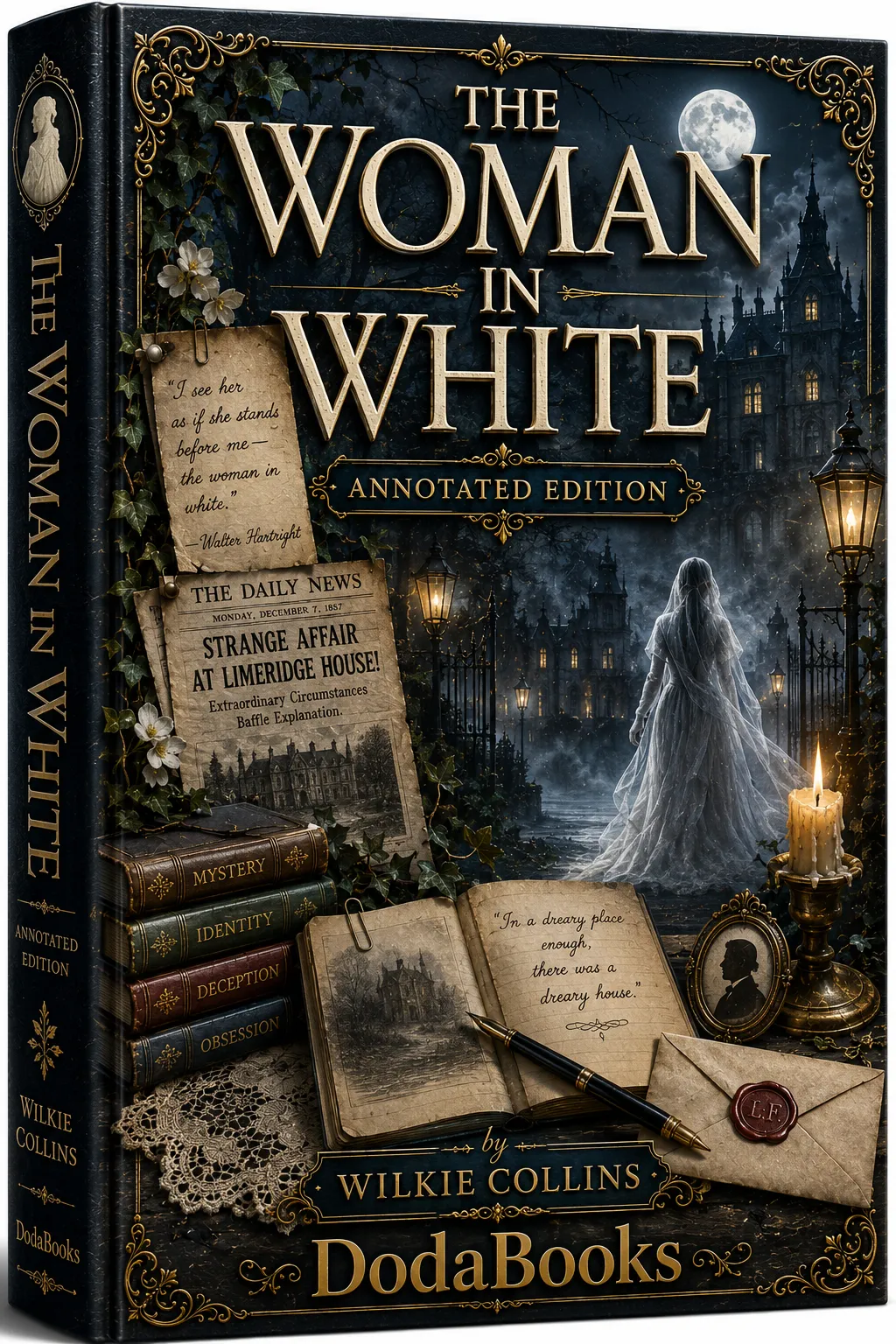
👗 Experience Collins’s Labyrinth With Every Secret Decoded
Read the thriller that founded the sensation novel in an authoritative, distraction-free edition:
- ✅ Complete, unabridged 1859–60 text across all three Epochs and witness testimonies
- ⚖️ Victorian legal context decoded — understand marriage settlements, coverture, and asylums
- 🗂️ Passage-specific annotation cards revealing historical clues and narrative timelines
- 🔒 DRM-free EPUB format — readable on any Kindle, Kobo, iPad, or mobile device
- 📥 Instant digital download delivered directly after checkout