The Woman in White Characters Explained: Marian Halcombe & Count Fosco
When Wilkie Collins unveiled The Woman in White in 1859, he shattered the conventional molds of Victorian characterization. Standard 19th-century domestic fiction operated on rigid moral binaries: heroines were delicate, submissive blonde angels confined to drawing rooms; heroes were chivalric gentlemen of independent means; and villains were snarling, mustachioed melodrama tropes.
Collins discarded these tired clichés. In their place, he crafted Marian Halcombe, an unconventional, physically plain, brilliantly intellectual woman who crawls across rainy slate roofs to spy on criminal conspiracies; Count Fosco, an obese, opera-loving Italian criminal mastermind who tames pet white mice while calculating identity theft; and Walter Hartright, an ordinary drawing master forced by tragedy to transform himself into a relentless private investigator.
This comprehensive guide analyzes the psychological depth, narrative agency, thematic symbolism, and Victorian socio-legal contexts of every major character in Wilkie Collins’s sensation masterpiece.
⚡ The Woman in White Characters: Core Dynamics
- Marian Halcombe: The true intellectual engine of the novel. Defies the Victorian "Angel in the House" ideal through sharp wit, physical courage, and unyielding sisterly devotion.
- Count Fosco: Literature's first modern criminal genius. Combines refined aesthetic taste, Italian charm, and hypnotic psychological dominance with ruthless sociopathy.
- Walter Hartright: Evolves from a passive, lovesick drawing tutor into a hardened, forensic investigator who deconstructs class boundaries to restore truth.
- Laura Fairlie: The passive, victimized heiress whose legal and physical erasure exposes the terrifying vulnerability of married women under Victorian law.
- Sir Percival Glyde: A desperate, violent aristocrat whose aristocratic privilege conceals financial ruin, blackmail, and criminal forgery.
- Anne Catherick (The Woman in White): Laura’s biological half-sister and physical doppelgänger, whose tragic persecution sets the mystery in motion.
🎭 Character Foils & Relational Dynamics
+---------------------------------------------------------------------------------------------------+
|                        THE WOMAN IN WHITE: CHARACTER FOILS & CONTRASTS                            |
+---------------------+---------------------+-------------------------------------------------------+
| CHARACTER PAIR      | PRIMARY CONTRAST    | THEMATIC SIGNIFICANCE                                 |
+---------------------+---------------------+-------------------------------------------------------+
| Marian Halcombe vs. | Intellect & Action  | Collins subverts Victorian aesthetics: plain Marian   |
| Laura Fairlie       | vs. Beauty &        | possesses all agency and courage, while delicate      |
|                     | Submission          | Laura is silenced and erased by property law.         |
+---------------------+---------------------+-------------------------------------------------------+
| Count Fosco vs.     | Cerebral Genius vs. | Fosco schemes through psychological manipulation and  |
| Sir Percival Glyde  | Brutal Impatience   | chemistry; Glyde resorts to crude screaming, locked   |
|                     |                     | doors, physical extortion, and desperate arson.       |
+---------------------+---------------------+-------------------------------------------------------+
| Laura Fairlie vs.   | Legitimate Heiress  | Born of the same father: one inherits £20,000 and     |
| Anne Catherick      | vs. Illegitimate    | Limmeridge; the other is born in shame and locked     |
|                     | Outcast             | in an asylum. Physical twins with opposite fortunes.  |
+---------------------+---------------------+-------------------------------------------------------+
| Walter Hartright vs.| Moral Integrity vs. | Walter earns his authority through manual labor,      |
| Sir Percival Glyde  | Criminal Usurpation | love, and forensic truth; Glyde claims nobility       |
|                     |                     | through forged parish registers and stolen titles.    |
+---------------------+---------------------+-------------------------------------------------------+
🔍 In-Depth Character Profiles & Analysis
1. Marian Halcombe: The Revolutionary Victorian Heroine
Marian Halcombe is widely regarded by modern scholars and Victorian contemporaries alike as the undisputed star of The Woman in White. Even when the novel was first serialized, hundreds of male readers wrote letters to Wilkie Collins begging for Miss Halcombe’s hand in marriage.
Defying the “Angel in the House” Aesthetic
Collins introduces Marian through Walter Hartright’s gaze with shocking physical specificity:
- From behind, her figure is exquisitely feminine, graceful, and athletic.
- But when she turns around, Walter is startled to see a dark, masculine complexion, coarse dark down on her upper lip, a piercing eye, and heavy features devoid of conventional Victorian prettiness.
- By consciously disconnecting Marian’s heroic goodness from physical beauty, Collins executed a profound critique of Victorian superficiality. Marian herself jokes self-deprecatingly: “I am dark and ugly, and she is fair and pretty… I haven’t a square inch of beauty about me.”
Intellectual Brilliance and Physical Courage
Marian is the intellectual powerhouse of the first two Epochs:
- Her Analytical Diary: The Second Epoch is narrated entirely through Marian’s private journal. Her prose is incisive, ironic, psychologically astute, and observant. She sees through Count Fosco’s charming facade while acknowledging his magnetic charisma.
- The Espionage on the Roof: In Chapter 8 of the Second Epoch, Marian exhibits physical courage exceeding any conventional male protagonist. She strips off her crinoline, dons black wool that will not rustle, climbs out her window onto the slippery veranda roof in a driving midnight rainstorm, and crouches in the mud to overhear Fosco and Glyde plotting.
- Her Tragic Vulnerability: Marian’s only weakness is her biology. The soaking on the roof causes a catastrophic attack of typhus fever. Her delirium is the hinge upon which the villains’ plot succeeds; it is only because Marian is unconscious that Fosco is able to separate Laura and execute the identity switch.
2. Count Fosco: The First Modern Criminal Mastermind
Before Count Fosco, literary villains were primarily Gothic tyrants who snarl, curse, and wield broadswords. Collins invented the blueprint for the modern gentleman supervillain that would later influence Arthur Conan Doyle’s Professor Moriarty, Thomas Harris’s Hannibal Lecter, and James Bond antagonists.
The Contradictions of Fosco
Count Fosco’s menace stems from his bizarre, disarming eccentricities:
- Physical Stature: He is immensely fat, with a pale, hairless, baby-like face, delicate white hands, and immaculate dress. He walks with soft, soundless, velvet footsteps that allow him to glide into rooms undetected.
- The Menagerie of Pets: He carries white mice in his pockets, letting them run over his fingers and climb up his neck, and treats singing canaries with effusive, cooing tenderness.
- Gastronomic & Aesthetic Refinement: He is a gourmet pastry chef, sings Italian opera arias while strolling in the garden, and possesses profound knowledge of medical chemistry and psychology.
Psychological Manipulation and Sociopathy
Fosco scorns crude physical violence:
- He rebukes Sir Percival for bullying Laura, noting that a wise criminal achieves his objectives bloodlessly: “Crimes cause their own detection… The great criminal is the man who never gets caught because he works through the laws, not against them.”
- He understands that society evaluates identity through paperwork and consensus. By engineering Anne Catherick’s death certificate under Laura’s name and placing Laura in the asylum under Anne’s, Fosco realizes that Laura’s own protests will merely serve as proof of her insanity.
- His Obsession with Marian: Fosco’s only human vulnerability is his genuine, almost worshipful admiration for Marian Halcombe. He recognizes her as his only intellectual equal. Even while executing his plot, he leaves a respectful postscript in her diary praising her magnificent intellect and ordering that her health be preserved.
The Nemesis from the Past
Fosco’s fatal vulnerability is not British law, but Italian politics. Having betrayed the Brotherhood—a revolutionary secret society—for money, Fosco lives in perpetual dread of assassination. When Walter Hartright uses Professor Pesca to corner him, the fearless mastermind collapses into a panic, agreeing to sign a total confession to escape with his life, only to be murdered on the streets of Paris months later.
3. Walter Hartright: The Metamorphosis of the Hero
Walter Hartright begins the novel as a mild-mannered, sensitive drawing instructor from the London middle class. He is an observer rather than an actor, drifting into an impossible, melancholy romance with his wealthy pupil Laura Fairlie.
The Hardening of Experience
Following his rejection, Walter leaves England for a harrowing expedition through the jungles of Central America:
- He survives malaria, shipwrecks, and native rebellions.
- When he returns in the Third Epoch, the romantic boy has died. In his place stands a battle-hardened, cold-eyed detective with nerves of steel.
- Walter represents the self-made, meritocratic Victorian hero. He possesses no aristocratic title and no private fortune, but armed with forensic deduction, legal research, and moral determination, he systematically brings down an English baronet and an Italian count.
The Family of Outcasts
In London, Walter establishes an unconventional domestic sanctuary with Marian and Laura. Living in humble lodgings, Walter works day and night as an illustrator to pay their bills, while Marian manages the household and Laura recovers her fractured spirit. This egalitarian household represents Collins’s vision of genuine love and partnership, directly contrasting with the abusive, transactional marriage of Sir Percival and Laura.
4. Laura Fairlie: The Erased Woman
Laura Fairlie is the narrative pivot around which the entire plot revolves, yet she is deliberately presented with far less psychological complexity than her sister Marian.
- The Angelic Victim: Fair, fragile, compliant, and obedient to patriarchal authority, Laura represents the traditional Victorian ideal of feminine virtue. Her fatal mistake is obeying her deceased father’s deathbed wish to marry Sir Percival Glyde, even after discovering that she does not love him.
- The Symbol of Coverture: Laura’s suffering embodies the legal horror of coverture—the 19th-century English common law doctrine under which a married woman’s legal existence was entirely suspended and subsumed into that of her husband. Under coverture, Sir Percival owned Laura’s body, her income, and could legally control her movements.
- Psychological Trauma: When Laura is drugged and locked in the asylum under Anne Catherick’s name, the institutional violence destroys her memory and spirit. When she escapes, she is unable to assert her identity; she is terrified of her own name. Her restoration requires Walter and Marian to rebuild her shattered consciousness piece by piece.
5. Sir Percival Glyde: Aristocratic Imposture and Violence
Sir Percival Glyde is the counterpoint to Count Fosco:
- The False Gentleman: Glyde is handsome, socially polished, and holds high aristocratic status in Hampshire society. Yet beneath his veneer lies an explosive temper, mounting debts, and ruthless cruelty.
- The Anxiety of Illegitimacy: Sir Percival’s villainy is fueled by terror. Because his parents never married, he is legally an outcast with no right to his title, his land, or his name. Every action he takes—from bullying Laura to locking Anne in an asylum—is driven by his frantic desire to prevent his forgery in the parish register from coming to light.
- His Violent End: Fittingly, Glyde is destroyed by the very instrument of his crime. Trapped inside the locked church vestry while attempting to burn the forged marriage record, he burns alive—a symbolic judgment on his manufactured identity.
6. Anne Catherick: The Living Doppelgänger
Anne Catherick, the “Woman in White,” is one of sensation fiction’s most haunting figures:
- Born out of wedlock to Mrs. Catherick and Philip Fairlie, Anne is Laura’s unacknowledged biological half-sister. This genetic tie explains their eerie, near-identical physical resemblance.
- Traumatized by wrongful imprisonment in an asylum by Sir Percival, Anne wanders the roads dressed in white, obsessively devoted to the memory of Mrs. Fairlie, the only person who ever showed her pure kindness.
- Anne functions as Laura’s shadow self: her physical weakness, terminal heart disease, and death allow the villains to orchestrate the swap, demonstrating how Victorian society discarded and buried vulnerable, illegitimate women without scrutiny.
❓ Frequently Asked Questions
Are Laura Fairlie and Anne Catherick identical twins?
No, they are not twins. They are half-sisters who share the same father, the late Philip Fairlie. Anne was born out of an affair between Philip Fairlie and Mrs. Catherick. Their uncanny physical resemblance is a genetic accident that makes the identity substitution possible.
Does Count Fosco genuinely fall in love with Marian Halcombe?
Count Fosco does not love Marian in a conventional romantic sense, but he experiences profound intellectual idolatry toward her. He recognizes that Marian is the only person at Blackwater Park with a mind equal to his own. His admiration is so intense that he preserves her life, protects her diary, and refuses to allow Sir Percival to harm her.
Why does Walter Hartright marry Laura instead of Marian?
While modern readers often find Marian the vastly more compelling and dynamic character, Walter’s initial romantic devotion is fixed upon Laura from Chapter 1. Marian and Walter share a profound, intimate intellectual partnership and mutual respect, but Walter views her as a cherished sister and comrade-in-arms, whereas his protective, romantic chivalry belongs to Laura.
What is the Brotherhood that executes Count Fosco?
The Brotherhood is a fictional Italian secret society based on real-world 19th-century revolutionary organizations such as the Carbonari, who fought for Italian national unification (Risorgimento). Members took blood oaths of loyalty, and traitors who sold secrets to foreign governments—as Fosco did—were tracked down and assassinated across Europe.
Where can I find an annotated edition with character trust mapping?
The DodaBooks Annotated Edition of The Woman in White includes integrated character trust tracking, legal explanations of coverture, and passage-specific annotation cards throughout the text.
📚 Related Articles
Exploring more Victorian mysteries and psychological duality? Discover our The Strange Case of Dr. Jekyll and Mr. Hyde Guide or our Jane Eyre Guide.
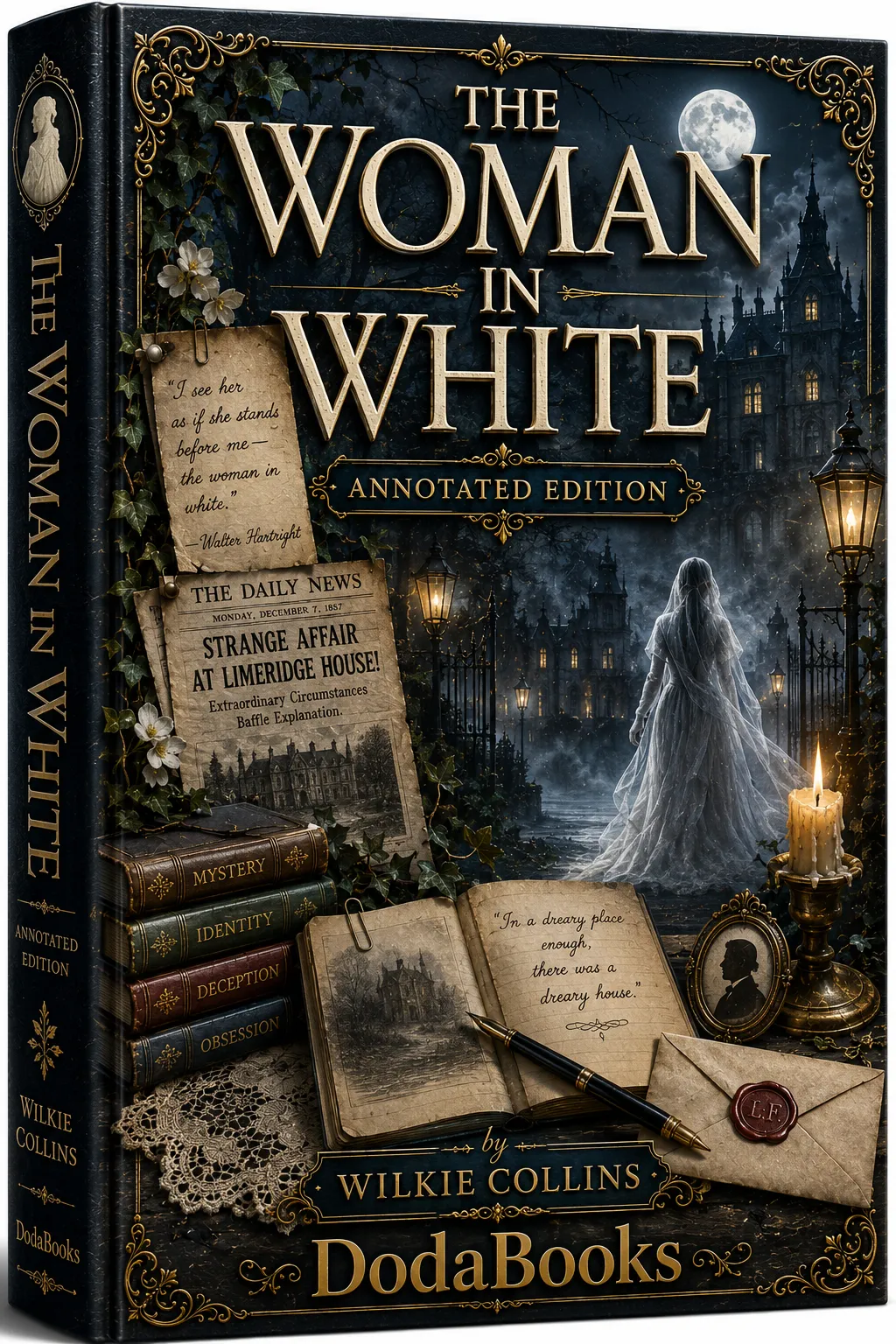
👗 Meet Victorian Literature’s Most Dynamic Cast
Experience Wilkie Collins’s sensation thriller with every psychological motive and legal trap illuminated:
- ✅ Complete, unabridged 1859–60 text across all witnesses and legal affidavits
- 🗂️ Interactive annotation cards detailing Victorian marriage laws and historical context
- 🧩 Narrator trust mapping to follow the clues alongside Walter Hartright
- 🔒 DRM-free EPUB format — read seamlessly on Kindle, Kobo, iPad, or Android
- 📥 Instant digital download delivered directly after checkout