The Waterloo Roll Call
Charles Dalton’s Monumental Biographical Register, Regimental Muster, and Officer Annals of Wellington’s Epic Victory on June 18, 1815
On Sunday, June 18, 1815, across a rain-soaked ridge of rye and clover twelve miles south of Brussels, the fate of modern Europe was decided in eight hours of catastrophic combat. The Duke of Wellington’s Anglo-Allied army, reinforced in the twilight hours by Field Marshal Blücher’s Prussian corps, shattered Napoleon Bonaparte’s veteran Armée du Nord, ending twenty-three years of continuous European warfare.
While hundreds of memoirs, military histories, and patriotic verses celebrated the triumph, it was not until 1890 that the definitive, exhaustive biographical monument to the men who commanded the British squares was published. The Waterloo Roll Call, compiled by the indefatigable British military historian and genealogist Charles Dalton (1850–1913), stands as one of the supreme achievements of nineteenth-century military scholarship. It is the indispensable roster, casualty ledger, and biographical directory of every British officer who stood beneath Wellington’s banner on that momentous day.
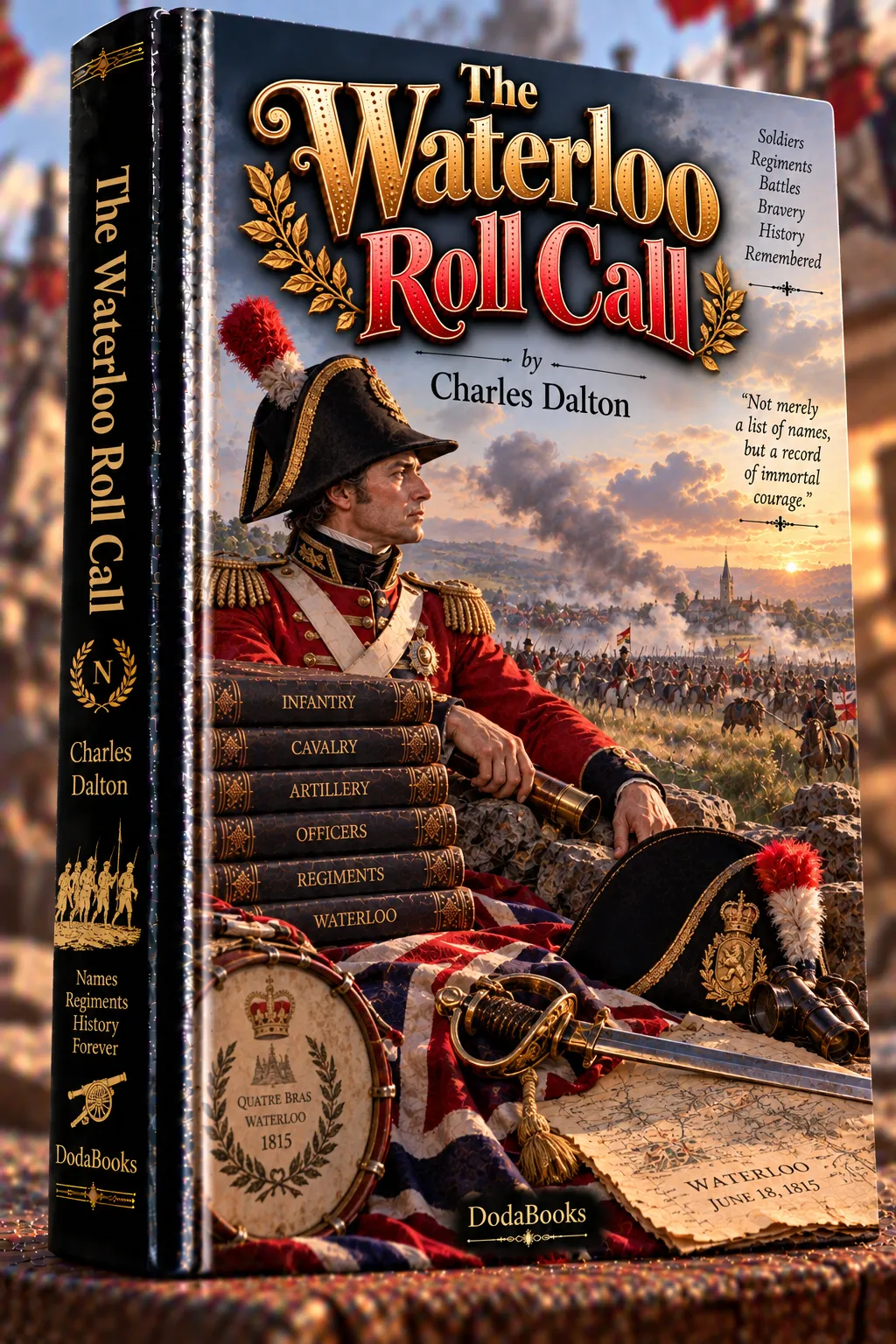
Explore the Complete Officer Roster of Waterloo
Read Charles Dalton's legendary military register in an annotated edition featuring regimental deployment maps, casualty cross-references, and Waterloo Medal distribution rolls.
Get The Waterloo Roll CallThis tradition of British military valor was carried forward onto Victorian seas in Admiral Lord Charles Beresford’s lively memoirs.
The Architecture of Dalton’s Masterwork
Compiling The Waterloo Roll Call was a herculean archival undertaking spanning decades. Working directly with official War Office muster books, regimental dispatches, paymaster ledgers, casualty returns, and private family archives in London and Dublin, Dalton meticulously reconstructed the entire British command structure at Waterloo.
The work is organized systematically by military branch and regiment:
- General Staff and Headquarters: Biographies of Field Marshal the Duke of Wellington, the Prince of Orange, Lord Uxbridge (commanding the cavalry), Sir Thomas Picton (killed leading the 5th Division), and their aides-de-camp.
- Cavalry Brigades: Detailed rosters of the Life Guards, Royal Horse Guards (the Blues), 1st Royal Dragoons, Scots Greys (2nd Dragoons), Inniskilling Dragoons, and the light hussar and lancer regiments.
- Foot Guards and Infantry Regiments: Complete rosters from the 1st Foot Guards (Grenadiers) and Coldstream Guards defending the burning chateau of Hougoumont, to the 27th Inniskillings who stood in square at the crossroads until two-thirds of their men fell, and the 95th Rifles armed with the deadly Baker rifle.
- Royal Artillery and Engineers: The gunners and sappers who manned the nine-pounder batteries and fortified La Haye Sainte.
Beyond Names and Dates: The Human Face of Battle
What transforms The Waterloo Roll Call from a dry statistical index into an emotionally gripping chronicle is Dalton’s inclusion of detailed biographical sketches, battlefield anecdotes, and post-war career notes for hundreds of individual officers.
Dalton records the grim human cost of the engagement with unflinching precision:
- Lord Uxbridge’s Leg: Dalton documents the famous exchange between Wellington and his cavalry commander in the closing minutes of the battle, when a cannonball shattered Uxbridge’s right knee: “By God, sir, I’ve lost my leg!” to which the Duke calmly replied, “By God, sir, so you have!”
- The Defense of Hougoumont: Profiles of Lieutenant-Colonel James Macdonnell and Sergeant John Graham, who performed the legendary feat of shutting the north gate of Hougoumont against attacking French soldiers, which Wellington later declared the turning point of the battle.
- Young Ensign James Lord Hay: The sixteen-year-old ensign of the 1st Foot Guards, who had danced at the Duchess of Richmond’s ball two nights earlier, killed carrying the King’s Colour at Quatre Bras.
- The Fate of the Wounded: Fascinating medical details documenting the crude state of battlefield surgery, detailing officers who survived multiple musket balls, amputations without anesthesia, and lived on to serve well into the Victorian era.
Unrivaled Archival Authority
Compiled directly from War Office archives, official casualty rolls, and regimental despatches, representing the definitive record of British officers at Waterloo.
Complete Regimental Rosters
Every unit of Wellington's army documented in order of precedence: Household Cavalry, Union Brigade, Foot Guards, Line Regiments, and Royal Artillery.
Rich Biographical Sketches
Fascinating historical notes tracking officers' earlier campaigns in the Peninsular War, wounds received at Waterloo, subsequent careers, and dates of death.
Essential for Genealogists
The premier reference work for family historians tracing British military ancestors, medals, and aristocratic commissions in the Georgian era.
The Historic Innovation of the Waterloo Medal
A key contribution of Dalton’s text is his detailed history of the Waterloo Medal—the first campaign medal issued by the British Crown to all soldiers and officers present at a battle, regardless of rank. Authorized by the Prince Regent in 1816, the Waterloo Medal was revolutionary:
- It was struck in fine silver, bearing the head of the Prince Regent on the obverse and a seated figure of Victory on the reverse.
- Every recipient’s name, rank, and regiment was machine-impressed around the rim, creating a permanent, individualized record of honor.
- Every soldier present at Waterloo was granted two years of bonus service toward their army pension and the official designation of “Waterloo Man.”
Dalton’s rosters allow military historians, antique medal collectors, and genealogists to verify genuine Waterloo Medals and trace the exact military service of their recipients.
Trace the Heroes of Wellington's Army
Read Charles Dalton's complete military masterpiece in an impeccably indexed digital edition with historical cross-references and biographical notes.
Get The Waterloo Roll CallRegimental Culture and the Purchase of Commissions
A crucial historical context that Dalton’s biographical notes illuminate is the functioning of the British Army purchase system in the Georgian era. In 1815, commissions and promotions from Ensign up to Lieutenant-Colonel in the cavalry and infantry were bought and sold as private property, rather than awarded through state examinations or merit boards:
- Aristocratic Leadership and Military Ethos: While modern critics often view the purchase system as corrupt plutocracy, Dalton shows how it fostered a distinct regimental culture. Officers regarded their regiment as an aristocratic family and brotherhood, considering it their sacred personal duty to lead from the front. At Waterloo, this meant British officers suffered a staggering casualty rate—over twenty-five percent were killed or wounded.
- Battlefield Field Promotions: In the brutal crucible of Waterloo, the purchase system was temporarily superseded by “death vacancies.” When senior officers fell in the squares, subalterns and junior captains were promoted on the field for valor without purchase, opening doors for talented officers without private fortunes.
- The King’s German Legion and Foreign Volunteers: Dalton meticulously documents the regiments of the King’s German Legion (KGL)—Hanoverian soldiers who fled Napoleon’s occupation to fight under King George III. The heroic defense of the farm of La Haye Sainte by Major George Baring’s 2nd Light Battalion KGL forms one of the most stirring chapters in Dalton’s register.
Charles Dalton: The Master Archivist of the British Army
Charles Dalton was one of the most distinguished military genealogists of Victorian Britain. In addition to The Waterloo Roll Call, he authored the massive six-volume English Army Lists and Commission Registers (1661–1714) and The Blenheim Roll, which did for Marlborough’s victory in 1704 what this volume accomplished for Wellington in 1815.
Dalton was motivated by a deep sense of historical justice. He recognized that while generals and field marshals receive statues in public squares, the subalterns, captains, and majors who held the line against French cavalry charges are all too easily forgotten by posterity. The Waterloo Roll Call stands as Dalton’s enduring monument to their courage.
Why Military Historians Still Rely on Dalton
More than a century after its initial publication, Dalton's Roll Call remains cited in virtually every serious academic and popular history of the Waterloo campaign, from John Keegan to Bernard Cornwell.
The Annotations in the DodaBooks Edition
The DodaBooks curated edition of The Waterloo Roll Call includes:
- Comprehensive Alphabetical Officer Index: Easily search across all regiments by officer surname.
- Order of Battle Diagrams: Explanations of Allied divisional and brigade command structures on June 18, 1815.
- Casualty Statistics & Analysis: Contextual summaries comparing losses at Quatre Bras, Ligny, and Waterloo.
Own the Definitive Historical Register
Download The Waterloo Roll Call today and explore the definitive record of the officers who made history on the fields of Belgium.
Download the Edition NowFrequently Asked Questions
Who was Charles Dalton?
Charles Dalton (1850–1913) was an eminent British military historian, genealogist, and archivist. He is renowned for compiling comprehensive biographical rolls of British military campaigns, including The Waterloo Roll Call and The Blenheim Roll.
What information is recorded for each officer in The Waterloo Roll Call?
For each officer, Dalton lists their full name, rank, regiment, battle wounds received at Quatre Bras or Waterloo, decorations awarded, subsequent military promotions, and often their later civilian career and date of death.
Which regiments are covered in the book?
The register covers every British army unit present at the Battle of Waterloo, including the Household Cavalry, heavy and light cavalry brigades, the Foot Guards, line infantry regiments (including the 27th, 28th, 30th, 33rd, 42nd Highlanders, and 95th Rifles), the Royal Artillery, and the Royal Engineers.
Why is this book valuable for medal collectors and genealogists?
It provides official verification for family historians tracing British officers who served in the Napoleonic Wars and allows medal collectors to confirm the authenticity and battle history of antique Waterloo Medals.
Where can I get the complete annotated ebook?
The complete, annotated digital edition of Dalton's masterwork is available for immediate download at DodaBooks at https://dodabooks.com/ebook/the-waterloo-roll-call-by-charles-dalton/.