Hamlet: Shakespeare’s Anatomy of the Modern Soul
Standing at the pinnacle of Western literature, William Shakespeare’s *The Tragedy of Hamlet, Prince of Denmark* (c. 1600–1601) revolutionized drama, transforming the conventions of the Elizabethan revenge play into an existential interrogation of human consciousness, mortality, and the rot of political power.
No literary work in world history has generated as much commentary, psychological fascination, and cultural debate as William Shakespeare’s The Tragedy of Hamlet, Prince of Denmark. Composed around 1600–1601 at the boundary between the Elizabethan and Jacobean eras, Hamlet marks the moment when Renaissance humanism encountered the abyss of modern skepticism.
On the mist-shrouded battlements of Elsinore Castle, the ghost of a murdered king commands his grieving, intellectual son to revenge his “foul and most unnatural murder.” Yet instead of rushing headlong into bloody vengeance like a conventional revenge hero, Prince Hamlet hesitates. He reflects, doubts, feigns madness, tests the spirit, and conducts a forensic psychological investigation into his own soul and the corrupt political court surrounding him. Readers exploring our distinguished Shakespearean collection will discover in Hamlet an immortal mirror of our deepest existential dilemmas.
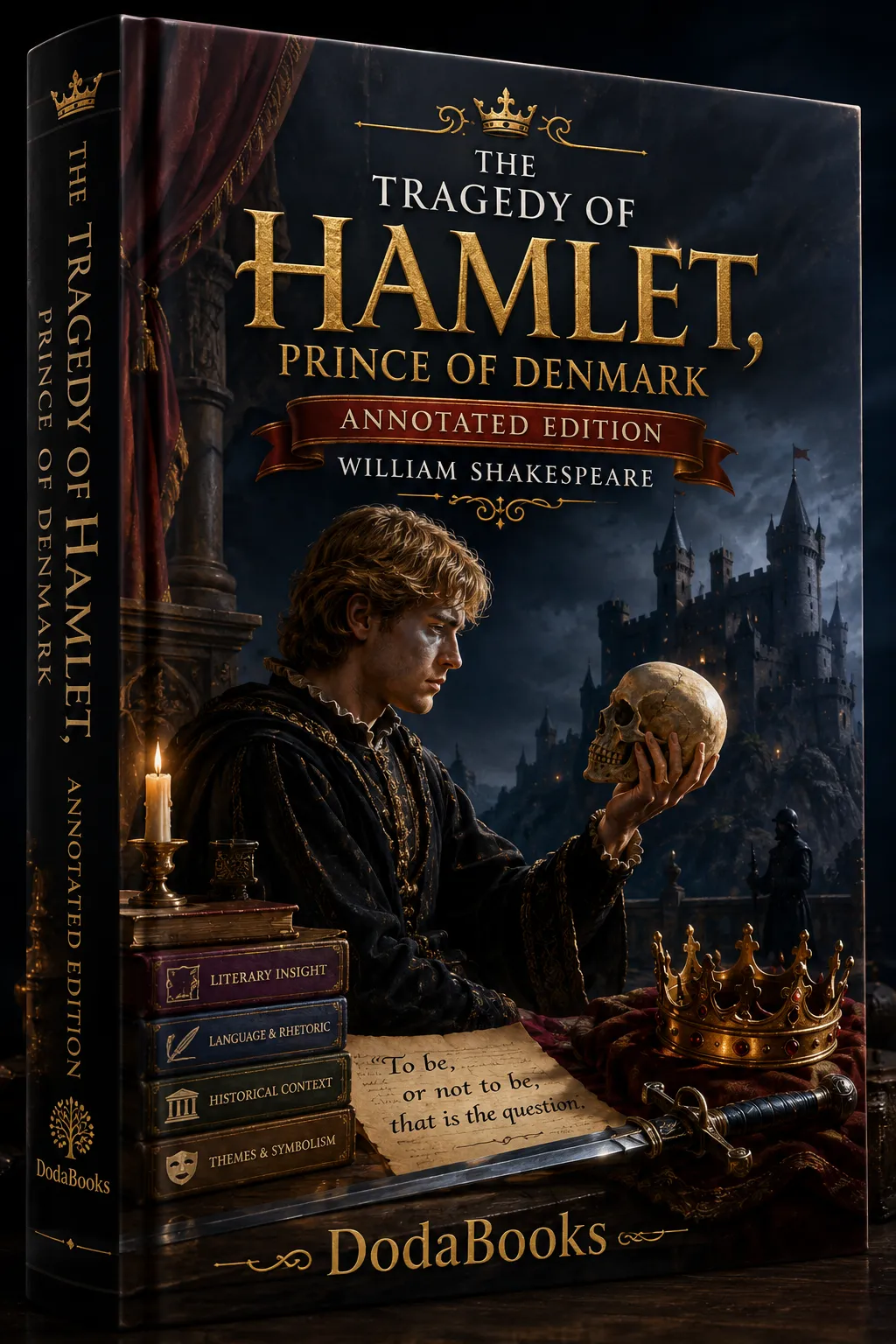
Read the Definitive Annotated Edition
Experience Shakespeare's crowning tragedy with comprehensive line-by-line annotations of Early Modern English, Elizabethan staging notes, and philosophical commentary.
Get the Annotated eBookPlot Architecture: The Five Acts of Decay
Shakespeare constructed Hamlet as a slow-burning psychological autopsy of a diseased state (“Something is rotten in the state of Denmark”):
                    THE FIVE DRAMATIC PHASES OF HAMLET

       ACT I: THE GHOST'S COMMAND              ACT II–III: THE ANTIC DISPOSITION
    ┌──────────────────────────────┐        ┌──────────────────────────────┐
    │ Midnight battlements of      │        │ Feigned madness & surveillance│
    │ Elsinore; Ghost reveals      │ ─────► │ "The Mousetrap" play catches │
    │ murder by Claudius's poison  │        │ the conscience of the King   │
    └──────────────┬───────────────┘        └──────────────┬───────────────┘
                   │                                       │
                   ▼                                       ▼
       ACT III: THE CLOSET SCENE ────────────► ACT IV: OPHELIA'S DESPAIR
       Slaying of Polonius behind arras        Drowning of Ophelia & Laertes's fury;
       Confrontation with Gertrude             Hamlet's sea-voyage escape
                   │                                       │
                   └───────────────────────────────────────┘
                                       │
                                       ▼
                         ACT V: THE GRAVEYARD & CATASTROPHE
                         Yorick's skull; poisoned rapier duel;
"The rest is silence" as Fortinbras arrives- Act I: The Ghost and the Command: On the freezing ramparts of Elsinore, the Ghost of King Hamlet reveals that his brother Claudius murdered him by pouring henbane poison into his ear, usurping both his crown and his queen, Gertrude.
- Act II: The Antic Disposition: Tormented by grief and moral disgust, Hamlet adopts an “antic disposition” (feigned madness) to evade surveillance by Claudius’s spymaster Polonius, while privately agonizing over whether the ghost is truly his father or an infernal devil tempting his soul to damnation.
- Act III: The Mousetrap and the Closet: Hamlet stages The Murder of Gonzago before the court, watching Claudius bolt from the hall in guilt. Summoned to his mother’s chamber, Hamlet denounces Gertrude’s incestuous marriage and slays the eavesdropping Polonius behind the tapestry.
- Act IV: The Exile and Ophelia’s Madness: Banished to England with secret orders for his execution, Hamlet foils the plot and returns. In Denmark, Polonius’s grieving daughter Ophelia descends into genuine madness and drowns, while her brother Laertes returns demanding blood.
- Act V: The Graveyard and the Fencing Match: Meditating upon Yorick’s skull in the graveyard, Hamlet achieves a fatalistic serenity (“The readiness is all”). In the final rigged fencing match, Claudius’s poisoned cup and Laertes’s envenomed rapier kill Gertrude, Laertes, Claudius, and Hamlet himself, leaving Horatio to tell his story.
The Great Soliloquies: The Mirror of Consciousness
What distinguishes Hamlet from all preceding drama is Shakespeare’s invention of the internal monologue as a genuine, spontaneous thinking process. Hamlet’s seven major soliloquies map the evolution of a soul under extreme moral pressure:
1. “O, that this too too solid flesh would melt…” (Act I, Scene 2)
Before he even meets the Ghost, Hamlet is paralyzed by existential weariness. The sudden marriage of his mother to his uncle Claudius within a month of his father’s funeral has turned the world into an “unweeded garden that grows to seed.”
2. “To be, or not to be, that is the question…” (Act III, Scene 1)
The most celebrated philosophical meditation in Western literature. Hamlet weighs the agony of enduring the “slings and arrows of outrageous fortune” against the temptation of suicide, checked only by the terrifying uncertainty of the afterlife—“the dread of something after death, the undiscover’d country from whose bourn no traveller returns.”
                      THE PARADOX OF HAMLET'S DELAY

          The Renaissance Scholar                The Medieval Avenger
     ┌───────────────────────────────┐   ┌───────────────────────────────┐
     │ Wittenberg University student │   │ Blood vengeance code demanded │
     │ Philosophical self-scrutiny   │   │ Violent, impulsive action     │
     │ Consciousness of moral consequences│ Immediate regicide & overthrow│
     │ "Thought makes cowards of us" │   │ Laertes & Fortinbras act fast │
     └───────────────────────────────┘   └───────────────────────────────┘
                     ▲                                   ▲
                     └─────────────────┬─────────────────┘
                                       ▼
                         The Synthesis of Act V:
                         "The Readiness is All" — Providence
3. “How all occasions do inform against me…” (Act IV, Scene 4)
Watching Prince Fortinbras of Norway march twenty thousand soldiers across the ice to fight for a worthless patch of ground, Hamlet rebukes his own intellectual hesitation, recognizing how abstract thought often dissolves the capacity for decisive action.
Major Characters: The Court of Elsinore
Shakespeare endowed every member of the Danish court with astonishing psychological complexity:
- Prince Hamlet: The quintessential modern intellectual. Wittiest of characters, prince, philosopher, poet, and critic, Hamlet’s tragedy is not that he thinks too little, but that he sees too much—perceiving the hidden hypocrisies and moral rot beneath all social institutions.
- King Claudius: One of Shakespeare’s most brilliant villains. Claudius is not a cartoonish brute; he is a competent, charming politician and diplomat whose private prayers reveal the agonizing torment of a conscience that desires forgiveness while refusing to surrender the crown and queen won through murder.
- Queen Gertrude: Caught between motherly love and sensual complicity. Gertrude’s shallow inability to mourn her first husband’s death shatters Hamlet’s faith in female integrity and the sanctity of love.
- Ophelia: The tragic, obedient daughter. Bullied by her father Polonius, used as a surveillance decoy by Claudius, and brutally rejected by Hamlet, Ophelia’s breakdown into lyrical madness and botanical lamentation remains one of the most heartbreaking sequences in world drama.
- Polonius: The aging Lord Chamberlain. Tedious, verbose, and pedantic, Polonius mistakes bureaucratic platitudes (“To thine own self be true”) for profound wisdom, treating human relationships as espionage operations.
- Horatio: Hamlet’s stoic, loyal scholar-friend from Wittenberg, who survives the carnage to report Hamlet’s cause aright to the unsatisfied.
Core Themes: Death, Corruption, and Feigned Madness
1. Physical and Moral Decay
Imagery of rot, disease, ulcers, and decomposition saturates the language of Hamlet. Claudius’s fratricide is an invisible poison that has infected the entire body politic of Denmark. In the graveyard scene with Yorick’s skull, Hamlet confronts the ultimate biological democracy of death: Alexander the Great and Julius Caesar rot into dust that eventually stops a beer-barrel.
2. Madness: Feigned vs. Real
Shakespeare constructs a brilliant, tragic contrast between Hamlet’s “antic disposition”—a calculated theatrical mask used to evade court traps—and Ophelia’s genuine descent into madness. While Hamlet’s feigned madness is razor-sharp with double-edged political satire, Ophelia’s real madness is fragmented, childlike grief that ends in suicidal despair.
3. The Play-Within-a-Play (The Mousetrap)
In Hamlet, the theater itself becomes a moral weapon: “The play’s the thing / Wherein I’ll catch the conscience of the king.” Just as in A Midsummer Night’s Dream, Shakespeare demonstrates how theatrical illusion can expose hidden reality more effectively than daylight interrogations.
Comparative Literary Context
To appreciate the vast shadow Hamlet casts across world literature, compare its themes with other classic masterpieces:
| Work & Author | Era & Milieu | Mode | Core Dynamic |
|---|---|---|---|
| Hamlet (William Shakespeare) | Elizabethan Denmark (1601) | Revenge Tragedy & Philosophy | Intellectual hesitation vs. rotten political usurpation |
| A Midsummer Night’s Dream (William Shakespeare) | Elizabethan Athens (1595) | Pastoral Romantic Comedy | Erotic illusion, woodland magic, comic metamorphosis |
| The Ballad of the White Horse (G. K. Chesterton) | Wessex, England (1911) | Epic Historical Poetry | Christian hope and courage against Viking darkness |
| At the Sign of the Cat and Racket (Honoré de Balzac) | 1810s Paris | French Realism | Bourgeois commerce vs. Romantic artistic ego |
Where Shakespeare’s earlier comedy A Midsummer Night’s Dream allowed characters to escape civic oppression into an enchanted forest where love is happily restored, in Hamlet there is no escape: Elsinore is a prison, the sea brings pirates and execution orders, and the woods offer only Ophelia’s muddy death. And unlike the resolute, faith-fueled heroism of King Alfred in Chesterton’s The Ballad of the White Horse, Prince Hamlet must navigate the paralyzing fog of doubt before accepting providence.
Experience Shakespeare's Greatest Tragedy
Immerse yourself in The Tragedy of Hamlet with line-by-line annotations of Early Modern English, textual variants (First Folio vs. Second Quarto), and performance notes.
Read The Annotated EditionWhy Hamlet Remains the Supreme Work of World Drama
Over four centuries after Richard Burbage first spoke Hamlet’s soliloquies at the Globe Theatre, Hamlet remains the measuring rod of human artistic expression. Every generation rediscovers itself in the Prince of Denmark: the Romantics saw an idealist paralyzed by intellect; the modernists saw an alienated soul in a collapsing society; our contemporary world sees an investigator unmasking state surveillance and psychological trauma.
In Hamlet’s final words to Horatio—“The rest is silence”—Shakespeare achieved the ultimate frontier of language, leaving the audience poised on the threshold of the infinite unknown. It is a work that will be read, staged, and revered as long as human beings continue to think, suffer, and search for truth.
Frequently Asked Questions
Why does Hamlet delay in killing Claudius?
Hamlet's delay is the central puzzle of the tragedy. Unlike simple revenge heroes, Hamlet is a Christian humanist and scholar from Wittenberg. He must first verify that the Ghost is not a demonic illusion; he hesitates to kill Claudius while praying for fear of sending his soul to heaven; and his profound philosophical intellect constantly scrutinizes the moral meaning, consequences, and hypocrisy of violence.
What is the difference between the Quarto and Folio texts of Hamlet?
There are three primary early texts of Hamlet: the First Quarto (Q1, 1603, a 'bad quarto' reconstructed from actors' memories), the Second Quarto (Q2, 1604–1605, the longest version, printed from Shakespeare's working papers), and the First Folio (F1, 1623, edited for the stage by his company). Modern editions combine Q2 and F1 to provide the full text.
Is Hamlet truly mad or only pretending?
Hamlet explicitly states to Horatio that he intends to 'put an antic disposition on' (feign madness) as a tactical shield to observe Claudius. However, the crushing psychological weight of his father's murder, Gertrude's betrayal, Ophelia's rejection, and his own intense melancholy push him to the very brink of genuine psychological breakdown.
Who was Yorick and why is his skull famous?
Yorick was the former King's court jester who carried Hamlet on his back when the prince was a young child. Discovering Yorick's skull in the graveyard in Act V forces Hamlet to confront the cold, physical reality of death, leading to his profound realization that earthly status, beauty, and wit all dissolve into common dust.
What features are included in the DodaBooks annotated edition?
The DodaBooks annotated edition includes complete line-by-line glosses of obscure Elizabethan words and rhetorical devices, textual apparatus comparing Quarto and Folio variants, detailed scene-by-scene staging and dramaturgical commentary, and essays analyzing Hamlet's psychological and philosophical legacy. You can explore and download the definitive annotated edition directly from DodaBooks at https://dodabooks.com/ebook/the-tragedy-of-hamlet-prince-of-denmark-annotated-edition-by-william-shakespeare/.
Related Shakespearean and Classic Literary Studies
Explore further masterworks of Elizabethan drama, French realism, and epic poetry: