The Thirty-Nine Steps Summary by Chapter: Complete 10-Chapter Breakdown
Published in the autumn of 1915, John Buchan’s The Thirty-Nine Steps virtually created the modern espionage thriller and established the archetypal “man-on-the-run” narrative that would influence novelists and filmmakers for more than a century. Buchan composed the book in a matter of weeks during the opening months of World War I while confined to bed with a duodenal ulcer, referring to it modestly as a “shocker”—a fast-paced adventure tale where romance and realism collide.
Set in the tense weeks leading up to the outbreak of the Great War in the summer of 1914, the story follows Richard Hannay, a practical thirty-seven-year-old mining engineer newly returned to London from South Africa. Bored with metropolitan society, Hannay is suddenly plunged into an international conspiracy when a frantic American neighbor warns him of a cabal of foreign spies called The Black Stone, plotting to plunge Europe into war through the assassination of a Balkan statesman and the theft of British naval deployment secrets.
When the informant is discovered pinned to Hannay’s parlor floor with a knife through his heart, Hannay becomes the target of both Scotland Yard for murder and the ruthless enemy agents desperate to silence him. What follows is a relentless, breathless chase across the heather-covered hills and railway junctions of southwest Scotland, culminating in a dramatic cliff-top confrontation on the coast of Kent.
This exhaustive chapter-by-chapter summary breaks down all ten chapters of The Thirty-Nine Steps, outlining Hannay’s ingenious disguises, the decoding of Scudder’s notebook, and Buchan’s masterful narrative mechanics.
| Chapter Group | Chapters | Key Locations | Major Plot & Espionage Developments |
|---|---|---|---|
| The Murder & Flight | Chapters 1–2 | Portland Place, London & Scottish Express | Scudder warns Hannay about the Black Stone; Scudder’s murder; milkman disguise; train to Galloway |
| The Hunt on the Moors | Chapters 3–5 | Dumfriesshire hills & Scottish Borders | The romantic literary innkeeper; aeroplane search; radical election speech for Sir Harry; spectacled roadman disguise |
| Behind Enemy Lines | Chapter 6 | Isolated country mansion | Hannay seeks shelter but walks into the lion’s den; imprisoned in the storeroom; explosive breakout with quarry cordite |
| The Official Connection | Chapters 7–8 | River Tweed & Queen Anne’s Gate, London | Meeting Sir Walter Bullivant while dry-fly fishing; Karolides assassinated; London naval conference infiltrated |
| The Tide & The Climax | Chapters 9–10 | Bradgate, Kent & Trafalgar Cottage | Decoding Scudder’s riddle of the thirty-nine steps; bridge game at the cliff villa; the hawk-like twitch; spies captured |
🏃 Chapters 1–2: A Knife in the Floor and the Milkman’s Coat
Chapter 1: The Man Who Died
The novel opens in late May 1914. Richard Hannay, having made a comfortable fortune as a mining engineer in Rhodesia and the Transvaal, has returned to London seeking fulfillment. Instead, he finds himself suffocated by the drab, respectable, and predictable routine of Edwardian urban life:
“I was three months in the Old Country, and was fed up with it… I gave it a fair trial of three months, and was just about thinking of chucking it and going back to the veld.”
On the evening of May 19th, as Hannay returns to his luxury bachelor flat in Portland Place, he is intercepted by his nervous upstairs neighbor, Franklin P. Scudder. An American journalist and freelance adventurer, Scudder begs for sanctuary, claiming he is already dead in the eyes of the world. Once inside Hannay’s parlor, Scudder reveals a staggering conspiracy: a secret international organization known as The Black Stone is orchestrating a catastrophic European war.
Scudder explains that the conspirators intend to assassinate Constantine Karolides, the Premier of Greece and the one statesman capable of preventing a Balkan explosion, during his official visit to London on June 15th. Furthermore, Scudder warns that the Black Stone’s ringleader is a criminal genius and master of disguise:
“The chief is a little old man with the eyes of a hawk. He can hood his eyes like a hawk, and he speaks English like a ditch-water cockney or a don at Oxford.”
Hannay hides Scudder in his spare bedroom for several days while the American fills a pocket-sized black notebook with ciphered intelligence. On May 23rd, Hannay returns home late at night to discover his flat silent and dark. Entering his study, he finds Scudder lying dead on the floor, pinned through the heart with Hannay’s own Swedish carving knife. Hannay immediately realizes that the killers have framed him; with no alibi and no one to corroborate Scudder’s wild story, Scotland Yard will arrest and hang him, leaving the Black Stone completely unchecked.
Chapter 2: The Milkman Sets on the Road
Hannay examines Scudder’s body and pocket contents. He salvages the crucial little black notebook, filled with numerical ciphers and cryptic notes, which Scudder had managed to hide behind the dresser before his death. Knowing that the building is under surveillance by both the conspirators and likely soon by the police, Hannay devises an escape plan relying on social camouflage.
At 3:30 a.m., Hannay intercepts the morning milkman at the back service stairs. Exploiting the young man’s financial troubles and romantic sympathy, Hannay spins a yarn about needing to escape an irate husband, handing the milkman a sovereign and trading clothes with him:
- Hannay dons the milkman’s white linen coat, rough trousers, and peaked cap, carrying the metal milk can.
- He walks boldly out the front door under the gaze of two suspicious foreign watchers loitering in the street, who ignore the working-class tradesman.
Rushing through London’s waking streets, Hannay makes his way to St. Pancras Station. He studies the railway timetable and selects an express train departing for southwest Scotland—a remote, sparsely populated terrain of moors, crags, and bogs where his South African bushcraft might keep him alive. Discarding his milkman attire in a railway lavatory, he boards the train for Dumfriesshire, setting his clock against the fateful deadline of June 15th.
🌲 Chapters 3–5: The Man-Hunt Across the Scottish Moors
Chapter 3: The Adventure of the Literary Innkeeper
Hannay leaves the train at an isolated country siding in Galloway. Taking to the hills, he walks miles across the boggy moorland, determined to evade the telegraph wires that are already carrying news of the “Portland Place Murder” across Britain. Hannay stops at a remote, run-down coaching inn beside a rushing burn.
The young innkeeper turns out to be an amateur romantic novelist whose imagination has been fed on popular sensationalist tales. When the innkeeper notices Hannay’s bruised hands and nervous posture, Hannay realizes honesty is useless, so he feeds the young man’s literary appetite:
- Hannay claims to be an innocent man pursued by an unjust domestic vengeance.
- Enchanted to find real-life melodrama on his doorstep, the innkeeper enthusiastically conceals Hannay in an upstairs bedroom.
- When an evening newspaper arrives featuring Hannay’s photograph and a reward for the Portland Place murder, Hannay reveals the truth of his identity.
Far from turning him in, the romantic innkeeper is thrilled to harbor a celebrated fugitive. He loans Hannay a rough tweed suit, provisions, and a bicycle, pointing him toward the wilder upland tracks before two suspicious motorcars carrying city detectives and foreign operatives arrive at the door.
Chapter 4: The Adventure of the Radical Candidate
Hannay pedals frantically through driving rain, but his bicycle suffers a broken chain on a steep hillside. Abandoning it in a ditch, he flees onto the open moor as a sinister monoplane sweeps low overhead, hunting him from the sky—an eerie foreshadowing of modern aerial reconnaissance.
Drenched and shivering, Hannay spots a small hall decorated with campaign bunting. Seeking shelter, he slips through the back door and is promptly seized by an anxious organizer who mistakes him for Mr. Topham, a visiting political orator from London scheduled to address the local Liberal association.
Hannay is pushed onto the platform before a crowd of Scottish electors. Drawing on his colonial mining experiences and charismatic boldness, he delivers an impassioned, rambling speech on imperial unity, tariff reform, and the spirit of the veld:
“I spoke of South Africa as I had seen it—the great open spaces, the pioneers, the pride of the British heritage… I took the house by storm.”
The local laird, a wealthy, idealistic young candidate named Sir Harry, is completely captivated by Hannay’s raw sincerity. After the meeting, Hannay privately confesses to Sir Harry that he is a hunted man, falsely accused of murder while trying to avert a national catastrophe. Sir Harry believes him instinctively. While Sir Harry lacks political influence himself, he writes an urgent letter of introduction to his uncle, Sir Walter Bullivant, the Permanent Secretary to the Foreign Office in London—the one man who holds the authority to act on Scudder’s intelligence. Furthermore, Sir Harry lends Hannay his motorcar to speed him past the local police cordons.
Chapter 5: The Adventure of the Spectacled Roadman
Driving through the night, Hannay encounters a police barricade on a narrow road bridge. He crashes the car through a ditch and slips away into the mist on foot. Morning finds him exhausted on a desolate upland road where he encounters Alexander Turnbull, an elderly, spectacled road-mender suffering from a violent hangover and terrified of losing his municipal post.
Hannay seizes the opportunity for another masterly transformation:
- He pays Turnbull five gold sovereigns for the loan of his patched coat, muddy trousers, broken boots, and wire-rimmed spectacles.
- Hannay sends Turnbull to sleep off his drinking binge in a hidden peat hag while Hannay takes up the roadman’s sledgehammer and begins breaking stones beside the highway.
- When a touring car carrying two men with foreign accents stops to inquire about a fleeing fugitive, Hannay’s performance as an illiterate, grumbling, half-deaf Scottish laborer completely deceives them.
- Moments later, local police officers cycle past and likewise pay no attention to the grimy laborer chipping gravel in the ditch.
Hannay spends the long afternoon decoding Scudder’s pocket notebook. Beneath the mathematical ciphers, he extracts three critical pieces of intelligence:
- The Black Stone’s code for communicating with their naval handlers.
- Confirmation that the assassination of Karolides on June 15th will be immediately followed by the theft of Britain’s secret Admiralty deployment plans.
- A recurring, enigmatic phrase: “Thirty-nine steps—I counted them—high tide 10:17 p.m.”
🏰 Chapters 6–7: The Old Man of the Hawk and the Dry-Fly Fisherman
Chapter 6: The Adventure of the Bald Archaeologist
With his roadman disguise exhausted, Hannay strikes out across the hills. A sudden thunderstorm drenches the moor, and Hannay seeks shelter at a substantial stone villa nestled in a secluded valley. A servant admits him to the library, where Hannay meets the master of the house: an elderly, distinguished gentleman with a bald forehead, pleasant manners, and a scholarly collection of local antiquities.
Hannay introduces himself as a lost fisherman and begins conversing politely. However, as the old gentleman leans forward to adjust the lamp, Hannay catches a glimpse of the man’s eyes:
“He looked at me, and his eyes hooded themselves like a hawk’s. In that freezing second, the bottom dropped out of my world. I had walked straight into the headquarters of the Black Stone!”
The charming scholar instantly sheds his academic demeanor. With razor-sharp coldness, he reveals that he knows Hannay’s real name and that Scudder was murdered by his own agents. Two armed accomplices enter the room. The hawk-eyed leader mocks Hannay’s amateurish heroics, informs him that his death will take place once their London operations conclude, and has him locked in an underground windowless masonry storeroom.
Hannay searches the storeroom in total darkness. He discovers that the villa’s cellar contains heavy construction materials used for building an unauthorized private airfield, including several canisters of quarry blasting powder (cordite).
- Using his professional mining skills, Hannay fashions an improvised explosive fuse from an old newspaper and scraps of twine.
- He packs the explosive charge against the heavy oak and iron door, buries himself beneath a mountain of empty cement sacks in the far corner, and ignites the fuse.
- The detonation blows out the masonry wall and door, knocking Hannay senseless and tearing off his clothes, but leaving him alive.
- Clad in singed rags and covered in lime dust, Hannay scrambles through the smoking crater into the stormy night just as the stunned servants rush into the courtyard.
Chapter 7: The Dry-Fly Fisherman
Hannay wanders for days through the wilderness of the Scottish Borders, dodging police patrols, tracker dogs, and the Black Stone’s pursuit cars. Sick with fever and physical exhaustion, he reaches the banks of the River Tweed near the border town of Kelso.
There, on a tranquil June morning, he observes an aristocratic English gentleman meticulously casting a dry fly for trout:
“He was a clean-shaved man of about fifty, with gray hair and a pleasant, humorous, weather-beaten face. He handled his rod with the easy grace of an artist.”
Hannay approaches the fisherman and presents Sir Harry’s water-stained letter. The gentleman is indeed Sir Walter Bullivant, Permanent Secretary to the Foreign Office. Sir Walter receives Hannay hospitably, taking him to his country estate, feeding him, and providing him with clean clothes and a bed.
Sitting in Sir Walter’s study, Hannay lays out Scudder’s entire narrative and presents the decoded notebook. Sir Walter listens attentively, recognizing Scudder’s handwriting and verifying several political details. However, Sir Walter remains skeptical about the assassination plot: the Foreign Office has surrounded Premier Karolides with impenetrable police protection, and Sir Walter believes British intelligence has the European situation firmly under control.
The following morning, June 15th, an urgent telegram arrives from London: Constantine Karolides has been shot dead in his motorcar in Athens. Scudder’s warning has been fulfilled to the minute. Horrified by his complacency, Sir Walter turns to Hannay with absolute trust: Hannay is immediately exonerated of murder, and the British government places the fate of the nation in his hands.
⚓ Chapters 8–10: The Sea-Cliffs of Bradgate and the Final Count
Chapter 8: The Coming of the Black Stone
Hannay travels with Sir Walter to London in an official car. They establish emergency headquarters at Sir Walter’s townhouse in Queen Anne’s Gate. Sir Walter arranges an urgent council of war with Britain’s senior military commanders, including the First Lord of the Admiralty and the Director of Military Operations.
The meeting revolves around the Royal Navy’s mobilization scheme. In the event of war with Germany, the entire British home fleet must take up secret positions in the North Sea within hours. The deployment chart—detailing every battleship, minefield, and destroyer patrol—is the supreme secret of the British Empire. Only six men have seen it.
Later that evening, an official messenger announces that the French Chief of Naval Staff and the First Sea Lord have arrived for a private conference. Hannay, observing from the hallway, watches the distinguished French officer and an English admiral enter the study.
Suddenly, Hannay notices a horrifying detail: the British admiral, supposed to be Lord Haldane or Sir Arthur, casually pulls an old pipe from his coat pocket and strikes a match against his trousers. Hannay remembers meeting the real admiral earlier that morning—a meticulous, fastidious gentleman who never smoked in uniform and possessed different mannerisms.
“A sudden electric shock went through my spine. The man in the study was an impostor! The Black Stone had walked directly into the inner sanctum of the Foreign Office!”
Hannay bursts into the room, but the impostor has already pocketed the top-secret naval documents, slipped through a side corridor, and fled into the London fog in a awaiting high-powered motorcar. The German espionage ring now possesses the complete deployment plans of the British Grand Fleet.
       [SCUDDER'S CLUES]
               │
               ▼
┌──────────────────────────────┐
│  "Thirty-Nine Steps" Riddle  │
│  High Tide: 10:17 p.m.       │
│  Trafalgar Cottage, Bradgate │
└──────────────┬───────────────┘
               │
               ▼
┌──────────────────────────────┐
│  Raid on the Cliff Villa     │
│  Spies disguised as golfers  │
│  Hawk-eyed leader's tic      │
└──────────────┬───────────────┘
               │
               ▼
┌──────────────────────────────┐
│  Arrest of the Black Stone   │
│  Naval plans recovered       │
│  Fleet saved before WWI      │
└──────────────────────────────┘
Chapter 9: The Thirty-Nine Steps
Britain stands on the precipice of catastrophic military disaster. If the stolen naval plans reach Berlin, the German High Seas Fleet can ambush the British squadrons before they can organize a blockade. With ports and railway stations under scrutiny, Hannay realizes the spies will not attempt to board a regular passenger liner; they will escape by sea via a private rendezvous.
Hannay returns to Scudder’s cryptic notebook and focuses intensely on the unsolved entry:
“Thirty-nine steps—I counted them—high tide 10:17 p.m.”
Hannay and Sir Walter consult the British Admiralty’s nautical almanac and coastal tide tables:
- They search for a location along the south or east coast of England where high tide occurs precisely at 10:17 p.m. on the night of June 18th.
- The tidal charts narrow the location down to a small stretch of the Kentish coast between Broadstairs and Ramsgate.
- Hannay takes a fast train to Kent and surveys the cliff paths near the coastal village of Bradgate.
- Examining several private villas perched on the chalk cliffs above the English Channel, Hannay discovers Trafalgar Cottage, a private residence with a private wooden staircase descending the sheer chalk face directly to a small rocky beach.
- Hannay walks down the staircase, counting each weathered wooden tread one by one:
“One, two, three… thirty-seven, thirty-eight, thirty-nine! Thirty-nine steps cut into the chalk and cased in wood! I had found the lair of the Black Stone.”
Anchored out in the Channel, just beyond British territorial waters, sits a trim, innocent-looking foreign steam yacht flying the Dutch merchant flag—waiting to pick up the spies and the stolen naval plans at high water.
Chapter 10: Various Parties Converging by the Sea
Hannay coordinates a clandestine joint operation with Scotland Yard detectives and a Royal Navy torpedo destroyer stationed over the horizon. At 9:30 p.m., accompanied by Inspector MacGillivray and armed police officers, Hannay approaches Trafalgar Cottage.
Peering through the French windows, Hannay observes an astonishingly ordinary, serene domestic scene:
- Three English gentlemen in evening dress are sitting around a table drinking port and playing a casual rubber of auction bridge.
- An elderly gentleman with white whiskers, a pleasant middle-aged man with gold spectacles, and a younger athletic man laugh and argue over card tricks.
- The domestic illusion of Edwardian upper-class respectability is so flawless that Inspector MacGillivray hesitates, convinced Hannay has made a humiliating mistake.
Hannay steps into the parlor and announces that the house is surrounded. The three men feign outraged bewilderment, demanding to know why their quiet country game has been invaded by ruffians. Even Hannay begins to doubt his senses; the elderly card player appears genial, frail, and utterly unlike the ruthless conspirator who held him captive in Galloway.
Hannay studies the old man intently. He engages him in conversation, deliberately shifting the subject to the Scottish moors and the blast of quarry cordite. The old man smiles warmly and denies ever visiting Scotland. But just as Hannay is about to despair, the old man glances at the mantle clock to check the time before high water, and for a fraction of a second, his eyelid lowers in an involuntary, predatory gesture:
“He hooded his eyes like a hawk! It was the exact trick Scudder had described in Portland Place. The mask fell away, and I saw the devil behind it.”
Hannay shouts the order. The detectives seize the conspirators. The younger man attempts to draw a revolver, while the hawk-eyed leader makes a desperate dash for the French doors leading to the cliff stairs. Hannay tackles him to the floor, disarming him and recovering the secret Admiralty deployment envelope concealed within his coat lining.
Outside, the Royal Navy destroyer sweeps its searchlight across the bay and intercepts the waiting German boat, taking its crew prisoner.
Three weeks later, on August 4, 1914, Britain officially enters the First World War. But because of Richard Hannay’s courage, resourcefulness, and relentless pursuit, the Grand Fleet is safely mobilized at its war stations in Scapa Flow, guarding the sea lanes and protecting the British Empire.
🧠 Key Themes and Literary Devices
1. The Fragility of Civilization
Buchan’s central thematic premise is that modern civilization is not a solid stone fortress, but an extraordinarily thin sheet of ice stretched over a dark abyss of chaos. As Scudder memorably observes in Chapter 1:
“You think that a wall as solid as the earth separates civilization from savagery. I tell you it is a thread, a glass of water, a breath of air.” Hannay learns that the polite surfaces of Edwardian life—railway porters, country teas, political speeches, and polite bridge games—can conceal lethal international conspiracies.
2. Disguise, Class, and Social Camouflage
Hannay survives his ordeal not through superheroic combat, but through social mimicry. In Edwardian Britain, people do not see individuals; they see social uniforms. Hannay successfully passes as:
- A Cockney milkman delivering morning dairy.
- A free-thinking colonial orator giving an election speech.
- A half-deaf roadman chipping roadside gravel.
- A respectable fisherman strolling by the river.
By adopting the precise speech patterns, clothing, and body language of each social caste, Hannay becomes invisible in plain sight.
3. Landscape as Character
The geography of Great Britain is central to the narrative velocity of The Thirty-Nine Steps. The narrative moves rhythmically between the claustrophobic corridors of London’s metropolis, the windswept, ancient freedom of the Scottish heather, and the white chalk cliffs of Kent overlooking the European conflict. Buchan’s intimate familiarity with the Scottish Borders imbues the chase scenes with authentic geological and cultural vitality.
❓ Frequently Asked Questions
Why does Franklin Scudder seek out Richard Hannay in Chapter 1?
Scudder chooses Hannay because he perceives him as a practical, cool-headed colonial outsider unconnected with the London political establishment. Scudder knows his own life is forfeit and needs a dependable, courageous man to protect his notebook and carry the warning to the authorities.
What does the title "The Thirty-Nine Steps" actually refer to?
The title refers to the exact number of wooden stairs descending the chalk cliff from Trafalgar Cottage near Bradgate, Kent, down to the private sea cove where the German espionage agents intended to rendezvous with their escape boat at high tide (10:17 p.m.).
How does Hannay prove his innocence to Sir Walter Bullivant?
Hannay provides Sir Walter with Scudder's decoded pocket notebook, which predicts the exact date and location of the assassination of Greek Premier Constantine Karolides. When news arrives on June 15th that Karolides has been murdered precisely as foretold, Sir Walter realizes Hannay's story is genuine.
How does John Buchan's novel differ from Alfred Hitchcock's 1935 film adaptation?
Hitchcock's celebrated film adaptation takes significant creative liberties with Buchan's plot. The film introduces a female romantic companion (Pamela, played by Madeleine Carroll), invents the "Mr. Memory" music-hall cipher climax, and replaces the thirty-nine cliff steps with the name of the spy ring itself. Buchan's original novel is an all-male, wilderness adventure story focused purely on survival, landscape, and naval secrets.
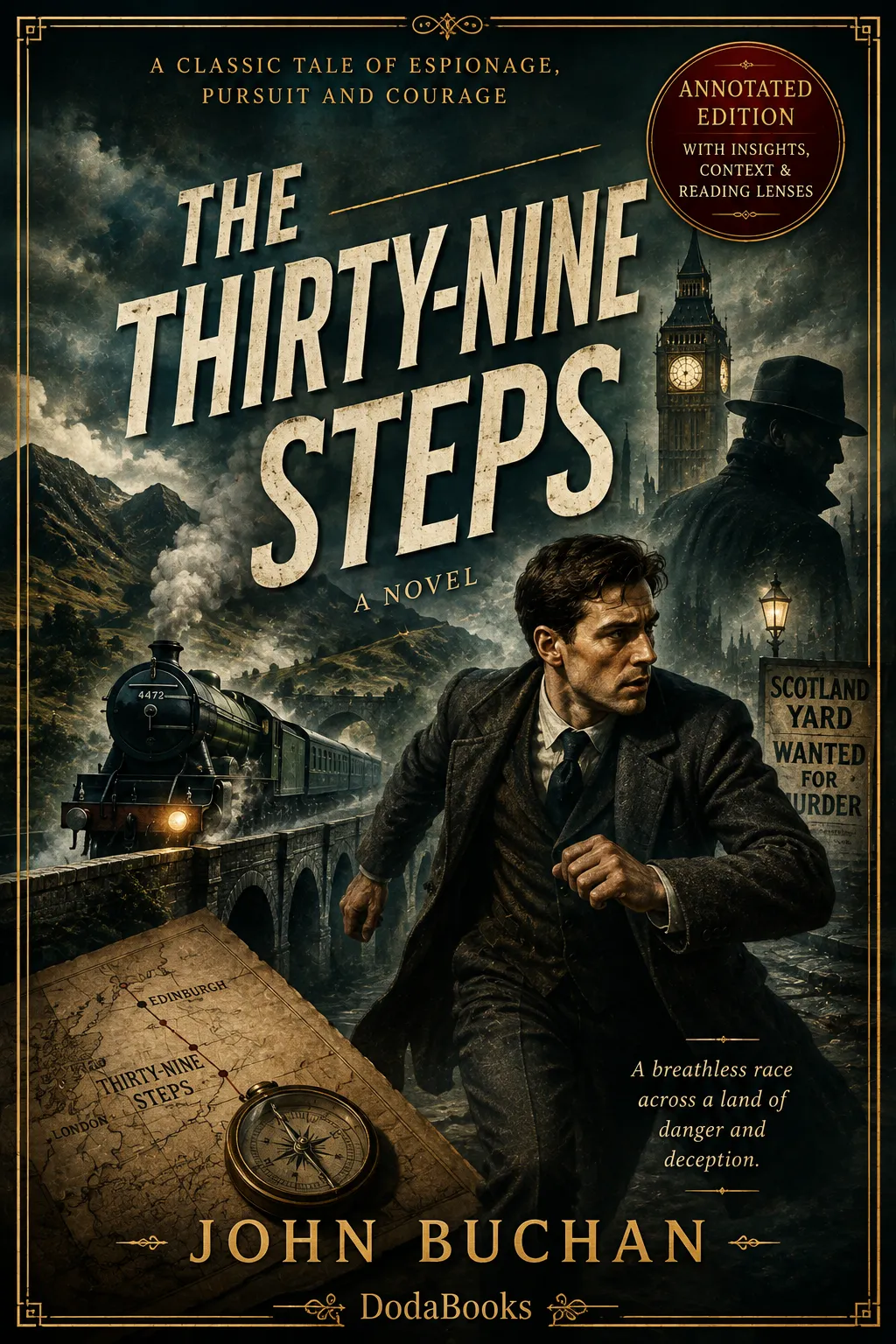
🕵️ Master Buchan’s Landmark Thriller with Full Historical Context
Experience the founding masterpiece of modern spy fiction in its definitive digital format. The DodaBooks Annotated Edition of The Thirty-Nine Steps offers:
- ✅ Complete Unabridged 1915 Text — All 10 pulse-pounding chapters exactly as Buchan wrote them
- 🗂️ 50 Visible Annotation Cards — Decoding Edwardian slang, Scots dialect, and pre-WWI geopolitics
- 🗺️ Detailed Maps & Geographical Notes — Follow Hannay’s exact escape route across the Scottish Borders
- 🔒 100% DRM-Free Freedom — Yours forever across Kindle, Kobo, iPad, Apple Books, and Android
- 📥 Instant EPUB Download — Begin reading immediately after checkout