The Thirty-Nine Steps Characters: Richard Hannay, Scudder & The Black Stone Explained
When John Buchan wrote The Thirty-Nine Steps in the late summer of 1914, he did more than craft an exhilarating chase across the Scottish Highlands—he forged the archetypes that would define twentieth-century espionage fiction. Long before Ian Fleming conceived James Bond or John le Carré sketched George Smiley, Buchan introduced readers to Richard Hannay, the world’s first modern action hero operating under civilian conditions.
Unlike the aristocratic amateur sleuths of Victorian fiction or the superhuman operatives of postwar pulp, Buchan’s characters are defined by their tactile humanity, acute social awareness, and moral realism. From the paranoid American adventurer Franklin P. Scudder to the chilling, hawk-eyed leader of The Black Stone, every figure in the novel embodies a distinct facet of Edwardian society on the razor’s edge of world conflict.
This comprehensive character guide examines the central figures of The Thirty-Nine Steps, analyzing their motivations, psychological profiles, narrative functions, and the intricate class dynamics that govern their survival.
| Character | Role / Archetype | Key Traits & Motivations | Crucial Narrative Contribution |
|---|---|---|---|
| Richard Hannay | Protagonist / The Reluctant Pioneer | 37-year-old South African mining engineer; resourceful, observant, physically tough, morally grounded | Survives manhunt via bushcraft and social disguise; unmasks the Black Stone and saves the British fleet |
| Franklin P. Scudder | The Catalyst / Doomed Informant | Nervous American journalist and freelance adventurer; paranoid, obsessive, courageous | Uncovers the June 15 assassination plot; entrusts ciphered black notebook to Hannay before his murder |
| The Hawk-Eyed Leader | Mastermind / Chief Antagonist | Elderly gentleman; brilliant linguist, master of disguise, predatory intellect | Heads the Black Stone spy ring; captures Hannay in Galloway; nearly escapes with stolen naval plans |
| Sir Walter Bullivant | Establishment Ally / Civil Service Pillar | Permanent Secretary to the Foreign Office; calm, aristocratic, pragmatic dry-fly fisherman | Validates Hannay’s intelligence; mobilizes Scotland Yard and the Royal Navy for the Kent raid |
| Sir Harry | Impetuous Benefactor / Country Squire | Wealthy young Scottish laird and Liberal political candidate; romantic, idealistic | Mistakes Hannay for an orator; gives Hannay his car and the crucial letter to Sir Walter |
| Alexander Turnbull | Working-Class Foil / Accidental Accomplice | Spectacled, dyspeptic road-mender; nursing a heavy hangover, resentful of authority | Sells his clothes, spectacles, and hammer to Hannay, providing the novel’s most effective disguise |
| The Literary Innkeeper | Romantic Enabler / Country Host | Young Scottish innkeeper obsessed with cheap sensationalist fiction; naive, adventurous | Harbors Hannay out of sheer literary delight; provides bicycle, tweed clothes, and food |
| Marmaduke Jopley | Upper-Class Snob / Comic Obstacle | Vain, cowardly London social climber driving a luxury touring car | Coerced by Hannay into providing transport; later points police in Hannay’s direction |
🏃 Richard Hannay: The Archetype of the Man on the Run
1. Origins and South African Background
Richard Hannay is thirty-seven years old when the novel opens, having spent the preceding two decades in southern Africa. Starting as an impoverished youth, he worked as a prospector, mining engineer, and bush scout in Bulawayo, the Witwatersrand, and the Rhodesian frontier. Through hard manual labor, sharp technical acumen, and shrewd investment, he amassed a comfortable private fortune.
Hannay’s colonial background is the psychological foundation of his character:
- The Outsider’s Perspective: Because Hannay grew up far from the British Isles, he views London and Edwardian society with detached objectivity. He is not blinded by class deference, political dogmas, or metropolitan complacency.
- Physical Bushcraft: Hannay’s formative years were spent navigating uncharted scrubland, tracking wildlife, enduring dysentery, and surviving armed conflict. When forced onto the desolate moors of Galloway, he treats the Scottish heather not as a romantic postcard, but as a tactical battlefield.
- Ennui and the Need for Purpose: Hannay begins the novel in a state of spiritual paralysis. Wealthy and idle in London, he confesses that he was “fed up with the Old Country” within three months. Scudder’s intrusion and subsequent murder do not merely threaten Hannay’s life; they rescue him from the slow death of boredom.
“I was tired of doing nothing, and I was in an irritable, discontented frame of mind… I could not settle down to life in a town, and I was wondering whether I had better chuck the whole business and head back to South Africa.”
                 [THE EVOLUTION OF RICHARD HANNAY]
                                 │
     ┌───────────────────────────┴───────────────────────────┐
     ▼                                                       ▼
[COLONIAL SCOUT]                                     [LONDON STRANGER]
- Physical endurance                                 - Social disconnection
- Practical bushcraft                                - Disillusionment with wealth
- Independence from class bias                       - Yearning for active purpose
     │                                                       │
     └───────────────────────────┬───────────────────────────┘
                                 │
                                 ▼
                     [THE RELUCTANT DEFENDER]
                     - Adopts rapid class disguises
                     - Decodes Scudder's ciphers
                     - Combines grit with civic duty
2. Physicality and Practical Intellect
Hannay is emphatically not Sherlock Holmes. He possesses no encyclopedic knowledge of rare tobaccos and makes no deductive leaps from the scuff marks on a boot. Instead, Hannay represents the triumph of practical competence.
When trapped in the windowless cellar of the Black Stone’s country house in Chapter 6, Hannay does not construct an intricate escape mechanism; he recognizes blasting powder from his years as a shaft-sinker, calculates the explosive force needed to blow down an iron-bound oak door, wraps the charge in old newspapers, and covers himself in lime bags. Hannay’s survival stems from his tactile familiarity with physical realities—mud, cordite, bicycle chains, train schedules, and cold iron.
3. The Moral Compass of Fair Play
Despite living in a cut-throat world of international espionage, Hannay adheres strictly to an unwritten code of decency. He refuses to steal without compensation, invariably leaving gold sovereigns behind whenever he commandeers a car, a coat, or a bicycle. Even when facing deadly enemies, he prefers open confrontation to assassination. Buchan constructs Hannay as the ideal British imperial subject: tough without cruelty, patriotic without chauvinism, and courageous without boastfulness.
📜 Franklin P. Scudder: The Doomed Prophet
1. The Nervous Adventurer
Franklin P. Scudder appears only in the opening chapter, but his nervous shadow looms over every page of The Thirty-Nine Steps. An American journalist, political gossip, and freelance intelligence collector, Scudder represents the hyper-aware modern observer who discovers that the world is governed by clandestine forces.
Scudder is twitchy, sleep-deprived, and consumed by visceral dread. Having spent years tracking covert political networks across Vienna, Bucharest, and Berlin, he has uncovered the impending conspiracy to assassinate Constantine Karolides, the Premier of Greece. Scudder knows that the murder will ignite the Balkan powder keg and force the European powers into a catastrophic general war.
“He had a sharp, restless face, like a ferret, with little pale eyes that never stood still… He told a tale that sounded like something out of the Arabian Nights, but the queer thing was that he made me believe him.”
2. Scudder’s Worldview: Civilization as an Illusion
Scudder provides the philosophical thesis of the novel: the belief that the stability of modern Western civilization is an extraordinarily fragile veneer. While the British public strolls peacefully through Hyde Park and reads cricket scores, ruthless forces are manipulating capital, armies, and political factions behind closed doors.
Scudder’s tragedy is that his brilliance is married to deep vulnerability. He fakes his own suicide in a Thames boarding house to throw pursuers off his scent, yet he underestimates the Black Stone’s reach. In choosing Hannay’s flat as his refuge, Scudder makes the fatal miscalculation that he can hide indefinitely in plain sight.
3. The Legacy of the Black Notebook
Scudder’s death by a Swedish carving knife through the heart transforms him from an active agent into a posthumous guide. His pocket-sized black notebook—filled with numerical tables, French railway ciphers, Greek political names, and the cryptic phrase about thirty-nine steps—becomes Hannay’s compass. Hannay’s journey is essentially an act of translation: he must convert Scudder’s academic paranoia into physical action.
🦅 The Antagonists: The Black Stone Conspiracy
Buchan deliberately avoids naming the foreign government behind the Black Stone in the early chapters, though the German imperial connection becomes unmistakable as the June 1914 crisis unfolds. The Black Stone operates not as a crude military unit, but as an elite fifth column embedded within British high society.
                  ┌──────────────────────────────┐
                  │    THE BLACK STONE RING      │
                  └──────────────┬───────────────┘
                                 │
         ┌───────────────────────┼───────────────────────┐
         ▼                       ▼                       ▼
┌─────────────────┐     ┌─────────────────┐     ┌─────────────────┐
│ The Hawk-Eyed   │     │ The Bald        │     │ The Impostor    │
│ Mastermind      │     │ Archaeologist   │     │ Admiral         │
│ - Linguistic    │     │ - Antiquarian   │     │ - Infiltrates   │
│   genius        │     │   cover in the  │     │   Foreign Office│
│ - Eyelid tic    │     │   Galloway hills│   │ - Steals Fleet  │
│ - Suburban disguised  │ - Secret airfield│    │   secret orders │
└─────────────────┘     └─────────────────┘     └─────────────────┘
1. The Hawk-Eyed Mastermind
The leader of the Black Stone is one of the most chilling villains in pre-war fiction. First described by Scudder as an elderly man capable of “hooding his eyes like a hawk,” he is an intellectual chameleon. He shifts effortlessly from an Oxford academic to a snarling East End dockworker, speaking immaculate idiomatic English in half a dozen regional accents.
What makes the leader truly terrifying is his absolute calm. When Hannay confronts him at Trafalgar Cottage in Kent, the mastermind does not draw a weapon or issue hysterical threats; he sits by an open hearth playing auction bridge, laughing warmly, and pretending to be a retired English gentleman complaining about his garden. His only fatal flaw is physiological: in a moment of unconscious concentration, his left eyelid twitches and hoods itself like a bird of prey, betraying his identity to Hannay.
2. The Bald Archaeologist
Encountered in Chapter 6 in the Galloway hills, this operative poses as a scholarly antiquarian collecting Neolithic flints and Roman coins. His persona is crafted to disarm suspicions: a gentle, balding, polite scholar living in seclusion. Yet behind this academic façade lies a ruthless logistical coordinator who maintains a private motorcar fleet, armed thugs, and an illegal airstrip designed to shuttle couriers across the North Sea.
3. The Impostor Admiral
Appearing in Chapter 8, this operative demonstrates the audacious reach of the Black Stone. Disguised as the First Sea Lord (or high Admiralty official), he walks boldly into Sir Walter Bullivant’s private London study during a closed council of war. He participates in top-secret strategic discussions, studies the Royal Navy’s emergency mobilization maps, and slips the empire’s supreme naval war plan into his pocket before slipping away into the night. His audacity reveals the Black Stone’s core strength: their total mastery of Edwardian social codes and bureaucratic etiquette.
🏛️ The Establishment Allies
1. Sir Walter Bullivant: The Diplomatic Anchor
Sir Walter Bullivant is the moral and structural counterpart to the Black Stone. As Permanent Secretary to the Foreign Office, he represents the British administrative state at its finest: calm, understated, highly educated, and fundamentally honorable.
When Hannay first encounters him on the banks of the River Tweed, Sir Walter is not surrounded by bodyguards or dispatch boxes; he is wearing weathered tweeds and casting a dry fly for trout with the delicate precision of a master craftsman. This juxtaposition is quintessential Buchan: the greatest affairs of empire are handled by gentlemen who maintain their inner equilibrium through rural sports.
Sir Walter’s key characteristics include:
- Humorous Skepticism: He initially doubts Hannay’s wild tales of international plots, treating Scudder’s warning as romantic melodrama.
- Immediate Decisiveness: The instant Karolides’ assassination is confirmed by telegram, Sir Walter abandons his skepticism. He displays no bureaucratic hesitation, instantly endorsing Hannay, overriding police arrest warrants, and placing the resources of the Admiralty and Scotland Yard at Hannay’s disposal.
- Unwavering Loyalty: Sir Walter judges men by their character rather than their paperwork. Once he determines that Hannay is honest, his trust is absolute.
2. Sir Harry: The Idealistic Country Laird
Sir Harry, encountered by Hannay during the Galloway manhunt, is a wealthy young Scottish landowner standing for Parliament as a radical Liberal candidate. Naive, enthusiastic, and overflowing with generous instincts, Sir Harry is the comic yet essential link in Hannay’s salvation.
When Hannay delivers an impromptu campaign speech on Sir Harry’s platform, the young politician is swept off his feet. Rather than questioning Hannay’s disheveled appearance, Sir Harry assumes Hannay is an eccentric political genius. Even when Hannay confesses to being a hunted murder suspect, Sir Harry’s aristocratic romanticism prompts him to offer his high-powered motorcar and write the crucial introduction to his uncle, Sir Walter. Sir Harry represents the youthful, uncorrupted idealism of pre-war Britain—generous to a fault and eager to assist a comrade in distress.
🛠️ The Working-Class Characters: Camouflage and Contrast
Hannay’s survival on the run depends entirely on his interactions with working-class Britons. Buchan’s treatment of these figures provides sharp social commentary and lively comic relief.
       [WORKING-CLASS ENCOUNTERS: HANNAY'S SURVIVAL CAMOUFLAGE]
                                   │
      ┌────────────────────────────┼────────────────────────────┐
      ▼                            ▼                            ▼
[THE MILKMAN]             [THE LITERARY INNKEEPER]      [THE ROAD-MENDER]
- London working class    - Scottish rural hospitality  - Scottish rural laborer
- Motivated by cash &     - Motivated by romantic       - Motivated by alcohol,
  sympathy for lovers       sensational fiction           money, and a day's rest
- Escapes Portland Place  - Provides bicycle & food     - Fools city detectives
1. Alexander Turnbull: The Spectacled Roadman
Turnbull is the battered, red-eyed road-mender whom Hannay meets beside a remote highway in Chapter 5. Suffering from the toxic aftermath of a local wedding celebration, Turnbull is terrified of losing his position with the district council if he fails to break his quota of stones.
Hannay’s transaction with Turnbull highlights the stark practicality of the rural working class:
- Turnbull does not care about high politics, European treaties, or London murders; he cares about his aching head, the cold wind, and five golden sovereigns.
- By trading his coat, boots, and wire spectacles for Turnbull’s rags, Hannay acquires the ultimate disguise.
- When foreign agents in a motorcar interrogate Hannay, he adopts Turnbull’s dialect, rheumy cough, and sullen, half-deaf demeanor, proving that the upper classes never truly look at the faces of manual laborers.
2. The Literary Innkeeper
The young innkeeper in Galloway represents the democratizing power of cheap print culture in late Edwardian Britain. Raised on penny dreadfuls, shilling shockers, and sensational newspaper serials, he views Hannay’s arrival not as a police matter, but as the fulfillment of his literary fantasies.
His romantic sympathy proves invaluable:
- He shelters Hannay in his back room.
- He provides clean clothing, a bicycle, and a stash of food.
- He sends pursuers down false trails. Through the innkeeper, Buchan winks at his own genre, acknowledging that the appetite for wild adventure was shared by readers of all classes on the eve of the Great War.
3. The London Milkman
Appearing in Chapter 2, the milkman is the first human being Hannay manipulates. Hard-pressed financially and harboring a natural working-class suspicion of the police and landlords, he readily accepts Hannay’s fabricated tale about escaping an angry husband. For a gold sovereign, he surrenders his uniform and milk cans, demonstrating that in metropolitan London, cash and a plausible romantic excuse can dissolve suspicion in seconds.
🎭 The Psychology of Disguise and Social Hierarchy
The Thirty-Nine Steps is fundamentally an investigation into the fiction of social identity. In Buchan’s world, identity is not an innate, immutable essence; it is a performance constructed through vocabulary, clothing, posture, and social deference.
Hannay is capable of moving across the entire British class spectrum because his South African upbringing taught him that social roles are arbitrary:
- The Milkman: Hannay slouches, speaks with an unhurried Cockney drawl, and carries heavy metal cans with practiced indifference. The police do not see Hannay; they see a tradesman fulfilling a morning routine.
- The Political Orator: By assuming a haughty, confident posture and projecting his voice with colonial gusto, Hannay commands an auditorium of Scottish burghers who never dream of checking his credentials.
- The Road-Mender: By hunching his shoulders, squinting through dusty wire spectacles, and chewing a plug of cheap tobacco, Hannay becomes invisible to both detectives and foreign spies.
Conversely, the Black Stone operatives use this same social blindness against Britain. Because the hawk-eyed leader and his accomplices wear tailored tweeds, speak with refined public-school accents, and play bridge in a seaside drawing room, Scotland Yard detectives hesitate to question them. Buchan warns his readers that the greatest danger to national security is not the foreign barbarian, but the cultivated adversary who speaks the king’s English and mimics the manners of a gentleman.
❓ Frequently Asked Questions
Is Richard Hannay based on a real historical figure?
Yes. John Buchan modeled Richard Hannay primarily on Field Marshal William Edmund Ironside (later Baron Ironside), a close friend of Buchan's. Ironside was a towering, multilingual British military officer who worked undercover as a Boer truck-driver during the Second Boer War, possessed extraordinary physical strength, and later rose to Chief of the Imperial General Staff.
Why is Franklin Scudder murdered so early in the story?
Scudder serves as the narrative catalyst. His murder accomplishes two essential storytelling goals: it raises the stakes from abstract political tension to immediate mortal peril, and it deprives Hannay of any official protector, forcing an ordinary man to take the entire weight of national salvation onto his own shoulders.
How many members belong to the Black Stone?
The core leadership of the Black Stone consists of five primary operatives: the hawk-eyed master of disguise, the bald antiquarian scholar, the elderly man with the lisp, and two high-level couriers and impostors (including the operative who poses as an Admiralty official). They are supported by a broader network of motorcar drivers, foreign scouts, and the crew of the Dutch vessel anchored off the Kentish coast.
What makes Sir Walter Bullivant trust Hannay when the police want him for murder?
Sir Walter's trust is based on two factors: the personal endorsement of his nephew Sir Harry, who vouches for Hannay's character, and the irrefutable accuracy of Scudder's decoded notebook. When the assassination of Constantine Karolides occurs on June 15th exactly as predicted, Sir Walter realizes Hannay is Britain's only hope of unmasking the conspiracy.
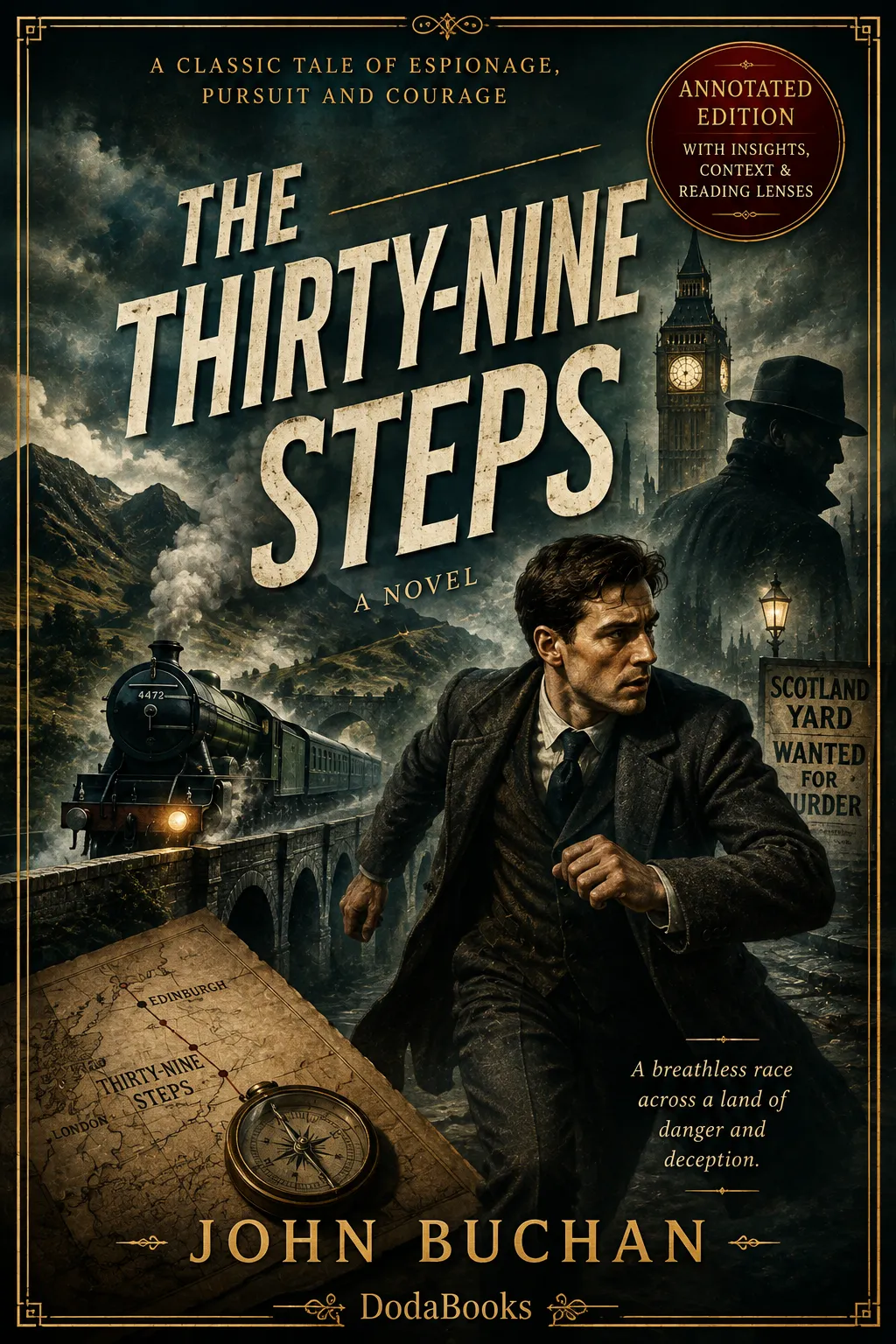
🕵️ Experience Buchan’s Legendary Characters with Full Annotations
Follow Richard Hannay’s desperate flight with every historical clue and character nuance revealed. The DodaBooks Annotated Edition of The Thirty-Nine Steps includes:
- ✅ Complete Unabridged Text — The definitive 1915 novel featuring Hannay, Scudder, and the Black Stone
- 🗂️ 50 Color-Coded Annotation Cards — Passage-specific notes explaining character historical inspirations
- 📜 Pre-WWI Espionage Context — Learn about the real spy scares and secret service operations of 1914
- 🔒 100% DRM-Free Ownership — Yours for life across all your favorite e-reading apps and devices
- 📥 Instant EPUB Delivery — Download your digital copy immediately