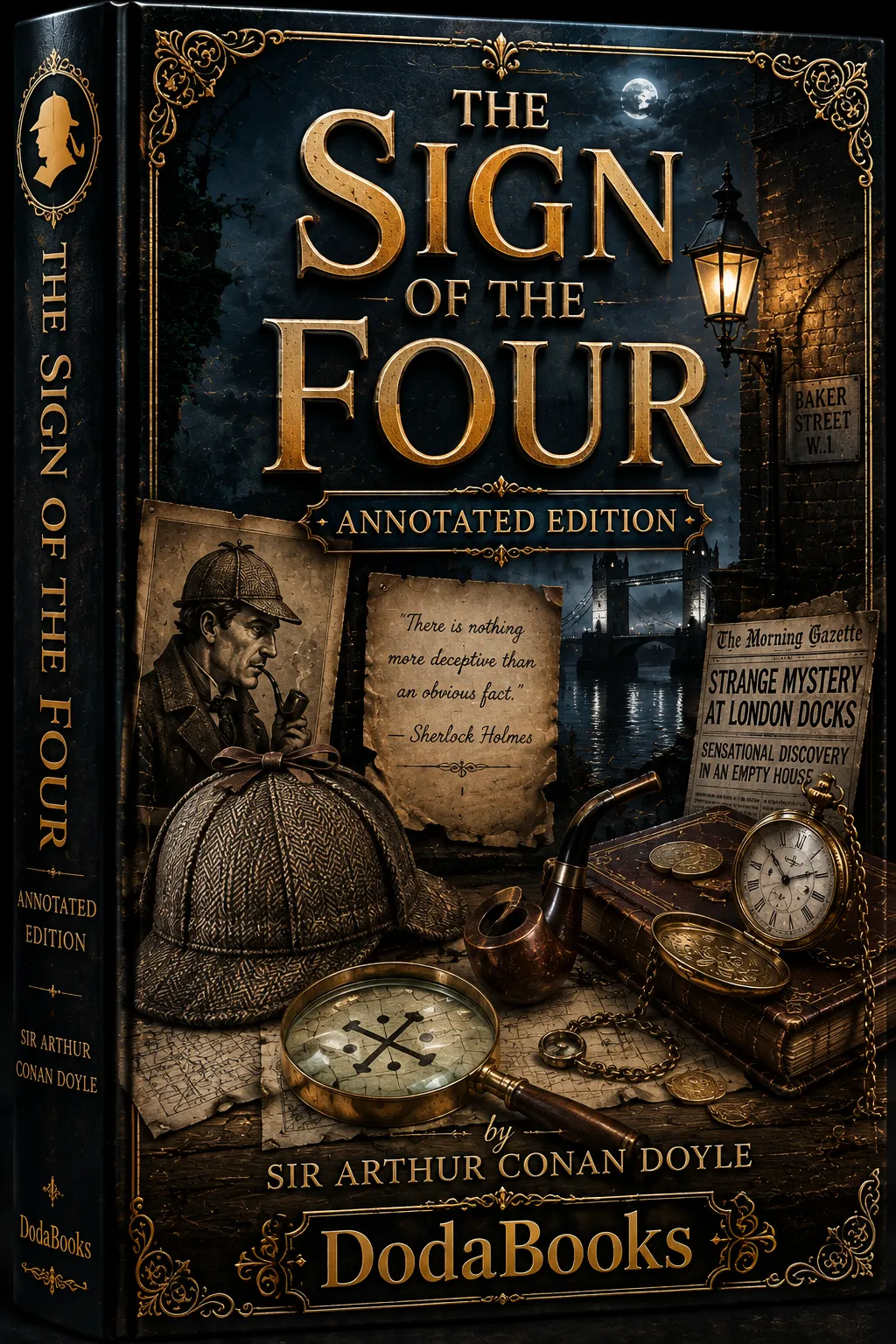
Arthur Conan Doyle’s The Sign of the Four is the second Sherlock Holmes novel — a 1890 case that sends the detective from the foggy streets of London to the Indian Mutiny, an Agra treasure, and a brutal revenge across half a century. It’s also the book that introduced the world to Holmes and Watson as a permanent partnership. This guide covers the plot, the history, and the DodaBooks Annotated Edition.
💍
The Sign of the Four
Six pearls arrive by post, one each year. The seventh comes with a letter: "It is growing too dangerous for me." Then her guardian disappears. Holmes pursues a case that reaches back to a mutiny, a fort, and four men bound by a secret.
| Author | Arthur Conan Doyle |
| Published | 1890 |
| Genre | Detective novel |
| Setting | London and the Thames, with a backstory in Agra, 1857 |
| Best For | Holmes fans, mystery readers, adventure lovers |
| Reading Time | 4–6 hours |
💍 The Story
Mary Morstan, a young governess, comes to Holmes with an enigma: her father, Captain Morstan, vanished a decade earlier, and since then she has received one precious pearl a year by post. That morning a letter has arrived at last — unsigned, summoning her to a meeting, “in a score of darkness and of rain.”
Holmes, Watson, and Mary follow the trail to a lonely house, where they meet Thaddeus Sholto — whose own father hid a stolen Agra treasure. The trail is followed by four men bound by an oath taken during the Indian Mutiny of 1857, and by the hoard’s bearer, Jonathan Small, a one-legged man who has pursued the fortune from India to the Thames Estuary, guarded by a primitive savage with a blowpipe full of poisoned darts.
The pursuit becomes a famous chase along the river, and the book gives us two of the most enduring images in the Sherlockian world: the poison-dart murderer cannot speak above a whisper, and the treasure itself, when finally recovered, turns out to be nothing but a hoard of empty care.
“It is a strange story, but I am afraid it is not a very interesting one to you, for as a story it is … you will want to see the end.”
🇮🇳 The Mutiny Backstory, and Why It Matters
The novel’s second half travels back to the Indian Mutiny of 1857 — a conflict that shook Victorian Britain and shaped its imagination of empire. Jonathan Small’s account of the siege of Agra, of four prisoners in a fort, and of a treasure split four ways, is adventure storytelling at full pitch. But it rests on a real history: the mutiny, its atrocities, its sieges, and the deep ambivalence Victorians held toward a jewel of empire that had cost so much blood.
The DodaBooks annotations make that weight visible — separating historical fact from Collins-style romance, and showing how Doyle balanced a crackling revenge plot with a story about the moral cost of conquest.
🔍 The Annotated Layer
Annotation Cards
Visible, color-coded notes beside the action — read without clicking.
Empire & the Mutiny
1857 history, the siege of Agra, and the real agents behind the plot.
The River Chase
London geography, the Thames, and the famous night pursuit mapped.
Character Arcs
Jonathan Small, Tonga, and how Doyle shades his "criminals."
Watson and Mary
The romance subplot and what it meant for the canon and its readers.
Deduction & Method
Holmes's reasoning, and his famous "rainy street" observations, explained.
📘 Annotated Insight — The Man Who Was Never Meant to Be a Villain
Jonathan Small is the most sympathetic criminal in the Sherlockian canon — a man swindled by his own accomplices, mutilated in the salt mines, and repaid with the fury of years. The annotations take note: Doyle deliberately engineers a villain whose injustice the reader can feel, so the final twist lands not as “caught!” but as “oh — of course.” It’s a sophistication most Holmes pastiche never approaches.
🧩 A Novel of Firsts
The Sign of the Four established the Holmes-and-Watson partnership as the permanent heartbeat of the series: the version of them the whole world would know — the deductions, the rainy expeditions, the friendship with a romantic subplot that would never quite resolve. It’s also the origin of the famous image of Holmes as the thinking machine who needs “my seven-per-cent solution” to survive the boredom between cases.
Short, fast, and foundational — the perfect Holmes entry point, annotated for a new century of readers.
🕵️ The Cast: Who’s Who in the Case
Mary Morstan is the heart of the book — a young governess whose father vanished a decade ago and who has received a single pearl every year since, the letter she dreads arriving at the story’s opening. Thaddeus Sholto, jumpy and theatrical, guards his dead father’s secret; his twin Bartholomew will not share it. And Jonathan Small — the one-legged soldier who carried the Agra treasure across half the world — is the engine of the plot, a man whose every crime the reader can trace to an original injustice.
Watson gets more to do here than in any other case: he falls in love with Mary at first meeting, and his courtship runs alongside the investigation. Tonga, Small’s silent companion with the poisoned darts, is the story’s one outright grotesque, rendered in the racist vocabulary of the Victorian age. Even Inspector Athelney Jones — the Scotland Yard man Holmes effortlessly outperforms — gets his moment.
🚤 The Chase on the Thames
The novel’s centrepiece is a night pursuit down the Thames — Holmes and Watson aboard a police launch racing the Aurora toward the estuary, with Small and the treasure on board. Doyle, who knew the river from his own sailing, maps the chase with real geography: bridges, wharves, and the fog-bound working harbour of the world’s busiest port.
The chase matters twice over. Dramatically it is the climax where every plot thread collides in engine-noise and river-mist, and it gives the story its most memorable image — the treasure chest sliding into the black water. Historically, it is a rarity in the detective fiction of 1890: an action set-piece that turns a drawing-room mystery into an adventure story. The annotated edition maps every one of its street and river names.
💔 Watson, Mary, and the Love Subplot
The romance between Watson and Mary was a first for the canon. In A Study in Scarlet the doctor is a passive observer; here he becomes a suitor, and his engagement is announced in the closing pages. Doyle threads the relationship lightly, but it changes the texture of the whole book: for the first time Watson has a personal stake in a case, and the woman he loves is at the centre of the mystery.
Doyle later quietly abandoned the subplot — Mary vanishes from later tales without ceremony — but its warmth is real, and Holmes’s dry commentary on it is some of the book’s finest comedy. To see how the partnership deepened in the short stories that followed, our guide to The Adventures of Sherlock Holmes picks up the canon right where this novel leaves it.
🎓 Why The Sign of the Four Still Matters
Every double-narrative detective novel since owes something to this book. Doyle did not invent the flashback, but he weaponised it — a London mystery that can only be explained by a mutiny in India, a fort, and a treasure split four ways. The structure lets him have it both ways: a tight English whodunit on top, an imperial adventure underneath.
For first-time readers of the canon it is the ideal second stop — short, fast, self-contained, with the best action sequence in the Sherlockian novels. Read it alongside our guide to The Hound of the Baskervilles and the later collections such as The Memoirs of Sherlock Holmes to see Doyle’s method evolve in real time.
❓ Frequently Asked Questions
Is this the correct order to read the canon?
It’s the second of the four Holmes novels in order of publication, after A Study in Scarlet. Reading it right after is ideal for continuity, but every book in this edition is annotated to work standalone.
Is the story very violent?
There’s a murder by exotic weapon, some offstage violence, and a revenge vendetta across decades. The tone is mature but far from grisly — firmly within family-friendly Victorian adventure.
Who is Tonga in the story?
Tonga is Jonathan Small’s companion — a small, fierce “Andaman islander” armed with a blowpipe and poisoned darts who has been killing for Small across the years. The representation is very period (and very dated), which the annotations address honestly in context.
Can I read it without other Holmes books?
Yes. The backstory is native to the novel; Holmes and Watson’s relationship is re-introduced for new readers. It’s often recommended as a starting point because it’s short, fast, and complete.
Is it connected to The Valley of Fear?
Both novels share the two-continent structure — English detective framing, Indian or American backstory. Reading them together shows Doyle repeatedly reaching for the double-narrative trick. Both are annotated in this series.
Why is the book called The Sign of the Four?
The title refers to a pact the four conspirators made during the Indian Mutiny — an oath of loyalty and secrecy sworn over the Agra treasure, with each man keeping a token. Jonathan Small’s copy, and his claim to that fourth share, drive the entire novel. The “sign of the four” is Doyle’s shorthand for the long shadow a shared secret casts over decades.
Does the treasure get recovered at the end?
No — and that is the whole point. During the Thames chase, Jonathan Small hurls the chest into the river, and despite dredging, only a handful of coins is ever recovered. The fortune that ruined so many lives sinks beyond saving, a deliberately anticlimactic reward for a generation of greed and revenge.
How does it compare to A Study in Scarlet?
Both novels share the double structure of an English mystery with a foreign backstory, but this is the more confident book. Doyle had seen the short stories succeed, knew Holmes’s voice, and lavishes a proper villain, a set-piece chase, and a genuine love story on the reader. It is often the better first Holmes novel precisely because it is the richer one.
📚 Related Articles
💍 Chase the Treasure With Every Clue in Place
Read the second Sherlock Holmes novel with the full annotated layer:
- ✅ Complete 1890 text — the entire case
- 🗂️ Passage-specific annotation cards — visible, color-coded
- 🧭 Indian Mutiny history — the real events behind the backstory
- ⛵ The Thames chase mapped in detail
- 🔒 DRM-free — read on any device
- 📥 Instant download — EPUB format