The Secret Agent Summary by Chapter: Complete 13-Chapter Breakdown
Published in 1907, Joseph Conrad’s The Secret Agent: A Simple Tale is a masterclass in psychological suspense, political cynicism, and corrosive irony. Subtitled with biting sarcasm, this “simple tale” is anything but simple: Conrad scrambles chronological order, shifts viewpoints across bureaucratic corridors and domestic bedrooms, and withholds the central catastrophe until its human consequences have already taken root.
At the epicenter of the novel is Adolf Verloc, a lazy Soho shopkeeper who juggles multiple identities as an anarchist agitator, a paid police informant, a double agent for a foreign embassy, and a respectable husband. When ordered to orchestrate a senseless terrorist attack against the Greenwich Royal Observatory, Verloc makes a catastrophic decision that shatters his domestic life and culminates in murder, betrayal, and suicide.
This comprehensive chapter-by-chapter summary provides an exhaustive breakdown of all thirteen chapters of The Secret Agent, detailing the non-linear timeline, key investigative turns, and tragic character trajectories.
| Chapter Group | Chapters | Key Settings | Major Plot & Dramatic Movements |
|---|---|---|---|
| The Conspiracy Begins | Chapters 1–3 | Brett Street, Soho & The Foreign Embassy | Introduction to the Verloc household; Vladimir orders the Greenwich bombing; the anarchist salon |
| The Anarchist Underworld | Chapters 4–5 | The Silenus beer-hall & London streets | The Professor’s lethal detonator; Chief Inspector Heat confronts the anarchist fringe |
| The Investigation & The Shift | Chapters 6–7 | Police morgue & Scotland Yard | Heat discovers Stevie’s coat label; bureaucratic rivalry between Heat and the Assistant Commissioner |
| The Backstory of Devotion | Chapters 8–9 | The Almshouse journey & Brett Street | Winnie’s mother departs; Verloc takes Stevie on country walks; the tragic misunderstanding |
| The Revelation & Murder | Chapters 10–11 | Sir Ethelred’s office & Verloc’s parlor | The Assistant Commissioner questions Verloc; Winnie discovers Stevie’s death; the sofa murder |
| The Flight & Fatal Climax | Chapters 12–13 | London night streets & Channel steamer | Winnie flees with Ossipon; Ossipon abandons her; Winnie’s suicide at sea; the deadly Professor |
💣 Chapters 1–3: The Conspiracy in the Fog
Chapter 1: The Domestic Facade in Soho
The novel opens in Brett Street, a dreary, disreputable side street in London’s Soho district. Here, Adolf Verloc operates a dim, shabby shop selling suspicious merchandise: cheap stationery, radical propaganda pamphlets, and furtive packages of obscene photographs. The shop is merely a front for Verloc’s real trade as an undercover political agent.
Verloc lives behind the shop with his younger wife, Winnie, her mentally disabled teenage brother, Stevie, and their infirm, wheel-chair-bound mother. Winnie is a calm, practical, and emotionally reserved woman who married Verloc not for love, but to secure a stable home and financial protector for Stevie. Stevie is hyper-sensitive, gentle, and easily unhinged by cruelty, possessing an obsessive habit of drawing chaotic, intricate spirals and concentric circles on scraps of paper. Verloc is corpulent, indolent, and proud of his quiet domestic comfort, believing that his marriage is founded on deep mutual affection.
Chapter 2: The Embassy Ultimatum
Verloc leaves his home and travels by omnibus across fashionable London to the embassy of an unnamed foreign power (clearly Imperial Russia). He expects his usual routine meeting with his long-time handler, Baron Stott-Wartenheim, only to discover that the old diplomat has died. Verloc is ushered into the office of the new First Secretary, Mr. Vladimir.
Vladimir is a cynical, razor-sharp aristocratic provocateur who holds Verloc’s indolence in supreme contempt. He informs Verloc that his monthly salary will cease unless he proves his value immediately. Vladimir explains that the British public is complacent, soft on political exiles, and indifferent to ordinary political assassinations. What is needed is an act of pure, irrational terrorism that will shock middle-class sensibilities and force the British government into repressive anti-anarchist legislation:
“A bomb outrage to have any influence on public opinion now must go deeper than personal violence. It must be directed against science—an act of pure, incomprehensible, destructive fury. You must blow up the Greenwich Observatory!”
Horrified, Verloc protests that targeting the prime meridian and modern astronomy is absurd and dangerous. Vladimir dismisses his fears with aristocratic cruelty: Verloc must execute the attack or be cast out into poverty.
Chapter 3: The Anarchist Parlor
Verloc returns to Soho in deep agitation. That evening, his parlor hosts an informal meeting of London’s prominent anarchist theorists:
- Comrade Alexander Ossipon: An ex-medical student, writer of sensationalist pamphlets, and predatory womanizer who views human behavior through Cesare Lombroso’s pseudo-scientific theories of criminal degeneracy.
- Michaelis (“The Ticket-of-Leave Apostle”): A gentle, morbidly obese visionary who served fifteen years in prison for his peripheral role in an armed prison-van raid; he preaches a utopian future where capitalist society will peacefully dissolve into communal harmony.
- Karl Yundt: An old, toothless, paralyzed terrorist who postures with savage rhetoric, boasting that the only weapon against capital is “a band of men ready to die and kill.”
Sitting in the kitchen, Stevie overhears their violent talk about suffering, poverty, and state oppression. The boy becomes wildly agitated, pacing the floor and sobbing with distress. Winnie comforts him, soothing his anxiety and admonishing him to leave political matters alone.
⚗️ Chapters 4–5: The Professor & The Lethal Flask
Chapter 4: The Perfect Anarchist
The narrative shifts abruptly to a dim, gas-lit beer-hall named the Silenus. Comrade Ossipon sits with The Professor, an emaciated, hollow-cheeked, and fanatical chemist. Unlike the parlor talkers who merely debate ideology, The Professor is entirely devoted to the manufacture of perfect explosives.
The Professor reveals that he carries an active bomb in his pocket: a glass flask filled with nitroglycerine connected to an instantaneous pressure detonator. He walks through the streets with his hand jammed into his overcoat pocket, clutching a rubber ball:
“I have twenty seconds’ delay for my own escape; but I have adjusted it so that if a policeman lays a hand on my collar, I squeeze this bulb, and we both blow into eternity.”
Ossipon shrinks back in terror. The Professor boasts that his absolute willingness to die makes him superior to the police and the entire legal order. Before leaving, the Professor casually reveals that he recently provided a powerful explosive device to Adolf Verloc.
Chapter 5: Heat Meets The Professor
Walking through the damp London fog, The Professor encounters Chief Inspector Heat, the celebrated star detective of the Metropolitan Police’s Special Crime Division.
Heat is an experienced, pragmatic police officer who treats criminals like professional opponents in a recognized game. However, Heat knows that The Professor does not play by the rules: if Heat attempts an arrest, The Professor will detonate himself on the crowded pavement, killing dozens of bystanders. Heat allows The Professor to walk away in disgust, warning him that the law will catch him eventually.
Examine Conrad's dark, prophetic political satire with our complete annotated edition.
📖 Get the Annotated Edition at DodaBooks →🔍 Chapters 6–7: The Aftermath & Bureaucratic Warfare
Chapter 6: The Remains in the Fog
Conrad executes a brilliant temporal jump: the Greenwich bombing has already occurred off-page.
Chief Inspector Heat visits the grim basement morgue of a suburban police station. An explosion occurred in the fog of Greenwich Park near the Royal Observatory. But the Observatory was undamaged: the bomb exploded prematurely in the hands of the perpetrator, reducing the bomber to an unrecognizable mass of bloody, shattered tissue.
While sifting through the gruesome fragments of flesh and clothing, Heat discovers a single intact clue: a cloth label sewn into the underside of the dead man’s flannel coat collar. Stitched into the fabric in Winnie Verloc’s neat handwriting is the address: 32 Brett Street, Soho.
Chapter 7: Police Politics at Scotland Yard
Heat reports his discovery to his superior, the Assistant Commissioner. Heat proposes using the information quietly: he wants to frame the gentle ex-convict Michaelis for the crime while keeping Verloc protected as a valuable police informant.
The Assistant Commissioner immediately rejects Heat’s plan. The Assistant Commissioner’s wealthy wife is a close friend and patroness of the influential Great Lady who finances Michaelis’s cottage in the country. If Michaelis is falsely arrested, the Assistant Commissioner will face social ruin at home. Recognizing that Heat is protecting Verloc for personal departmental glory, the Assistant Commissioner decides to take charge of the case himself and investigate the Soho shop in disguise.
👵 Chapters 8–9: The Backstory of Devotion
Chapter 8: The Mother’s Sacrifice
Conrad flashes backward in time to several days before the explosion. Winnie’s aging mother decides to move into a charitable almshouse in south London. Her departure is a deliberate, sacrificial act: she fears that her physical infirmity makes her a burden on Verloc, and she believes that if she leaves, Verloc will feel a deeper, unencumbered responsibility to support Stevie.
During the journey in an ancient, decrepit horse cab, Stevie is deeply traumatized by the sight of the impoverished, one-armed cabman whipping his emaciated horse. When they arrive at the almshouse, Stevie weeps bitterly, unable to comprehend why his beloved grandmother has been abandoned in a cold institution. Winnie consoles him, repeatedly impressing upon him that he must love and obey Mr. Verloc, who is their sole protector.
Chapter 9: The Tragic Misunderstanding
Following the mother’s departure, Verloc falls into deep, brooding silence, terrified by Vladimir’s deadline. Seeking a way to transport the bomb without suspicion, Verloc begins taking Stevie on long day trips into the country.
Winnie misinterprets Verloc’s sudden attention: she joyfully assumes that her husband has developed genuine fatherly affection for her brother. Blinded by her relief, Winnie actively encourages Stevie to accompany Verloc everywhere, happily stitching Verloc’s home address into Stevie’s coat collar in case the simple-minded boy gets lost in the London fog.
🔪 Chapters 10–11: The Climax of Domestic Horror
Chapter 10: The Secret Interrogation
The timeline moves forward to the evening following the Greenwich explosion. The Assistant Commissioner, dressed in an ordinary tweed suit, slips into Verloc’s shop. He finds Verloc sitting in darkness, pale and shivering with panic. The Assistant Commissioner informs Verloc that the police know everything. Terrified of imprisonment, Verloc breaks down and agrees to turn King’s evidence, promising to expose Mr. Vladimir and the foreign embassy.
The Assistant Commissioner leaves and visits the private parliamentary office of Sir Ethelred, the formidable Home Secretary (“the Great Presence”). The Assistant Commissioner reveals that the Greenwich bombing was not an anarchist conspiracy, but an act of state-sponsored terrorism orchestrated by Vladimir’s embassy, using Verloc as a pawn. Sir Ethelred authorizes the immediate diplomatic exposure of the embassy.
Chapter 11: The Murder on the Sofa
The novel reaches its devastating, iconic climax in the parlor behind the shop. Chief Inspector Heat arrives to confront Verloc, only to find Winnie present. Heat callously pulls the burnt piece of overcoat from his pocket and shows it to Winnie.
In a flash of horrifying lucidity, the veil drops from Winnie’s eyes. She understands everything:
- Stevie was the bomber.
- Verloc gave her gentle, terrified little brother a bomb and sent him into Greenwich Park.
- Stevie tripped on a tree root in the dense fog and was blown into pieces.
Heat departs, leaving husband and wife alone. The scene that follows is a masterclass in psychological horror. Verloc, completely blind to Winnie’s agony, launches into an endless, self-pitying monologue. He complains about his ruined nerves, the cold walk from Greenwich, and his lost career, patronizingly telling Winnie that she must get over her grief:
“Do you think I wanted it to happen? The boy stumbled on a root. It was an accident! You are a sensible woman, Winnie. You must comfort me… A man needs his wife at a time like this.”
Verloc reclines comfortably on the horsehair sofa, closing his eyes and commanding Winnie to bring him food.
Winnie stands by the table. The grief and maternal fury inside her crystallize into absolute, lethal calm. She picks up the heavy carving knife from the roast beef platter. She glides toward the sofa. Verloc opens his eyes just in time to see the shadow of the blade descending:
“He saw the knife planted in his breast; he had just time to utter a short, choked cry—and then the dark shadow fell over his face.”
Verloc dies on the sofa, his blood dripping slowly onto the floorboards with a quiet, regular ticking sound like a clock.
🌊 Chapters 12–13: The Descent into Nothingness
Chapter 12: The Cowardice of Comrade Ossipon
Winnie rushes into the dark, foggy streets of London in blind panic. Paralyzed by the terror of the gallows and the executioner’s drop, she contemplates drowning herself in the Thames.
Suddenly, she bumps into Comrade Alexander Ossipon. Ossipon has read the evening newspapers reporting an explosion at Greenwich and believes that Verloc is the man who was blown to bits. Knowing that Verloc had substantial savings, Ossipon feigns romantic devotion, promising to help Winnie flee to the Continent.
Winnie brings Ossipon back to the shop to fetch the money. When Ossipon enters the dark parlor and strikes a match, he gazes upon the corpse of Adolf Verloc sprawled on the sofa with a carving knife through his heart. Realizing that Winnie is a cold-blooded killer, Ossipon is paralyzed with terror. He pretends to help her, escorting her to the night boat-train for Southampton.
Just as the steam train begins to pull away from the platform, Ossipon snatches the pocketbook containing all of Winnie’s money, leaps through the carriage door onto the platform, and abandons her penniless and alone on the moving train.
Chapter 13: The Suicide at Sea & The Invulnerable Pest
Days later, Ossipon sits in a shabby pub, ruined by guilt and fear. He pulls a crumpled newspaper clipping from his pocket and reads it obsessively:
“Suicide from a Cross-Channel Steamer: An unknown woman leaped into the sea from the night boat midway between Dover and Calais… An impenetrable mystery.”
Winnie is dead, having drowned herself in the icy black waters of the English Channel. Ossipon feels his mind decaying, haunted forever by the phrase “an impenetrable mystery.”
The novel closes with The Professor walking through the crowds of London, his hand still clutched around the detonator in his pocket. He passes through the bustling throng—unnoticed, untouchable, and filled with supreme contempt for humanity:
“He passed on unsuspected and deadly, like a pest in the street full of men.”
❓ Frequently Asked Questions
Why did Mr. Vladimir order the bombing of the Greenwich Observatory?
Mr. Vladimir wanted to stage an outrage against science because he believed the British public was desensitized to church bombings and political assassinations. Attacking the Greenwich Royal Observatory—the global symbol of time, navigation, and rationality—was designed to be so incomprehensible that it would compel the British government to outlaw all political exiles.
How did Stevie die in the explosion?
Verloc gave Stevie the bomb inside a parcel and instructed him to place it against the Observatory wall. However, as Stevie was walking through the dense fog in Greenwich Park, he stumbled on an exposed tree root, causing the pressure-sensitive detonator to trigger prematurely, blowing the boy to pieces instantly.
Why does Winnie Verloc murder her husband?
Winnie married Verloc solely to provide a safe home for her disabled brother Stevie. When she realizes that Verloc treated Stevie as a disposable tool for his bomb plot, and then watches Verloc callously demand comfort for his own troubles, her entire purpose for living is annihilated, driving her to stab him with the carving knife.
Why does Comrade Ossipon abandon Winnie on the train?
Ossipon is a cynical opportunist and coward. When he discovers that Winnie murdered Verloc with a carving knife, he fears she is an insane, violent lunatic who will drag him to the gallows. He steals all her life savings and leaps from the departing boat-train, abandoning her to her fate.
What does The Professor carry in his coat pocket?
The Professor carries an active bomb made of a glass flask of nitroglycerine attached to an instantaneous pressure bulb. He keeps his hand in his pocket at all times, prepared to squeeze the bulb and blow himself and any arresting police officer to pieces if he is ever touched.
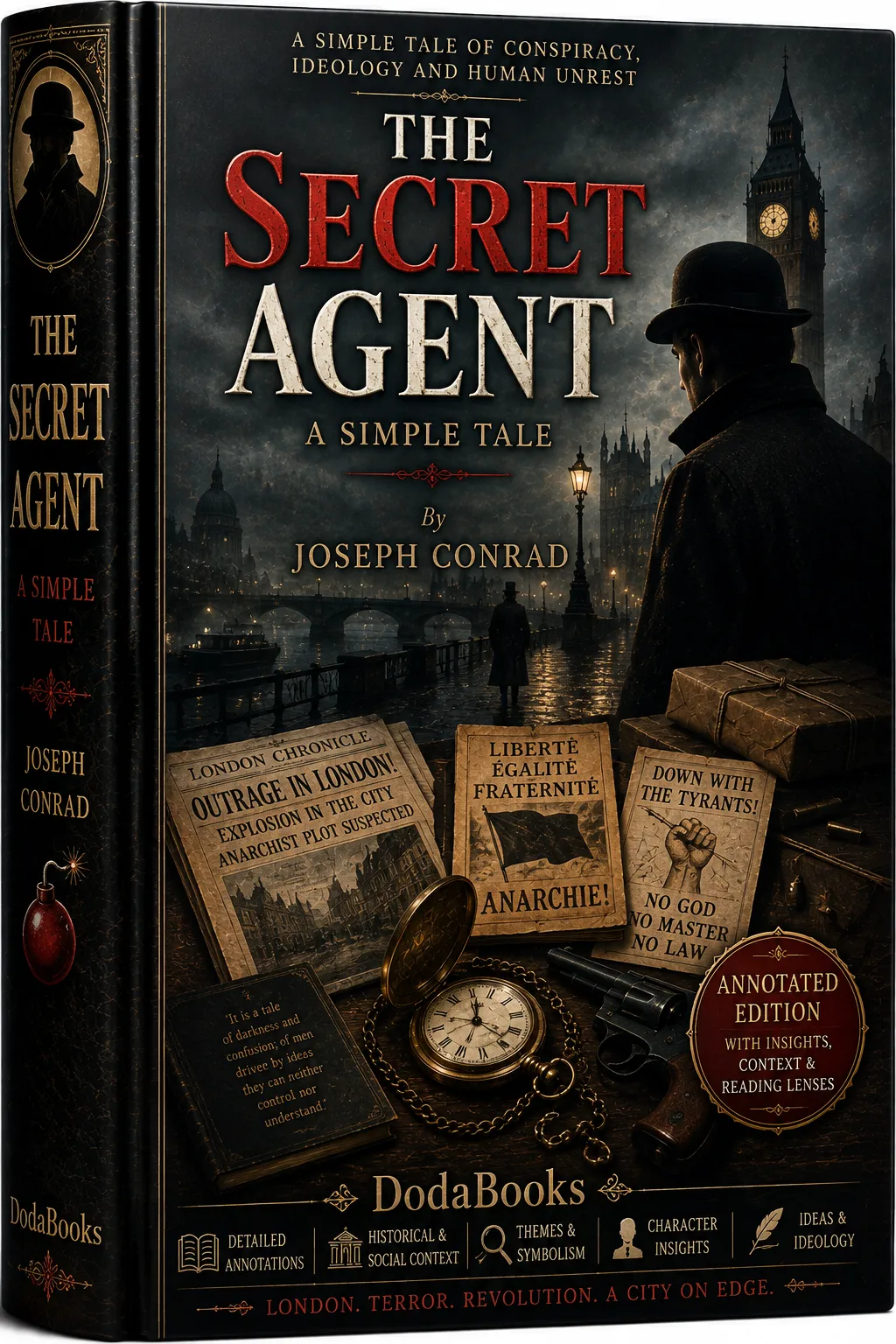
⚗️ Experience Joseph Conrad’s Dark Masterpiece in Full
Read the definitive unabridged edition of Conrad’s chilling political thriller. The DodaBooks Annotated Edition of The Secret Agent delivers:
- ✅ Complete Unabridged 1907 Text — All 13 chapters in authoritative prose
- 📜 Historical & Anarchist Annotations — Explanations of the real 1894 Greenwich bombing and Edwardian police politics
- ✒️ Typeset for Modern E-Readers — Beautiful typography, clean navigation, and responsive tables
- 🔒 100% DRM-Free Ownership — Yours forever across Kindle, Kobo, iPad, and desktop
- 📥 Instant EPUB Delivery — Download your digital copy immediately