The Secret Agent Characters: Verloc, Winnie, and Stevie Explained
In The Secret Agent: A Simple Tale (1907), Joseph Conrad constructed one of the most psychologically penetrating and morally unsettling casts in modern fiction. The novel strips away the romantic glamour of espionage, politics, and revolution to reveal a squalid underworld of self-deceiving bureaucrats, predatory ideologues, and ordinary domestic souls trapped in misunderstandings that lead to horrific violence.
At the core of the tragedy lies a fundamental breakdown of human communication: Adolf Verloc lives with a woman whose true motives he never suspects; Winnie Verloc lives with a man whose true employment she deliberately refuses to see; and innocent Stevie is torn apart by political theories he cannot comprehend.
This comprehensive character analysis unpacks the psychological motivations, symbolic functions, and tragic trajectories of every major figure in Joseph Conrad’s masterpiece.
| Character | Role / Profession | Core Psychological Drive | Ultimate Fate |
|---|---|---|---|
| Adolf Verloc | Shopkeeper, double agent, and police informant | Preservation of domestic ease, indolence, and self-esteem | Murdered on his parlor sofa by Winnie with a carving knife |
| Winnie Verloc | Verloc’s wife and shop manager | Maternal devotion to her disabled brother Stevie | Drowns herself in the English Channel following Stevie’s death |
| Stevie | Winnie’s mentally disabled teenage brother | Pure compassion and hyper-sensitivity to suffering | Blown to pieces in Greenwich Park when he stumbles with the bomb |
| The Professor | Fanatical chemist and explosives maker | Absolute nihilism, puritanical hatred of the weak | Walks the London streets untouched, carrying a live bomb in his coat |
| Chief Inspector Heat | Star detective of the Special Crime Division | Professional pragmatism, departmental turf preservation | Humiliated when his private informant arrangement with Verloc is exposed |
| The Assistant Commissioner | Head of the Criminal Investigation Department | Colonial cynicism, moral independence, class survival | Solves the crime in disguise; exposes the foreign embassy plot |
| Mr. Vladimir | First Secretary at the foreign embassy | Aristocratic boredom, intellectual cynicism, state terrorism | Exposed and politically ruined; ostracized by London society |
| Comrade Alexander Ossipon | Anarchist pamphleteer and pseudo-scientist | Parasitic cowardice, sexual vanity, fear of the gallows | Driven half-insane by guilt and terror after robbing Winnie |
🎭 The Domestic Tragedy: The Verloc Household
1. Adolf Verloc: The Complacent Double Agent
Adolf Verloc is literature’s greatest study in the banality and indolence of evil. Heavily built, thick-necked, and lethargic, Verloc views espionage not as a grand ideological crusade, but as an easy way to avoid regular physical labor. He prides himself on being a “respectable” married man with domestic comforts.
Verloc’s fatal flaw is his monumental complacency and self-deception:
- He convinces himself that his eleven years of perfunctory reporting to the foreign embassy have earned him a lifetime pension.
- He convinces himself that his secret relationship with Chief Inspector Heat guarantees him immunity from police harassment.
- Most fatally, he convinces himself that his wife Winnie loves him for his personal charms rather than for the financial shelter he provides to Stevie.
When Mr. Vladimir threatens him with destitution unless he bombs the Greenwich Observatory, Verloc’s cowardly mind casts about for a way to carry the explosive without risking his own skin. He selects Stevie, rationalizing that the boy is expendable and loyal.
Verloc’s psychological blindness reaches monstrous proportions in Chapter 11. After Stevie has been blown to shreds, Verloc expects Winnie to comfort him:
“Do you think I wanted it to happen? The boy stumbled on a root. It was an accident! A man needs his wife at a time like this. You must comfort me, Winnie.”
Reclining comfortably on the sofa, Verloc summons his wife like a servant, completely oblivious to the fact that he has murdered the only thing she lived for. His sudden death at the end of Winnie’s carving knife is the logical conclusion of a life spent ignoring human reality.
2. Winnie Verloc: The Sacrificial Mother-Sister
🔪 WINNIE VERLOC
The Devoted Protector Turned Avenging Angel
“Her philosophy consisted in not taking notice of the things that did not concern her… Life wouldn’t bear much looking into, which was Mrs. Verloc’s private conviction.”
Winnie Verloc is the emotional heart and tragic heroine of the novel. As a young woman, Winnie abandoned the young butcher’s boy she genuinely loved in order to marry Adolf Verloc—an older, unappealing shopkeeper with sufficient income to support her disabled younger brother Stevie and their aging mother.
Winnie’s entire survival strategy rests on willful blindness: she deliberately avoids asking questions about Verloc’s foreign visitors, his mysterious trips abroad, or the shady pamphlets in the front window. She believes that as long as the household is quiet and Stevie is fed, the surface of life will hold.
When Chief Inspector Heat reveals the scorched piece of coat collar bearing the address she stitched with her own hands, Winnie’s universe implodes. She realizes that her marriage was an illusion, her sacrifice was wasted, and the man she served for seven years has fed her brother into an explosive meat-grinder.
Winnie’s transformation from silent domestic manager to cold-blooded executioner is one of Conrad’s finest achievements:
“She was free. Her identity was gone with the identity of the boy. Her whole life had been a bargain; and the other party had violated the contract.”
When Winnie stabs Verloc on the sofa, she acts with the silent precision of an executioner. Her subsequent betrayal by Comrade Ossipon leaves her utterly alone, and her suicide from the night steamer into the black waters of the English Channel represents the tragic extinguishing of a soul whose single virtue—love—was exploited by every man she met.
Why She Matters
Winnie embodies the silent, sacrificial suffering of working-class women in Edwardian society. Her tragedy proves that deliberate ignorance cannot protect vulnerable innocents from institutional violence.
3. Stevie: The Holy Innocent Destroyed by Abstraction
🌀 STEVIE
The Hypersensitive Soul in a Brutal World
“Stevie’s compassion was so intense that it bordered on physical agony… The world was too hard for his tender skin.”
Stevie is Winnie’s mentally disabled younger brother, a gentle, hyper-sensitive boy whose psychological condition resembles modern autism or neurodivergence. Stevie possesses an extreme, visceral empathy for all suffering creatures:
- When he hears Karl Yundt talk about the poor being ground down by capitalism, Stevie shakes with terror.
- When an impoverished cab driver whips an emaciated horse, Stevie weeps aloud, wanting to take the horse’s burden upon his own shoulders.
- In moments of stress, Stevie retreats into drawing endless concentric circles and spirals on paper—a visual symbol of the chaotic, dizzying madness of the modern world.
Stevie is pure moral instinct untainted by cynicism or self-interest. Because he loves Verloc and believes Verloc is “good,” he eagerly agrees to carry the heavy parcel to Greenwich Park.
When Stevie trips on an exposed root in the fog, the bomb detonates, reducing his gentle body to an unrecognizable mass of shredded flesh. In Conrad’s grim moral universe, the pure innocent is the first casualty of political theory.
Why He Matters
Stevie represents the innocent, defenseless victims who are routinely sacrificed by political ideologues, terrorists, and state agents in pursuit of abstract social goals.
Unpack the tragic psychology of the Verloc household with our comprehensive annotated guide.
📖 Get the Annotated Edition at DodaBooks →⚗️ The Extremists: Idealists, Fanatics & Parasites
1. The Professor: The Apotheosis of Nihilism
💣 THE PROFESSOR
The Untouchable Agent of Pure Annihilation
“He was an artist in explosives, living on water and biscuits in an attic… He had no love for humanity, but he had a supreme contempt for the legal order.”
The Professor is the most chilling figure in the novel. An emaciated, hollow-cheeked chemist who lives on bread crusts in a squalid London garret, The Professor has abandoned all human connection, politics, and compassion in pursuit of one perfection: the perfect bomb.
The Professor carries an active glass flask of nitroglycerine in his coat pocket at all times, his fingers perpetually resting on a rubber detonator bulb:
“I have twenty seconds’ delay for my own escape; but if a policeman touches my collar, I squeeze this bulb, and we both blow into eternity.”
The Professor disdains both the police and his fellow anarchists. He regards men like Michaelis and Ossipon as cowardly talkers who secretly crave middle-class comfort. For The Professor, the only true revolutionary act is the total, uncompromised annihilation of the weak and the institutions that protect them.
In the final sentence of the novel, Conrad leaves The Professor walking through the crowded London streets: “unsuspected and deadly, like a pest in the street full of men.”
Why He Matters
The Professor is modern literature’s first psychological portrait of the lone-wolf, suicidal extremist—an individual whose absolute contempt for life makes him immune to conventional legal and moral deterrence.
2. Comrade Alexander Ossipon: The Parasitic Charlatan
Comrade Alexander Ossipon (nicknamed “The Doctor”) is an ex-medical student who lives by writing sensationalist political pamphlets and seducing vulnerable, working-class women for their savings. Ossipon views human behavior through the pseudo-scientific lens of Cesare Lombroso’s criminal anthropology, obsessively classifying people based on ear shapes, skull measurements, and signs of “degeneracy.”
When Winnie approaches him for help after Verloc’s death, Ossipon feigns passionate romantic devotion, intending to steal Verloc’s hidden fortune. But when he discovers Verloc’s butchered corpse on the sofa, Ossipon’s pseudo-scientific courage vanishes into sheer, gibbering cowardice. He steals Winnie’s cash, leaps from the moving boat-train, and abandons her to drown. In Chapter 13, Ossipon is reduced to a haunted, drunken wreck, paralyzed by guilt and terror.
3. Michaelis & Karl Yundt: The Parlor Revolutionaries
- Michaelis (“The Ticket-of-Leave Apostle”): A gentle, morbidly obese ex-convict who spent fifteen years in prison for his minor role in an armed prison-van breakout. Michaelis is a saintly utopian who believes that capitalism will dissolve peacefully through historical inevitability. Supported by a wealthy aristocratic patroness, Michaelis writes memoirs in a countryside cottage, completely detached from the violent reality of the movement.
- Karl Yundt: An ancient, toothless, and gout-ridden terrorist who postures as a ferocious advocate of bloodshed. Yundt sneers at Michaelis’s gentleness, declaring that capital must be destroyed by fire and iron, yet he is physically helpless and depends on an elderly female domestic to nurse him.
🏛️ The State & The Police: The Men of Order
┌─────────────────────────────────────────────────────────────┐
│  The Law & The Lawless: Mirror Images                       │
│  "The terrorist and the policeman both come from the same   │
│   basket." — Chief Inspector Heat                          │
├─────────────────────────────────────────────────────────────┤
│  Chief Inspector Heat vs. The Assistant Commissioner        │
│  Heat protects informants for personal departmental pride;  │
│  The Commissioner uses disguise to subvert police politics. │
├─────────────────────────────────────────────────────────────┤
│  Mr. Vladimir vs. The Anarchists                            │
│  The diplomat uses state power to engineer the exact terror │
│  he claims to despise, treating human lives as pawns.       │
└─────────────────────────────────────────────────────────────┘
1. Chief Inspector Heat: The Sporting Policeman
Chief Inspector Heat is Scotland Yard’s star detective. Heat views his profession as a civilized game with clear rules: regular thieves and burglars are respectable opponents who play by the book.
Heat’s moral failure is his bureaucratic self-interest. He treats Adolf Verloc as a private asset to be protected at all costs, even if it means falsely framing the innocent, gentle Michaelis for the Greenwich bombing to ensure his own departmental glory.
2. The Assistant Commissioner: The Detached Investigator
The Assistant Commissioner is Heat’s superior, an aristocratic gentleman with years of colonial administrative service in tropical colonies. Disillusioned with metropolitan police corruption, he sees through Heat’s departmental games.
When he discovers that Michaelis’s arrest would embarrass his own wife’s social circle, the Assistant Commissioner adopts an undercover disguise, interrogates Verloc in Soho, and brings the truth directly to the Home Secretary, Sir Ethelred, effectively outmaneuvering Heat and exposing the foreign embassy.
3. Mr. Vladimir: The Aristocratic Provocateur
First Secretary at the foreign embassy, Mr. Vladimir is a witty, polyglot aristocrat who treats international politics as a cynical parlor game. Vladimir represents state-sponsored terrorism in its purest form: he orders an attack on the Greenwich Observatory not out of political necessity, but out of arrogant boredom and diplomatic manipulation, treating Verloc and Stevie as expendable pawns.
Stevie's Neurodivergence Decoded
Read historical analyses of how Victorian psychiatry classified sensory hypersensitivity and developmental disability in 1907.
The Real Greenwich Bomber
Discover the true historical story of Martial Bourdin, the 1894 French anarchist whose death inspired Conrad's plot.
Cesare Lombroso & Ossipon
Understand Conrad's sharp parody of 19th-century criminal phrenology through Comrade Ossipon's pseudoscientific obsession with skulls.
The Professor's Ideological Roots
Explore how Conrad based The Professor on real Russian nihilists and Johann Most's notorious dynamite manuals.
The Symbolism of the Carving Knife
Examine how the domestic carving knife bridges the boundary between kitchen comfort and violent retribution in Chapter 11.
Winnie's Suicide & Victorian Law
Historical context on the legal treatment of suicide and the execution of female murderers in Edwardian Britain.
❓ Frequently Asked Questions
Why does Winnie Verloc love Stevie so intensely?
Winnie was essentially a mother to Stevie from childhood. Their father was a violent, abusive man, and Winnie routinely placed her own body between her father's blows and her defenseless brother. Her love for Stevie is the only pure, selfless emotion in her life, forming the sole foundation of her identity.
Why is Chief Inspector Heat afraid of The Professor?
Chief Inspector Heat knows that The Professor carries an active glass bomb in his coat pocket wired to an instantaneous detonator. Heat understands that any attempt to arrest The Professor on the street would result in mutual annihilation, killing both men and dozens of civilian bystanders.
Does Adolf Verloc feel guilty about Stevie's death?
No. Verloc feels only shock, self-pity, and fear for his own legal safety. He views Stevie's death as an unfortunate accident caused by the boy's clumsiness on a tree root. Verloc is so self-centered that he expects Winnie to comfort him for his ruined nerves.
What do Stevie's drawings of circles symbolize?
Stevie's obsessive drawings of concentric circles and spirals symbolize the chaotic, dizzying madness of modern industrial civilization. They represent an attempt by a pure, sensitive mind to impose order on a world of incomprehensible violence and cruelty.
Why does Conrad conclude the novel with The Professor?
Conrad ends the novel with The Professor walking through the crowded London streets to emphasize that fanatical nihilism cannot be eliminated by conventional police methods. The Professor remains an eternal, invisible menace lurking in the heart of modern civilization.
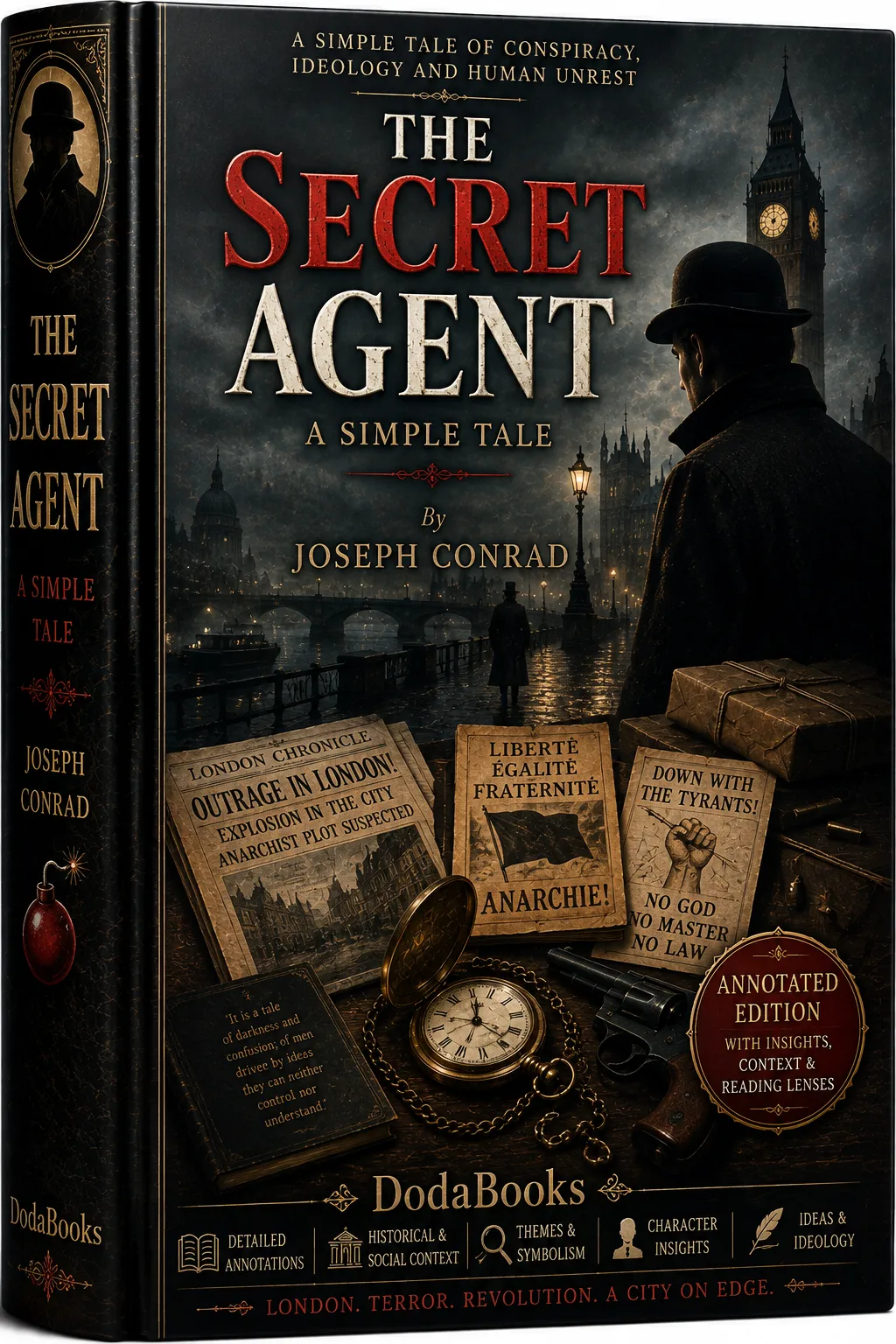
⚗️ Meet the Unforgettable Figures of Conrad’s Masterpiece
Unpack the brilliant character psychology of Edwardian London’s underworld. The DodaBooks Annotated Edition of The Secret Agent delivers:
- ✅ Complete Unabridged 1907 Text — Follow Verloc, Winnie, Stevie, and the Professor in original prose
- 📜 Exhaustive Character Footnotes — Context on Victorian policing, anarchist history, and Lombrosian phrenology
- ✒️ Clear Structural Design — Elegant typography, clean margins, and readable formatting
- 🔒 100% DRM-Free Ownership — Yours forever across Kindle, Kobo, iPad, and Android
- 📥 Instant EPUB Delivery — Download your digital copy immediately