The Problem of Cell 13 Summary: Complete Plot & Step-by-Step Escape Breakdown
Published in 1905 in the Boston American and later collected in The Thinking Machine (1907), Jacques Futrelle’s The Problem of Cell 13 stands as the undisputed masterpiece of the “impossible escape” genre. Where traditional locked-room mysteries challenge a detective to explain how a murderer entered and fled a sealed room, Futrelle inverted the entire formula: he placed his brilliant detective inside an impenetrable maximum-security prison cell and challenged him to break out using nothing more than logic and ordinary human intellect.
At the heart of the story is Professor Augustus S. F. X. Van Dusen, Ph.D., LL.D., F.R.S., M.D., famously dubbed “The Thinking Machine.” Van Dusen firmly believes that the human brain is an infallible mechanism capable of overcoming any physical barrier. When two aristocratic colleagues scoff at his claim, Van Dusen accepts a wager: he agrees to be locked into Cell 13—the death-row cell of Chisholm Prison—under round-the-clock surveillance, stripped of all tools and weapons, and promises to walk free within seven days.
This comprehensive guide delivers an exhaustive plot summary of The Problem of Cell 13, providing a day-by-day chronological breakdown of Van Dusen’s imprisonment and revealing the ingenious scientific mechanics behind his escape.
| Phase / Day | Key Setting | Major Plot Developments | Crucial Scientific / Escapist Clues |
|---|---|---|---|
| The Wager | Van Dusen’s Boston Study | Intellectual debate with Dr. Ransome and Alfred Fielding; conditions of the bet established | Van Dusen insists: “Nothing is impossible. Two and two always make four.” |
| Day 1: Incarceration | Chisholm Prison (Cell 13) | Van Dusen stripped, searched, and locked into the granite death cell by Warden Baker | Allowed five $10 bills, one $5 bill, shoe polish, two toothpicks, socks, and shoes |
| Days 2–3: Reconnaissance | Cell 13 & Prison Yard | Mysterious white linen notes found in yard; Van Dusen catches a sewer rat | Van Dusen requests tooth powder; splinters toothpick into pen; explores drain pipe |
| Days 4–5: Psychological Warfare | Prison Corridors | Warden Baker triples guards; unexplained light short-circuits terrify prison staff | Van Dusen uses electrical wiring to create arc lights; recruits reporter Hutchinson Hatch |
| Day 6: The Siege | Cell 13 & Yard Wall | Mysterious sounds beneath the yard; acid smuggled to cut bars; search reveals nothing | Van Dusen uses nitric acid and linen cord; sewer conduit connected to outside river |
| Day 7: The Grand Escape | Warden Baker’s Office | At the stroke of the deadline, Cell 13 is empty; Van Dusen enters the warden’s parlor | The complete step-by-step logical chain revealed before the stunned witnesses |
🎲 Part 1: The Intellectual Wager
The story opens in the comfortable Boston library of Professor Augustus S. F. X. Van Dusen. The diminutive scientist—possessing a massive domed head, pale face, coke-bottle spectacles, and a perpetually irritable demeanor—is hosting an evening discussion on chess and mathematics with two distinguished friends:
- Dr. Charles Ransome: A renowned surgeon and skeptical rationalist.
- Alfred Fielding: A wealthy aristocrat and amateur intellectual.
The conversation turns to the human mind. Ransome and Fielding argue that certain physical obstacles—such as a modern steel-and-granite penitentiary—render intellectual genius completely powerless. Van Dusen flatly rejects their fatalism:
“The mind is the master of all things. There are no problems that the human intellect cannot solve. A man can apply his brain to an escape-proof prison cell just as he would apply it to an equation in calculus. Within seven days, I will walk out of any cell you choose.”
Amused and convinced of his folly, Ransome and Fielding arrange with the state authorities to test Van Dusen in Chisholm Prison, the most modern and escape-proof correctional facility in the state.
                 [THE PROTOCOL OF THE WAGER]
                              │
     ┌────────────────────────┴────────────────────────┐
     ▼                                                 ▼
[PHYSICAL PRISON CONFINEMENT]              [STRICT CONDITIONS]
- Placed in Cell 13 (Death Row)            - Thorough physical search
- Solid granite walls, iron grating        - No outside visitors or mail
- Patrolled yard, armed wall sentries      - 7-day time limit to the hour
The Conditions of the Confinement
Warden Baker of Chisholm Prison takes personal pride in the absolute security of his facility. To ensure the test is fair and uncompromised, strict rules are agreed upon:
- Van Dusen will be placed in Cell 13, the isolated cell reserved for condemned murderers awaiting the electric chair.
- The professor is subjected to a rigorous physical strip-search. He is stripped of all money, watches, pocketknives, and matches.
- He is permitted only the plain clothes he stands in: shirt, trousers, socks, and shoes.
- At his own specific request, he is allowed to retain:
- Five ten-dollar bills and one five-dollar bill ($55 total).
- Two wooden toothpicks.
- His pocket handkerchief.
- A small container of tooth powder.
- He is permitted no visitors, letters, or outside communication. The cell will be searched three times daily, and armed guards will patrol outside his grated window day and night.
🔒 Part 2: Inside Cell 13 (Days 1–3)
Day 1: The Inspection
Warden Baker escorts Van Dusen into Cell 13 and locks the double-bolted steel door. The cell is a grim vault of heavy granite blocks, measuring eight by ten feet, with a concrete floor. High on the rear wall sits a small window barred with solid steel rods, looking out across an enclosed yard toward a thirty-foot outer perimeter stone wall patrolled by guards with rifles. In the corner sits a disused iron water pipe connected to an old subterranean drainage conduit.
Warden Baker smiles indulgently, bidding the professor good luck. Van Dusen ignores him, sits down on the iron cot, rests his massive head in his hands, and closes his eyes in silent contemplation.
Day 2: The Mysterious Note
On the morning of the second day, a prison guard patrolling the yard beneath Van Dusen’s window finds a scrap of white cloth pinned down by a small piece of plaster. Unfolding it, the guard is shocked to find an ink message written in microscopic, elegant lettering:
“Only another week, and I will be free.”
Warden Baker rushes to Cell 13 and demands an explanation. How did Van Dusen write the note? He had no pen, no ink, and no paper!
- A rigorous search of the cell reveals nothing.
- The cot, blanket, walls, and floor are thoroughly tapped with hammers.
- Van Dusen merely sneers: “Two and two always make four, Warden. Why look for a mystery when logic answers all questions?”
             [THE FIRST ESCAPE ENGINE: CELL IMPROVISATION]
                                  │
     ┌────────────────────────────┼────────────────────────────┐
     ▼                            ▼                            ▼
[THE INK]                    [THE PEN]                   [THE PAPER]
- Shoe blacking mixed with   - Splintered wooden         - Strips torn from the
  water and tooth powder       toothpick nib               white linen shirt hem
Day 3: The Sewer Rat and the Yard Note
On the third afternoon, another note lands in the yard. This note is wrapped around a five-dollar bill and addresses anyone who finds it, instructing them to deliver it to Hutchinson Hatch, a tenacious investigative reporter for the Boston American.
Suspicion deepens when the night guard hears strange scuffling noises in Cell 13. Looking through the peephole, the guard sees Van Dusen crouching on the floor, holding a large grey sewer rat by the scruff of its neck. Around the rat’s leg is tied a thread of white linen. When the guard enters, Van Dusen calmly releases the rat, which scurries down into the iron drainpipe in the floor.
Warden Baker orders the floor drain soldered shut with an iron plate. He posts armed sentries directly below the window and orders hourly inspections throughout the night.
⚡ Part 3: Psychological Warfare and Sabotage (Days 4–6)
Day 4: The Voice in the Darkness
As twilight falls on Day 4, the guards outside the prison wall hear bizarre, disembodied whispering coming from the top of the masonry wall. When searchlights sweep the parapet, no one is there.
Simultaneously, the incandescent electric light bulb inside Cell 13 begins flickering erratically. A loud popping sound echoes through the death-tier corridor, followed by a bright flash of blue electrical flame and a shower of sparks. The entire wing’s electrical circuit blows out, plunging the death tier into pitch-black darkness.
When emergency lanterns are brought, Van Dusen is found sitting peacefully in his bunk. He complains petulantly that the prison’s electrical wiring is substandard and demands that his light be restored.
       [VAN DUSEN'S DUAL ASSAULT: INNER CELL & OUTER RECON]
                                │
       ┌────────────────────────┴────────────────────────┐
       ▼                                                 ▼
[INTERNAL CELL TACTICS]                       [EXTERNAL COORDINATION]
- Short-circuits lighting wiring              - Hutchinson Hatch decodes messages
- Unravels linen thread for communication     - Employs steeplejack for wire rig
- Corrodes window grating with acid           - Locates drainage conduit exit river
Day 5: The Acid and the Smugglers
Warden Baker is growing visibly haggard. He has stationed armed guards inside the corridor, outside the window, and on top of the outer wall, yet impossible events continue:
- A guard in the yard discovers a small glass vial containing a pungent, fuming liquid: nitric acid.
- A second message addressed to Hutchinson Hatch is intercepted, containing detailed mathematical calculations regarding the water flow of the nearby river and the dimensions of the prison drainage pipes.
Warden Baker conducts a surprise raid on Cell 13. Every stitch of Van Dusen’s clothing is removed and examined under magnifying glasses. The warden’s men rip up the bedding and examine the stone blocks with chisels. Still, they find no tools, no keys, and no weapons. Van Dusen shivers in his blanket, sarcastically rebuking the warden:
“You look for magic, Baker. You search the bed, but you do not search your own mind. It is your own rules that are releasing me.”
Day 6: The Final Warning
On the evening of the sixth day, Van Dusen politely informs Warden Baker:
“Warden, tomorrow is the seventh day. At precisely eight o’clock in the evening, I will keep my appointment with Dr. Ransome and Mr. Fielding in your private office. I suggest you post your best men.”
Warden Baker goes into a state of total siege:
- He places two armed guards inside the corridor right outside Cell 13’s steel door.
- Two guards stand in the courtyard directly under the window with shotguns.
- Four sentries patrol the yard wall with high-powered searchlights.
- The warden locks himself in his office with the cell keys in his pocket, vowing that the prisoner will only leave in chains.
🚪 Part 4: The Empty Cage and the Reveal (Day 7)
The Stroke of Eight
At 7:45 p.m. on the seventh evening, Dr. Charles Ransome and Alfred Fielding arrive at Chisholm Prison, ushered into Warden Baker’s private reception office. The warden is triumphant:
“Gentlemen, your professor is still safely inside Cell 13. My guards have stared through his peephole every five minutes. The bet is yours.”
At 7:55 p.m., the warden telephone rings frantically. The guard at Cell 13 stammers in horror: the cell is empty.
Warden Baker, Ransome, and Fielding sprint down the stone corridor to Cell 13. The heavy steel door is locked; the padlocks are undisturbed. Peering through the grating, they see an empty cot and a discarded blanket. The window bars are in place; the floor drain plate is intact.
As the warden fumbles with his keys in sheer panic, the outer door of his own office quietly clicks open. Walking into the room, impeccably groomed, wearing clean trousers, and brushing dust from his coat, is Professor Augustus S. F. X. Van Dusen.
“Good evening, gentlemen,” Van Dusen rasps, adjusting his glasses. “Two and two make four, not some of the time, but all of the time. I believe I am five minutes early.”
       [THE COMPLETE ESCAPE CHAIN DECODED]
                        │
 1. [IMPROVISED TOOLS] ──► Toothpick + shoe polish + linen shirt strips
                        │
 2. [SEWER RECON]     ──► Caught sewer rat proved drain led to river
                        │
 3. [HATCH CONTACT]   ──► Threw cash/messages to enlist external ally
                        │
 4. [SMUGGLING]       ──► Hatch tied nitric acid/wire to line at drain mouth
                        │
 5. [ACID ON BARS]    ──► Dissolved mortar & severed window bar; replaced with putty
                        │
 6. [BLACKOUT]        ──► Shorted arc light to blind guards & create panic
                        │
 7. [EXIT & RE-ENTRY] ──► Slipped through yard in blackout; walked into front office
🧩 Part 5: The Step-by-Step Escape Mechanics
Sitting in Warden Baker’s office, Van Dusen condescendingly explains the logical sequence that made his escape inevitable:
Step 1: The Improvised Writing Apparatus
- Paper: Van Dusen tore narrow strips from the bottom hem of his white linen shirt.
- Ink: He scraped black shoe polish from his shoes, mixed it in his palm with water from his drinking cup and a pinch of tooth powder to give it body and permanence.
- Pen: He splintered a wooden toothpick against the masonry wall, fashioning a remarkably fine pen nib.
Step 2: The Sewer Rat and the Conduit
Van Dusen observed that Cell 13 was formerly connected to a gravity-fed rainwater drain. The presence of a large sewer rat proved that the subterranean pipe was open to the outside world—specifically, to the tidal river that flowed behind the prison walls.
- By tying a piece of thread to the rat, he verified that the pipe reached an exit point beyond the inner security perimeter.
- When the warden soldered the floor grate, it made no difference: Van Dusen had already mapped the sewer route.
Step 3: Outside Coordination via Hutchinson Hatch
Van Dusen threw strips of cloth wrapped around five-dollar bills out the window into the prison yard. He knew that underpaid yard laborers would pick up the money and, tempted by the promise of more cash, deliver the notes to Hutchinson Hatch, the reporter.
- Hatch rented a rowboat, located the underwater sewer conduit outlet on the riverbank, and followed Van Dusen’s instructions.
- Hatch tapped on the drainage pipes from the outside, creating the mysterious “voices” heard by the wall sentries.
Step 4: The Nitric Acid and the Window Bars
Through the pipe conduit (before it was sealed) or via strings dropped from the window, Hatch delivered a small bottle of nitric acid and a fine wire.
- Van Dusen applied nitric acid to the mortar holding the bottom of the window bars and to one steel rod. The acid quietly ate away the iron over three days.
- To conceal his work during the three daily searches, Van Dusen mixed bread dough with dust and shoe polish, creating an artificial dark putty that perfectly disguised the severed joints.
Step 5: The Electrical Short-Circuit
Van Dusen noticed that the electric light wires in his cell were uninsulated near the ceiling socket.
- Using fine wire smuggled by Hatch, he created a dead short-circuit across the positive and negative leads.
- This blew out the main fuse for the entire death block, plunging the corridor into darkness and causing confusion that allowed him to work undetected.
Step 6: The Final Flight
On the final evening, when the scheduled blackout was triggered by a pre-arranged short-circuit:
- Van Dusen removed the severed window bar.
- He squeezed his small, frail body through the narrow opening and dropped into the dark yard.
- During the confusion of the blackout and electrical fires, he slipped through the yard gate left open by distracted guards responding to the emergency.
- Instead of attempting to scale the thirty-foot perimeter wall, he walked calmly into the administration building, waited behind a curtain in the warden’s corridor, and entered the warden’s office as soon as the officials rushed down to the cells.
🧠 Literary Significance and Fair Play Legacy
The Problem of Cell 13 occupies a foundational position in detective fiction for three primary reasons:
- The Invention of the “Fair-Play” Escape: Every tool Van Dusen used was explicitly declared at the beginning of the story (the shoe polish, the toothpicks, the tooth powder, the money). Futrelle never cheated his readers; the solution relied strictly on chemistry, physics, and human nature.
- The “Thinking Machine” Archetype: Van Dusen established the cold, anti-social, hyper-rational sleuth that would influence characters from Hercule Poirot and Nero Wolfe to modern figures like Sherlock’s TV incarnation and Dr. Gregory House.
- The Tragic Fate of Jacques Futrelle: Futrelle’s life was tragically cut short in April 1912 aboard the RMS Titanic. After ensuring his wife Lily boarded Lifeboat 9, Futrelle remained on the deck, smoking a cigarette with John Jacob Astor as the ship went down. His legacy endures through this single, perfect locked-room puzzle.
❓ Frequently Asked Questions
Why did Professor Van Dusen request tooth powder when entering Cell 13?
Van Dusen used the tooth powder for two critical scientific purposes: he mixed it with water and black shoe polish to create a durable, opaque ink for writing messages, and he used its chalky abrasive texture to polish and prepare wire surfaces for electrical short-circuits.
How did Van Dusen communicate with reporter Hutchinson Hatch from inside the cell?
Van Dusen wrote microscopic messages on strips of white linen torn from his shirt hem, wrapped them around five-dollar bills, and threw them out his barred window into the prison yard. Yard workers found the money and delivered the notes to Hatch, who followed Van Dusen's exact instructions from outside the prison walls.
Did Van Dusen actually escape the prison walls, or just his cell?
Van Dusen escaped both. He removed the acid-weakened window bar, dropped into the prison yard, and in the panic caused by an electrical blackout and fire, slipped through the inner yard gates. He then entered the warden's administration building, proving that physical walls cannot restrain a determined intellect.
Is The Problem of Cell 13 a short story or a novel?
It is a novelette (long short story) of approximately 9,500 words. Because of its brisk pacing and self-contained plot, it is typically read in a single sitting of 1 to 2 hours.
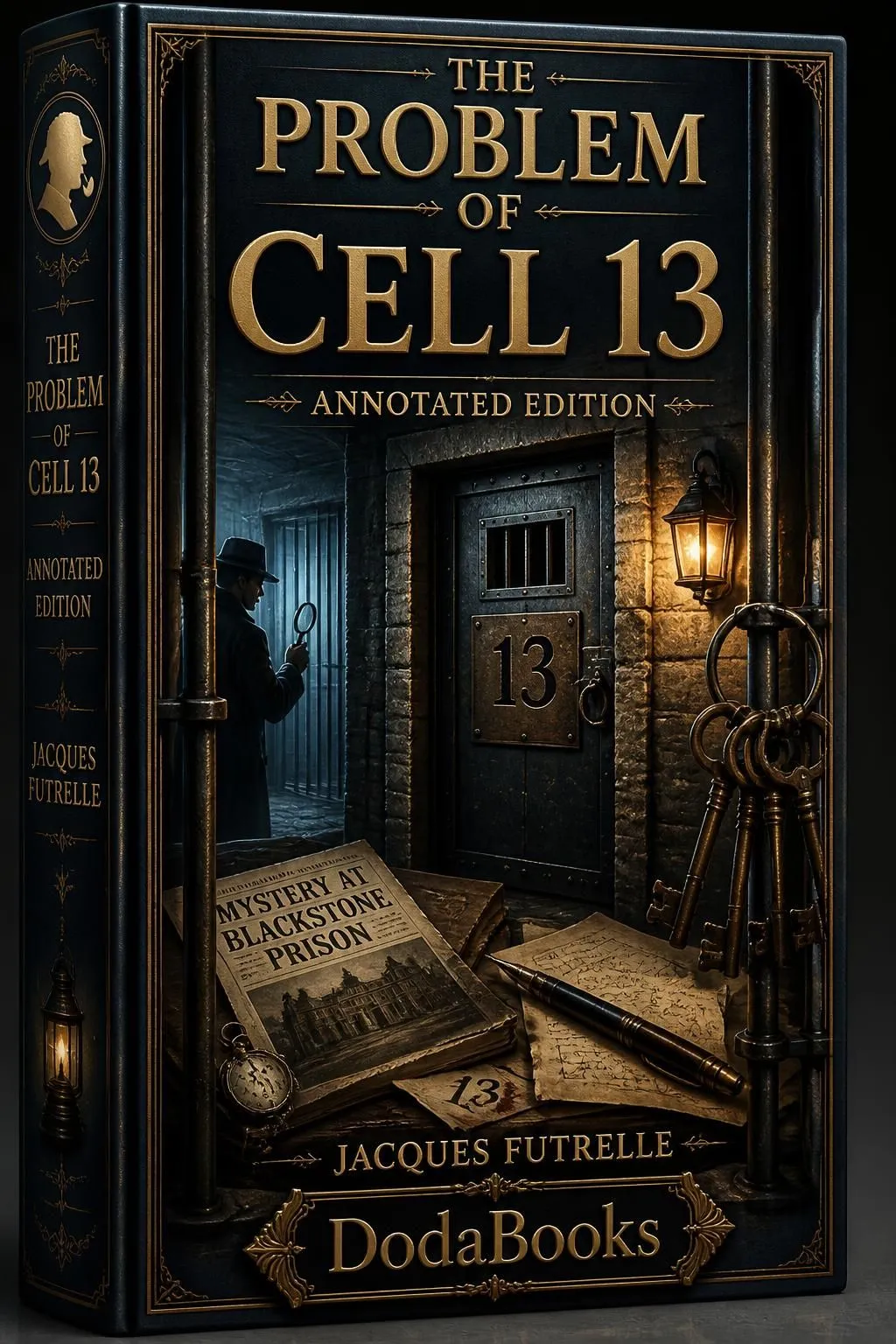
🔒 Experience Detective Fiction’s Greatest Impossible Escape
Step inside the legendary death cell with “The Thinking Machine.” The DodaBooks Annotated Edition of The Problem of Cell 13 includes:
- ✅ Complete Unabridged 1905 Text — Jacques Futrelle’s original, uncut classic
- 🗂️ 50 Color-Coded Annotation Cards — Decoding every clue, chemical reaction, and misdirection
- 🧩 Interactive Clue Map — Follow Van Dusen’s scientific escape step-by-step
- 🔒 100% DRM-Free Freedom — Yours forever across Kindle, Kobo, iPad, and Android
- 📥 Instant EPUB Download — Download and begin reading immediately