The Problem of Cell 13 Characters: The Thinking Machine, Van Dusen & Warden Baker Explained
When Jacques Futrelle published The Problem of Cell 13 in the autumn of 1905, he created one of the most distinctive and memorable intellectual protagonists in the history of detective fiction: Professor Augustus S. F. X. Van Dusen, universally known as “The Thinking Machine.”
In the late Victorian and Edwardian eras, mystery writers were striving to move beyond the shadow of Arthur Conan Doyle’s Sherlock Holmes. While others leaned into psychic sleuths or scientific forensic doctors, Futrelle took deduction to its absolute, unsparing extreme. He envisioned a man who was not merely a detective, but an intellectual calculator—a being who regarded human emotion, physical strength, and institutional authority as irrelevant variables beside the unyielding laws of mathematics.
Against this cold titan of pure logic, Futrelle positioned an array of vividly drawn characters: the proud, bureaucratic Warden Baker, the skeptical medical establishment represented by Dr. Charles Ransome, and the resourceful young journalist Hutchinson Hatch.
This comprehensive character guide examines the figures of The Problem of Cell 13, exploring their psychological dynamics, narrative functions, and the philosophical conflict between institutional force and individual reason.
| Character | Role / Archetype | Defining Physical & Personality Traits | Core Narrative Function |
|---|---|---|---|
| Prof. Augustus S. F. X. Van Dusen | Protagonist / “The Thinking Machine” | Diminutive, frail, massive head (size 8 hat), pale face, coke-bottle lenses, petulant | Proves that human intellect can overcome any physical barrier; escapes Cell 13 |
| Warden Baker | Chief Antagonist / Institutional Authority | Pompous, confident, methodical; utterly convinced of Chisholm Prison’s security | Serves as the guardian of the status quo; outwitted by his own rules and staff |
| Hutchinson Hatch | Crucial Ally / The Modern “Watson” | Energetic, shrewd, practical investigative reporter for the Boston American | Acts as Van Dusen’s hands and eyes outside the prison; executes technical tasks |
| Dr. Charles Ransome | Skeptic / Academic Challenger | Distinguished medical scientist, dignified, conservative rationalist | Originates the wager by arguing that physical prisons render intellect helpless |
| Alfred Fielding | Accomplice to the Wager / Gentleman | Wealthy Boston aristocrat, patron of intellect, fair-minded | Finances the bet and coordinates with prison authorities for the grand experiment |
| The Prison Guards & Turnkeys | Working-Class Foils / Human Variables | Underpaid, superstitious, susceptible to minor bribes and startled by blackouts | Represent the human flaws in bureaucratic systems that logic can manipulate |
🧠 Professor Augustus S. F. X. Van Dusen: “The Thinking Machine”
1. Physical Grotesque vs. Intellectual Titan
Futrelle deliberately designed Van Dusen’s physical appearance as a sharp, almost grotesque contrast to the tall, athletic, aristocratic figure of Sherlock Holmes. Van Dusen is physically insignificant, bordering on frail:
- He is slight, stoop-shouldered, and possesses negligible physical strength.
- His face is pale, bloodless, and crowned with a thick mop of untidy yellow-white hair.
- His eyes are tiny, watery slits hidden behind thick, coke-bottle spectacles.
- Dominating his entire appearance is his enormously oversized head—the story notes that he requires a size eight hat, an anatomical anomaly suggesting a brain too vast for an ordinary human skull.
“He was a small man, slight, with drooping shoulders, and upon his face was that pallor which comes only from long study in dark rooms. But his head! It was a great, round, dome-like forehead… He looked like a human brain walking upon two spindly legs.”
              [THE ANATOMY OF "THE THINKING MACHINE"]
                                │
     ┌──────────────────────────┴──────────────────────────┐
     ▼                                                     ▼
[PHYSICAL FRAILTY]                             [INTELLECTUAL SUPREMACY]
- Stoop-shouldered, sickly                     - Size 8 domed skull
- Diminutive height, weak muscles              - Pure mathematical calculus
- Completely defenseless in combat             - Absolute confidence in logic
2. The Core Philosophy: “Two and Two Make Four”
Van Dusen’s entire existence is anchored in a single, inflexible epistemological premise:
“Two and two make four, not some of the time, but all of the time. They cannot make five. They cannot make three. Nothing is impossible to the human intellect when it applies the rules of cold logic.”
To Van Dusen, life is an equation. A maximum-security prison is not an impenetrable fortress of stone and steel; it is simply a physical structure built by ordinary human minds, operating according to fixed physical laws (gravity, chemistry, electrical circuits) and governed by predictable human psychology (greed, routine, fear). Because those laws are constant, any system designed by man can be unpicked by a superior intellect.
3. Arrogance and Social Isolation
Van Dusen is emphatically not a warm, endearing gentleman. He is abrasive, impatient, irritable, and socially contemptuous. He holds medical degrees, law degrees, and scientific fellowships (Ph.D., LL.D., F.R.S., M.D.), yet he views universities and polite academic societies with disdain.
When challenged, he does not debate; he issues caustic ultimatums. He accepts the Cell 13 wager not out of financial greed (he cares nothing for money), but out of sheer intellectual vanity. He cannot tolerate the assertion that any material structure is beyond the comprehension of the human mind.
🔍 The Great Detective Archetype: Van Dusen vs. Holmes vs. Father Brown
To understand Van Dusen’s historical significance, one must compare him to his famous literary contemporaries:
                  ┌─────────────────────────────────────────┐
                  │    THREE SCHOOLS OF CLASSIC DETECTION   │
                  └────────────────────┬────────────────────┘
                                       │
         ┌─────────────────────────────┼─────────────────────────────┐
         ▼                             ▼                             ▼
┌───────────────────┐        ┌───────────────────┐         ┌───────────────────┐
│ SHERLOCK HOLMES   │        │ PROF. VAN DUSEN   │         │ FATHER BROWN      │
│ (Conan Doyle)     │        │ (Jacques Futrelle)│         │ (G.K. Chesterton) │
│ - Forensic detail │        │ - Pure mathematical│        │ - Moral empathy   │
│ - Physical action │          deduction         │         │ - Intuition       │
│ - Master of       │        │ - Zero physical   │         │ - Spiritual       │
│   disguise        │          force; pure logic │           forgiveness       │
└───────────────────┘ └───────────────────┘ └───────────────────┘- Sherlock Holmes (Forensic Observation): Holmes relies heavily on empirical sensory data—cigar ash, bicycle tire treads, mud splatters on a trouser leg. Holmes is also an accomplished boxer, fencer, and disguise artist who takes joy in physical adventure. Van Dusen, by contrast, despises disguise and physical combat; he solves problems sitting with his eyes closed, treating the universe as a pure mathematical theorem.
- Father Brown (Moral Psychology): Created by G. K. Chesterton, Father Brown solves crimes by entering empathetically into the sinful soul of the criminal, seeking repentance and spiritual redemption. Van Dusen has zero interest in morality, sin, or redemption; he views crime and escapes purely as technical puzzles to be calculated and dismissed.
- The Thinking Machine (Pure Rational Calculus): Van Dusen is the purest expression of the “brain in a jar” archetype. He represents the late nineteenth-century scientific triumphalism that believed mathematics, chemistry, and physics could conquer all mysteries of existence.
🏛️ Warden Baker: The Voice of Institutional Complacency
Warden Baker of Chisholm Prison is the human embodiment of bureaucratic security. He is not a cruel or sadistic warden; on the contrary, he is polite, professional, and proud of his institution. Chisholm Prison represents the cutting edge of 1905 correctional engineering:
- Solid granite masonry blocks impenetrable to picks.
- Electric perimeter lights and telephone communications.
- Multi-tier checkpoints and armed perimeter guards.
       [WARDEN BAKER'S PSYCHOLOGICAL BREAKDOWN]
                           │
 1. [CONFIDENT SKEPTICISM] ──► Laughs off Van Dusen's wager; trusts stone & iron
                           │
 2. [ANXIOUS BEWILDERMENT] ──► Intercepts yard notes; cannot explain the ink
                           │
 3. [PARANOID VIGILANCE]   ──► Solder drains, triples sentries, strips bedding
                           │
 4. [SUPERSTITIOUS DREAD]  ──► Mystified by blackouts and ghostly wall whispers
                           │
 5. [TOTAL HUMILIATION]    ──► Discovers empty cell while key remains in his pocket
The Flaw of Institutional Thinking
Baker’s downfall is his inability to see past physical forms:
- He searches Van Dusen’s clothing three times daily with magnifying glasses, looking for traditional escape tools: files, keys, revolvers, saws.
- He fails to realize that Van Dusen’s most dangerous tools are his allowed personal items: shoe polish, two toothpicks, tooth powder, and five-dollar bills.
- Baker assumes that rules and routines prevent escapes. In reality, Van Dusen uses the prison’s rigid routines—the fixed hours of yard patrols, the predictable shifts of guards, the standard wiring of the electric lamps—as the very gears of his escape engine.
When Van Dusen calmly steps into Baker’s office at 7:55 p.m. on the seventh day, Baker’s defeat is total. The warden’s keys are still in his pocket; his guards are still staring through the bars of an empty room.
📰 Hutchinson Hatch: The Pragmatic External Agent
While Van Dusen provides the intellect, the physical execution of the escape requires an operative on the outside. That operative is Hutchinson Hatch, an ambitious young investigative reporter for the Boston American.
1. The Dynamic of the Partnership
Hatch is the narrative stand-in for the reader. He is intelligent, practical, energetic, and courageous, yet completely baffled by the professor’s bizarre requests. Unlike Dr. Watson, who primarily observes Holmes and records his exploits, Hatch is an active logistical coordinator:
- When he receives Van Dusen’s mysterious notes thrown from the window, Hatch does not question the professor’s sanity; he immediately goes to work.
- Hatch rents a boat to inspect the river outlet of the prison sewer.
- Hatch purchases nitric acid, locates a reliable steeplejack, and rigs the external wires that produce the eerie sounds on the prison wall.
2. The Rise of the American Reporter Hero
Hatch represents a uniquely American Edwardian literary type: the intrepid metropolitan journalist. In 1905, American newspapers like the Boston American and New York World were engines of investigative crusading. Hatch knows how to navigate city docks, bribe laborers, interview electricians, and dodge police patrols. Without Hatch’s physical agility and unquestioning loyalty, Van Dusen’s mathematical plans would have remained trapped inside his head.
🏛️ The Catalysts: Dr. Charles Ransome and Alfred Fielding
Dr. Charles Ransome and Alfred Fielding appear only at the beginning and the climax of the story, but their intellectual complacency is the spark that ignites the plot.
       [THE CATALYST MATRIX: THE BOSTON LIBRARY DIALOGUE]
                               │
      ┌────────────────────────┴────────────────────────┐
      ▼                                                 ▼
[DR. CHARLES RANSOME]                         [ALFRED FIELDING]
- Conservative medical establishment          - Wealthy Boston socialite
- Believes physical stone beats mind          - Finances the test; arranges access
- Provokes Van Dusen's professional fury      - Acts as neutral arbiter of the bet
1. Dr. Charles Ransome
Dr. Ransome represents conservative academic orthodoxy. A physician who works with physical tissue, disease, and bones, he believes that material reality is ultimately superior to abstract thought:
“A man cannot think himself through a stone wall, Van Dusen. When a man is locked behind two feet of granite, his brain is as helpless as his hands.”
It is this specific assertion—that physical matter can defeat human intellect—that infuriates Van Dusen. To the professor, Ransome’s attitude is an insult to the Enlightenment. The wager is Van Dusen’s method of publicly humiliating Ransome’s materialist dogma.
2. Alfred Fielding
Fielding provides the social leverage and financial credibility for the wager. A wealthy, cultured gentleman with political connections in Boston, Fielding secures the state governor’s permission and arranges the terms with Warden Baker. Fielding represents the civilized spectator who treats intellectual debate as high sport, perfectly willing to wager money to witness an unprecedented spectacle of human ingenuity.
🎭 The Human Variables: The Prison Staff and Society
A crucial thematic revelation of The Problem of Cell 13 is that all security systems depend on imperfect human components.
Van Dusen outwits the prison not by defeating iron bars, but by exploiting human nature:
- Mercenary Labor: The yard laborers and low-ranking guards are poorly paid. When they find five-dollar bills thrown out of a cell window, their immediate economic self-interest overpowers their sense of institutional duty. They deliver the notes to Hatch because the money is real, whereas the prison’s rules are abstract.
- Superstition and Panic: When Van Dusen short-circuits the electric lights and Hatch creates strange vibrations on the walls, the guards do not respond with rational analysis; they panic. They whisper about ghosts, supernatural occurrences, and death curses in the condemned cell. Their superstitious terror blinds them to the physical wires running across the ceiling.
❓ Frequently Asked Questions
Why is Professor Van Dusen nicknamed "The Thinking Machine"?
The nickname was bestowed upon him by a Russian grandmaster whom Van Dusen defeated in a game of chess. Van Dusen had never played chess in his life; he simply spent one morning studying the mathematical rules of the game, applied pure logic to the board, and crushed the champion in a dozen moves, prompting the defeated master to exclaim that he was playing against an unfeeling "thinking machine."
Does Van Dusen appear in other detective stories by Jacques Futrelle?
Yes. Professor Van Dusen is the star of nearly fifty detective short stories and two full-length novels written by Futrelle between 1905 and 1912, including classics like "The Scarlet Thread," "The Crystal Gazer," and "The Chase of the Golden Plate."
What role does Hutchinson Hatch play in the wider Thinking Machine series?
Hatch is Van Dusen's permanent investigative partner throughout the entire series. Whenever an impossible crime, mysterious poisoning, or locked-room disappearance occurs in Boston, Hatch brings the details to the professor's library and conducts the legwork required to verify Van Dusen's deductive hypotheses.
Why did Jacques Futrelle make Van Dusen so physically frail and unlikable?
Futrelle wanted to strip the detective archetype of romantic sentimentality and athletic heroics. By making Van Dusen physically weak, petulant, and anti-social, Futrelle emphasized that the detective's only weapon was pure, unadulterated intellect, creating a memorable character who triumphed solely through the power of mind.
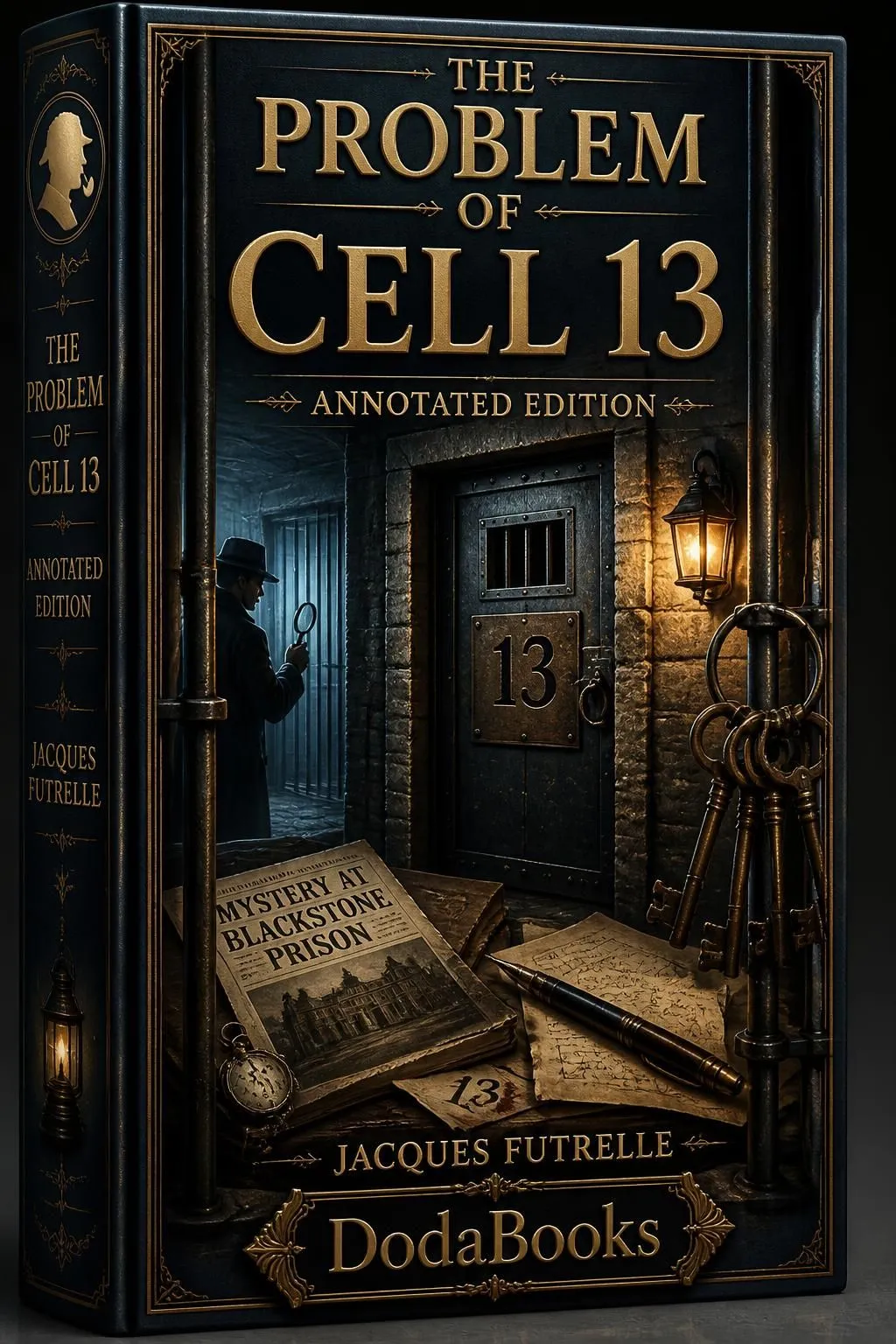
🔒 Uncover the Mind of “The Thinking Machine” in Full
Explore the greatest impossible-escape mystery ever written with full character notes and historical commentary. The DodaBooks Annotated Edition of The Problem of Cell 13 features:
- ✅ Complete Unabridged 1905 Classic — Jacques Futrelle’s timeless locked-room masterpiece
- 🗂️ 50 Interactive Annotation Cards — Passage-specific notes explaining character psychology
- 🧩 The Full Clue Map — Follow Van Dusen’s brilliant scientific deductive trail
- 🔒 100% DRM-Free Ownership — Read across Kindle, Kobo, iPad, and Android without limits
- 📥 Instant EPUB Delivery — Download your digital copy in seconds