The Pirate
Sir Walter Scott’s Majestic 1822 Waverley Romance of Storm-Swept Shetland Cliffs, Norse Superstitions, Shipwrecks, and High-Seas Buccaneering
In the summer of 1814, Sir Walter Scott embarked on a six-week voyage around the rugged coasts of Scotland and the Northern Isles aboard the lighthouse tender of the Northern Lighthouse Commission, accompanied by the legendary civil engineer Robert Stevenson (grandfather of Robert Louis Stevenson). Fascinated by the stark, treeless beauty of the Shetland and Orkney archipelagos, their ancient Scandinavian dialect, and their rich oral folklore of mermaids, seal-folk, and Viking jarls, Scott gathered the atmospheric materials that would blossom into one of his most unique and enchanting Waverley novels: The Pirate (1822).
Set at the close of the seventeenth century—an era when the ancient Norse laws and Udal land tenures of the Northern Isles were being aggressively superseded by Scottish feudal governance—The Pirate dramatizes the collision between ancient island traditions and the violent, predatory modernity of the maritime world. It remains one of Scott’s most evocative romances, inspiring later maritime classics from James Fenimore Cooper’s The Pilot to Stevenson’s Treasure Island.
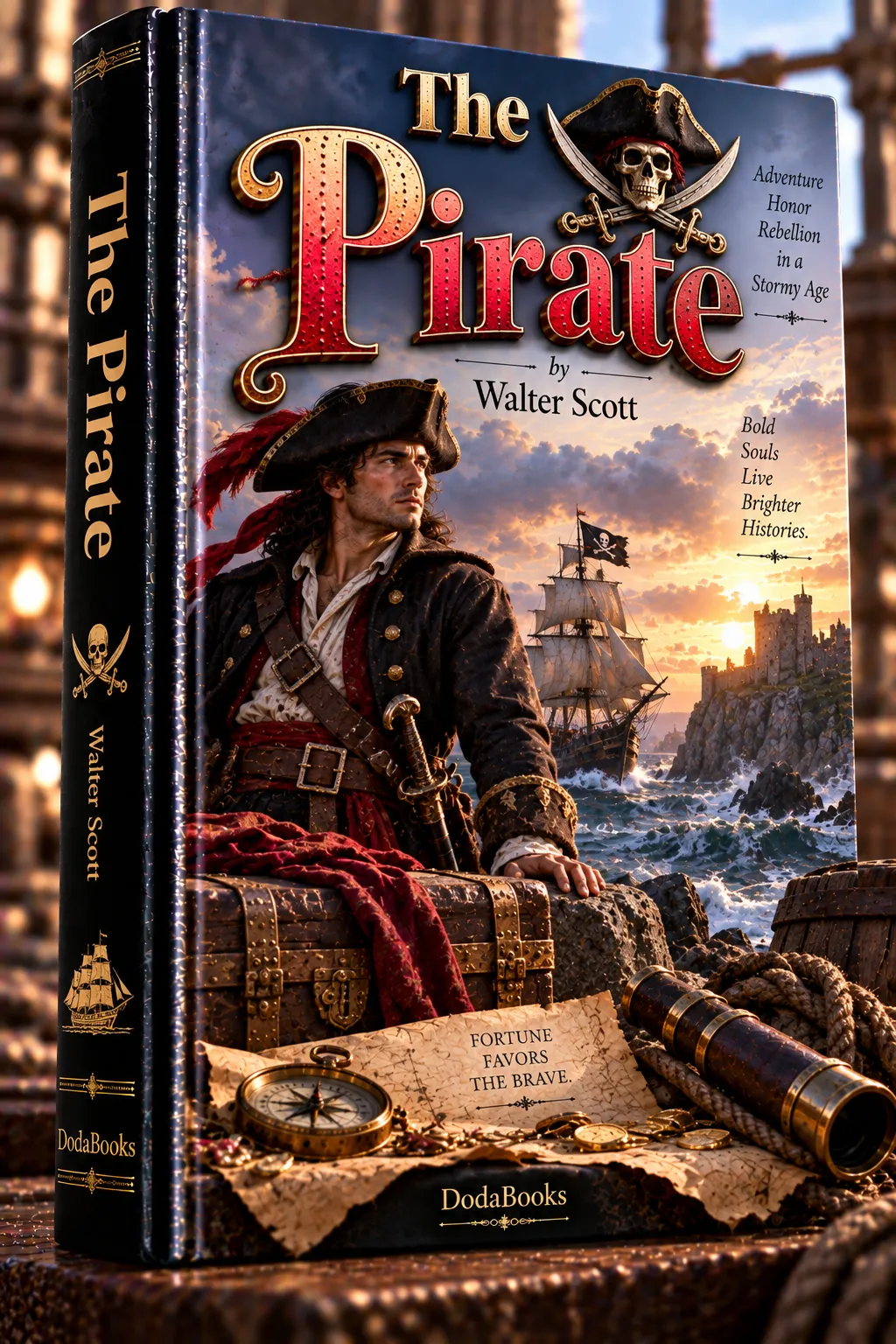
Journey to the Storm-Swept Shetland Isles
Read Sir Walter Scott's legendary maritime epic in an annotated edition featuring Norse-Scottish dialect glossaries, geographical guides to Shetland and Orkney, and Scott's 1814 lighthouse journal notes.
Get The Pirate by Walter ScottThe Shipwreck and the Swashbuckler: Cleveland’s Arrival
The novel opens dramatically on the wave-battered southern tip of Shetland, where a catastrophic gale drives an armed brig onto the jagged rocks of Sumburgh Head. The sole survivor of the wreck, rescued through the daring bravery of young Mordaunt Mertoun, is the mysterious and charismatic Captain Clement Cleveland—a dashing, swaggering buccaneer whose vessel was engaged in predatory raiding across the Spanish Main.
Cleveland’s arrival shatters the peaceful equilibrium of the island community, sparking a web of romantic rivalry and family drama centered on the household of Magnus Troil, the proud Udaller (hereditary Norse chieftain) of Burgh-Westra:
- Minna Troil: The elder daughter, serious, romantic, and captivated by the ancient Viking sagas of her ancestors. Dazzled by Cleveland’s tales of naval battles and tropical plunder, Minna romanticizes the pirate as a modern sea-king and Norse berserker.
- Brenda Troil: The younger sister, cheerful, sensible, and affectionate, who sees Cleveland not as a mythic hero, but as a dangerous outlaw whose lawless trade brings misery and blood. Brenda’s heart remains loyal to Mordaunt Mertoun.
- Mordaunt Mertoun: The noble island youth whose estrangement from his reclusive father and growing jealousy of Cleveland lead him into deadly peril across the cliffs and sounds of the archipelago.
Norna of the Fitful-Head: The Pytho-Nisse of the North
Towering over the human drama of The Pirate is one of Scott’s greatest supernatural character creations: Norna of the Fitful-Head. Based on an actual eccentric woman, Bessie Millie of Stromness, who sold favorable winds to sailors when Scott visited Orkney in 1814, Norna is an imposing, half-demented prophetess who genuinely believes she commands the winds, tides, and weather through ancient Runic incantations.
Clothed in moss-green robes, dwelling in desolate mountain stone towers above the crashing Atlantic breakers, Norna embodies the dying embers of Scandinavian paganism:
“The tempest is my brother, and the northern meteor my lamp. Think ye that Norna of the Fitful-Head needs your mortal aid when the spirits of Odin ride the storm cloud?”
Scott handles Norna’s supernatural pretensions with his trademark Enlightenment skepticism and romantic sympathy. While the reader understands that Norna’s “powers” stem from acute weather observation, coincidences, and mental trauma caused by a youthful tragedy, her commanding presence lends the narrative an eerie, mythic majesty that elevates it far above standard pirate adventures.
Unrivaled Norse-Scottish Atmosphere
Scott's brilliant depiction of late-17th-century Shetland and Orkney, capturing Scandinavian dialects, ancient Udal land customs, and Viking sagas.
Complex Pirate Psychology
Clement Cleveland is not a caricature of villainy, but a complex, tragic figure caught between genuine love and the inescapable curse of his bloody trade.
Epic Maritime Set-Pieces
Heart-pounding scenes of shipwrecks on Sumburgh Head, pilot boat rescues in roaring tidal roosts, and the naval bombardment of Kirkwall harbour.
Explanatory Dialect & Lore Footnotes
Extensive annotations explaining Shetland Norn dialect words, Orkney standing stones, Norse mythology, and the historical pirate John Gow.
The Historical Inspiration: The Real Pirate of Orkney
Behind the romantic fiction of Clement Cleveland lies the true historical saga of John Gow, a notorious Orkney-born pirate whose armed vessel The Revenge terrorized shipping in the English Channel and the Mediterranean in the 1720s. Returning to his native Orkney Islands under the alias Captain Smith, Gow posed as a respectable merchant and wooed the daughter of a local gentleman before his true identity was discovered. Trapped on the island of Eday by resolute local gentry, Gow was captured, tried at the Old Bailey, and hanged at Execution Dock in London in 1725.
Scott took this dark local history and transformed it into a profound moral inquiry into the romantic illusion of piracy. While Minna Troil initially envisions pirates as noble Robin Hoods of the sea, the arrival of Cleveland’s drunken, ruthless crew in Kirkwall brutally shatters her romantic illusions, forcing her to confront the grim reality of murder, betrayal, and violence.
Experience the Classic Tale of Sea and Storm
Read the definitive edition of The Pirate with complete explanatory notes, historical introductions, and glossaries of Shetland terms.
Get The Pirate on DodaBooksUdal Law vs. Feudal Encroachment: The Legal Tragedy of the Isles
Beneath the swashbuckling adventures and romantic intrigues of The Pirate lies a profound legal and cultural conflict that Scott, as a practicing Scottish advocate and legal antiquarian, understood with acute precision: the historical destruction of Udal law by Scottish feudalism.
For centuries under Norse rule, the inhabitants of Orkney and Shetland held land by “odal” or “udal” right—an ancient allodial land tenure where property was held directly from the gods and ancestral lineage, free of any feudal lord, land charter, or vassalage duties:
- The Chieftain Magnus Troil: Troil represents the stubborn dignity of the old Udallers. He refuses to hold his estate by feudal parchment from the Scottish Crown, boasting that his ancestors possessed their acres before kings or parliaments existed. He treats his tenants with patriarchal generosity and views feudal charters as legalized theft.
- The Feudal Tax-Collectors and Factors: Scott introduces characters like Triptolemus Yellowley, a pedantic Scottish agricultural improver who seeks to impose mainland farming methods and feudal rents upon a population whose survival depends on fishing, peat cutting, and seal hunting.
- The Erosion of Linguistic Heritage: Scott documents the twilight of the Norn language—the ancient West Norse dialect spoken in Shetland and Orkney until the eighteenth century. Through songs, proverbs, and island superstitions, Scott preserves fragments of this unique Scandinavian culture as it was being absorbed into Scots and English.
Landscape and the Sublime in Scott’s Maritime Writing
Scott’s descriptions of the maritime scenery of the Northern Isles represent some of the finest prose poetry in nineteenth-century literature:
“The Roost of Sumburgh roared like a monster lashed to fury, its conflicting currents churning the sea into a wilderness of white foam. Above the cliffs, the sea-fowl circled in screaming clouds, while beneath the abyss the black reef waited like a tomb for the shattered hull.”
The novel takes readers from the dramatic sea-cliffs of Fitful Head and the ancient stone circles of Stenness in Orkney, to the fortified palace of Earl Patrick Stewart in Kirkwall. Scott makes the Northern landscape a central character in the drama—a wild, elemental presence that tests the courage and moral resolve of every soul who braves its storms.
Why The Pirate Remains a Cornerstone of Scottish Romanticism
Scott did for the Northern Isles what he had done for the Scottish Highlands in Waverley: he rescued a vanishing culture, its songs, and its ancient Norse memories, preserving them for global literature in an unforgettable romantic epic.
The Annotations in the DodaBooks Edition
The DodaBooks curated edition of The Pirate includes:
- Comprehensive Shetland & Norn Glossary: Definitions of archaic Norse-Scots words (voe, udaller, scathold, foukd, trow).
- Historical Essay on John Gow and the 1725 Trial: Documenting the real-life pirate whose career inspired the novel.
- Topographical Notes: Guiding readers through the real geography of Mainland Shetland, the Fair Isle, and Orkney.
Download Sir Walter Scott's Masterpiece Today
Step onto the storm-swept cliffs of Shetland and experience one of the greatest maritime romances in the English language.
Download the Edition NowFrequently Asked Questions
When and where is The Pirate set?
The novel is set in the late 17th century (circa 1690–1700) across the remote Shetland and Orkney Islands off the northern coast of Scotland, during a period when ancient Norse customs and laws were clashing with Scottish feudal rule.
Who was the real-life pirate that inspired Scott's novel?
The character of Captain Clement Cleveland was inspired by John Gow, an Orkney-born pirate who returned to his native islands in 1725 under an assumed name before being captured by local islanders and hanged at Execution Dock in London.
Who is Norna of the Fitful-Head?
Norna is an eccentric and imposing prophetess who claims supernatural descent from Norse gods and believes she controls the winds and storms. She was based on Bessie Millie, an elderly woman Scott met in Stromness who sold 'favorable winds' to sailors.
How did Scott's 1814 voyage influence the novel?
In 1814, Scott toured the lighthouses of Scotland and the Northern Isles with engineer Robert Stevenson. His diary entries and observations of island folklore, Norse dialects, and scenery formed the direct foundation for the setting and characters of The Pirate.
Where can I get the complete annotated ebook?
The complete, annotated digital edition of The Pirate is available for immediate download at DodaBooks at https://dodabooks.com/ebook/the-pirate-by-walter-scott/.