The Picture of Dorian Gray Chapter Summary: Complete Plot Breakdown
Oscar Wilde’s only published novel, The Picture of Dorian Gray (1891), is one of the most intoxicating and morally complex works of late-Victorian literature. Beneath its surface of dazzling epigrams, exquisite London drawing rooms, and aesthetic philosophy lies a sinister, supernatural horror story—a modern Faustian tragedy about vanity, moral decay, and the devastating price of eternal youth.
When the exceptionally handsome young aristocrat Dorian Gray wishes that Basil Hallward’s painted portrait of him could grow old while he remains forever youthful, he enters into an unspoken, demonic pact. For eighteen years, Dorian indulges in every forbidden vice and debauchery known to Victorian London. His body remains unblemished, luminous, and pure, while hidden in a locked attic schoolroom, the painted canvas rots with the physical and spiritual deformities of his crimes.
Whether you are studying the novel for class, analyzing Wilde’s aesthetic philosophy, or diving into Victorian Gothic literature, this complete chapter-by-chapter summary covers all 20 chapters of the definitive 1891 edition.
⚡ The Picture of Dorian Gray at a Glance
- Author: Oscar Wilde (first serialized in Lippincott’s Monthly Magazine in 1890; expanded to 20 chapters with the famous Preface in 1891)
- Setting: High-society Mayfair drawing rooms, dingy East End opium dens, and the country estate of Selby Royal in 1880s–1890s London
- Core Themes: Aestheticism vs. morality, the duality of human nature, vanity and the Faustian bargain, art as a mirror of the soul
- The Turning Point: Chapter 7, when Sybil Vane's onstage failure prompts Dorian’s cruel rejection, causing the portrait’s sneer to appear for the first time
- The Climax: Chapter 13, when Dorian murders Basil Hallward in front of the rotting portrait
🎨 Act I: The Temptation and the Wish (Chapters 1–4)
Chapter 1: Basil Hallward’s Studio and Lord Henry’s Philosophy
The novel opens in the intoxicating, sunlit London studio of artist Basil Hallward, rich with the heavy scent of roses and lilac. Basil is conversing with his aristocratic, cynical friend Lord Henry Wotton. Basil has just completed a life-sized, full-length portrait of an extraordinarily handsome young man.
Lord Henry is captivated by the painting and urges Basil to exhibit it at the Grosvenor Gallery. Basil refuses, confessing a strange secret: he has put too much of his own soul into the canvas. Basil explains that meeting this young man, Dorian Gray, sparked a complete artistic renaissance within him. However, Basil fears Lord Henry’s corrupting influence, begging him not to poison the young man’s pure, innocent mind with cynical wit.
Chapter 2: Dorian Arrives and the Faustian Wish
Dorian Gray arrives at the studio. While Basil puts the finishing touches on the canvas, Lord Henry charms Dorian with a radical, seductive philosophy of “New Hedonism.” Henry warns Dorian that youth and beauty are the supreme virtues of human existence, but that they fade with terrifying rapidity:
“Youth! Youth! There is absolutely nothing in the world but youth!… Time is jealous of you, and wars against your lilies and your roses. You will become sallow, and hollow-cheeked, and dull-eyed.”
When Basil finishes the painting, Dorian gazes upon his own portrait for the first time. Awakened by Lord Henry’s words to the tragic transience of his youth, Dorian is overcome by grief and jealousy. In a moment of volcanic emotion, he utters his fateful wish:
“How sad it is! I shall grow old, and horrible, and dreadful. But this picture will remain always young… If it were only the other way! If it were I who was to be always young, and the picture that was to grow old! For that—for that—I would give everything! Yes, there is nothing in the whole world I would not give! I would give my soul for that!”
Basil, disturbed by Dorian’s distress, grabs a palette knife to slash the canvas, but Dorian stops him, declaring that destroying the portrait would be like committing murder. Basil gifts the portrait to Dorian, and Dorian leaves to attend the theater with Lord Henry, ignoring Basil’s quiet protests.
Chapter 3: Lord Henry Investigates Dorian’s Past
Lord Henry visits his uncle, Lord Fermor, to research Dorian Gray’s family background. He learns that Dorian is the grandson of the tyrannical, ruthless Lord Kelso. Dorian’s beautiful mother, Lady Margaret Devereux, had eloped with a penniless junior military officer, whom Lord Kelso had killed in a staged duel before Margaret died young of grief.
Fascinated by Dorian’s tragic, romantic heritage, Lord Henry attends a society luncheon where he dazzles the guests with cynical epigrams about marriage, philanthropy, and pleasure. Watching Dorian hang on his every word, Henry resolves to treat the handsome youth as a psychological experiment, deliberately molding his soul.
Chapter 4: Dorian Falls for Sybil Vane
One month later, Dorian visits Lord Henry’s home in Mayfair. Dorian enthusiastically confesses that he has fallen desperately in love with a seventeen-year-old actress named Sybil Vane, who performs Shakespeare at a shabby, dilapidated theater in London’s East End.
Dorian is enraptured by her talent, calling her a divine genius of art who transforms into Juliet, Ophelia, and Rosalind each night. Although they have barely exchanged words and Sybil knows him only as “Prince Charming,” Dorian announces that he intends to marry her. Lord Henry listens with detached amusement, viewing Dorian’s passionate infatuation as a thrilling new stage in his psychological observation.
🎭 Act II: The First Cruelty and the Hidden Canvas (Chapters 5–10)
Chapter 5: The Vane Family in the Slums
The narrative shifts to the modest, impoverished lodgings of the Vane family. Sybil Vane is ecstatic, talking endlessly of her handsome “Prince Charming.” Her mother, an aging, theatrical woman obsessed with theater debts, worries whether the wealthy gentleman intends to marry Sybil or merely ruin her virtue.
Sybil’s sixteen-year-old brother, James Vane, is preparing to depart London to work as a sailor on a ship bound for Australia. James is rough, protective, and intensely suspicious of the aristocratic stranger. Walking with Sybil in Hyde Park, James spots Dorian’s carriage. Before departing, James makes a solemn, terrifying vow to his mother:
“If that man harms my sister, I will find him, and wherever he is, I will kill him like a dog.”
Chapter 6: The Society Dinner Before the Theater
Lord Henry and Basil Hallward dine at the Bristol before heading to the East End to watch Sybil perform. Basil is stunned and skeptical of Dorian’s sudden engagement to an obscure, penniless actress, but expresses hope that love will protect Dorian from cynical influences. Dorian arrives radiant with excitement, declaring that Sybil’s sacred beauty has elevated his soul above Lord Henry’s hedonistic philosophies.
Chapter 7: Sybil’s Failure and Dorian’s Heartless Rejection
The three gentlemen arrive at the dingy theater to watch Sybil perform as Juliet in Romeo and Juliet. To Dorian’s overwhelming horror, Sybil’s performance is an unmitigated disaster: she speaks her lines flatly, mechanically, and without a trace of passion or life. The audience groans, and Basil and Lord Henry quietly slip out of the theater, trying to console Dorian.
Backstage after the curtain falls, Dorian finds Sybil beaming with radiant joy. She explains that before meeting him, the stage was her only reality; acting was the only way she understood love. But now that she has experienced true, living love with Dorian, the artificial illusions of the theater have lost all meaning:
“You had brought me something higher, something of which all art is but a reflection… I hate the stage. I might mimic a passion that I do not feel, but I cannot mimic a passion that burns me like fire.”
Dorian is disgusted. He did not love Sybil as a flesh-and-blood human being; he loved her as an exquisite work of art. In a rage of narcissistic cruelty, he violently repudiates her:
“You have killed my love! You used to stir my imagination. Now you don’t even stir my curiosity… You are shallow and stupid. My God! how mad I was to love you! What a fool I have been! You are nothing to me now. I will never see you again.”
Leaving Sybil sobbing hysterically on the floor, Dorian wanders the cold London streets all night.
Chapter 8: The Portrait Changes Its Expression
Returning home at dawn, Dorian walks into his library. Glancing at Basil’s portrait, he stops dead in his tracks: the painted face has changed. Around the mouth, there is a distinct, cruel sneer:
“The quivering, ardent sunlight showed him the lines of cruelty round the mouth as clearly as if he had been looking into a mirror after he had done some dreadful thing… The picture was to bear the burden of his shame: that was all.”
Dorian is seized by terror. Remembering his rash wish in Basil’s studio, he realizes the canvas is absorbing the moral reality of his cruelty while his own face remains untouched. Stung by conscience, Dorian resolves to resist Lord Henry’s influence, return to Sybil, beg for her forgiveness, and marry her regardless of consequences. He covers the altered painting with an embroidered Japanese screen.
Later that afternoon, Lord Henry arrives with devastating news: Sybil Vane swallowed prussic acid backstage the previous night and is dead.
Dorian is initially overcome with horror, blaming himself for her suicide. But Lord Henry masterfully manipulates Dorian’s vanity, reframing Sybil’s death not as a sordid tragedy, but as a sublime, romantic masterpiece of drama:
“The girl never really lived, and so she has never really died… Do not waste your tears over Sybil Vane. She was less real than you are.”
Swayed by Henry’s hypnotic rationalizations, Dorian chooses to view her suicide as a poetic sacrifice to art. That evening, he joins Lord Henry at the opera.
Chapter 9: Basil Hallward’s Suspicion
The next morning, Basil arrives at Dorian’s home, deeply shaken by Sybil’s death and expecting to find Dorian devastated by grief. Instead, he finds Dorian cheerful, dressed in exquisite clothes, and eating breakfast. Basil is horrified by Dorian’s cold indifference.
When Basil asks to see his portrait, intending to exhibit it in Paris, Dorian panics with hysterical rage, threatening never to speak to Basil again if he touches the screen. Stunned by Dorian’s ferocity, Basil relents. Basil confesses that the reason he originally refused to exhibit the portrait was that he harbored an idolatrous, passionate worship of Dorian that he feared the world would detect. Relieved that Basil has not uncovered the painting’s supernatural secret, Dorian allows him to leave.
Chapter 10: Locking the Soul in the Attic
Terrified that servants or visitors might uncover his secret, Dorian decides to hide the painting forever. He summons his housekeeper, Mrs. Leaf, to retrieve the key to his old childhood schoolroom at the very top of the mansion.
Dorian hires two burly picture-hangers to haul the heavy, covered frame up the stairs. The attic is a dusty, forgotten room filled with childhood toys and his grandfather’s discarded books. Dorian locks the portrait inside, pockets the only key, and covers the canvas with a magnificent purple satin pall embroidered with gold.
Returning downstairs, Dorian finds a package sent by Lord Henry: a Parisian novel bound in yellow paper (widely understood as Joris-Karl Huysmans’ À rebours) detailing the psychological experiments of an eccentric young aristocrat seeking every exotic sensation. Dorian becomes utterly hypnotized by the book.
🕯️ Act III: The Descent into Hedonism (Chapters 11–13)
Chapter 11: The Years of Poison and Decadence
Chapter 11 covers eighteen years in Dorian’s life, functioning as a tour de force of Decadent literature. Under the toxic spell of the “Yellow Book” and Lord Henry’s mentorship, Dorian becomes the arbiter of London fashion and aesthetic taste.
His face remains untouched by age, displaying the innocent bloom of a twenty-year-old youth. Meanwhile, Dorian leads a secret double life. By day, he hosts magnificent musical evenings and immerses himself in esoteric collections: rare perfumes, ecclesiastical vestments, Renaissance jewels, exotic musical instruments, and medieval tapestries.
By night, he disguises himself in rough sailor clothes and frequents the wretched, fog-choked opium dens and brothels of Whitechapel. Periodically, Dorian creeps up to the locked schoolroom, unlocks the door, and stands before the canvas with a mirror in his hand:
“He would look first at the evil and aging face on the canvas, and then at the fair young face that laughed back at him from the polished glass. The very sharpness of the contrast used to quicken his sense of pleasure. He grew more and more enamoured of his own beauty, more and more interested in the corruption of his own soul.”
Rumors of ruin, scandal, and mysterious deaths begin to follow Dorian. Young men whom he befriended lose their reputations, commit suicide, or are shunned from society. Yet, whenever high society sees his radiant, angelic face, they dismiss the rumors as slander.
Chapter 12: Basil’s Final Confrontation
On the eve of Dorian’s thirty-eighth birthday (November 8), Dorian is walking home through a thick London fog when he encounters Basil Hallward. Basil is on his way to Victoria Station to catch the midnight train to Paris, where he plans to live for six months, but insists on speaking with Dorian first.
Inside Dorian’s library, Basil confronts Dorian about the horrific scandals destroying his reputation: the ruined young aristocrats, the suicide of Lord Henry’s sister’s husband, and the whispers of vile crimes in the slums. Basil pleads with Dorian:
“I don’t believe these rumors at all. At least, I can’t believe them when I see you. Sin is a thing that writes itself across a man’s face… But you, Dorian, with your pure, bright, innocent face, and your marvellous untroubled youth—I can’t believe anything against you. And yet I see you very seldom, and you never come to the studio now… Dorian, they say that you corrupt everyone you become intimate with!”
Basil demands to see Dorian’s soul. Dorian laughs with bitter, demonic malice and tells Basil: “You shall see it yourself tonight. Come up to the schoolroom.”
Chapter 13: The Murder of Basil Hallward
Dorian leads Basil up to the locked attic and pulls away the gold-embroidered satin pall. Basil gazes in utter horror upon the canvas. The painted face is an atrocity: bald, bloated, sneering, its hands dripping with red, glistening blood, and its eyes burning with loathsome corruption. Only the original brushstrokes and the signature in the corner confirm that this was once his portrait of Dorian Gray.
Overcome by terror and grief, Basil falls to his knees and urges Dorian to pray for redemption:
“Pray, Dorian, pray! What is it that one was taught to say in one’s boyhood? ‘Lead us not into temptation. Forgive us our sins. Wash away our iniquities.’ Let us say that together. The prayer of your pride has been answered. The prayer of your repentance will be answered also. I worshipped you too much. I am punished for it. You worshipped yourself too much. We are both punished.”
Hearing Basil pray, an uncontrollable fury boils inside Dorian. He blames Basil for creating the portrait and exposing his shame. Spotting a hunting knife on a chest of drawers, Dorian rushes at Basil from behind, drives the blade into the carotid artery of his neck, and repeatedly stabs him until the artist slumps dead onto the table in a pool of blood.
Dorian steps out of the room, locks the heavy oak door, and checks his pocket watch: it is twenty minutes past one in the morning.
🧪 Act IV: The Disposal and the Shadow of Vengeance (Chapters 14–16)
Chapter 14: Blackmailing Alan Campbell
The following morning, Dorian calmly writes a letter summoning Alan Campbell, a brilliant young chemist who was once an intimate friend before breaking off all contact with Dorian in disgust.
When Campbell arrives, Dorian reveals that there is a dead body in the attic room and demands that Campbell use his chemical expertise and scientific apparatus to utterly dissolve the corpse with nitric acid. Campbell angrily refuses to participate in a criminal cover-up.
Dorian then produces a slip of paper and writes down a secret name—an unspeakable personal scandal involving Campbell’s private life. Blackmailed into submission, Campbell sends for his chemical equipment. Two hours later, the corpse is entirely incinerated, leaving behind only the sickening stench of burned flesh and chemicals in the attic air.
Chapter 15: Lady Narborough’s Dinner Party
That evening, Dorian attends an elegant high-society dinner party at Lady Narborough’s mansion. Lord Henry is present, tossing off brilliant witticisms about food, marriage, and boredom. Dorian acts charming and cheerful, but suffers intense inward paranoia and feverish thirst.
Returning home alone, Dorian burns Basil Hallward’s hat and traveling bag in the fireplace to eliminate all physical evidence. Desperate to escape his guilty conscience and the phantom memory of Basil’s corpse, Dorian changes into rough beggar clothes, hail a hansom cab, and heads east toward the docks.
Chapter 16: The Opium Den and James Vane’s Revenge
Dorian arrives at a filthy, squalid opium den near the London docks:
“There were opium-dens, where one could buy oblivion, dens of horror where the memory of old sins could be destroyed by the madness of sins that were new.”
Inside, he encounters Adrian Singleton, one of the ruined young men he corrupted. As Dorian turns to leave, a drunken prostitute mocks him, calling him “the devil’s bargain” and “Prince Charming.”
Hearing the name “Prince Charming,” a rough sailor leaps up from a dark corner. It is James Vane, Sybil’s brother, who has spent eighteen years searching for his sister’s seducer. James drags Dorian into a dark alley, pins him against a brick wall, and presses a loaded revolver to his head.
Dorian keeps his head. He asks James when his sister died. James answers: “Eighteen years ago.” Dorian laughs and pulls James beneath the yellow streetlight, demanding that he look at his face. James looks upon a fresh, radiant young man who appears barely twenty years old. Horrified that he almost murdered an innocent boy, James releases Dorian and apologizes.
Moments after Dorian disappears into the fog, the prostitute approaches James and asks why he let him go. When James explains that the boy is too young, the woman bitterly curses him:
“I swear on my soul that that man on his knees before you was Dorian Gray! He made me what I am, forty years ago. They say he sold himself to the devil for a pretty face. It’s nigh on eighteen years since he ruined Sybil Vane, and he hasn’t changed a bit!”
Enraged by the trick, James Vane swears he will hunt Dorian down and butcher him.
⚡ Act V: Retribution and the Final Stroke (Chapters 17–20)
Chapter 17: Paranoia at Selby Royal
A week later, Dorian is hosting a fashionable shooting party at his country estate, Selby Royal, entertaining the Duchess of Monmouth and Lord Henry. While laughing with his guests in the conservatory, Dorian glances across the glass panes and spots the face of James Vane pressed against the glass, glaring in at him like a phantom. Overcome by terror, Dorian collapses unconscious onto the floor.
Chapter 18: The Hunting Accident and James Vane’s Death
For three days, Dorian stays locked inside his bedchamber, paralyzed by the fear that James Vane is stalking the estate grounds. On the fourth day, he joins a hunting party in the estate’s game thickets. Sir Geoffrey Clouston aims his shotgun at a hare darting through the brush. Dorian impulsively begs him not to shoot, but Sir Geoffrey fires into the bushes.
A human cry rings out. The gamekeepers drag out the body of a man dressed in rough sailor clothes who was hiding in the thicket. Dorian rides out to the stables to inspect the corpse. Turning over the dead man’s face, Dorian recognizes James Vane. He weeps with relief, realizing that he is finally safe from mortal vengeance.
Chapter 19: The Pretense of Reform
Back in London, Dorian converses with Lord Henry in his library. Dorian claims that he is beginning a new life of moral virtue. As proof, he tells Henry that he recently met a beautiful country girl named Hetty Merton, seduced her, but spared her innocence by leaving her unruined. Lord Henry scoffs at Dorian’s supposed “reformation,” calling it merely an exquisite new form of vanity.
Henry casually mentions that Basil Hallward’s disappearance has baffled Scotland Yard, and notes that Alan Campbell recently committed suicide. When Henry asks Dorian, “What does it profit a man if he gain the whole world and lose his own soul?”, Dorian nervously changes the subject.
Chapter 20: The Death of Dorian Gray
Late that night, Dorian walks through the London streets, tormented by the realization that his vanity and selfishness have destroyed everyone around him: Sybil, Basil, Alan Campbell, and his own soul.
He wonders if his act of “mercy” toward Hetty Merton has softened the horror of his portrait. Creeping upstairs to the locked schoolroom, he lifts the satin cloth.
The portrait is more hideous than ever. Instead of improving, the painted eyes burn with hypocritical cunning, and around the hands, red blood has dripped like wet dew down the canvas. Dorian realizes that his “reformation” was nothing more than an arrogant pose—an attempt to bribe his conscience.
Looking around the room, Dorian spots the knife he used to murder Basil Hallward. Believing that if he destroys the painted evidence of his crimes, he can finally be at peace, Dorian seizes the blade:
“It had kept him awake at night… It had brought melancholy across his passions. It had been like conscience to him. Yes, it had been conscience. He would destroy it. He looked round, and saw the knife that had stabbed Basil Hallward… As it had killed the painter, so it would kill the painter’s work, and all that that meant. It would kill the past, and when that was dead he would be free… He seized the thing, and dug it into the picture.”
A blood-curdling shriek of agony rings out from the top of the mansion, so terrible that pedestrians in the street stop in horror.
The servants and a policeman enter the house, break down the heavy schoolroom door, and step inside:
“When they entered, they found hanging upon the wall a splendid portrait of their master as they had last seen him, in all the wonder of his exquisite youth and beauty. Lying on the floor was a dead man, in evening dress, with a knife in his heart. He was withered, wrinkled, and loathsome of visage. It was not till they had examined the rings that they recognized who it was.”
Experience Oscar Wilde's masterwork in its complete, uncensored brilliance. The DodaBooks Annotated Edition includes explanatory cards for all aesthetic references, Victorian historical scandals, and the famous 1891 Preface.
Get the Annotated Edition at DodaBooks🎭 The Tragic Arc: Dorian Gray’s Moral Degeneration
| Phase | Key Event & Chapters | Portrait’s Transformation | Psychological Reality |
|---|---|---|---|
| Innocence | Chapters 1–4 (Basil’s studio & Henry’s temptation) | Pristine, luminous masterpiece of youthful beauty | Pure tabula rasa; unawakened aesthetic sensibility |
| First Sin | Chapters 7–8 (Sybil Vane’s cruel rejection & suicide) | Sneer of cruelty appears around the painted mouth | Vanity triumphs over empathy; art replaces real human emotion |
| Institutional Hedonism | Chapters 10–11 (Locked in attic; Yellow Book influence) | Visible aging, bloated flesh, decaying moral rot | Dual existence; aesthetic indulgence masking spiritual decay |
| Mortal Crime | Chapters 13–14 (Murder of Basil; blackmailing Campbell) | Blood drips from hands; face becomes a demonic monstrosity | Complete moral disintegration; psychopathy and paranoid dread |
| False Reform & Doom | Chapters 19–20 (Hetty Merton pretense & final stabbing) | Hypocrisy in eyes; blood expands across canvas | Inability to truly repent; suicide through attempted erasure of conscience |
❓ Frequently Asked Questions
Why does Dorian Gray die when he stabs the portrait?
Because of Dorian’s supernatural wish in Chapter 2, his soul was transferred into the portrait. The physical body that roamed London was merely a hollow mask, while the canvas held his true moral and physical vitality. When Dorian drove the knife into the canvas, he was literally stabbing his own soul, reversing the supernatural enchantment and instantly transferring all the decay, age, and mortal wounds back into his physical body.
What is the "Yellow Book" that Lord Henry gives Dorian in Chapter 10?
Although Oscar Wilde never names the book in the text, he acknowledged during his 1895 trial that it was modeled on Joris-Karl Huysmans' scandalous 1884 French Decadent novel À rebours (translated as Against Nature or Against the Grain). In the novel, the protagonist Des Esseintes withdraws from society into an eccentric house filled with exotic perfumes, jewels, and aesthetic experiments to escape boredom.
Why did Victorian critics attack the novel in 1890?
When the original 13-chapter version was published in Lippincott’s Monthly Magazine in July 1890, British reviewers condemned it as "corrupt," "effeminate," "unclean," and filled with "moral and spiritual leprosy" due to its thinly veiled homoerotic undertones between Basil, Dorian, and Lord Henry, as well as its decadent celebration of hedonism without explicit Victorian moralizing.
What is the difference between the 1890 and 1891 editions?
In response to the public scandal, Wilde revised the novel for its 1891 book publication by Ward, Lock and Company. He added six brand-new chapters (Chapters 3, 5, 15, 16, 17, and 18) introducing James Vane and fleshing out the plot, softened some of Basil Hallward's most overt romantic declarations toward Dorian, and added the famous 24-epigram Preface defending the autonomy of art ("There is no such thing as a moral or an immoral book. Books are well written, or badly written. That is all.").
Is Lord Henry Wotton evil, or just cynical?
Lord Henry is an armchair philosopher rather than an active criminal. He preaches radical hedonism and the pursuit of every forbidden sensation, but personally lives a relatively safe, conventional aristocratic life. His moral culpability lies in using Dorian as a psychological guinea pig, pouring seductive poisonous ideas into an impressionable young mind while evading the real-world consequences of those ideas.
📚 Related Reading Guides
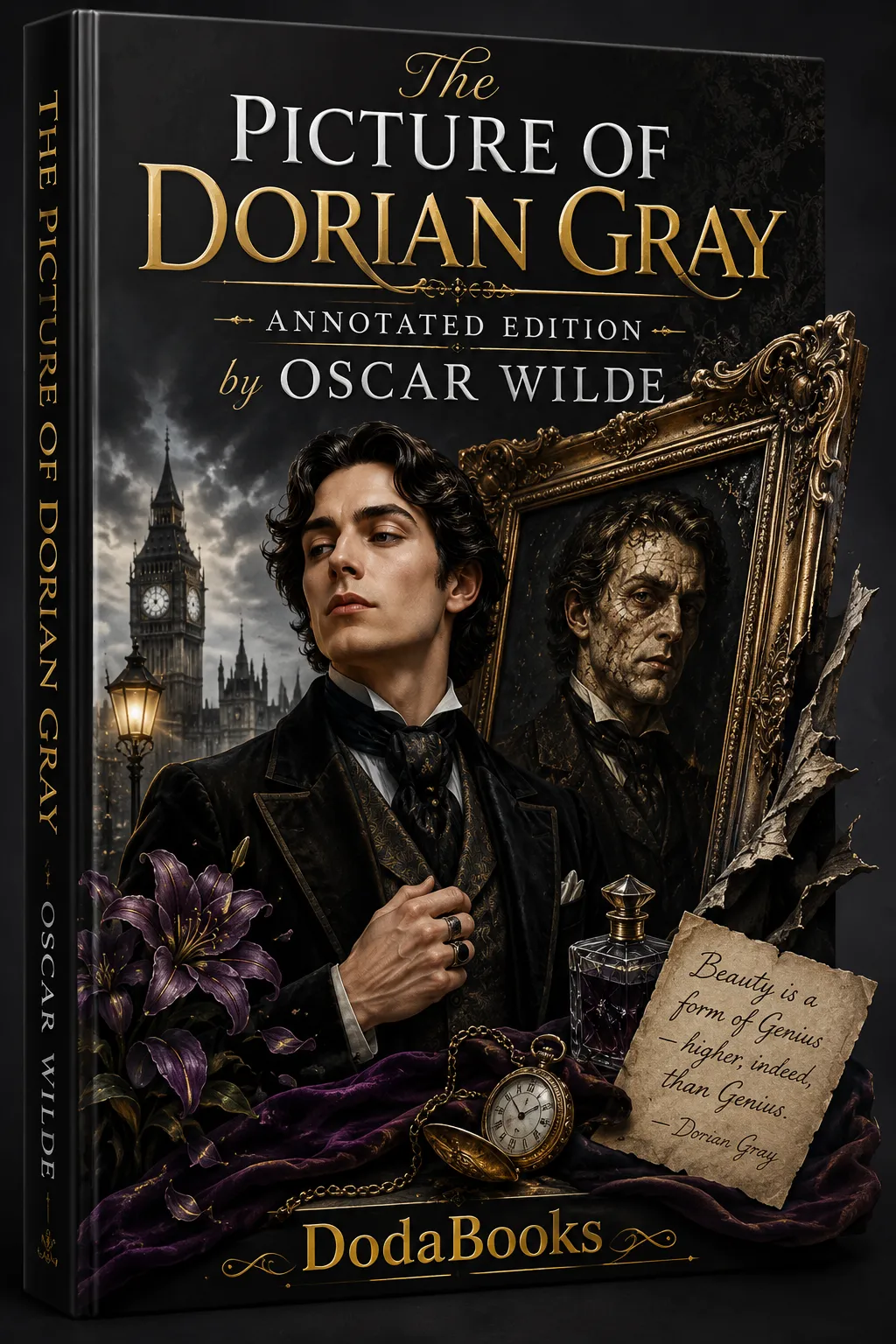
Read Oscar Wilde's Masterpiece With Total Clarity
Discover why The Picture of Dorian Gray remains the defining Gothic novel of the Decadent era. The DodaBooks Annotated Edition unlocks every layer:
- Complete, unabridged 20-chapter 1891 text including the famous Preface
- Explanatory notes decoding Victorian aestheticism, Huysmans' Yellow Book, and French Decadence
- Comprehensive timeline of the 1890 Lippincott's censorship scandal and Wilde's trial
- Pristine digital typography optimized for Kindle, Apple Books, Kobo, and desktop