The Picture of Dorian Gray Characters: Full Analysis & Relationship Map
In a famous 1894 letter to his admirer Ralph Payne, Oscar Wilde revealed the intimate psychological secret behind his only novel:
“I am so glad you like that strange coloured book of mine… It contains much of me in it. Basil Hallward is what I think I am; Lord Henry what the world thinks me; Dorian what I would like to be—in other ages, perhaps.”
This confession unlocks the core of The Picture of Dorian Gray (1891). The characters are not merely realistic Victorian socialites; they represent a brilliant, tripartite dissection of the human psyche and the Aesthetic movement itself. Together, Dorian Gray, Lord Henry Wotton, and Basil Hallward form what literary scholars call the “Aesthetic Trinity”—a psychological struggle between pure artistic creation, cynical intellectual hedonism, and raw, narcissistic sensation.
Whether you are writing an essay, preparing for an exam, or analyzing the moral depths of Wilde’s Gothic tragedy, this guide provides an exhaustive character analysis of every major figure and their complex relationships.
⚡ Dorian Gray Character Guide: At a Glance
- The Sensualist: Dorian Gray — A radiantly beautiful young man whose Faustian bargain grants him eternal physical youth while his painted portrait absorbs the horrific moral decay of his sins.
- The Philosopher: Lord Henry Wotton ("Harry") — A brilliant, aristocratic dandy who preaches radical "New Hedonism," serving as the Mephistopheles who psychologically corrupts Dorian.
- The Conscience: Basil Hallward — A moral, idealistic painter who creates the fatal portrait out of pure artistic idolatry, whose tragic attempt to save Dorian's soul results in his murder.
- The Tragic Muse: Sybil Vane — A seventeen-year-old East End actress who abandons the artifice of the stage for real love, only to be crushed by Dorian's cruel vanity.
- The Avenger: James Vane — Sybil's protective sailor brother who spends eighteen years hunting Dorian down to avenge his sister's suicide.
🎨 1. The Aesthetic Trinity: Wilde’s Threefold Self
The novel’s dramatic engine is the tug-of-war for Dorian Gray’s soul between Basil Hallward’s moral idealism and Lord Henry Wotton’s seductive hedonism:
                      +---------------------------------------+
                      |         OSCAR WILDE'S PSYCHE          |
                      +-------------------+-------------------+
                                          |
         +--------------------------------+--------------------------------+
         |                                |                                |
         v                                v                                v
+----------------------+        +----------------------+        +----------------------+
|   BASIL HALLWARD     |        |     DORIAN GRAY      |        |  LORD HENRY WOTTON   |
| "What I think I am"  |        | "What I'd like to be"|        | "What the world      |
|                      |        |                      |        |  thinks me"          |
| - The Conscience     |        | - The Sensation      |        | - The Intellect      |
| - Idealistic Artist  |        | - The Living Canvas  |        | - Cynical Dandy      |
| - Moral Responsibility|       | - Narcissistic Sinner|        | - Amoral Corruptor   |
+----------+-----------+        +----------+-----------+        +----------+-----------+
           |                               ^                               |
           | Paints portrait /             | Mentors / poisons with        |
           | urges repentance              | "New Hedonism"                |
           +-------------------------------+-------------------------------+
🖼️ 2. Dorian Gray: The Living Canvas and Tragic Monster
Dorian Gray begins the novel as a completely unawakened youth: pure, naive, wealthy, and possessing an astonishing, angelic physical beauty that captivates everyone he meets. He is, in John Locke’s terms, a psychological tabula rasa waiting for an artist or philosopher to write upon his soul.
The Awakening and the Faustian Pact
In Chapter 2, Lord Henry’s sermon on the supreme value of fleeting youth terrifies Dorian. Gazing upon Basil’s finished masterpiece, Dorian experiences an acute crisis of vanity:
“I shall grow old, and horrible, and dreadful. But this picture will remain always young… If it were only the other way! If it were I who was to be always young, and the picture that was to grow old! For that—for that—I would give everything! Yes, there is nothing in the whole world I would not give! I would give my soul for that!”
Dorian’s wish is granted. He becomes a living work of art: his body remains suspended in permanent twenty-year-old perfection, while the canvas hidden in the schoolroom bears the wrinkles, rot, and moral stains of his crimes.
The Descent into Psychopathy
Dorian’s moral evolution moves through three distinct phases:
- The Esthetic Consumer (Chapters 4–10): Dorian treats human beings as aesthetic objects. He loves Sybil Vane not as a woman, but as a living avatar of Shakespeare’s heroines; the moment she reveals her vulnerable human self, he casts her aside with contempt, driving her to suicide.
- The Systematic Decadent (Chapter 11): Hypnotized by Huysmans’ “Yellow Book,” Dorian spends eighteen years curating exotic perfumes, jewels, and vestments while roaming East End opium dens and corrupting London youth. He takes sadistic pleasure in visiting the portrait with a mirror, contrasting his radiant face with the monster on the canvas.
- The Paranoid Murderer (Chapters 13–20): When Basil Hallward confronts him and urges him to pray, Dorian’s guilt and shame curdle into uncontrollable fury. He butchers his oldest friend with a hunting knife, blackmails Alan Campbell to dissolve the corpse in acid, and lives in trembling paranoia of James Vane.
The Illusion of Reform
In Chapter 20, Dorian attempts to reform by sparing the innocence of a rural girl, Hetty Merton. But when he inspects the portrait, the canvas reveals the truth: his eyes gleam with hypocritical cunning. Realizing that his vanity makes true repentance impossible, he attempts to destroy the only remaining witness to his guilt—the portrait itself. By driving the blade into the canvas, he unknowingly plunges the knife into his own heart.
🚬 3. Lord Henry Wotton: The Intellectual Mephistopheles
Lord Henry Wotton—known affectionately as “Harry”—is the most quotable character in Victorian fiction. He is a languid, wealthy aristocrat who views the world with cynical detachment, charming London dinner parties with brilliant, paradoxical epigrams designed to overturn conventional Victorian morality.
The Philosophy of “New Hedonism”
Lord Henry preaches that the only purpose of human life is the relentless pursuit of new, intense sensations:
“The only way to get rid of a temptation is to yield to it. Resist it, and your soul grows sick with longing for the things it has forbidden to itself… Be always searching for new sensations. Be afraid of nothing.”
Henry attacks marriage, philanthropy, religion, and self-denial as unnatural Victorian hypocrisies that suppress human vitality.
The Armchair Corruptor
What makes Lord Henry morally insidious is that he is an armchair hedonist. Henry rarely gets his own hands dirty; he lives a respectable, relatively tame aristocratic life. Instead, he treats Dorian as an exciting vivisection experiment:
“To a large extent the boy would be his own creation… He would seek to dominate him—had already, indeed, half done so. He would make that wonderful spirit his own.”
Lord Henry pours intellectual poison into Dorian’s ear, sends him the toxic “Yellow Book,” and excuses every atrocity Dorian commits—framing Sybil Vane’s suicide as a romantic play and laughing off Basil Hallward’s disappearance. Yet, at the end of the novel, Henry remains completely ignorant of the supernatural horror and actual murders his philosophy inspired.
🎨 4. Basil Hallward: The Moral Conscience and Tragic Idolater
Basil Hallward is the moral and emotional anchor of the novel. An earnest, highly principled artist, Basil believes that art should be a sacred, noble pursuit reflecting the soul’s divine light.
The Fatal Idolatry
Basil’s fatal flaw is his idolatrous adoration of Dorian Gray. When Basil first sees Dorian at a society gathering, he experiences a moment of visceral panic, realizing that Dorian’s personality has the power to absorb his entire nature and soul:
“I knew that I had come face to face with someone whose mere personality was so fascinating that, if I allowed it to do so, it would absorb my whole nature, my whole soul, my very art itself.”
Basil paints the portrait out of pure worship, pouring his secret passion onto the canvas. Recognizing that Lord Henry’s cynicism will ruin Dorian, Basil repeatedly tries to separate them, begging Henry: “Don’t spoil him. Don’t try to influence him. Your influence would be bad.”
The Martyr of Redemption
Unlike Lord Henry, Basil genuinely cares for Dorian’s spiritual welfare. When London is filled with horrific rumors about Dorian’s crimes in Chapter 12, Basil does not mock or abandon him. He visits Dorian to challenge him and, upon seeing the rotting face on the canvas, drops to his knees in tears, urging Dorian to pray for forgiveness.
Basil’s tragic reward for trying to save Dorian’s soul is to be brutally murdered by the very hands he once immortalized on canvas.
🥀 5. Sybil Vane: The Muse of Pure Art
Sybil Vane is a seventeen-year-old actress performing in a squalid, third-rate East End theater. Despite her impoverished surroundings, she possesses extraordinary natural genius, performing Shakespeare’s greatest heroines with transcendent passion.
Art vs. Reality
Sybil’s tragedy illustrates the central paradox of the Aesthetic movement:
- Before meeting Dorian: Acting was Sybil’s entire reality. Because she had never known real passion, she poured all her emotional vitality into fictional illusions.
- After falling in love: Real human love shatters the artificial illusions of the stage. When she tries to perform Juliet for Dorian and his friends, her performance is hollow and dead.
Sybil naively believes Dorian will celebrate this transformation from shadow to substance. Instead, Dorian rejects her with cruel ferocity, proving that he never loved Sybil the person—he only loved the aesthetic reflection of his own tastes. Devastated, Sybil commits suicide by swallowing prussic acid, becoming the first sacrificial victim of Dorian’s vanity.
⚓ 6. James Vane: The Relentless Nemesis
James Vane—Sybil’s sixteen-year-old sailor brother—serves as the dramatic embodiment of retribution and the class divide. Rough, fiercely protective, and deeply suspicious of the wealthy “Prince Charming,” James swears a deadly oath before sailing for Australia: if the gentleman harms Sybil, James will hunt him down and kill him.
The Foil to Aristocratic Decadence
James represents the rough, working-class reality of London that Dorian’s aesthetic world tries to ignore:
- When James corners Dorian in the dark alley outside the opium den in Chapter 16, Dorian escapes only through the supernatural accident of his unaging face.
- James’s spectral presence lurking outside the conservatory at Selby Royal in Chapter 17 shatters Dorian’s aristocratic composure, plunging him into paranoid hysteria.
- James’s accidental death during the hunting party in Chapter 18 delivers the supreme irony: while Dorian believes James’s death frees him from physical danger, it actually seals his spiritual doom by stripping away the external fear that was the last barrier holding back his self-destructive guilt.
🧪 7. Secondary Characters & Their Thematic Significance
| Character | Role & Background | Thematic Function |
|---|---|---|
| Alan Campbell | Brilliant young scientist and former intimate friend of Dorian; blackmailed into dissolving Basil’s corpse with nitric acid. | Demonstrates Dorian’s ruthless willingness to destroy innocent lives to save himself; Campbell’s subsequent suicide underscores the toxic contagion of Dorian’s presence. |
| Adrian Singleton | Former promising young gentleman introduced to opium dens and debauchery by Dorian. | Shows the real-world devastation of Dorian’s influence; a ruined life serving as a living reflection of Dorian’s unseen decay. |
| Mrs. Vane | Sybil and James’s mother; a vain, theater-obsessed woman blind to her daughter’s danger. | Represents the moral bankruptcy and shallow theatricality of the lower-middle class, prioritizing potential aristocratic wealth over her daughter’s safety. |
| Victoria (Lady Henry) | Lord Henry’s flighty, eccentric wife who eventually elopes with another man. | Highlights the farcical reality of Victorian marriage; underscores Lord Henry’s inability to live out his philosophies in his own home. |
📊 Character Foils and Dynamics Matrix
| Foil Pairing | Core Contrast | Philosophical Implication |
|---|---|---|
| Lord Henry vs. Basil Hallward | Intellectual cynicism and amoral aestheticism vs. Moral conscience and idealistic devotion. | Words vs. Deeds; the corrupter of souls vs. the creator of beauty. |
| Dorian Gray vs. Lord Henry | Active practitioner of forbidden vices vs. Passive spectator who observes from the safety of dinner parties. | The tragedy of taking a philosopher’s aesthetic theories literally and living them out without moral restraint. |
| Dorian Gray vs. Sybil Vane | Narcissist who sacrifices human love for cold artifice vs. Artist who sacrifices art for living human love. | True love requires self-forgetfulness; vanity destroys both the self and the beloved. |
| Dorian Gray vs. James Vane | Privileged, immortal aristocratic predator vs. Impoverished, weathered working-class avenger. | Class injustice and the inescapable moral law of retribution. |
Decode the psychological depths and aesthetic debates of Wilde's characters. The DodaBooks Annotated Edition includes comprehensive profiles, literary analyses, and historical annotations.
Get the Annotated Edition at DodaBooks❓ Frequently Asked Questions
Why did Oscar Wilde say Basil Hallward is what he thought he was?
Basil Hallward represents the pure artist who believes in the sacred, transformative power of beauty and who loves with total devotion. Wilde viewed his own artistic soul as earnest, generous, and vulnerable like Basil's, in contrast to the cynical, performative public persona he projected in society.
Does Lord Henry Wotton ever realize he corrupted Dorian?
No. Even in Chapter 19, on the eve of Dorian’s death, Lord Henry views Dorian as an unblemished, perfect work of art. When Dorian asks what Henry would say if he confessed to murdering Basil Hallward, Henry laughs it off, declaring that murder is too vulgar for someone of Dorian’s exquisite taste. Henry remains blind to the real-world monstrosity his philosophies spawned.
What did Dorian Gray write on the piece of paper to blackmail Alan Campbell?
Wilde intentionally leaves the contents of the note unstated, creating a powerful sense of gothic mystery. Given the historical context of late-Victorian England and the Criminal Law Amendment Act of 1885 (which criminalized homosexuality), scholars widely believe the note contained evidence of a past homosexual affair between Dorian and Campbell, which would have meant instant criminal prosecution, prison, and social ruin for Campbell.
Is Sybil Vane's brother James in the original 1890 magazine edition?
No. James Vane was completely absent from the original 13-chapter Lippincott’s Monthly Magazine text published in July 1890. Wilde invented James Vane and added six new chapters for the 1891 book edition to give the novel more dramatic tension, narrative suspense, and a conventional element of gothic retribution.
Why does Dorian hate Basil Hallward so intensely before murdering him?
Dorian hates Basil because Basil is his conscience. Basil painted the portrait and urged Dorian to repent and pray. Seeing Basil look upon the rotting canvas fills Dorian with unbearable shame. In a fit of narcissistic rage, Dorian projects all his self-hatred onto the man who created the mirror of his soul, slaughtering the creator rather than confronting his own sins.
📚 Related Reading Guides
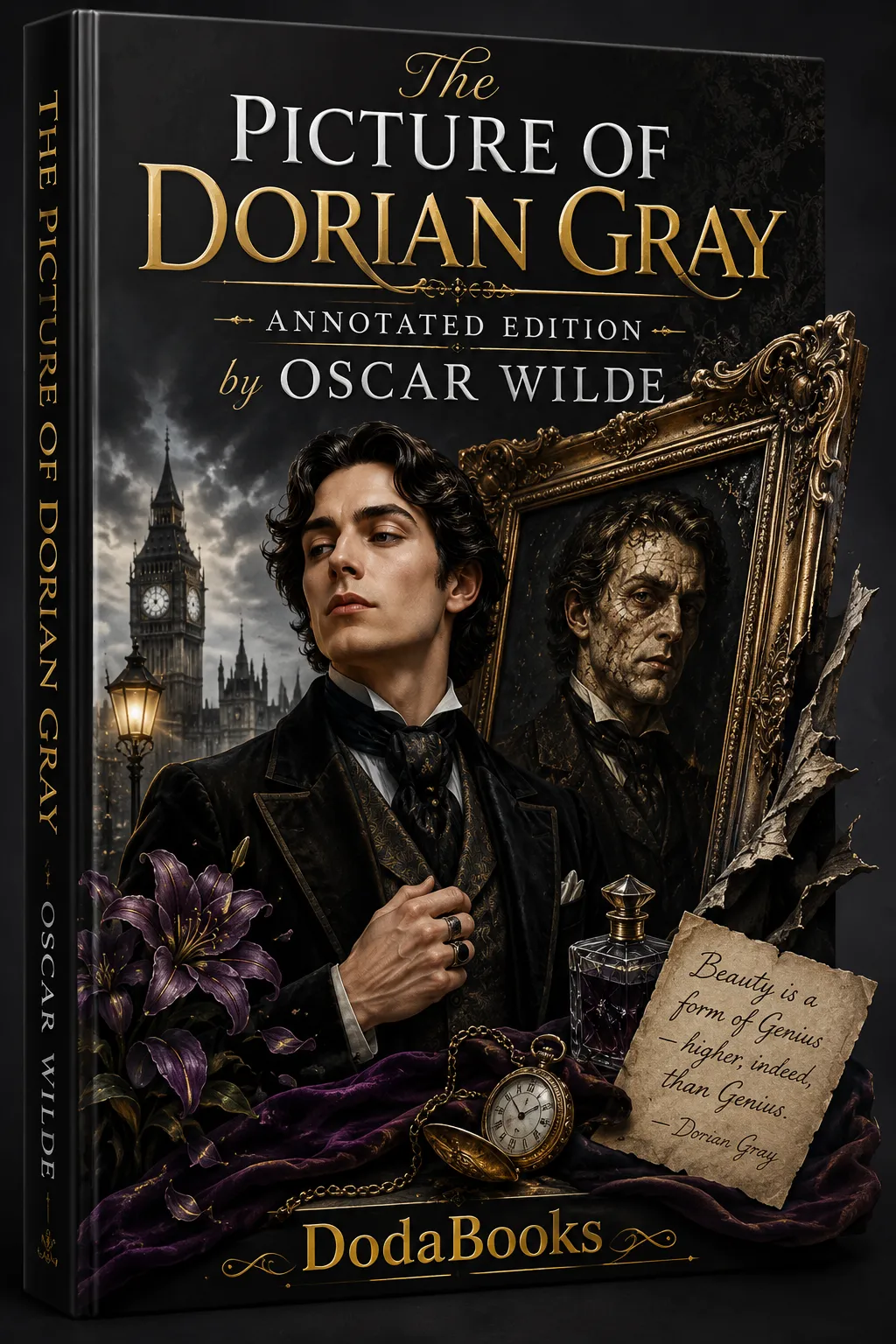
Master the Depths of Oscar Wilde's Characters
Read The Picture of Dorian Gray with expert character profiles, philosophical notes, and historical context alongside the text:
- Complete, authoritative 20-chapter 1891 text including the famous Preface
- Explanatory cards for all aesthetic references, Walter Pater's philosophy, and French Decadence
- Full breakdown of the Aesthetic Trinity (Dorian, Henry, and Basil)
- Instant digital delivery compatible with Kindle, Apple Books, Kobo, and Android