The Phantom of the Opera Summary: Complete Chapter-by-Chapter Guide
Gaston Leroux’s The Phantom of the Opera (Le Fantôme de l’Opéra), published in serialized form in 1909 and as a novel in 1910, is one of the most enduring gothic mysteries in world literature. While modern audiences know the story primarily through Andrew Lloyd Webber’s celebrated 1986 stage musical, Leroux’s original novel is a dark, gripping, and intricate piece of investigative gothic fiction.
Written in the form of an authentic journalistic investigation, Leroux opens with the bold assertion that “the Opera Ghost really existed.” Through official police records, theatrical memoirs, eyewitness testimonies, and the crucial confessions of the mysterious figure known as “the Persian,” Leroux reconstructs the tragic and horrifying events that unfolded beneath the gilded domes of the Palais Garnier in late nineteenth-century Paris.
Beneath the velvet curtains, grand staircases, and sparkling gas lamps lies a subterranean labyrinth: five cellar levels, subterranean vaults, an underground lake, and the secret torture chamber designed by Erik—the architectural genius, illusionist, ventriloquist, and disfigured “living corpse” who terrorized the opera management to win the heart of Swedish soprano Christine Daaé.
Whether you are studying the novel for a literature course, preparing a theatrical comparative analysis, or diving into Leroux’s original masterpiece, this exhaustive chapter-by-chapter summary covers every scene, secret passageway, and dramatic revelation.
⚡ The Phantom of the Opera: Plot at a Glance
- The Prologue & Mystery: Leroux presents authentic historical evidence proving that the Opera Ghost was a real man of flesh and blood named Erik, an architectural wizard with a face resembling a skull.
- The Haunted Opera House: The outgoing directors of the Palais Garnier warn their skeptical successors, Moncharmin and Richard, to respect the Ghost's demands: 20,000 francs per month and Box Five reserved exclusively for him.
- The Angel of Music: Christine Daaé, an obscure Swedish chorus girl, stuns Paris with a transcendent performance at the gala farewell, crediting her sudden vocal genius to the heavenly "Angel of Music" promised by her dying father.
- The Reign of Terror: When the managers defy Erik by selling Box Five and casting the prima donna Carlotta, Erik causes Carlotta to croak like a toad and drops the massive 200-ton chandelier onto the audience, killing a spectator.
- The Labyrinth & Lair: Erik abducts Christine across the underground lake to his subterranean home, forcing her to choose between marrying him or having the entire Opera House detonated by buried gunpowder.
- The Climax & Redemption: Moved by Christine’s courageous kiss of pure compassion—the first human kindness of his agonizing life—Erik weeps, releases her to marry her childhood love Raoul, and dies of a broken heart.
🗺️ The Architecture of Terror: The Palais Garnier Layout
Leroux’s novel derives much of its terrifying claustrophobia from the real, labyrinthine architecture of Paris’s Palais Garnier, designed by Charles Garnier and completed in 1875:
+---------------------------------------------------------------------------------------+
|                       THE SUBTERRANEAN REALMS OF ERIK'S EMPIRE                        |
+---------------------+-----------------------------------------------------------------+
| LEVEL / LOCATION    | NARRATIVE ROLE & ARCHITECTURAL SIGNIFICANCE                     |
+---------------------+-----------------------------------------------------------------+
| The Grand Hall &    | Society spectacle; Box 5 (Erik's invisible box with hollow      |
| Box Five            | acoustic column); the massive 7-ton bronze and crystal          |
|                     | chandelier hanging above the stalls.                            |
+---------------------+-----------------------------------------------------------------+
| Dressing Room 7     | Christine Daaé's private salon; hollow mirror wall with secret  |
| (The Trapdoors)     | springs leading directly into the opera house's wall conduits.   |
+---------------------+-----------------------------------------------------------------+
| Cellar Levels 1–4   | The domain of stagehands, scene-shifters, trapdoors, and        |
|                     | machinery; patrolled by the mysterious "Rat-catcher."           |
+---------------------+-----------------------------------------------------------------+
| The Fifth Cellar    | The subterranean underground lake (the reservoir beneath the    |
| & Underground Lake  | foundations); navigated by Erik's boat; patrolled by siren pipes.|
+---------------------+-----------------------------------------------------------------+
| The House on the    | Erik's secret mansion: organ room, Louis-Philippe salon, the    |
| Lake & Torture Room | lead-walled coffin chamber, and the hexagonal mirror room.      |
+---------------------+-----------------------------------------------------------------+
📜 Chapter-by-Chapter Plot Summary
Prologue: The Reality of the Opera Ghost
The narrator introduces his historical investigation into the mysterious events at the Paris National Academy of Music in the late 1880s. While public rumor attributed the disappearance of Christine Daaé, the death of Count Philippe de Chagny, and the suicide of stagehand Joseph Buquet to a supernatural demon, the narrator presents documentary proof—including the memoirs of the retired managers, police archives, and the personal testimony of the Persian—demonstrating that the “Opera Ghost” was a physical human being named Erik, who possessed unprecedented genius in mechanics, acoustics, and ventriloquism.
Chapter 1: Is It the Ghost?
During the farewell gala for the departing opera directors, Messieurs Debienne and Poligny, panic ripples through the dressing rooms of the corps de ballet. Little Jammes and Meg Giry (the daughter of the box-keeper Madame Giry) whisper that they have seen the Opera Ghost backstage.
The dancers describe his ghastly appearance: dressed in formal evening clothes, impossibly emaciated, with deep sunken yellow eyes, a nose consisting of a shadowy void, and skin like parched, parchment-yellow leather—resembling a living skull.
At the same time, the chief scene-shifter, Joseph Buquet, boasts that he has seen the phantom up close. Moments later, during the performance, Buquet is found dead in the third cellar level, hanging from a noose in the fly machinery. Strangely, the hangman’s rope vanishes before the authorities can inspect it.
Chapter 2: The New Margarita
At the grand retirement gala, the opera’s reigning Spanish prima donna, Carlotta, falls ill with a sudden, mysterious throat ailment. The managers substitute an obscure Swedish chorus singer, Christine Daaé.
To the astonished audience, Christine sings Marguerite in Charles Gounod’s Faust with supernatural emotional brilliance and radiant vocal purity. The entire Parisian elite is electrified.
In the audience sits young Viscount Raoul de Chagny, who is overwhelmed with passion upon recognizing Christine as the sweet childhood friend he loved years ago on the windswept shores of Brittany. Following the performance, Raoul rushes backstage to her dressing room. Through the heavy wooden door, he overhears a mysterious, beautiful masculine voice speaking to Christine from within the empty room, promising to teach her the divine art of song. When the voice falls silent, Raoul enters the dressing room, only to find Christine completely alone.
Chapter 3: The Mysterious Reason
Raoul questions Christine about the masculine voice, but she treats him with icy distance and refuses to answer his inquiries. Bewildered, Raoul conceals himself behind a velvet tapestry outside her dressing room.
When Christine departs, Raoul slips inside to search for secret cupboards or concealed doors. As the gas lamps dim, an invisible, melodious voice suddenly echoes throughout the room: “You must love me!”
Raoul searches every inch of the walls and furnishings, but finds nothing. The voice appears to emanate from the very air itself.
Chapter 4: Box Five
The new directors, Monsieur Armand Moncharmin and Monsieur Firmin Richard, take over the management of the Palais Garnier. During their handover meeting, the retiring managers present them with a memorandum of bizarre conditions:
- Box Five on the grand tier must remain empty and reserved exclusively for the Opera Ghost at every performance.
- The Ghost must be paid a monthly stipend of 20,000 francs (240,000 francs annually).
Moncharmin and Richard burst into laughter, assuming Debienne and Poligny are playing an elaborate practical joke. They resolve to treat the Ghost’s demands with total contempt.
Chapter 5: The Enchanted Violin
Distraught by Christine’s emotional withdrawal, Raoul recalls their childhood in Brittany. Christine’s father was a poor Swedish folk violinist who regaled the children with Norse legends, particularly the tale of the Angel of Music, a heavenly spirit who visits worthy musicians and inspires sublime genius. On his deathbed, Father Daaé had solemnly sworn that he would send the Angel of Music from heaven to watch over his daughter.
Raoul receives a letter from Christine asking him to meet her in Perros-Guirec, Brittany, where her father is buried. Raoul travels north and finds Christine staying at an inn. She confides that her father’s promise has come true: the Angel of Music has visited her in her dressing room at night, singing with divine beauty and training her voice.
That midnight, Christine slips away to the graveyard. Raoul follows her to the snowy churchyard. In the freezing moonlight, an invisible violin begins to play Father Daaé’s favorite tune, the “Resurrection of Lazarus,” with heart-wrenching beauty. Raoul catches sight of a terrifying cloaked figure with glowing, yellow skull-eyes perched on the graveyard wall. When Raoul rushes to confront the apparition, he is knocked senseless in the snow.
+-------------------------------------------------------------------------------+
|                       THE ANGEL OF MUSIC VS. THE REALITY                      |
+-----------------------------------+-------------------------------------------+
| CHRISTINE'S CHILDHOOD BELIEF      | THE COLD INVESTIGATIVE REALITY            |
+-----------------------------------+-------------------------------------------+
| - Heavenly spirit sent by her     | - Erik: Disfigured runaway from Persia    |
|   beloved dying father            | - Operates through hollow acoustic walls  |
| - Pure divine vocal inspiration   | - Master ventriloquist & illusionist      |
| - Celestial protector and guide   | - Consumed by desperate, possessive lust  |
+-----------------------------------+-------------------------------------------+
Chapter 6: An Examination of Box Five
Back in Paris, the directors receive a handwritten letter signed “O.G.” (Opera Ghost), furious that Box Five was sold to patrons during Faust. The Ghost warns that if his box is not kept vacant and his monthly stipend not paid, catastrophe will strike the theatre.
Determined to expose the hoax, Moncharmin and Richard attend the opera in Box Five themselves. During the performance, they hear a mocking voice whispering sarcastic comments directly beside their ears, yet the chairs around them are completely empty. They inspect the box with magnifying glasses, tap the wooden partitions, and question the box-keeper, Madame Giry, who insists that the Ghost is a gentleman who leaves her generous tips and clean foot-warmers. Infuriated, the directors fire Madame Giry on the spot.
Chapter 7: The Chandelier Falls
The directors decide to flaunt their defiance openly. For the upcoming performance of Faust, they ban Christine from singing and reinstate Carlotta as Marguerite. Furthermore, they sell Box Five to a wealthy socialite.
That afternoon, Carlotta receives an anonymous letter warning her not to sing, prophesying that a terrible disaster will strike her if she takes the stage. Carlotta suspects Christine is trying to usurp her role and stubbornly appears.
During the jewel song in Act II, Carlotta opens her mouth to sing, but instead of her soaring soprano, a repulsive, guttural sound erupts from her throat: “CO-ACK!”—the loud croak of a toad. The audience roars with laughter and gasps in shock.
At that exact moment, the Ghost’s booming voice echoes from Box Five across the entire auditorium: “She is singing tonight to bring the chandelier down!”
Seconds later, the massive bronze and crystal chandelier, weighing thousands of pounds, snaps from its suspension cables in the ceiling dome and plunges into the crowded stalls below. Dozens of spectators are injured, and the concierge who replaced Madame Giry is crushed to death.
Chapter 8: The Mysterious Mask
In the aftermath of the chandelier catastrophe, the Opera House closes for several weeks. Christine vanishes from the public eye.
Raoul searches desperately for her. When she returns, she contacts Raoul and agrees to meet him in secret at the annual Opera Masked Ball.
At the midnight ball, Raoul encounters Christine dressed in a domino costume. Beside her stalks a towering, terrifying figure dressed in scarlet velvet, wearing a plumed hat and a death’s-head mask: The Red Death (an homage to Edgar Allan Poe). The Red Death bears the chilling inscription: “Don’t touch me! I am Red Death!”
Raoul follows the Red Death and Christine back to her dressing room. Peering through the keyhole, Raoul watches as the mirror on the wall pivots silently outward. Christine steps through the open wall into the black void, and the mirror glides back into place without a sound.
Chapter 9: The Secret of the Underground Lair
Christine disappears for two weeks. When she returns to her Parisian apartment, she is pale, trembling, and wears a gold wedding band on her finger.
She invites Raoul to meet her on the highest roof of the Palais Garnier, perched among the bronze statues of Apollo and the muses, where she believes no one can eavesdrop on them.
There, Christine reveals the horrifying truth:
- The Angel of Music is not a heavenly messenger; he is a man of flesh and blood named Erik.
- Erik kidnapped her through the dressing room mirror, leading her down spiral staircases deep into the earth.
- At the fifth cellar level, they boarded a flat-bottomed boat across a dark, subterranean lake to a luxurious home carved out of the foundations of Paris.
- Erik has a face so grotesque, misshapen, and decomposed that his own mother forced him to wear a mask from childhood.
- In his underground organ room, Erik played his life’s magnum opus, the Don Juan Triumphant, with such sublime, agonizing passion that Christine was transported into another world.
Chapter 10: The Unmasking
Christine recounts to Raoul the terrible scene that unfolded in Erik’s subterranean music salon:
“I thought of the mask, and of what lay beneath it. A sudden curiosity seized me… With a swift gesture, I tore the mask from his face!”
Erik’s reaction was explosive. He let out a shriek of animal fury, burying his face in his hands, before turning on Christine with incandescent wrath. His bare face was a living nightmare: hollow blackened eye sockets without pupils, a decaying void where a nose should be, parchment skin stretched taut over yellow bone, and rotten yellow fangs:
“He screamed: ‘Look at me! Gaze on Erik! Am I not beautiful? Have you seen enough of Erik’s corpse face? Now that you have seen me, you can never leave!’”
For days, Erik kept her a prisoner. But when Christine wept without flinching and listened to his music, Erik softened. He confessed his desperate longing to live like an ordinary man—to walk in the park with a wife on his arm on Sundays. He permitted Christine to return to the surface world under one condition: she must wear his golden ring and remain faithful to him, returning to the opera within two weeks.
+---------------------------------------------------------------------------------------+
|                       THE DUEL ON THE ROOFS OF PALAIS GARNIER                         |
+---------------------+-----------------------------------------------------------------+
| RAOUL'S PLEDGE      | Promises to rescue Christine, flee France by train to Brussels, |
|                     | and marry her under a new identity.                             |
+---------------------+-----------------------------------------------------------------+
| THE EAVESDROPPER    | As they embrace beside Apollo's lyre, two glowing yellow eyes   |
|                     | peer from the shadows of a stone cloak; Erik heard everything.  |
+---------------------+-----------------------------------------------------------------+
Chapter 11: The Disappearance of Christine Daaé
The night of Christine’s scheduled farewell performance arrives. Raoul has packed his bags, arranged for post-horses, and booked night train tickets to Brussels.
During the final act of Faust, Christine sings the trio with celestial radiance. Just as the stage lights flare for Marguerite’s ascension into heaven, the theatre suddenly plunges into total pitch darkness for five seconds.
When the gas lamps reignite, Christine Daaé has vanished into thin air from the middle of the stage.
Chapter 12: The Persian’s Secret Knowledge
Raoul is frantic with grief and rage. The police, led by the incompetent Inspector Mifroid, suspect Raoul or his elder brother, Count Philippe de Chagny, of engineering Christine’s abduction.
As Raoul searches the empty corridors of the opera house in despair, he is tapped on the shoulder by an enigmatic middle-aged man wearing an astrakhan cap: The Persian.
The Persian, a former high-ranking police official from the court of the Shah of Persia, has tracked Erik across continents. He informs Raoul that Erik was the secret architect employed by Charles Garnier to construct the foundations of the Palais Garnier. While working on the building, Erik secretly installed concealed doors, trapdoors, acoustic hollow tubes, and a private residence accessible only to himself.
The Persian offers to guide Raoul into Erik’s underworld to rescue Christine before Erik carries out his ultimate threat.
Chapter 13: The Descent into the Catacombs
The Persian and Raoul slip into Christine’s dressing room. Using a secret catch concealed in the sculpted molding beside the full-length mirror, the Persian releases the counterweighted wall.
They descend a dizzying spiral staircase down through the masonry of Paris, slipping through the damp cellars and dodging the opera house’s night watchmen.
As they descend toward the third and fourth cellars, they encounter the legendary “Rat-catcher,” an eccentric old man dressed in rags who catches the millions of rodents inhabiting the opera vaults with a pipe like the Pied Piper. The Persian warns Raoul to hold his gun in hand and keep his arm held strictly across his eyes: “The Punjab Lasso” is Erik’s favorite weapon—a strangling cord spun from catgut that Erik whips around his victims’ necks from the darkness above. Only by keeping one arm raised to deflect the loop can a man prevent his neck from being snapped.
+-------------------------------------------------------------------------------+
|                       THE DEFENSE AGAINST THE PUNJAB LASSO                     |
+-----------------------------------+-------------------------------------------+
| ERIK'S TECHNIQUE                  | THE DEFENSIVE COUNTERMEASURE              |
+-----------------------------------+-------------------------------------------+
| In darkness, Erik hurls a loop of | Keep one hand raised to chest level with  |
| braided catgut around the neck,   | the forearm stiffened; this prevents the  |
| instantly snapping the vertebrae  | noose from closing flush around the neck, |
| like Joseph Buquet's fate.        | allowing the victim to draw a weapon.     |
+-----------------------------------+-------------------------------------------+
Chapter 14: The Torture Chamber of Mirrors
The Persian and Raoul reach the subterranean reservoir. Rather than entering through the lake door, the Persian attempts to access Erik’s house through an iron trapdoor in the fifth cellar.
However, they trigger a concealed trapdoor mechanism. The floor gives way, and both men plunge into Erik’s crowning architectural terror: The Hexagonal Chamber of Mirrors.
The room is an optical nightmare:
- Every wall is lined with massive, distorting mirrors reflecting incandescent electric heat and light.
- Iron branches painted to resemble an equatorial jungle create the terrifying illusion that the prisoners are lost in a vast, burning African forest.
- Erik controls the thermostat from outside, gradually raising the temperature to oven-like extremes to drive his victims to madness and suicide.
Through an iron wall grill, Raoul and the Persian can hear Christine’s muffled voice in the adjacent salon. Erik is presenting Christine with an ultimatum: she must choose between turning the Scorpion key (agreeing to marry Erik) or the Grasshopper key (turning the lever that detonates hundreds of barrels of gunpowder buried beneath the opera foundations, blowing the entire Palais Garnier and everyone inside into the sky).
Chapter 15: The Ordeal of Thirst
Trapped in the sweltering mirror room, Raoul and the Persian suffer delirious hallucinations from the baking heat. Desperate for water, they discover a small hatch in the floor.
The Persian unscrews the iron plug, expecting to find the cool waters of the underground lake. Instead, rushing water bursts from the opening—Erik has connected the pipe to the lake to drown them alive!
The water rapidly rises to their waists, their chests, and their chins. Raoul and the Persian cling to the iron branches, gasping for breath against the ceiling.
Chapter 16: The Choice of the Scorpion
Hearing the drowning men’s screams, Christine throws herself at Erik’s feet. To save Raoul and the Persian from certain death, Christine agrees to turn the Scorpion key.
Erik turns off the flood mechanism and drains the mirror room. He drags the unconscious Persian and Raoul from the chamber. He locks Raoul in a stone dungeon, promising to spare his life as long as Christine keeps her solemn wedding vow.
Chapter 17: The Epilogue & The Death of Erik
A few weeks later, the Persian is resting in his Parisian apartment on the Rue de Rivoli when an emaciated visitor knocks at his door. It is Erik.
Erik is visibly dying. He can barely walk and coughs blood. He sits before the Persian and weeps, recounting the miracle that occurred in his underground home:
When Christine prepared to seal her fate, Erik leaned close to kiss her forehead. Expecting her to shriek in horror or turn away in disgust, Erik was stunned when Christine stood motionless and gently pressed her lips to his grotesque forehead.
“She did not run away! She wept with me! She kissed my poor, horrible brow! No one had ever kissed me—not even my mother, who threw me a mask whenever I came near her! I cried tears of joy upon her hands… I knew then that I could never force her to live in my darkness.”
Overcome by love and redeemed by pure compassion, Erik released Christine. He gave her Raoul, led them to the surface, and handed Christine his gold ring to wear in memory of him.
Erik asks the Persian to fulfill his final request: after his death, the Persian must publish an announcement in the Époque newspaper reading: “Erik is dead.” Erik returns to his house on the lake, lies down in his lead-lined coffin, and passes away peacefully in his sleep.
Years later, when workmen excavate the subterranean vaults beneath the Palais Garnier during renovations, they uncover a skeleton wearing a gold wedding band around its finger.
❓ Frequently Asked Questions (FAQ)
Was the Phantom of the Opera a ghost or a real human?
Erik was entirely human. Gaston Leroux’s central narrative premise is that the “Opera Ghost” was an extraordinary mortal man named Erik—a master architect, acoustician, illusionist, and ventriloquist who suffered from extreme congenital facial deformities that gave him the appearance of a living skeleton.
How did Erik make the chandelier fall?
Erik deliberately cut or unfastened the counterweight cables securing the seven-ton bronze and crystal chandelier in the ceiling dome of the Palais Garnier. He did this as an act of calculated terror after the managers, Moncharmin and Richard, defied his instructions by casting Carlotta and selling Box Five.
Why does Erik wear a mask?
Erik was born with severe facial deformities—sunken yellow eyes without pupils, a nose consisting of a hollow void, and shriveled yellow parchment skin stretched across his skull. His own mother was so horrified by his face that she refused to kiss him and forced him to wear a mask from early childhood.
Who is "The Persian" and why is he important?
The Persian (Daroga) is a former police chief from the court of the Shah of Persia who knew Erik when Erik worked as a royal entertainer, architect, and executioner in Mazanderan. The Persian knows all of Erik’s illusions, architectural tricks, and deadly traps, serving as Raoul’s guide through the subterranean catacombs.
How does the novel's ending differ from the Andrew Lloyd Webber musical?
In the stage musical, Raoul and Christine flee while an angry mob storms the lair, finding only Erik’s discarded white mask on a velvet throne. In Leroux’s novel, Christine’s kiss of compassion redeems Erik. He willingly frees both lovers, weeps in gratitude, visits the Persian to recount his story, and dies alone in his underground home, where his skeleton is discovered decades later.
📚 Related Articles & Guides
Looking for an overarching analysis of themes, Victorian theater, and Gothic mystery? Explore our master The Phantom of the Opera Novel Guide.
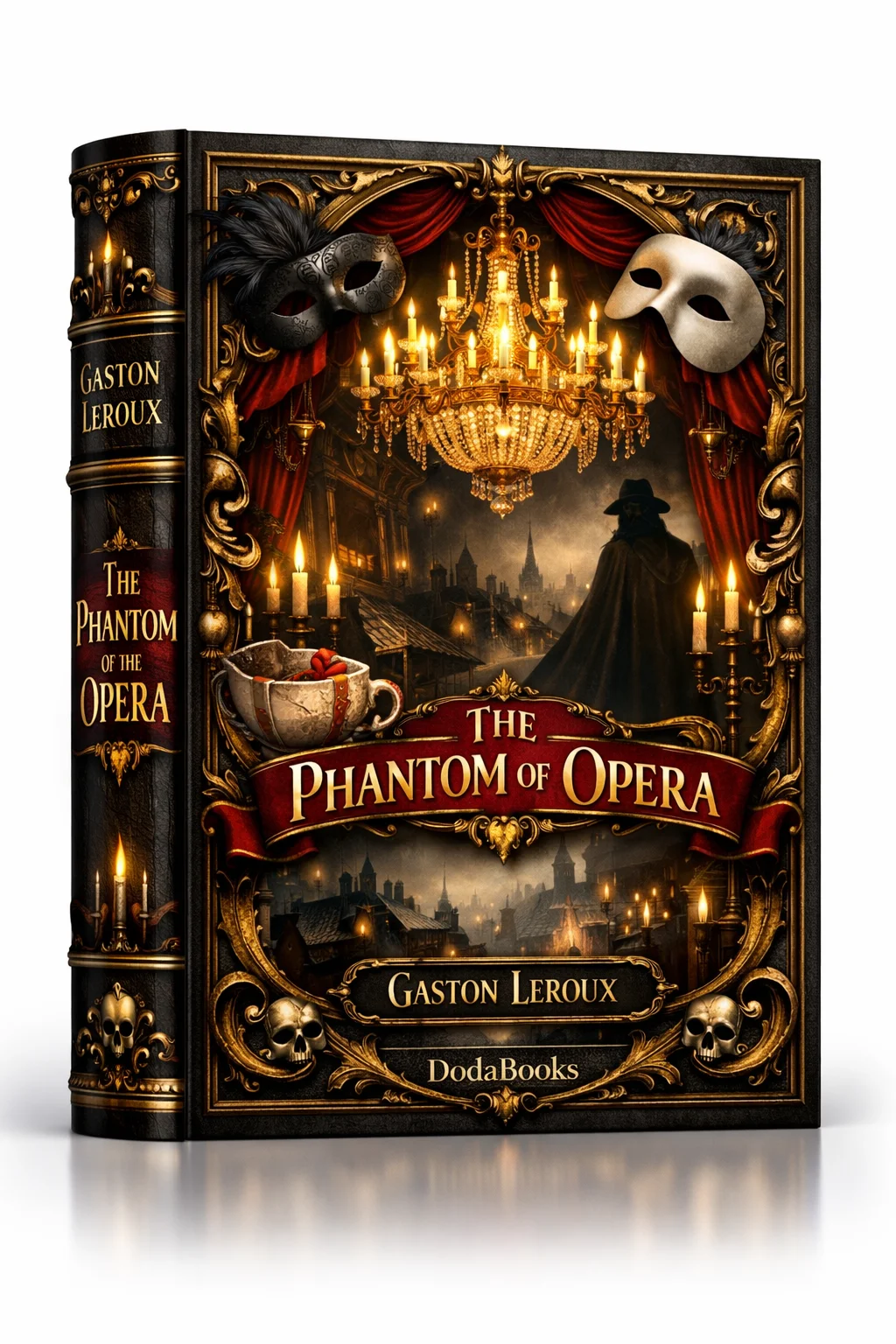
📖 Read the Definitive Annotated Edition of The Phantom of the Opera
Experience Gaston Leroux’s chilling gothic original with complete architectural notes, French opera history, and Parisian commentary:
- ✅ Complete Authoritative 1910 Text — Unabridged English translation with authentic chapter divisions
- 🏛️ Palais Garnier Blueprints & Notes — Understand the real subterranean lake, trapdoors, and fly machinery
- 🎭 French Theatrical Context — Learn about Gounod’s Faust, Meyerbeer’s operas, and Belle Époque society
- 📜 The Persian’s Complete Epilogue — Discover Erik’s backstory in Persia and Constantinople
- 🔒 Universal DRM-Free Formats — Delivered instantly in EPUB, PDF, and AZW3/Kindle formats
Get The Phantom of the Opera Annotated Edition at DodaBooks →