The Mysteries of Udolpho Summary by Volume: Complete 4-Volume Guide
Published in London in four volumes in 1794, Ann Radcliffe’s The Mysteries of Udolpho: A Romance; Interspersed with Some Pieces of Poetry is the crowning masterpiece of eighteenth-century Gothic fiction. Captivating audiences across Europe and earning Radcliffe the title “The Shakespeare of Romance Writers,” the novel established the classic conventions of the genre: a virtuous, sensitive heroine trapped in an isolated mountain fortress, a brooding and ruthless Italian villain, mysterious spectral music echoing across midnight ramparts, and terrifying apparent supernatural occurrences that are ultimately revealed to have natural explanations.
Set in the year 1584, the narrative traces the trials and emotional maturation of Emily St. Aubert, a young French noblewoman whose pastoral tranquility is shattered by the death of her parents, propelling her into the clutches of the tyrannical Signor Montoni within the blood-stained walls of the Castle of Udolpho in the Italian Apennines.
This comprehensive volume-by-volume summary provides a detailed chapter breakdown across all four original volumes, exploring Radcliffe’s celebrated landscape aesthetics, plot architecture, and the famous resolution of her Gothic mysteries.
| Volume | Chapters | Primary Setting | Narrative Focus & Gothic Milestones |
|---|---|---|---|
| Volume I | Chapters 1–13 | La Vallée (Gascony) & The Pyrenees | Pastoral innocence; St. Aubert’s philosophy; meeting Chevalier Valancourt; death of St. Aubert; the burnt letters mystery. |
| Volume II | Chapters 14–25 | Toulouse, Venice & The Apennines | Aunt Madame Cheron marries the sinister Signor Montoni; arrival at Castle Udolpho; the mystery of the Black Veil. |
| Volume III | Chapters 26–40 | Castle of Udolpho (Italy) | Montoni’s bandit regime; imprisonment and death of Madame Montoni; Count Morano’s midnight raid; Emily lifts the Black Veil; escape with Du Pont. |
| Volume IV | Chapters 41–58 | Château-le-Blanc & La Vallée (France) | Shipwreck; the haunted chamber of the late Marchioness de Villeroi; Ludovico’s disappearance; Sister Agnes’s confession; Valancourt’s redemption and marriage. |
🏰 Volume I: The Lost Eden of La Vallée (Chapters 1–13)
Pastoral Innocence and the St. Aubert Philosophy
The novel opens in 1584 at the idyllic estate of La Vallée in the lush, picturesque province of Gascony, southwestern France. Here, young Emily St. Aubert lives in serene harmony with her cultured parents, Monsieur and Madame St. Aubert. Emily is educated in botany, literature, music (playing the lute), and landscape painting, embodying the 18th-century cult of Sensibility—a refined emotional responsiveness to beauty, virtue, and nature.
Her father, an enlightened philosopher, constantly warns Emily against allowing her delicate emotional sensitivity to overwhelm her rational judgment:
“Above all, my dear Emily, do not indulge in that morbid sensibility which magnifies every sorrow… Sensibility is the dangerous quality which is too often mistaken for virtue. Rule your passions, or they will rule you.”
Tragedy strikes when Madame St. Aubert succumbs to a fatal fever. Devastated and suffering from failing health himself, St. Aubert takes Emily on a journey across the sublime, majestic peaks of the Pyrenees toward Roussillon, seeking physical recovery.
                  [ EMILY'S GEOGRAPHICAL JOURNEY ]

          La Vallée (Gascony) ====> [ Pastoral Innocence ]
                   |
                   v
       Pyrenees Mountains ====> [ Meeting Valancourt & Father's Death ]
                   |
                   v
        Venice & The Brenta ====> [ Sensual Temptation & Forced Marriage ]
                   |
                   v
     Castle of Udolpho (Apennines) ====> [ Gothic Terror & Imprisonment ]
                   |
                   v
       Château-le-Blanc (Languedoc) ====> [ Supernatural Mystery Resolved ]
                   |
                   v
          La Vallée (Gascony) ====> [ Restored Harmony & Marriage ]
The Meeting with Valancourt and St. Aubert’s Death
While traversing the mountainous wilderness, they encounter the handsome, spirited young Chevalier Valancourt, who is exploring the mountains with gun and dog. Valancourt shares Emily’s passionate love of romantic poetry and sublime mountain landscapes. A tender, respectful mutual love blossoms between them, blessed by St. Aubert.
Near the Mediterranean coast, St. Aubert’s condition deteriorates rapidly. They take refuge in a peasant cottage near Château-le-Blanc, the ancient ancestral seat of the noble Villeroi family. Here, St. Aubert dies. Before his death, he gives Emily a solemn, mysterious deathbed charge: she must travel back to his study at La Vallée, retrieve a hidden packet of private papers beneath the floorboards, and burn them completely without reading a single line.
While carrying out this command in tears, Emily’s eyes accidentally fall upon a few sentences describing a terrible, dark secret, and she glimpses a miniature painted portrait of a strikingly beautiful woman who is not her mother. Haunted by the suspicion that her revered father had an illicit romantic past, Emily burns the letters as promised, preserving her filial obedience.
🏰 Volume II: Into the Clutches of Montoni (Chapters 14–25)
Madame Cheron and the Italian Adventurer
Orphaned and vulnerable, Emily is forced by law into the guardianship of her only living relative, her paternal aunt Madame Cheron. Madame Cheron is a vain, frivolous, and selfish woman residing near Toulouse, entirely incapable of understanding Emily’s delicate sensibility.
When Valancourt arrives in Toulouse to ask for Emily’s hand in marriage, Madame Cheron initially rejects him due to his modest financial estate, but later vacillates. However, Madame Cheron’s own foolish romantic vanity soon precipitates disaster: she accepts the suit of Signor Montoni, a haughty, aristocratic Italian who presents himself as a wealthy Venetian nobleman.
In reality, Montoni is a ruthless, ruined gambler, mercenary condottiere, and soldier of fortune seeking Madame Cheron’s French estates to replenish his lost fortunes. Immediately after their marriage, Montoni terminates Valancourt’s courtship, forbidding Emily from contacting him, and abruptly moves the household to Venice.
       [ THE TYRANNY OF SIGNOR MONTONI ]
+-------------------------------------------------------------+
| Outward Mask: Wealthy, charismatic Venetian nobleman        |
+-------------------------------------------------------------+
                               |
                               v
+-------------------------------------------------------------+
| Inward Reality: Ruined gambler, condottiere, mercenary      |
+-------------------------------------------------------------+
                               |
                               v
+-------------------------------------------------------------+
| Motive: Confiscate Madame Cheron's French estates & sell    |
| Emily to the wealthy Venetian libertine Count Morano        |
+-------------------------------------------------------------+
Venice, Count Morano, and the Flight to the Mountains
In Venice, Emily is introduced to the glittering, seductive society of masked carnivals and gondola excursions along the Brenta canal. Montoni attempts to force Emily into an unwanted marriage with the wealthy, profligate Count Morano. When Emily firmly refuses, Montoni threatens severe physical violence.
On the very eve of the forced wedding, Montoni discovers that his political intrigues and financial crimes have made him an outlaw in Venice. Under cover of darkness, he evacuates his household from the city, fleeing southward into the rugged, desolate wilderness of the Apennine Mountains.
As the sun sets over the craggy peaks, Emily catches her first breathtaking, terrifying glimpse of her new prison:
“Emily gazed with melancholy awe upon the castle, which appeared in dark silhouette against the glowing crimson of the western horizon: silent, lonely, and sublime; its towers frowning proudly above the precipice.”
The Black Veil Mystery
Inside the decaying, gothic fortress of Castle Udolpho, Emily is surrounded by gloomy corridors, creaking tapestries, and Montoni’s band of hardened, uncouth mercenary soldiers.
While exploring a deserted gallery of the castle, Emily notices a mysterious picture hanging on the wall, shrouded beneath a dark black veil. Her maid Annette whispers frightening rumors that something unspeakably horrible lies hidden behind that drapery. When Emily summons the courage to pull back the black cloth, she catches sight of an appalling, unearthly horror—and collapses instantly onto the floor in a dead faint!
🏰 Volume III: The Siege and Escape from Castle Udolpho (Chapters 26–40)
Montoni’s Extortion and Madame Montoni’s Martyrdom
Montoni’s true character now reveals itself in all its naked savagery. He transforms Udolpho into an armed fortress for his private mercenary troop, who raid nearby villages and mountain travelers.
Needing funds to pay his mutinous soldiers, Montoni demands that Madame Montoni formally sign over all her French properties and estates to him. When his wife stubbornly refuses to surrender her patrimony, Montoni locks her in a remote, freezing stone tower of the castle, depriving her of food, warmth, and medical care.
Emily risks her life to smuggle comfort to her aunt. Despite Emily’s heroic care, Madame Montoni’s health breaks under the torment. Realizing she is dying, Madame Montoni repents of her past cruelty to Emily, warns her of Montoni’s murderous greed, and bequeaths her independent estate directly to Emily before dying in her niece’s arms.
       [ MONTONI'S SIEGE & EMILY'S RESISTANCE ]
+-------------------------------------------------------------+
| Montoni: Demands Madame Montoni sign over French lands      |
+-------------------------------------------------------------+
                               |
                               v
+-------------------------------------------------------------+
| Madame Montoni refuses -> Imprisoned in tower -> Dies       |
| Bequeaths her French estate directly to Emily!             |
+-------------------------------------------------------------+
                               |
                               v
+-------------------------------------------------------------+
| Montoni turns fury on Emily: Signs or faces permanent prison|
+-------------------------------------------------------------+
                               |
                               v
+-------------------------------------------------------------+
| Emily resists with moral courage -> Secret rescue arranged  |
+-------------------------------------------------------------+
Count Morano’s Midnight Intrusion
One midnight, Emily is awakened in her bedchamber to find Count Morano standing over her! Having bribed a guard and entered the castle through an underground secret passageway, Morano attempts to abduct Emily to save her from Montoni.
Emily screams, alerting the guards. Montoni rushes into the chamber with a drawn rapier. A savage duel ensues between the two villains, and Montoni runs Morano through the chest, leaving him grievously wounded. Montoni locks Morano in the dungeons and increases the sentries on the ramparts.
Supernatural Horrors on the Battlements
As imperial troops loyal to the Venetian government lay siege to Castle Udolpho, the castle is wracked by seemingly supernatural occurrences:
- Emily hears mournful, heavenly lute music drifting through the midnight air where no human player could be standing.
- Sentry guards flee their posts, claiming to have seen a spectral, glowing phantom pacing the eastern ramparts.
- Disembodied voices whisper warnings from inside locked stone walls.
The Daring Escape
Montoni attempts to force Emily to sign the deed transferring her aunt’s estate to him, threatening to marry her off to the brutal mercenary officer Verezzi. Emily displays remarkable moral fortitude, refusing to sign away her rightful property under illegal duress.
Seeing that Emily’s life is in imminent danger, Ludovico, an honest Italian servant, coordinates a daring midnight escape. He enlists the aid of a French prisoner of war held in the dungeons, who turns out to be Monsieur Du Pont, a noble French officer and a former neighbor of Emily’s father at La Vallée who has long loved Emily in secret.
Together, Du Pont, Ludovico, Emily, and the maid Annette slip through the secret postern gate during a storm, evade Montoni’s patrols, and ride desperately toward the Mediterranean coast, boarding a ship bound for France.
🏰 Volume IV: The Secrets of Château-le-Blanc (Chapters 41–58)
The Haunted Chamber and Ludovico’s Disappearance
Emily’s ship is caught in a violent storm off the coast of Roussillon and wrecked upon the French shore. Emily and her companions are warmly rescued by Count De Villefort, the benevolent, aristocratic owner of Château-le-Blanc—the grand estate near where St. Aubert had died in Volume I.
The Count welcomes Emily into his family, treating her as a daughter. However, Château-le-Blanc has its own dark Gothic mysteries:
- The private apartments of the late Marchioness de Villeroi have remained locked and untouched for twenty years, ever since the Marchioness died under mysterious, sudden circumstances.
- Servants report seeing apparitions and hearing spectral sounds in the Marchioness’s bedroom.
To prove that the rumors are superstitious nonsense, the brave servant Ludovico volunteers to spend the night locked alone inside the haunted bedchamber, armed with a sword and a book of romances. In the morning, when the Count and his men unlock the heavy iron doors, Ludovico has completely vanished without a trace!
               [ THE RESOLUTION AT CHÂTEAU-LE-BLANC ]
+-------------------------------------------------------------+
| The Haunted Chamber: Spectral apparitions and music         |
+-------------------------------------------------------------+
                               |
                               v
+-------------------------------------------------------------+
| Ludovico watches inside -> Mysteriously vanishes overnight! |
+-------------------------------------------------------------+
                               |
                               v
+-------------------------------------------------------------+
| Truth Revealed: Smugglers using secret sea-cave tunnels!    |
| Ludovico was abducted into the caves, not taken by ghosts   |
+-------------------------------------------------------------+
Valancourt’s Fall and Sister Agnes’s Confession
While staying at Château-le-Blanc, Emily is devastated to learn about Chevalier Valancourt’s recent conduct. Believing Emily lost to him forever in Italy, Valancourt had succumbed to despair in Paris, falling into bad company, gambling debts, and dissipation. When Valancourt arrives at Château-le-Blanc, racked with guilt and shame, Emily feels compelled by moral principle to break their engagement, though the decision nearly breaks her heart.
Meanwhile, in the neighboring convent of St. Claire, a crazed, dying nun known as Sister Agnes sends for Emily. On her deathbed, Sister Agnes makes an explosive, terrifying confession:
- Her real identity is Signora Laurentini di Udolpho, the former mistress of Castle Udolpho whose unexplained disappearance had fueled the castle’s ghost stories!
- Consumed by insane, jealous passion for the Marquis de Villeroi, Laurentini had seduced the Marquis and supplied him with a slow, undetectable poison to murder his virtuous wife, the beautiful Marchioness de Villeroi.
- Racked with guilt after the Marquis abandoned her, Laurentini took the veil in France to atone for her heinous crimes.
Furthermore, Laurentini reveals that the Marchioness de Villeroi was the beloved sister of Emily’s father, Monsieur St. Aubert! The miniature portrait and private papers Emily burned in Volume I belonged to his tragically murdered sister, entirely clearing St. Aubert’s moral memory.
                  [ THE LAURENTINI SKELETON ]

              Castle of Udolpho (Original Estate)
                            |
             Signora Laurentini di Udolpho
                            | (Jealous Passion)
                            v
       Seduced Marquis de Villeroi -> Poisoned his Wife
                            |
           (The Marchioness was St. Aubert's SISTER!)
                            |
                            v
           Guilt -> Flees to Convent of St. Claire
                            |
                            v
            Deathbed Confession to Emily St. Aubert
The Explained Supernatural
Radcliffe now methodically resolves every apparent supernatural terror in the novel through natural, rational causes:
- The Black Veil at Udolpho: What Emily saw beneath the veil was not a rotting corpse or the murdered body of Signora Laurentini. It was a centuries-old wax memento mori effigy of a decomposing human corpse, created by an ancient lord of Udolpho as penance for a mortal sin! Emily’s terrified imagination had supplied the rest.
- The Disappearance of Ludovico: Ludovico was not taken by spirits; a ring of international smugglers was using subterranean sea vaults beneath Château-le-Blanc to store contraband, utilizing secret doors in the bedchamber wall to frighten away the estate servants. Ludovico was captured by the smugglers, but later managed to overpower his captors and escape.
- The Spectral Music at Udolpho and Château-le-Blanc: The midnight lute playing was not ghostly; it was performed by Monsieur Du Pont, who was imprisoned in Udolpho and later wandered the grounds of Château-le-Blanc playing his melancholy melodies in secret tribute to Emily!
The Triumph of Virtue and Reason
Montoni’s crimes are finally brought to an end when the Venetian Republic storms Castle Udolpho. Montoni is arrested, convicted of treason and murder, and dies in a Venetian dungeon.
Emily learns that Valancourt’s moral “crimes” in Paris were greatly exaggerated by envious gossips: he had merely lost money at cards and landed in prison while trying to pay the debts of a destitute friend. Having proved his repentance and repaid his debts, Valancourt is fully forgiven by Emily.
The novel concludes where it began: Emily and Valancourt are joyfully married and return to the restored pastoral Eden of La Vallée, surrounded by the honest peasants who revere them. Radcliffe finishes with an immortal tribute to rational virtue:
“O! useful may it be to have shewn, that, though the vicious may triumph for an hour, their prosperity is fleeting and their joy a phantom; and that innocence and virtue, supported by reason, can bear the soul unhurt through the darkest tempests of adversity.”
❓ Frequently Asked Questions
What was actually behind the Black Veil in The Mysteries of Udolpho?
One of the most famous plot devices in literary history, the Black Veil concealed a realistic, waxwork memento mori sculpture depicting a decomposing human corpse with worms crawling across its flesh. An ancient lord of Udolpho had commissioned it as penance for a horrific crime. Emily’s overactive Gothic imagination and terror led her to mistake the wax figure for a real human corpse, causing her to faint.
What does "the explained supernatural" mean in Gothic fiction?
Ann Radcliffe popularized the literary technique of the "explained supernatural" (or le surnaturel expliqué). Unlike Horace Walpole or Matthew Lewis, who included real ghosts and demonic entities, Radcliffe created terrifying, spectral atmospheres that seemed genuinely supernatural, only to later reveal that every mysterious sound, floating voice, or vanishing figure had a completely rational, natural explanation (such as smugglers, secret passageways, or acoustic echoes).
How did The Mysteries of Udolpho influence Jane Austen's Northanger Abbey?
Jane Austen loved Radcliffe's novel and used it as the central satirical target in Northanger Abbey (1817). Her heroine, Catherine Morland, becomes so obsessed with reading The Mysteries of Udolpho that she begins to imagine horrifying Gothic conspiracies, hidden skeletons, and murderous plots inside the ordinary, modern home of General Tilney, providing a brilliant, humorous critique of Gothic romance reading.
Is Signor Montoni the first "Byronic Hero"?
Yes. Although Lord Byron popularized the archetype in poetry decades later, Ann Radcliffe’s Signor Montoni—dark, brooding, fiercely independent, morally corrupted, and disdainful of conventional society—served as the direct literary ancestor of the Byronic hero, directly influencing characters like Byron’s Manfred and Emily Brontë’s Heathcliff in Wuthering Heights.
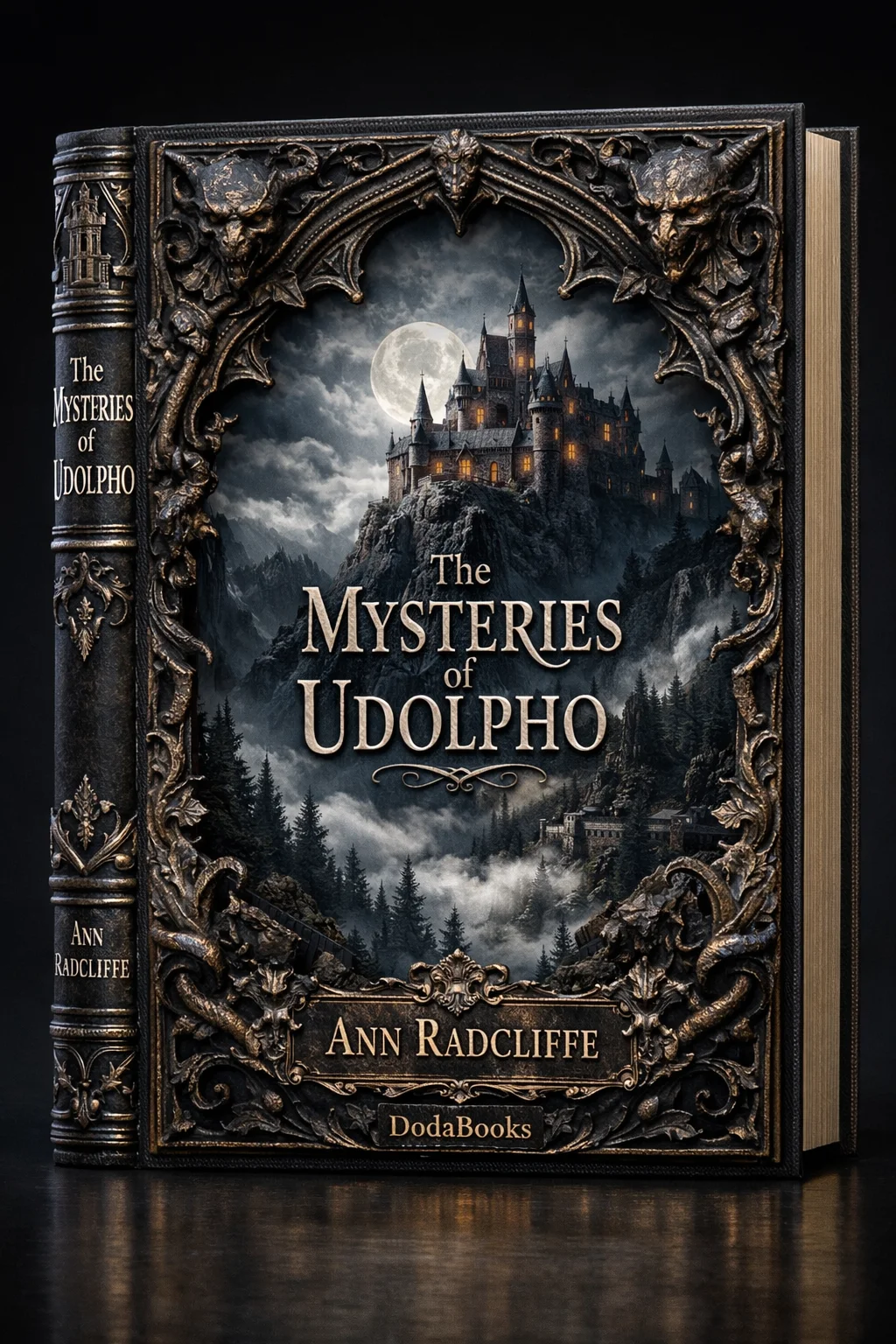
🏰 Experience the Greatest Gothic Romance Ever Written
Immerse yourself in Ann Radcliffe’s spine-chilling 18th-century masterpiece with the definitive, beautifully formatted edition from DodaBooks:
- 📖 Complete 4-Volume & 58-Chapter Text — Unabridged, featuring all original poetry and landscape descriptions
- 💡 Exhaustive Gothic Annotations — Explaining 18th-century aesthetic philosophy, the sublime, and historical Italian politics
- 📱 Engineered for E-Readers — Crystal-clear digital typography with clean chapter breaks and navigation
- 🔓 100% DRM-Free — Read on Kindle, Kobo, iPad, or Android anytime, anywhere
👉 Get the Annotated Edition of The Mysteries of Udolpho at DodaBooks →