The Moonstone Summary by Period & Narrative: Complete Plot Breakdown
When Wilkie Collins serialized The Moonstone in Charles Dickens’s weekly journal All the Year Round in 1868, he established the architectural foundation of the modern detective novel. T. S. Eliot famously proclaimed it “the first, the longest, and the best of modern English detective novels,” and Dorothy L. Sayers called it “probably the very finest detective story ever written.” Almost every convention of the classic murder-mystery or country-house whodunit—the isolated aristocratic estate, the eccentric professional detective who arrives by train, the celebrated red herrings, the botched police investigation, the murder weapon or clue buried in quicksand, and the dramatic final reconstruction of the crime—was pioneered in this book.
At the center of Collins’s labyrinth is the Moonstone: a priceless yellow diamond looted from the holy city of Somnath, India, during the 1799 British storming of Seringapatam. When the diamond vanishes from the Yorkshire bedroom of heiress Rachel Verinder on the night of her eighteenth birthday, suspicion cascades across an entire household.
What elevates The Moonstone far above a simple procedural is its extraordinary narrative architecture. Instead of an all-knowing narrator, the investigation is delivered through fourteen distinct firsthand testimonies penned by witnesses who each possess only fragmented, biased, and often self-deceptive pieces of the truth.
Whether you are analyzing Collins for a literature seminar or immersing yourself in Victorian mystery, this comprehensive guide traces the Prologue, the First Period, the Second Period, and the Epilogue in exhaustive detail.
⚡ The Moonstone: Masterwork Overview
- Author: Wilkie Collins (1824–1889)
- Publication Date: Serialized January – August 1868 in All the Year Round; published in three volumes in 1868
- Structure: Formal legal dossier comprising a Prologue, First Period (Loss of the Diamond), Second Period (Discovery of the Truth in 8 distinct narratives), and Epilogue
- Key Narrators: Gabriel Betteredge (house steward), Drusilla Clack (evangelical cousin), Mathew Bruff (solicitor), Franklin Blake (investigator/unconscious thief), Ezra Jennings (doctor's assistant), Sergeant Cuff (detective)
- Setting: Seringapatam (India, 1799), the Yorkshire coast at the Verinder estate near the Shivering Sand, and London (1848–1849)
- The Mystery: Who stole the sacred diamond from Rachel Verinder's cabinet during the night of June 21, 1848?
- The Resolution: Franklin Blake took the gem while sleepwalking under an involuntary dose of laudanum administered by Dr. Candy; Godfrey Ablewhite stole it from Blake's hands to pay his secret debts and was murdered by Brahmin priests in a London sailor's tavern
📜 The Structural Architecture of The Moonstone
Collins divides his 500-page masterpiece into a rigorously dated epistolary case file:
+--------------------------------------------------------------------------------------------------------------------+
|                                    THE MOONSTONE FORMAL DOSSIER TIMELINE                                           |
+----------------------+----------------------------+-----------------------------+----------------------------------+
| SECTION              | NARRATOR                   | SETTING & DATE              | PRIMARY PLOT DEVELOPMENTS        |
+----------------------+----------------------------+-----------------------------+----------------------------------+
| Prologue             | An English Officer         | Seringapatam, India (1799)  | Storming of the palace; theft of  |
|                      | (Family paper)             |                             | the sacred gem by John Herncastle|
+----------------------+----------------------------+-----------------------------+----------------------------------+
| First Period         | Gabriel Betteredge         | Yorkshire estate            | Rachel's 18th birthday party;   |
| (Chapters 1–23)      | (House steward)            | (May – July 1848)           | diamond vanishes; Sergeant Cuff  |
|                      |                            |                             | investigates; Rosanna drowns     |
+----------------------+----------------------------+-----------------------------+----------------------------------+
| Second Period:       | Miss Drusilla Clack        | London                      | Evangelical tracts; Godfrey's   |
| Narrative 1          | (Sanctimonious cousin)     | (July – Dec 1848)           | proposal; Rachel breaks off match|
+----------------------+----------------------------+-----------------------------+----------------------------------+
| Second Period:       | Mathew Bruff               | Lincoln's Inn Fields       | The Indian pledge at Septimus    |
| Narrative 2          | (Family lawyer)            | (Nov 1848 – June 1849)      | Luker's; Godfrey's trust fraud|
+----------------------+----------------------------+-----------------------------+----------------------------------+
| Second Period:       | Franklin Blake             | Yorkshire & Cumberland      | Return from Europe; discovery of |
| Narrative 3          | (Protagonist)              | (May – June 1849)           | Rosanna's letter & stained gown |
+----------------------+----------------------------+-----------------------------+----------------------------------+
| Second Period:       | Ezra Jennings              | Yorkshire                   | Medical journals; the recreation |
| Narrative 4          | (Medical assistant)        | (June 1849)                 | of Franklin's opium trance      |
+----------------------+----------------------------+-----------------------------+----------------------------------+
| Second Period:       | Franklin Blake             | London                      | Tracking the disguised sailor;   |
| Narrative 5          |                            | (June 1849)                 | the locked room at the pub       |
+----------------------+----------------------------+-----------------------------+----------------------------------+
| Second Period:       | Sergeant Cuff              | London                      | The corpse unmasked; Godfrey's   |
| Narrative 6          | (Retired detective)        | (June 1849)                 | double life and motive revealed  |
+----------------------+----------------------------+-----------------------------+----------------------------------+
| Second Period:       | Dr. Candy & Cuff's Man   | Yorkshire & London          | Memory recovery & passenger ship |
| Narratives 7–8       | (Physician & Officer)      | (July 1849)                 | tracking of the Indian Brahmins  |
+----------------------+----------------------------+-----------------------------+----------------------------------+
| Epilogue             | Mr. Murthwaite             | Somnath, India              | Restoration of the Moonstone     |
|                      | (Renowned traveler)        | (1850)                      | to the forehead of the Moon God  |
+----------------------+----------------------------+-----------------------------+----------------------------------+
🏛️ Prologue: The Storming of Seringapatam (1799)
The novel begins with an extract from a family paper written in 1799 by an English officer serving in the siege of Seringapatam during the Fourth Anglo-Mysore War.
The officer recounts the ancient Hindu legend of the Moonstone: a sacred yellow diamond placed in the forehead of the four-handed Indian God of the Moon in the temple of Somnath. When the Mughal emperor Mahmud of Ghazni plundered the temple in the 11th century, the diamond was saved and protected by three Brahmin priests, sworn across generations to guard the sacred jewel day and night until the god reclaimed it.
During the bloody British assault on Tipu Sultan’s palace in 1799, the narrator encounters his cousin, the depraved and violent Colonel John Herncastle, murdering the temple guards in cold blood to snatch the gem. As the last dying Brahmin falls, he utters a solemn curse: the Moonstone shall bring disaster, dishonor, and violent death upon Herncastle and any of his kin who inherit it.
Herncastle brings the diamond back to England, where he is completely ostracized by polite society for his villainy. Living in vindictive isolation, Herncastle dies in 1848. In a final act of calculated spite against his sister, Lady Julia Verinder, Herncastle leaves his will bequeathing the cursed Moonstone to his niece, Rachel Verinder, on her eighteenth birthday.
💎 First Period: The Loss of the Diamond (1848)
The main narrative opens in Yorkshire, told through the voice of Gabriel Betteredge, the devoted sixty-eight-year-old house steward of the Verinder estate. Betteredge is an unforgettable character: pragmatic, deeply loyal to Lady Verinder, mildly misogynistic, and obsessively reliant on Daniel Defoe’s Robinson Crusoe, which he consults like holy scripture whenever he needs advice.
Franklin Blake’s Arrival and the Birthday Gathering
In May 1848, Franklin Blake, Rachel’s charming and cosmopolitan cousin, arrives in Yorkshire with the diamond, which he retrieved from a London bank vault in accordance with Colonel Herncastle’s will. Franklin is uneasy: he has noticed three suspicious Indian jugglers lingering along his travel route, and he deposits the jewel in the local bank until Rachel’s birthday on June 21.
Franklin and Rachel quickly fall in love while spending weeks together painting decorative floral designs on Rachel’s sitting-room door. Meanwhile, Rachel’s other cousin, Godfrey Ablewhite—a handsome, charismatic London philanthropist who leads dozens of charitable ladies’ societies—also arrives to court Rachel and is rejected.
On June 21, the birthday party takes place. Rachel wears the radiant Moonstone pinned to her dress. Among the guests is the eccentric local doctor, Mr. Candy, who quarrels heatedly with Franklin Blake over dinner regarding modern medicine and the efficacy of drugs. During the night, Rachel places the diamond inside an Indian cabinet in her bedroom sitting-room, leaving the inner door slightly ajar.
The Vanishing and the Arrival of Sergeant Cuff
The next morning, June 22, the household awakens in panic: the Moonstone has vanished.
The local police superintendent, Superintendent Seegrave, completely botches the initial inquiry, badgering the domestic maids and examining footmarks clumsily. Desperate for competence, Franklin Blake summons London’s most renowned Scotland Yard investigator: Detective Sergeant Cuff.
Cuff is a legendary literary creation: gaunt, pale, melancholy, obsessed with breeding roses, and terrifyingly observant. Cuff immediately sweeps aside the theories of an outside break-in. He inspects Rachel’s newly painted sitting-room door and discovers a critical clue: a smear on the wet white varnish made by a woman’s dress or a gentleman’s coat trailing against the door at roughly midnight.
Sergeant Cuff proclaims his famous investigative axiom:
“In all the years I have been in the Police, I have never met with such a thing as a clean, simple, straightforward case. In all my experience, I have never seen a mess that was not caused by someone acting out of motives they were ashamed to confess.”
Cuff determines that whoever took the diamond must have white paint smeared on their nightgown or dress. But when he attempts to examine the household laundry, Rachel Verinder violently intervenes. Rachel displays fierce hostility toward the investigation, refuses to cooperate with Sergeant Cuff, insults Franklin Blake, and abruptly leaves for London. Cuff deduces a shocking conclusion: Rachel Verinder stole her own diamond to pawn it for secret debts.
The Tragedy of Rosanna Spearman and the Shivering Sand
Meanwhile, one of the housemaids, Rosanna Spearman, acts with extreme distress. Rosanna is a reformed London pickpocket whom Lady Verinder charitably took in from a refuge. Rosanna is physically marked by a deformed shoulder, but possesses a tender, tragic heart—and is secretly and hopelessly in love with Franklin Blake.
When Sergeant Cuff discovers that Rosanna secretly bought plain cloth to sew a replacement nightgown and was seen carrying a hidden tin box out to the Shivering Sand—a dreadful quicksand bog on the Yorkshire shore—he prepares to question her. But before he can act, Rosanna walks into the Shivering Sand and drowns herself, leaving behind a letter for Franklin Blake that cannot yet be found.
Lady Verinder, appalled by Cuff’s accusation that her daughter Rachel is a thief, pays Cuff his fee and dismisses him from the case. The investigation collapses in disgrace. Franklin Blake, heartbroken by Rachel’s cold hatred toward him, leaves England for a year of wandering through Europe and the Orient.
🔍 Second Period: The Discovery of the Truth (1848–1849)
The Second Period picks up the fragmented threads of the mystery across eight distinct narratives, revealing the secret lives and moral hypocrisies of Victorian London.
Narrative 1: Miss Drusilla Clack
The first narrative of the second period is written by Miss Drusilla Clack, Rachel’s pious, impoverished evangelical cousin. Clack is Collins’s satire of Victorian sanctimony at its most venomous: she is armed with thousands of religious conversion tracts (with titles like Pious Pushes for Gentle Peccadilloes), which she leaves hidden in cushions, soup tureens, and cab seats.
Clack documents the events in London in late 1848:
- Lady Julia Verinder dies of heart disease.
- Godfrey Ablewhite re-emerges, acting as the pious consoler of the grieving Rachel, and successfully convinces Rachel to accept his marriage proposal.
- However, Rachel’s solicitor discovers financial irregularities, and Rachel abruptly breaks off the engagement with Godfrey after realizing he is primarily pursuing her inheritance.
- Clack also records that Godfrey Ablewhite and a notorious London moneylender named Septimus Luker were separately lured into an empty London house by three disguised Indian men, tied up, and searched, though the assailants took nothing of value from their pockets.
Narrative 2: Mathew Bruff
The second narrative is supplied by Mathew Bruff, the shrewd and honorable Verinder family solicitor. Bruff reveals that Septimus Luker placed a valuable, unspecified object into the vault of a prominent London bank in late June 1848, taking out a receipt redeemable one year later: in June 1849.
Bruff suspects that the object is the Moonstone, pledged as collateral for a short-term loan. Furthermore, Bruff consults with Mr. Murthwaite, a celebrated British traveler and ethnologist who has lived in India disguised as a native. Murthwaite warns them: the three Brahmins have not given up. They know the loan expires in June 1849, and the moment the borrower retrieves the diamond from the bank, the Brahmins will strike.
Narrative 3: Franklin Blake and the Revelation at the Shivering Sand
In May 1849, Franklin Blake returns to England upon hearing of his father’s death. Unable to endure Rachel’s continued silence, he visits Gabriel Betteredge in Yorkshire.
Betteredge reveals that Rosanna Spearman left instructions with the local fisherwoman, Limping Lucy, to deliver a hidden letter to Franklin whenever he returned. Franklin retrieves the tin box from the depths of the Shivering Sand. Inside, he finds Rosanna’s stained nightgown and her heartbreaking suicide letter.
Franklin examines the neckband of the nightgown, expecting to find the name of the thief. To his utter horror and disbelief, the embroidered name on the nightgown is: FRANKLIN BLAKE.
Rosanna’s letter confesses that on the morning after the theft, she discovered the smear of wet paint on Franklin’s nightgown. Believing that Franklin had stolen the diamond to pay his heavy foreign debts, Rosanna made a duplicate nightgown to conceal his guilt from the police, destroying her own reputation and eventually her life out of devotion to him.
Franklin is thrown into psychological torment: How could he be the thief when he has zero recollection of taking the diamond?
He rushes to London to confront Rachel Verinder. In a tempestuous scene, Rachel finally reveals the secret of her year-long silence: she watched Franklin Blake steal the diamond with her own eyes. She saw him walk into her bedroom at midnight, open her cabinet, take the Moonstone, look her directly in the face, and walk out. Rachel hid the truth from Sergeant Cuff because she loved Franklin too much to send him to prison, but despised him for his apparent villainy and hypocrisy.
🧪 The Science of the Opium Experiment (Narrative 4: Ezra Jennings)
Desperate to clear his name or prove himself insane, Franklin returns to Yorkshire. There he encounters Ezra Jennings, the assistant to the dying Dr. Candy.
Ezra Jennings is one of the most poignant figures in 19th-century literature. Suffering from an agonizing terminal illness, visibly marked by hair that is half-black and half-white, and driven out of London medical circles by an unfounded scandal, Jennings survives only through regular doses of laudanum.
Jennings uncovers the physiological key to the entire mystery:
- Dr. Candy’s Delirium: During Rachel’s birthday dinner, Dr. Candy had been insulted by Franklin’s disdain for medical science. That night, Candy rode home through a freezing rainstorm, contracted brain fever, and suffered complete amnesia.
- The Shorthand Transcripts: While nursing Dr. Candy through his delirium, Jennings meticulously recorded the doctor’s raving, fragmented utterances in shorthand. By applying linguistic analysis and piecing together the broken sentences, Jennings reconstructs what Candy did: Candy had secretly slipped a massive dose of liquid laudanum into Franklin’s nightcap of brandy to play a medical joke on him, intending to tease Franklin the next morning for having slept like a log.
- The Opium Trance: Franklin, who was unaccustomed to opium, was suffering from acute nervous anxiety regarding the safety of the Moonstone and the presence of the Indian jugglers. The laudanum induced a state of somnambulism (sleepwalking). In his drug-induced trance, Franklin’s subconscious mind acted on its dominating waking fear: he rose from bed, walked into Rachel’s room, took the diamond to move it to his own bedroom for safekeeping, and dropped it or lost consciousness as the narcotic took full effect.
+-----------------------------------------------------------------------------------------------+
|                       DR. CANDY'S FRAGMENTED DELIRIUM TRANSCRIPT SOLVED                      |
+--------------------------+--------------------------------------------------------------------+
| DR. CANDY'S RAVINGS     | "...give him... dose... laugh at him tomorrow... medicine...       |
|                          | laudanum... drops in the brandy... sleep soundly..."               |
+--------------------------+--------------------------------------------------------------------+
| EZRA JENNINGS'S DECODED | Dr. Candy secretly administered a heavy medicinal dose of laudanum|
| MEDICAL REALITY          | into Franklin Blake's drink on the night of June 21, 1848.       |
+--------------------------+--------------------------------------------------------------------+
| CLINICAL CONSEQUENCE     | Franklin became a somnambulist; acted under hypnotic suggestion    |
|                          | to protect the diamond, with complete retrograde amnesia.          |
+--------------------------+--------------------------------------------------------------------+
The Recreation of the Crime
To legally and scientifically prove this theory to Rachel and the world, Jennings stages a daring psychological experiment. On June 21, 1849—the exact anniversary of the theft—they reconstruct the Verinder house down to the smallest detail: Rachel’s room is redecorated, Franklin follows his exact daily schedule, and Jennings administers the identical dose of laudanum.
Under the influence of the drug, Franklin sleepwalks into Rachel’s room, takes the dummy crystal from the drawer, walks toward his room, and drops it on the floor as the sedative overpowers him. Rachel, watching from the shadows with Gabriel Betteredge and Mathew Bruff, is overwhelmed with joy: Franklin is completely innocent of theft.
🎭 The London Trap and Sergeant Cuff’s Final Triumph
While Franklin was exonerated of criminal intent, a fatal question remained: What happened to the diamond after Franklin dropped it in his sleep?
Franklin Blake, Mathew Bruff, and Sergeant Cuff (recalled to active service) travel to London to monitor the bank vault where Septimus Luker pledged the gem. On the exact day the one-year loan pledge expires, a dark-complexioned man dressed in rough sailor’s clothing collects the parcel and takes a cab into the squalid waterfront district of the East End.
Franklin, Cuff, and Bruff track the sailor to a seedy public house called The Wheel of Fortune in Grays’ Inn Lane. The landlord informs them that the sailor took a room upstairs for the night.
When Cuff knocks on the bedroom door, there is no reply. Breaking open the door, they find the sailor lying dead on the bed, smothered with a pillow. The sailor’s chest has been rummaged through, and an empty morocco jewel case lies discarded on the floor: the Moonstone has been stolen.
Sergeant Cuff steps forward, takes a sponge with warm water, and washes the dark walnut-juice dye from the dead sailor’s face and removes a false black wig. Beneath the disguise lies the handsome, well-known face of Godfrey Ablewhite.
+-----------------------------------------------------------------------------------------------+
|                             GODFREY ABLEWHITE'S DOUBLE LIFE UNMASKED                         |
+--------------------------+--------------------------------------------------------------------+
| PUBLIC PERSONA           | Revered Christian philanthropist; trustee of numerous charitable   |
|                          | women's funds; admired orator across London high society.         |
+--------------------------+--------------------------------------------------------------------+
| PRIVATE REALITY          | Reckless embezzler; kept an extravagant secret mistress in a villa |
|                          | in the suburbs; squandered £20,000 from a trust fund under his care|
+--------------------------+--------------------------------------------------------------------+
| THE THEFT                | Was in the hallway when Franklin sleepwalked; took the gem from    |
|                          | Franklin's unconscious hand; pledged it to Luker for 12 months.   |
+--------------------------+--------------------------------------------------------------------+
| THE END                  | Disguised as a sailor to take the gem to Amsterdam to be cut;      |
|                          | intercepted and suffocated by the three Brahmin priests.           |
+--------------------------+--------------------------------------------------------------------+
Sergeant Cuff explains the final sequence of events:
- On the night of Rachel’s birthday, Godfrey had stayed in the house and observed Franklin wandering the halls in a trance holding the diamond. When Franklin dropped the diamond, Godfrey seized it.
- Facing imminent prison for embezzling a young ward’s trust fund, Godfrey pledged the diamond to Luker for £2,000 to buy one year of time.
- When the year expired, Godfrey planned to take the diamond to Amsterdam to have it cut into separate stones.
- But the three Indian Brahmins had tracked his every move. They entered the tavern room through a skylight, smothered Godfrey, seized the Moonstone, and escaped onto an outward-bound vessel bound for Bombay.
🛕 Epilogue: The Moonstone in Its Ancient Shrine (1850)
The novel closes with an Epilogue written by the explorer Mr. Murthwaite in 1850. Traveling in the interior of India, Murthwaite joins a massive pilgrimage to the sacred rock temple of Somnath.
Amid the sound of chanting and the smoke of incense, the three Brahmins ascend to the altar, having fulfilled their sacred oath at the cost of their caste and lives. As the veil falls, Murthwaite gazes upon the ancient statue of the Moon God:
“There, in the forehead of the deity, gleaming through the clouds of incense, shone the sacred jewel—parted from the European world forever, restored to the deity whose shrine it had adorned for eight hundred years.”
❓ Frequently Asked Questions
Who actually stole the Moonstone?
The theft was a two-stage crime. First, Franklin Blake took the diamond from Rachel’s room while sleepwalking under an involuntary dose of laudanum administered as a prank by Dr. Candy. Second, Godfrey Ablewhite, who was deeply in debt from embezzling charitable trusts, took the gem from the unconscious Franklin and pawned it with Septimus Luker.
Why did Rachel Verinder refuse to cooperate with Sergeant Cuff?
Rachel saw Franklin Blake take the diamond from her cabinet with her own eyes. Because she was deeply in love with Franklin, she could not bear to see him arrested and hanged, but because she believed he was a deceitful thief who stole her jewel for money, she treated him with cold contempt.
Why is Sergeant Cuff considered the prototype for Sherlock Holmes?
Sergeant Cuff was modeled after real-life Scotland Yard inspector Jonathan Whicher. Like Sherlock Holmes, Cuff is gaunt, ascetic, notices minute physical clues (such as paint stains and laundry lists) that local police dismiss, and pairs forensic deduction with an eccentric hobby (breeding roses, much like Holmes’s violin and beekeeping).
How does the multi-narrator structure enhance the mystery?
Collins uses fourteen different narrators—including a devoted servant, a religious hypocrite, a lawyer, and an opium-addicted physician’s assistant—to turn the reader into a jury. Each narrator tells only what they personally witnessed, concealing vital clues within their personal vanities, biases, and blind spots. To analyze the main characters, read our The Moonstone Characters Explained.
Is The Moonstone difficult to read for modern mystery fans?
Not at all. While it spans roughly 500 pages, Collins was a master of serialized pacing. For a full breakdown of 1840s medical science, vocabulary, and a 10-day reading plan, see our guide: Is The Moonstone Hard to Read?.
📚 Related Articles
Exploring classic Victorian mysteries and detective fiction? Check out our The Woman in White Summary Guide or our The Hound of the Baskervilles Guide.
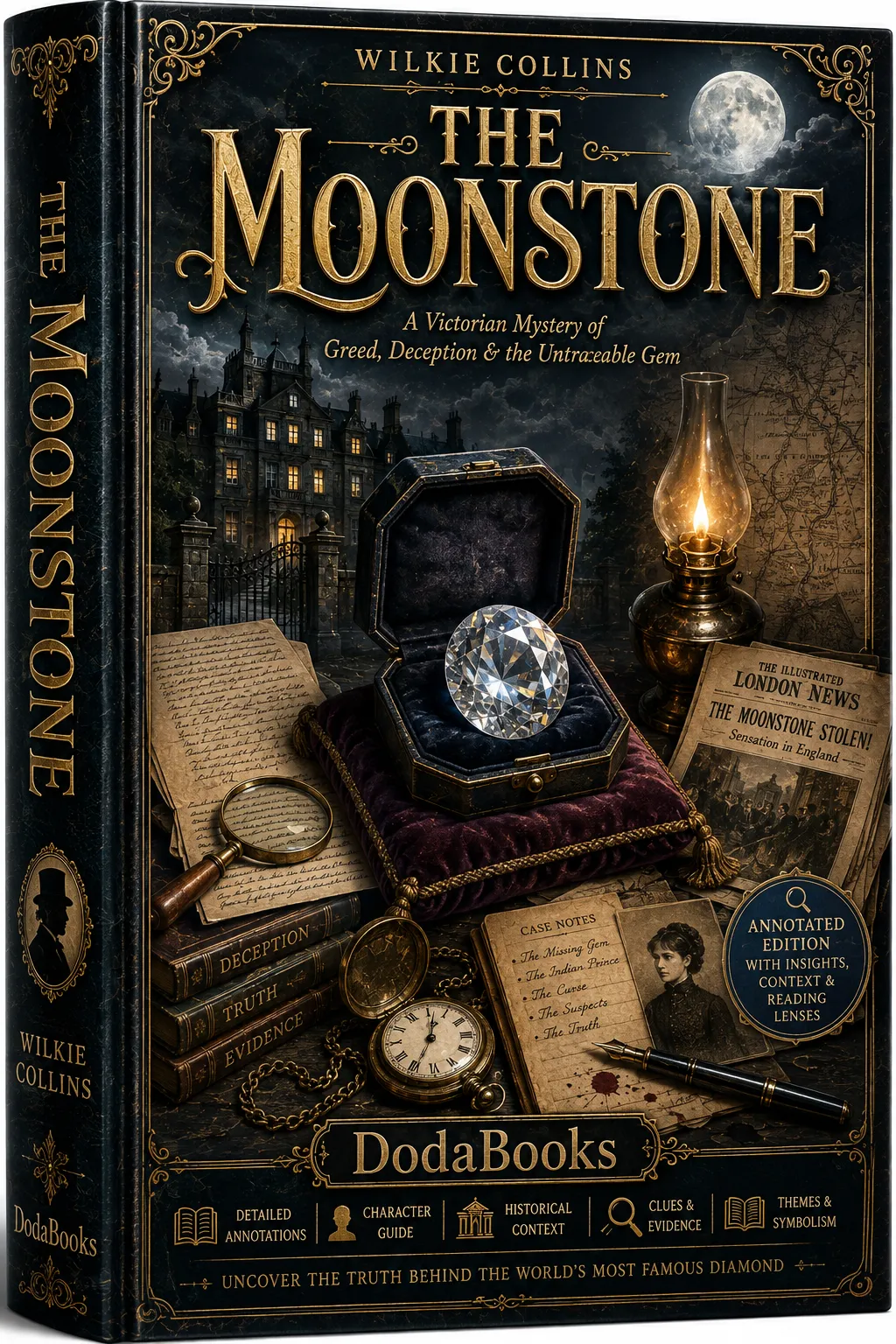
💎 Experience the Birth of Detective Fiction Fully Annotated
Read Collins’s diamond mystery with every medical clue and historical nuance illuminated:
- ✅ Complete, unabridged 1868 text across all fourteen narrators and testimonies
- 🧪 Victorian medical & opium science decoded — understand the somnambulism experiment
- 🗂️ Passage-specific annotation cards revealing historical clues and narrative timelines
- 🔒 DRM-free EPUB format — readable on any Kindle, Kobo, iPad, or mobile device
- 📥 Instant digital download delivered directly after checkout