The Moonstone Characters: Sergeant Cuff, Franklin Blake & Villains Explained
When Wilkie Collins constructed The Moonstone in 1868, he created far more than an ingenious locked-room puzzle; he populated the novel with one of the most psychologically complex and subversive casts of characters in Victorian literature.
Where conventional Victorian fiction celebrated pious charity, unblemished aristocratic virtue, and straightforward domestic morality, Collins systematically pulled back the velvet curtains of the English country house. In The Moonstone, the revered Christian philanthropist turns out to be an embezzling sybarite; the Scotland Yard master detective gets the case completely wrong; the delicate aristocratic heroine conceals a theft out of stubborn passion; and the ultimate solution is discovered not by high-born gentlemen, but by a tragic, deformed housemaid and a dying, biracial medical outcast.
By telling the story through fourteen firsthand narratives, Collins allows his characters to expose their own vanities, prejudices, and moral hypocrisies in their own voices. This comprehensive character guide analyzes the major figures in The Moonstone, examines their psychological motivations and symbolic functions, and maps out the character relationships that drive the plot.
⚡ The Moonstone: Character Roster at a Glance
- Detective Sergeant Cuff: The gaunt Scotland Yard investigator with a passion for breeding roses; the pioneering prototype for Sherlock Holmes and modern forensic detectives.
- Franklin Blake: The cosmopolitan, indecisive protagonist who investigates the theft of the Moonstone, only to discover that he himself was the sleepwalking thief under the influence of opium.
- Rachel Verinder: The fiercely independent, passionate heiress who defies Victorian submissive gender norms by protecting the man she loves while refusing to speak to him.
- Rosanna Spearman: The tragic housemaid and reformed thief whose unrequited love for Franklin drives her to hide his stained nightgown in the Shivering Sand and drown herself.
- Ezra Jennings: The terminally ill, outcast doctor's assistant whose knowledge of opium pharmacology and sympathy for suffering clears Franklin's name.
- Godfrey Ablewhite: The charming public philanthropist and ladies' committee leader who hides a ruinous double life of debt, mistresses, and embezzlement.
- Gabriel Betteredge: The devoted, conservative house steward whose sacred oracle is Daniel Defoe's Robinson Crusoe.
📊 Comprehensive Character Dynamics & Foils Matrix
+--------------------------------------------------------------------------------------------------------------------+
|                                      THE MOONSTONE CHARACTER DYNAMICS & FOILS                                      |
+----------------------+-----------------------+-----------------------------+---------------------------------------+
| CHARACTER            | SOCIAL ROLE           | APPARENT NATURE             | HIDDEN TRUTH / SECRET                 |
+----------------------+-----------------------+-----------------------------+---------------------------------------+
| Detective            | Scotland Yard         | Cold, omniscient, infallible| Melancholy, rose-obsessed; completely  |
| Sergeant Cuff        | professional officer  | logic machine               | misinterprets Rachel's silence       |
+----------------------+-----------------------+-----------------------------+---------------------------------------+
| Franklin Blake       | Cosmopolitan gentry   | Heroic, rational detective  | Divided psyche; took the diamond      |
|                      | and amateur sleuth    | determined to uncover truth | while in an involuntary opium trance  |
+----------------------+-----------------------+-----------------------------+---------------------------------------+
| Rachel Verinder      | Wealthy aristocratic  | Haughty, secretive, guilty  | Fiercely loyal; saw Franklin take the |
|                      | heiress               | suspect protecting debts    | gem and sacrificed all to protect him |
+----------------------+-----------------------+-----------------------------+---------------------------------------+
| Ezra Jennings        | Alienated medical     | Sinister, grotesque outcast | Brilliant, compassionate physician who|
|                      | assistant with opium  | with mysterious past        | stages the somnambulism experiment    |
+----------------------+-----------------------+-----------------------------+---------------------------------------+
| Godfrey Ablewhite    | Celebrated Christian  | Chaste, eloquent, moral     | Vicious hypocrite, embezzler, thief,  |
|                      | philanthropist        | paragon of charity          | and patron of secret London villas    |
+----------------------+-----------------------+-----------------------------+---------------------------------------+
| Rosanna Spearman     | Plain, reformed maid  | Suspicious former criminal  | Selfless martyr whose love for        |
|                      | with deformed shoulder| plotting a robbery          | Franklin leads to suicide in the bog  |
+----------------------+-----------------------+-----------------------------+---------------------------------------+
| Miss Drusilla Clack  | Impoverished cousin   | Saintly, self-denying       | Malicious gossip weaponizing religious|
|                      | and tract distributor | evangelical Christian       | tracts to punish those who reject her |
+----------------------+-----------------------+-----------------------------+---------------------------------------+
| Gabriel Betteredge   | Venerable estate      | Shrewd English patriarch    | Parochial, superstitious traditionalist|
|                      | head steward          | and loyal family retainer   | consulting Robinson Crusoe for fate   |
+----------------------+-----------------------+-----------------------------+---------------------------------------+
🌹 Detective Sergeant Cuff: The Modern Sleuth Prototype
Long before Sherlock Holmes made 221B Baker Street famous, Wilkie Collins introduced Detective Sergeant Cuff to the literary world. Modeled on real-life Scotland Yard inspector Jonathan Whicher (who gained national notoriety during the 1860 Constance Kent Road Hill House murder case), Cuff established the enduring tropes of the forensic detective.
The Contrast Between Exterior and Mind
Cuff is physically unassuming, even gaunt:
“He was a dreadful-looking old man… a lean face, as yellow as a quaking custard; melancholy eyes; a great hooked nose; and skin as wrinkled as an old potato. He looked like an undertaker on a holiday.”
Unlike the bumbling, blustering local police superintendent Seegrave—who tramples over physical evidence and relies on class prejudice to accuse the lower-ranking servants—Cuff brings cold, scientific detachment:
- Attention to Trivialities: Cuff instantly identifies the smear on the wet varnish of Rachel’s sitting-room door as the pivotal clue, remarking that the smallest physical detail often reveals the greatest crimes.
- The Rose Obsession: To escape the moral ugliness of human criminality, Cuff maintains an eccentric passion for gardening, engaging in intense debates with the estate gardener about the proper soil mixtures for white moss roses. This established the tradition of the detective possessing a highbrow, calming hobby (Holmes’s violin, Hercule Poirot’s tisanes, Nero Wolfe’s orchids).
- The Limits of Deductive Logic: In a brilliant twist that subverts detective fiction before it was even fully established, Cuff is wrong. While his forensic observation is flawless (he proves the thief must have paint on their garment), his psychological deduction that Rachel stole her own diamond collapses because he cannot fathom the irrational heights of feminine romantic sacrifice.
🎭 Franklin Blake: The Divided Self and the Unconscious Thief
Franklin Blake is one of the most fascinating psychological portraits in 19th-century literature, anticipating Sigmund Freud’s theories of the subconscious and repression by three decades.
A Man Divided Between Cultures
Having been educated across France, Germany, and Italy, Franklin is viewed by the traditional English household of Gabriel Betteredge as a kaleidoscope of contradictory European impulses:
- The French side makes him witty, elegant, and excessively talkative.
- The German side makes him prone to brooding, metaphysical introspection and philosophical doubt.
- The Italian side makes him volatile and theatrical.
The Irony of the Investigator
Franklin acts as the driving motor of the novel: he organizes the narratives, collects testimonies, hires lawyers, and returns to England determined to solve the mystery and reclaim Rachel’s love.
The devastating climax of Franklin’s narrative occurs when he fishes Rosanna Spearman’s hidden tin box from the quicksands of the Shivering Sand and discovers his own name embroidered on the nightgown:
“I was the thief. I had taken the Moonstone with my own hands. I had hidden the evidence of my crime. And yet, before God, I had no memory, no consciousness, no will in the matter.”
Franklin represents the terrifying fragility of Victorian rationalism: a man can commit an unforgivable crime in the dark of night while remaining completely ignorant of his own actions in the morning light. Only the medical intervention of Ezra Jennings can bridge the severed halves of Franklin’s mind.
💎 Rachel Verinder: The Fierce Defiance of Victorian Propriety
In typical sensation fiction and Victorian domestic novels, the heroine was expected to be a submissive, weepingly fragile “Angel in the House.” Rachel Verinder completely shatters this archetype.
- Fierce Independence: Rachel is physically small, dark-haired, with resolute, piercing black eyes. She refuses to behave according to Victorian decorum, rejecting unwanted marriage proposals with blunt honesty and despising hypocritical social flattery.
- The Burden of the Secret: When Rachel sees Franklin Blake take her diamond at midnight, she does not faint, scream, or seek counsel. Believing that the man she loves is a treacherous thief who has prostituted his honor for money, she chooses absolute silence:
“I will not help you hang the man I loved. But I will never speak to him again as long as I live.”
- Moral Courage: Her hostility toward Sergeant Cuff and Franklin is not hysteria, but an agonizing moral protest. Rachel is willing to endure public humiliation, rumors that she is an unchaste or ruined woman, and the loss of her mother’s peace of mind rather than send Franklin to the gallows.
🌿 Ezra Jennings: The Ostracized Healer
If Sergeant Cuff represents the intellectual brilliance of the state, Ezra Jennings represents the compassionate genius of the outcast.
The Stigma of the Outsider
Jennings is a man marked by universal rejection:
- Physical Disfigurement: His hair is sharply split—jet black on one side and silver-white on the other—the physical manifestation of an acute nervous shock suffered in his youth.
- Colonial Alienation: Born in the British colonies to an English father and a non-white native mother, Jennings is viewed with deep racial suspicion by conservative English villagers.
- The Shadow of Scandal: Driven out of his London practice by an unfounded moral accusation he is too honorable to refute, Jennings is slowly dying of an agonizing internal cancer and manages his pain with laudanum.
The Triumph of Compassion and Science
While conventional society shuns him, Jennings possesses the scientific imagination that Scotland Yard lacks. Recognizing that Franklin Blake was subjected to an involuntary dose of laudanum by Dr. Candy, Jennings uses cutting-edge physiological research (referencing real medical theorists like William Benjamin Carpenter and John Elliotson) to prove that the mind under narcotics acts out its waking subconscious fears.
Jennings is the true moral hero of the novel: dying and uncelebrated, he restores love, honor, and sanity to Rachel and Franklin before slipping into an unremembered grave.
🐍 Godfrey Ablewhite: The Great Victorian Hypocrite
Godfrey Ablewhite is Collins’s most scathing caricature of mid-Victorian bourgeois philanthropy.
The Public Saint
To the outside world, Godfrey is an angel of benevolence:
- A towering, magnificent-looking gentleman with a resonant baritone voice that moves wealthy dowagers to tears at charitable galas.
- President, treasurer, and chairman of dozens of pious causes: the Mothers’-Small-Clothes-Conversion Society, the Destitute-Caterpillar-Care Union, and the Reformed-Pickpocket-Auxiliary.
- Miss Drusilla Clack worships Godfrey as a living martyr and Christian saint.
The Embezzling Sybarite
Behind this façade lies ruthless, predatory sociopathy:
- As trustee of a substantial £20,000 legacy belonging to a young orphan, Godfrey embezzled the capital to fund high-stakes financial speculation and maintain an opulent secret suburban villa for his mistress.
- Facing imminent bankruptcy and transportation to a penal colony, Godfrey seized the Moonstone from Franklin’s unconscious fingers and pledged it to money-lender Septimus Luker.
- His pious courtship of Rachel Verinder was a predatory scheme to seize her inheritance and replace the stolen trust funds before the fraud was uncovered.
Godfrey’s grotesque death—suffocated in a dingy sailor’s boarding house, with his face dyed with walnut-juice and unmasked by Sergeant Cuff—is Collins’s ultimate verdict on Victorian moral pretense.
⏳ Rosanna Spearman: The Voice from the Quicksand
Although she dies before the midpoint of the novel, Rosanna Spearman casts an indelible shadow over every page.
- The Stigma of the Past: A reformed London pickpocket with a deformed shoulder, Rosanna is given an opportunity for redemption as second housemaid in the Verinder home. Yet she remains alienated and lonely, finding solace only at the edge of the Shivering Sand, whose terrifying, churning mud seems to call out to her.
- The Fatal Passion: Rosanna falls hopelessly in love with Franklin Blake—a romance doomed by Victorian class barriers. When she finds the wet white paint on Franklin’s nightgown, she assumes he is a thief and destroys herself to shield him.
- The Haunting Legacy: Her suicide is not weakness, but a despairing act of tragic loyalty. The letter she leaves buried in the quicksand is a devastating indictment of Victorian class stratification:
“If I had been a pretty girl, oh, what a difference it would have made! You would have looked at me; you would have spoken to me. But I was plain, and I had a deformed shoulder, and you never noticed that I had a woman’s heart beating inside me.”
📖 Gabriel Betteredge & Miss Clack: The Comic Extremes
Collins balances the tragic horror of the novel with brilliant social comedy through two unforgettable narrators:
Gabriel Betteredge and the Gospel of Defoe
Betteredge is the archetypal traditionalist English retainer. Whenever life presents an emotional crisis, an insolent daughter, or a baffling crime, Betteredge reaches for his copy of Robinson Crusoe:
“When my spirits are bad—Robinson Crusoe. When I want advice—Robinson Crusoe. When I have eaten too much—Robinson Crusoe. He has been my friend in need for forty years.” Betteredge represents the comfort, blind loyalty, and stubborn chauvinism of old rural England.
Miss Drusilla Clack and the Weapons of Piety
Miss Clack is sensational fiction’s sharpest satire of aggressive evangelical tracts. Broke and unloved, Clack wields her religion as a cudgel to bully her wealthy relatives, concealing her envy and spite under pious declarations of Christian charity. Her narrative is a comic tour de force of unintentional self-exposure.
❓ Frequently Asked Questions
How does Sergeant Cuff differ from modern fictional detectives?
Sergeant Cuff is unique because, unlike modern infallible super-detectives, he fails to solve the crime. While his forensic methodology (paint stains, footprints, laundry tracking) is flawless, his inability to account for the emotional irrationality of love leads him to accuse Rachel Verinder falsely. He represents realistic police deduction rather than omniscient magic.
Why did Godfrey Ablewhite steal the Moonstone if he was wealthy?
Godfrey appeared wealthy, but his wealth was an illusion. He was secretly living beyond his means, maintaining an extravagant secret household for a mistress, and had embezzled £20,000 from a trust fund under his guardianship. He stole the Moonstone to prevent financial collapse and arrest.
What is the symbolic meaning of the Shivering Sand?
The Shivering Sand on the Yorkshire shore symbolizes the dark, unstable secrets buried beneath the polite surface of Victorian society. Just as the quicksand swallows clothes, tin boxes, and bodies, Victorian domestic respectability swallows the crimes and suffering of the lower classes.
Why is Ezra Jennings such an important character in literary history?
Ezra Jennings is one of the earliest empathetic portrayals of an outcast and biracial character in mainstream English literature. Furthermore, his scientific application of pharmacology, subconscious psychological trauma, and forensic medical experiments was decades ahead of its time.
Where can I find an annotated edition detailing the historical context of these characters?
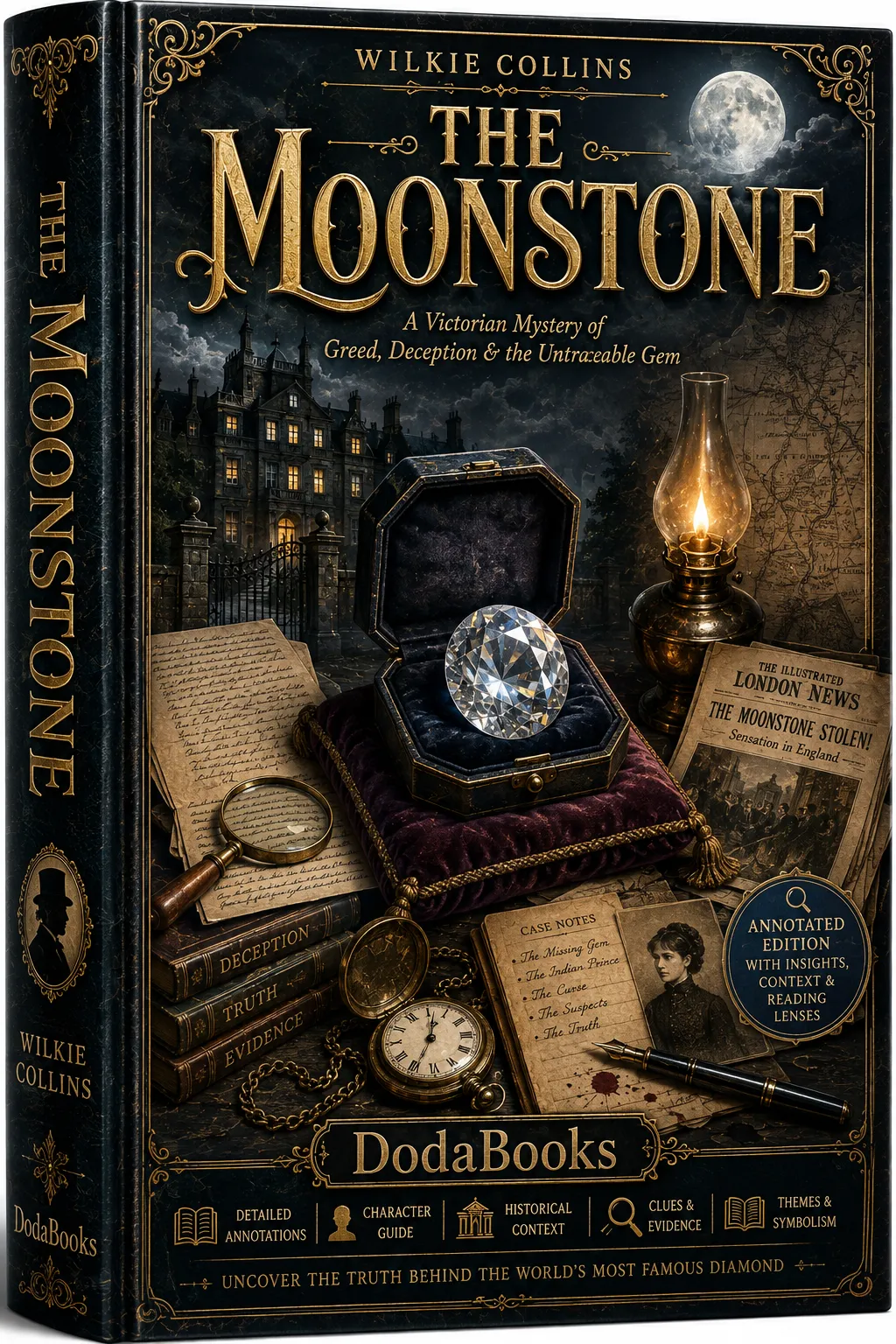
To explore the real-life historical models behind Sergeant Cuff, Victorian opium science, and colonial history, discover the DodaBooks Annotated Edition, featuring interactive annotation cards and narrative trust maps.
📚 Related Articles
Interested in more Victorian detective masterpieces and sensation characters? Explore our The Woman in White Characters Explained or our The Hound of the Baskervilles Guide.
💎 Experience Collins’s Masterpiece With Every Character Decoded
Read the novel that founded detective fiction in an authoritative, distraction-free edition:
- ✅ Complete, unabridged 1868 text across all fourteen narrators and testimonies
- ⚖️ Victorian medical & colonial context decoded — understand the opium science and Seringapatam theft
- 🗂️ Passage-specific annotation cards revealing character credibility and narrative clues
- 🔒 DRM-free EPUB format — readable on any Kindle, Kobo, iPad, or mobile device
- 📥 Instant digital download delivered directly after checkout