The Letters of Franklin K. Lane: The Inner Mind of Progressive America
Woodrow Wilson’s visionary Secretary of the Interior penned some of the most lucid, intimate, and philosophically rigorous epistolary reflections in American political history, capturing conservation battles, wartime mobilization, and unwavering civic devotion.
Few historical artifacts bridge the chasm between raw administrative mechanics and lyrical personal introspection as vividly as The Letters of Franklin K. Lane, Personal and Political (published posthumously in 1922). Serving as Secretary of the Interior under President Woodrow Wilson from 1913 to 1920, Franklin Knight Lane stood at the epicentre of American modernization. He championed the establishment of the National Park Service in 1916, spearheaded complex reclamation and resource conservation programs across the American West, guided national resource logistics during World War I, and navigated the ideological fractures of an expanding federal bureaucracy.
Yet unlike conventional political memoirs penned with an eye toward defensive self-vindication, Lane’s private correspondence—curated by his wife Anne Wintermute Lane and Louise Herrick Wall—reveals an intellectual of startling candor, wry humor, and searching poetic spirit. Written to presidents, Supreme Court justices, European diplomats, artists, and boyhood companions, these letters illuminate the moral dilemmas of modern democracy. Readers exploring our curated historical literature collection will discover in Lane a statesman who treated governance not as technocratic management, but as an ongoing spiritual venture to dignify the common citizen.
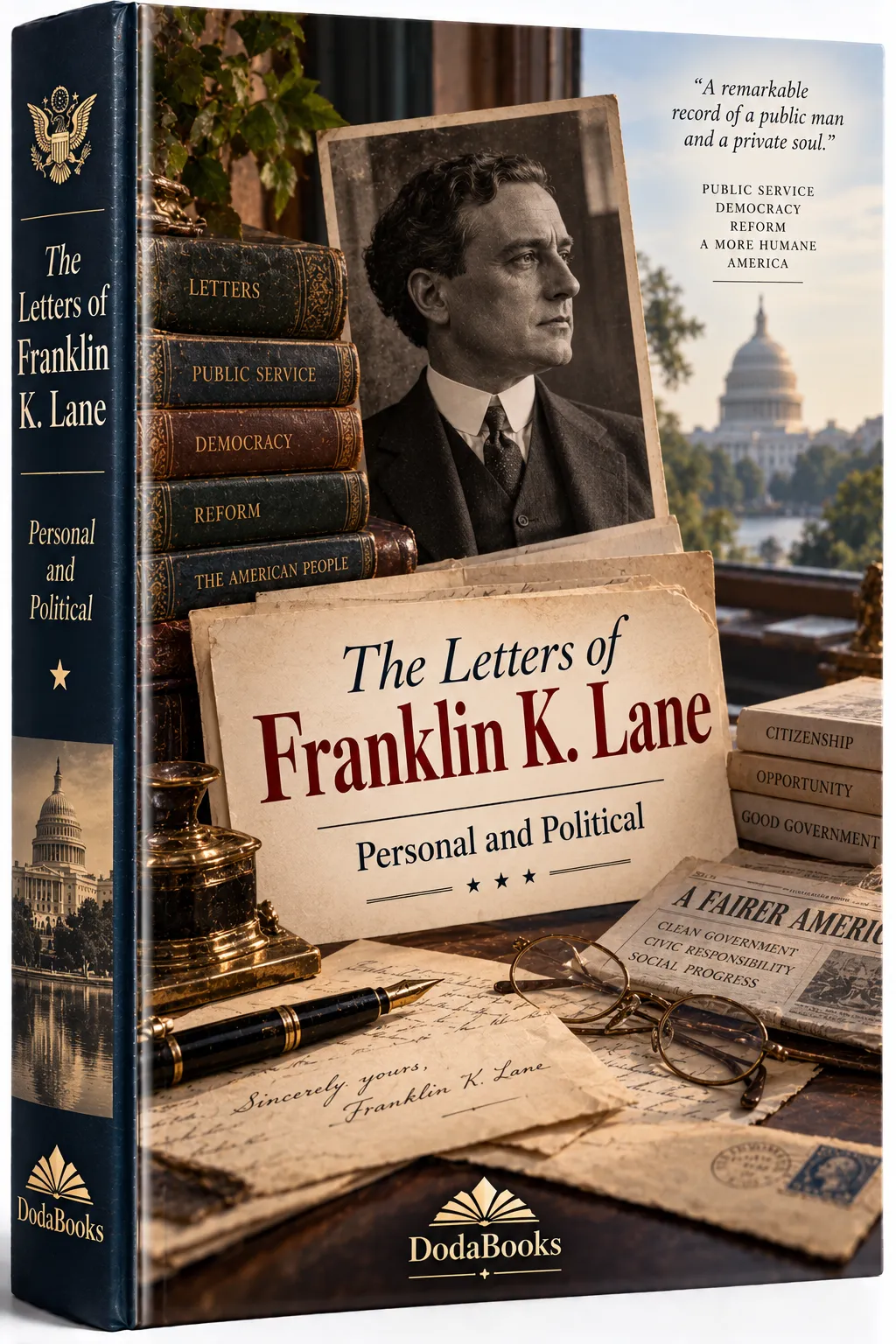
Read the Definitive Annotated Edition
Experience The Letters of Franklin K. Lane with comprehensive historical commentary, biographical annotations of Cabinet figures, and explanatory notes on Western resource politics.
Get the Annotated eBookThe Man Behind the Desk: Frontier Realism and Washington Power
Franklin K. Lane was born on Prince Edward Island in 1864, grew up in California, and forged his professional worldview in the rough-and-tumble spheres of frontier journalism and West Coast law. Serving as City Attorney of San Francisco and subsequently appointed by Theodore Roosevelt to the Interstate Commerce Commission (ICC), Lane belonged to that distinctive wing of Progressive Era thinkers who wedded pragmatic Western individualism to vigorous federal regulation of corporate monopolies.
When Woodrow Wilson invited Lane into his inaugural cabinet in March 1913, the Department of the Interior was widely regarded as an administrative graveyard—an unruly agglomeration of competing bureaus managing public lands, Indian affairs, mining patents, and territorial governance, frequently marred by graft and patronage disputes. Lane brought to the department a luminous clarity of purpose. His letters from 1913 through 1916 chart a deliberate campaign to transform the public domain from an arena of speculative plunder into an enduring democratic heritage.
                    THE PROGRESSIVE CABINET CRUCIBLE

    Western Conservation ──────► [ Franklin K. Lane ] ◄────── Modern Bureaucracy
    (Muir, Mather, Public Lands)   (Sec. of Interior)        (ICC, Mineral Leasing)
                 │                         │                         │
                 ▼                         ▼                         ▼
          National Parks            Wilson Cabinet           WWI Mobilization
         Organic Act (1916)       Deliberations (1917)     Council of Nat. Defense
In his private correspondence with conservationists such as Stephen Mather and Horace Albright, Lane documented the delicate legislative maneuvering that culminated in the National Park Service Organic Act of 1916. He possessed an almost transcendental reverence for the natural grandeur of the continent, describing the redwoods of California, the canyons of Arizona, and the glacial peaks of Montana not merely as scenic reserves, but as secular cathedrals necessary for the spiritual regeneration of American democracy. For students of early twentieth-century environmental literature, Lane’s correspondence stands alongside the writings of Theodore Roosevelt and John Muir as an essential primary document.
Wilson’s Cabinet Room: Intimate Witnesses to World War I
The dramatic heart of Lane’s epistolary legacy resides in his detailed, real-time accounts of Wilson’s cabinet meetings during the agonizing period of American neutrality and eventual entry into World War I. While President Wilson maintained an aloof, austere public facade, Lane’s private journal letters captured the mounting psychological tension inside the executive mansion:
- The Agony of Neutrality (1914–1916): Lane recorded the Cabinet’s fractious debates following the sinking of the Lusitania, depicting Secretary of State William Jennings Bryan’s evangelical pacifism against his own conviction that German imperial aggression threatened the basic architecture of international law.
- The Cabinet Rupture (February–April 1917): Following the interception of the Zimmermann Telegram and Germany’s resumption of unrestricted submarine warfare, Lane described the fateful meetings where Wilson sat wrestling with his conscience before asking Congress for a declaration of war.
- The Industrial Home Front: As a driving member of the Council of National Defense, Lane corresponded furiously on coal production, railway coordination, and mineral reserves, observing how modern total war forced democratic governments to invent novel instruments of industrial planning overnight.
- The Tragic Aftermath and Paris: Lane’s later letters offer a devastating critique of post-war domestic exhaustion, the bitter Senate deadlock over the League of Nations, and the physical breakdown of President Wilson, providing an unfiltered window into the unraveling of progressive internationalism.
Lane’s portrait of Woodrow Wilson is among the most nuanced ever recorded by a contemporary. While revering Wilson’s rhetorical genius and moral elevation, Lane lamented the President’s growing intellectual isolation, his reluctance to take counsel from his cabinet colleagues, and his tragic inability to compromise with political adversaries. Readers of European court chronicles, such as the aristocratic power games depicted in Saint-Simon’s Versailles memoirs, will note striking parallels in how executive power inexorably isolates the ruler, whether an absolute Bourbon monarch or an American wartime president.
Literary Style and Philosophic Humanism
What elevates Franklin K. Lane’s collection above standard archival documentation is his consummate command of prose style. Lane was a prose stylist of remarkable grace, blending the conversational warmth of an old friend with the moral gravity of a classical Stoic. His letters are punctuated with aphoristic gems, literary quotations, and reflections on the fleeting nature of political acclaim:
“The only real satisfaction in life is to do your work with all your might, to keep your heart clean, to love a few people faithfully, and to look out upon the world with curiosity and goodwill.”
His correspondents included a dazzling cross-section of intellectual and cultural luminaries: Justice Oliver Wendell Holmes Jr., philosopher William James’s circle, author Mark Twain, financier Bernard Baruch, and British ambassador Sir Cecil Spring Rice. Lane moved effortlessly from disputing legal theories of federal sovereignty to analyzing Russian literature, contemplating Buddhism, or mourning the passing of intimate friends.
In an era when political discourse was already succumbing to partisan slogans and mechanical committee reports, Lane insisted on treating language as an art of empathy. Even when exhausted by relentless congressional inquiries or battling the chronic angina that would cut his life short at age fifty-six, his epistolary voice remained resilient, inquisitive, and fundamentally joyful.
Key Themes Explored in Franklin K. Lane’s Correspondence
To appreciate the intellectual architecture of this epistolary volume, modern readers should focus on several overarching themes that recur throughout the correspondence:
1. The Democratic Ethics of Conservation
Lane refused to view conservation through the narrow lens of preservationist exclusion or commercial exploitation. He articulated what he termed “intelligent utilization”—preserving pristine national parks for public wonder while managing mineral, oil, and water rights under stringent public accountability. His correspondence captures the bitter political fights against private monopoly syndicates seeking to seize public water powers and coal lands in Alaska.
2. The Psychology of Power and Isolation
Throughout his tenure in the Cabinet, Lane maintained a running philosophical inquiry into how high office warps human character. He observed how the flattery of subordinates, the incessant press scrutiny, and the burden of momentous decisions tempted public servants into vanity or cynicism. Lane consciously used his private correspondence as an anchor to keep himself grounded in everyday human sympathies.
3. Civic Idealism vs. Bureaucratic Inertia
Having managed one of the largest federal departments, Lane wrote trenchantly on the paralyzing effects of red tape. In several celebrated letters penned toward the close of his service in 1920, he warned that federal departments risked choking creative initiative beneath mountains of procedural paperwork—a critique that anticipates modern public administration theory by half a century.
                       LANE'S CIVIC TRIAD

                  ┌────────────────────────┐
                  │    Civic Idealism      │
                  │ (Democratic Faith &    │
                  │ Public Education)      │
                  └───────────┬────────────┘
                              │
             ┌────────────────┴────────────────┐
             ▼                                 ▼
   ┌───────────────────┐             ┌───────────────────┐
   │ Conservation &    │             │ Administrative    │
   │ Natural Heritage  │◄───────────►│ Efficiency &      │
   │ (National Parks)  │             │ Ethical Power     │
   └───────────────────┘             └───────────────────┘
Comparative Context: Epistolary Literature and Political Chronicles
To contextualize Lane’s letters within the broader sweep of literature and memoir, it is illuminating to examine how other historical chroniclers engaged with public life and private conscience:
| Work & Author | Setting & Era | Dominant Focus | Epistolary & Narrative Style |
|---|---|---|---|
| The Letters of Franklin K. Lane | United States (1913–1921) | Progressive Era cabinet, Conservation, WWI | Lyrical, intimate, philosophical, democratic |
| Memoirs of Louis XIV (Duc de Saint-Simon) | Versailles (1690–1715) | Royal court rituals, aristocratic factionalism | Acidic, psychological, forensic portraiture |
| Memoirs of the Court of Marie Antoinette (Mme. Campan) | Pre-Revolution France (1770–1792) | Queen’s household, Diamond Necklace, fall of monarchy | Eyewitness testimony, defensive loyalty, domestic detail |
| The Amazing Marriage (George Meredith) | Victorian Britain (1895) | High-society pride, social contracts, marital tragedy | Complex, psychological realism, aphoristic wit |
While European court memoirs such as those by Madame Campan document the tragic blindness of decadent monarchies, Lane’s letters record the energetic, chaotic, and hopeful dawn of twentieth-century American democracy. At the same time, Lane shares with great psychological writers like George Meredith an intense interest in character, motive, and the self-deceptions that accompany pride and status.
Explore Progressive Era Statesmanship
Immerse yourself in Woodrow Wilson's cabinet, early National Park battles, and the personal philosophy of Franklin K. Lane in this elegant, fully annotated edition.
Read The Annotated EditionWhy Read Franklin K. Lane Today?
In an age dominated by instantaneous digital messaging and sound-bite politics, the art of long-form epistolary reflection has largely vanished from public governance. Franklin K. Lane’s letters remind us of a time when national leaders thought deeply with pen in hand, grappling with the moral consequences of their decisions and seeking universal wisdom in the midst of administrative crisis.
Whether you are an American history enthusiast, an environmental advocate interested in the roots of the National Park Service, or a lover of classic personal correspondence, Lane’s letters offer an inspiring antidote to political cynicism. His vision of citizenship—grounded in love of nature, ethical responsibility, and relentless democratic faith—remains as urgent and compelling today as when his words were first written.
Frequently Asked Questions
Who was Franklin K. Lane and what positions did he hold?
Franklin Knight Lane (1864–1921) was an American attorney, journalist, and statesman who served as City Attorney of San Francisco, Commissioner on the Interstate Commerce Commission under Theodore Roosevelt and William Howard Taft, and Secretary of the Interior under Woodrow Wilson from 1913 to 1920. He is especially celebrated for founding the National Park Service in 1916 and managing national resources during World War I.
What makes The Letters of Franklin K. Lane historically significant?
The collection provides an invaluable first-hand, real-time insider account of Woodrow Wilson's cabinet meetings during the First World War, the passage of landmark conservation legislation, the creation of the National Park Service, and the domestic mobilization of the United States. Its frank, personal observations offer unique insight into Wilson's temperament and Progressive Era statecraft.
Are these letters dry official government documents?
Not at all. While discussing critical public affairs, the vast majority are private letters addressed to Lane's wife, children, intimate friends, authors, and fellow statesmen. They are written in an extraordinarily lyrical, witty, and candid literary style, filled with philosophical musings, literary criticism, and poignant reflections on mortality and friendship.
What role did Franklin K. Lane play in the creation of the National Park Service?
As Secretary of the Interior, Lane was the executive champion of the National Park Service. He recruited Stephen Mather and Horace Albright into the Department of the Interior, secured federal funding, and spearheaded the legislative campaign that resulted in President Wilson signing the National Park Service Organic Act into law on August 25, 1916.
What value does the DodaBooks annotated edition add to Lane's letters?
The DodaBooks annotated edition includes detailed historical introductions, biographical glossaries identifying hundreds of contemporary politicians, diplomats, and cultural figures referenced by Lane, contextual notes on legislative acts and WWI cabinet debates, and scholarly analysis of Lane's conservation philosophy. You can explore and download the definitive annotated edition directly from DodaBooks at https://dodabooks.com/ebook/the-letters-of-franklin-k-lane-personal-and-political-by-franklin-k-lane/.
Related Historical and Literary Studies
Discover more historical memoirs, political studies, and classic literature in our curated collection: