The Lady of the Lake Characters Explained: Ellen, Fitz-James, Roderick Dhu & Cast
Sir Walter Scott’s The Lady of the Lake (1810) is celebrated for its sweeping verse and magnificent descriptions of the Scottish Trossachs, but the enduring emotional heart of the poem is its dramatic cast of characters. Set against the backdrop of sixteenth-century Scottish nation-building, Scott crafts a dynamic clash of personalities that represents competing cultural worlds: the centralized feudal monarchy of the Lowlands, the fierce patriarchal independence of the Celtic Highland clans, and the noble, exiled chivalry of the Border aristocracy.
At the center of this cultural and martial conflict stands Ellen Douglas, whose beauty, moral integrity, and filial devotion make her the prize sought by three powerful men: a sovereign king, an outlawed Highland chieftain, and a brave young mountain warrior.
This comprehensive character study provides in-depth profiles, symbolic roles, historical context, and character trajectories for all major and supporting figures in Scott’s epic narrative poem.
| Character | Allegiance / Identity | Symbolic Archetype | Narrative Trajectory & Key Conflict |
|---|---|---|---|
| Ellen Douglas | House of Douglas; exiled | Highland Purity / Moral Agency | Resists political marriage to Roderick; journeys to Stirling Castle to save her father. |
| James Fitz-James (King James V) | Crown of Scotland | Chivalric Monarch / Incognito Ruler | Disguised huntsman; falls in love with Ellen; duels Roderick Dhu; reconciles his kingdom. |
| Roderick Dhu (Roderick the Black) | Chieftain of Clan Alpine | Tragic Celtic Warlord / Proud Rebel | Shelters the Douglases; summons the Fiery Cross; defends Gael land; dies in Stirling prison. |
| Lord James of Douglas | Exiled patriarch of the Douglases | Chivalric Nobility / Filial Honor | Banished friend of the King; surrenders himself to prevent civil war; wins Stirling games. |
| Malcolm Graeme | Young Highland nobleman | Gallant Romantic Hero | Loyal to the King yet devoted to Douglas; Ellen’s true love; arrested and united with Ellen. |
| Allan-bane | Ancient family bard of the Douglases | Celtic Oral Tradition / Minstrelsy | Sings the history of the clans; accompanies Ellen to Stirling; comforts dying Roderick Dhu. |
| Brian the Hermit | Demonic ascetic monk of Glenfinlas | Pagan-Christian Occult Prophet | Consecrates the Fiery Cross with goat blood; foretells the outcome of the war via the Taghairm. |
| Blanche of Devan | Deranged Highland captive woman | Tragic Gothic Victim of Clan Violence | Her lover was murdered by Roderick; warns Fitz-James of ambush; avenged by Fitz-James. |
🛶 1. Ellen Douglas: The Lady of the Lake
ELLEN'S HEROIC JOURNEY
Highland Sanctuary ──► Rejection of Roderick ──► The Goblin's Cave ──► Royal Audience
(Ellen's Isle, Canto I)   (Refusing Power, Canto II)  (Refuge, Canto IV)   (Stirling, Canto VI)
Ellen Douglas is Scott’s idealized vision of feminine grace, natural innocence, and moral heroism. Though she lives in primitive seclusion on an isolated island in Loch Katrine, she is not an uncivilized savage; she is the daughter of Scotland’s premier noble house, educated in courtly refinement yet free from the artificial vanity and corruption of Edinburgh court life.
Key Character Dimensions:
- Natural Royalty: When Fitz-James first sees her guiding her light skiff across the water in Canto I, he is struck by her aristocratic bearing. Scott compares her to a mountain flower that loses none of its beauty by blooming in the wilderness.
- Romantic Agency: Unlike passive damsels in conventional chivalric romances, Ellen possesses a clear will and steadfast heart. Although Roderick Dhu is her family’s sole protector, she refuses to sell her hand in marriage to purchase safety:
“I’d rather on the mountain side
Die of the cold with Malcolm Graeme,
Than be of Alpine’s lord the bride,
With all the wealth of Alpine’s name!” - Courage & Daughterly Devotion: When her father sneaks away to Stirling Castle to face the King’s executioner, Ellen does not despair. Accompanied only by the aged minstrel Allan-bane, she braves the lawless roads and military guard-rooms of Stirling, presenting her gold ring directly to the crown to save her family.
👑 2. James Fitz-James (King James V): The Chivalric Monarch
James Fitz-James is the catalyst of the entire narrative. When he first appears in Canto I, he is introduced simply as a wealthy Saxon huntsman whose horse has perished in the chase. In reality, he is King James V of Scotland (1512–1542), traveling in disguise through his realm.
THE DUAL IDENTITY OF FITZ-JAMES
┌────────────────────────────────────────────────────────┐
│ THE PRIVATE MAN (Fitz-James):                          │
│ • Adventurous huntsman & courtly romantic              │
│ • Courageous master of the rapier in single combat     │
│ • Generous giver of the signet ring to Ellen           │
├────────────────────────────────────────────────────────┤
│ THE PUBLIC SOVEREIGN (King James V):                   │
│ • Determined to centralize law and suppress clans      │
│ • Torn between justice and affection for Douglas       │
│ • The "King of the Commons" reconciling Scotland       │
└────────────────────────────────────────────────────────┘
Historical & Thematic Significance:
In Scottish folklore, King James V was celebrated as the “Gudeman of Ballengeich”—a monarch who loved slipping out of Stirling Castle dressed as a common farmer or trader to mingle with commoners, assess corrupt magistrates, and woo country maidens.
In the poem, Fitz-James embodies Renaissance chivalry:
- Personal Honor: In Canto V, even when he realizes that his guide is his mortal enemy Roderick Dhu, Fitz-James honors his truce until they cross the ford into Lowland territory.
- Mercy over Vengeance: While King James enforces the law against clan raiding, he is fundamentally noble. When he reveals his true identity in the Stirling presence chamber, he does not execute his defeated foes; he pardons Douglas, praises Roderick’s courage, and unites Ellen with Malcolm Graeme.
🌲 3. Roderick Dhu: The Tragic Celtic Warlord
Roderick Dhu (literally Roderick the Black, so named for his dark hair, brooding countenance, and ruthless temperament) is Scott’s most complex, compelling character. He is not a one-dimensional villain, but a fierce, proud embodiment of the ancient Highland clan system fighting a desperate, losing battle against modernization and royal authority.
The Duality of Roderick:
- The Ruthless Marauder: To the Lowlands, Roderick is a murderous reiver and robber who burns border villages, steals cattle, and kills royal messengers. His cruelty is highlighted by the tragedy of Blanche of Devan, whose bridegroom was butchered by Clan Alpine.
- The Noble Patriarch: To his clan, Roderick is a loving, self-sacrificing father. He risks his life, property, and clan to shelter the outlawed Douglases because sacred Celtic hospitality forbids turning away a guest in distress.
- The Anti-Feudal Philosopher: In his great dialogue with Fitz-James on the mountain path (Canto V), Roderick delivers an impassioned defense of the Gaelic way of life:
“These fertile plains, that softened vale,
Were once the garden of the Gael;
The stranger came with iron hand,
And from our fathers reft the land.
Where dwell we now! See, rudely swell
Crag over crag, and fell o’er fell…
What reap we but the robber’s name?”
His Heroic Death:
Roderick’s adherence to the Highland code of honor leads directly to his downfall. When he has Fitz-James completely surrounded by five hundred spearmen at Coilantogle Ford, he refuses to take an unfair advantage, choosing to fight him man-to-man. In Canto VI, dying of his wounds in Stirling Castle, his last moments are spent listening to Allan-bane’s song of his clan’s bravery, passing away as the last titanic champion of the Gaelic heroic age.
🛡️ 4. Lord James of Douglas: The Exiled Titan
Lord James of Douglas represents the pinnacle of feudal chivalry. Historically, the Black Douglases were Scotland’s most powerful noble dynasty—so mighty that kings frequently feared they would usurp the throne.
- Paternal Nobility: Douglas’s love for Ellen is absolute. When Roderick offers a military alliance that could defeat the King and restore Douglas to his lands—conditional upon Ellen marrying Roderick—Douglas refuses without hesitation, refusing to sacrifice his daughter’s happiness for political gain.
- Physical Supremacy: In Canto V, despite his advancing age, Douglas enters the royal games at Stirling Castle in disguise, effortlessly winning the archery shoot, the stone toss, and the wrestling championship against younger royal champions.
- Civic Patriotism: When war threatens to consume Clan Alpine and the Lowlands, Douglas voluntarily surrenders himself to King James V to prevent civil bloodshed, proving that his loyalty to Scotland transcends his personal grievances.
🏹 5. Malcolm Graeme: The Young Highland Champion
Malcolm Graeme is the romantic hero of the poem and Ellen’s true love. A young Scottish nobleman possessing lands on both sides of the Highland boundary line, Malcolm bridges the two worlds:
- Defiant Spirit: In Canto II, when Roderick Dhu insults the Douglases and demands Ellen’s hand, Malcolm steps between them with drawn sword. When Roderick attempts to humble him, Malcolm refuses to accept Roderick’s boat, diving into Loch Katrine with his target and broadsword held high and swimming to the opposite shore in magnificent defiance.
- The Romantic Reversal: In Canto VI, King James V playfully stages Malcolm’s arrest for treason, only to place Malcolm’s golden fetters directly into Ellen’s hands, making him her lifelong “captive” in marriage.
🎶 6. Allan-bane: The Voice of Celtic Memory
Allan-bane is the white-haired minstrel and harpist of the House of Douglas. In Scott’s poetic universe, the minstrel is not merely a musician; he is the keeper of history, genealogy, and prophecy:
- Second Sight: Allan-bane possesses the Celtic gift of foresight, predicting impending sorrow when Fitz-James first sets foot on the island.
- The Bardic Death: In Canto VI, Allan-bane brings dignity and peace to the dying Roderick Dhu by singing the epic battle lay of Beal’ an Duine. Through Allan-bane, Scott pays homage to the ancient oral tradition of Scotland that was disappearing in the nineteenth century.
🔮 7. Brian the Hermit: The Occult Fanatic
Brian the Hermit is Scott’s most eerie, Gothic creation. Born of an unholy union on a midnight heath, Brian has abandoned Christian monastic life to live in caves as an ascetic pagan-Christian prophet:
- The Consecration of Blood: In Canto III, Brian forges the Fiery Cross with terrifying ritualistic hatred, cursing anyone who hesitates to shed blood in defense of Clan Alpine.
- The Taghairm Vision: Suspended in a bull’s hide above a thundering mountain waterfall, Brian channels the spirit world to deliver the prophecy that shapes the climax: “Which spills the foremost foeman’s life, that party conquers in the strife!”
❓ Frequently Asked Questions
Why did King James V banish the Douglas family?
Historically, the Douglas family controlled the Scottish crown during James V's minority, essentially holding the young King prisoner until he escaped at age sixteen in 1528. Upon gaining power, James V banished the Douglases and confiscated their lands to break their overbearing aristocratic power.
How does Roderick Dhu differ from a conventional literary villain?
Roderick Dhu is a tragic hero rather than a simple villain. He strictly observes the sacred Highland code of hospitality, refuses to execute a captured enemy who is his guest, and fights not for personal wealth, but to protect his ancestral clan and territory from royal Lowland encroachment.
What is the symbolic significance of Allan-bane's harp?
Allan-bane's harp symbolizes the dying oral culture of the Gaelic Highlands. In the opening and closing stanzas of the poem, Scott invokes the "Harp of the North," presenting his poem as an attempt to revive the silenced music of ancient Scotland before it is lost to modern industrial history.
Did Ellen Douglas ever consider marrying Roderick Dhu?
No. While Ellen deeply respected Roderick as her family's generous protector and recognized his courage, she felt an instinctive romantic revulsion toward his violent, brooding nature, comparing the idea of their union to an eagle mating with a dove.
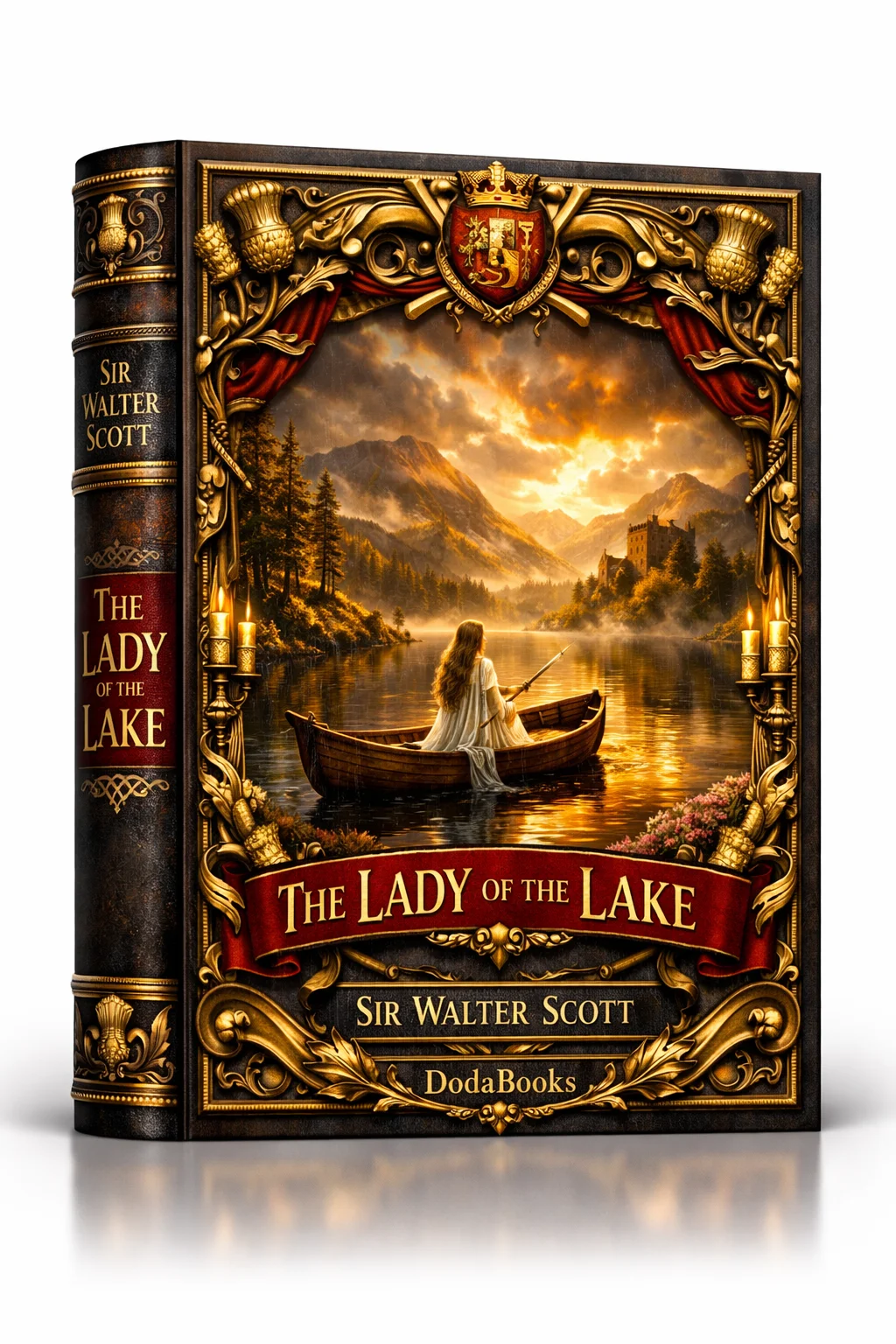
📖 Explore the Highland Legends in Verse
Discover the full psychological and historic depth of Scott’s legendary characters in the annotated digital edition from DodaBooks:
- 🗡️ Unabridged 6-Canto Text — Featuring all songs, laments, and Spenserian preludes
- 💡 Exhaustive Clan & Heraldry Footnotes — Contextualizing James V, the Douglases, and Celtic warfare
- 📱 Pristine Poetic Layout — Optimized for verse reading on Kindle, Kobo, iPad, and smartphone
- 🔓 100% DRM-Free — Keep and transfer your files with zero digital restrictions
👉 Get the Annotated Edition of The Lady of the Lake at DodaBooks →