The King in Yellow Summary: All 10 Stories & Mythology Explained
Published in 1895, Robert W. Chambers’s The King in Yellow is one of the foundational cornerstones of modern weird fiction and cosmic horror. Decades before H.P. Lovecraft conceived of Cthulhu, the Necronomicon, and Arkham, Massachusetts, Chambers created a terrifying fictional mythology centered around a banned, sanity-shattering theatrical play whose poetic second act drives anyone who reads it irrevocably mad.
Today, The King in Yellow is famous worldwide: it directly influenced Lovecraft’s Cthulhu Mythos, inspired Neil Gaiman, Alan Moore, and Stephen King, and served as the haunting thematic backbone of the acclaimed first season of HBO’s True Detective (featuring Rust Cohle and the sinister Yellow King of Carcosa).
Yet despite its towering reputation, The King in Yellow is widely misunderstood. Many readers are shocked to discover that it is not a traditional novel, nor is it purely a collection of horror stories. It is a brilliant, multifaceted ten-story anthology that moves from dystopian alternate-history sci-fi and cosmic dread in its opening half to haunting romantic time-slips and tender, nostalgic portraits of bohemian artist life in Paris’s Latin Quarter in its second half.
Whether you are preparing a literature analysis, studying the roots of cosmic horror, or exploring the mythology of Hastur and Carcosa, this comprehensive guide provides an exhaustive summary and thematic breakdown of all ten stories in Chambers’s masterpiece.
⚡ The King in Yellow: At a Glance
- The Mythic Play: *The King in Yellow* is a fictional two-act verse play published in France, suppressed by church and state. Act I lures the reader with innocent poetry; Act II reveals unendurable, cosmic truths about the universe.
- The 4 Cosmic Horror Tales: "The Repairer of Reputations", "The Mask", "In the Court of the Dragon", and "The Yellow Sign" form the core Mythos cycle directly linking characters to the play, the Pallid Mask, and the King.
- The Gothic Time-Slip Romance: "The Demoiselle d'Ys" — A young American hunter is lost in the misty moors of Brittany, slipping centuries into the past to fall in love with a medieval falconer maiden.
- The Latin Quarter Bohemian Tales: Four rich stories ("The Street of the Four Winds", "The Street of the First Shell", "The Street of Our Lady of the Fields", "Rue Barrée") exploring young American artists, bohemian love, and the 1870 Siege of Paris.
- Key Mythological Concepts: Carcosa (the ruined ancient city beneath black stars), Lake of Hali, the Hyades, Aldebaran, the Pallid Mask, the Yellow Sign, and the Imperial Dynasty of America.
🌌 The Cosmic Mythology: Decoding Chambers’s World
Before exploring the individual stories, one must understand the interconnected web of symbols, poems, and names that Robert W. Chambers wove through his text:
+---------------------------------------------------------------------------------------+
|                    THE MYTHOLOGY OF THE KING IN YELLOW EXPLAINED                      |
+-------------------+-------------------------------------------------------------------+
| MYTHIC ELEMENT    | ORIGIN & COSMIC SIGNIFICANCE                                      |
+-------------------+-------------------------------------------------------------------+
| The Play          | A published French tragedy in two acts; reading the second act    |
| *The King in      | reveals sanity-destroying truths about human insignificance and   |
| Yellow*           | cosmic dominion. Banned throughout Europe and America.            |
+-------------------+-------------------------------------------------------------------+
| Carcosa           | An ancient, forgotten alien city situated on the shores of the    |
|                   | misty Lake of Hali under twin suns and black stars. Borrowed by   |
|                   | Chambers from Ambrose Bierce's 1886 story "An Inhabitant of       |
|                   | Carcosa".                                                         |
+-------------------+-------------------------------------------------------------------+
| The Pallid Mask   | A motif from the play's masquerade scene: Stranger: "I wear no    |
|                   | mask." Camilla: "No mask? No mask!" Terrifying symbol of bare,    |
|                   | unvarnished cosmic horror.                                        |
+-------------------+-------------------------------------------------------------------+
| The Yellow Sign   | A strange golden/amber glyph carved into black onyx; whoever      |
|                   | possesses or looks upon it is marked for immediate destruction by |
|                   | the King in Yellow's avatars.                                     |
+-------------------+-------------------------------------------------------------------+
| Hastur &          | Celestial bodies and entities associated with the King; Hastur is |
| Aldebaran         | a city or shepherd god in Bierce, adopted by Chambers as an       |
|                   | ambient force, and later turned into an Old One by Lovecraft.     |
+-------------------+-------------------------------------------------------------------+
Cassilda’s Song (From Act I, Scene 2)
Chambers opens the volume with the haunting poem that serves as the lyrical overture to the entire work:
Along the shore the cloud waves break,
The twin suns sink behind the lake,
The shadows lengthen
In Carcosa.Strange is the night where black stars rise,
And strange moons circle through the skies,
But stranger still is
Lost Carcosa.Songs that the Hyades shall sing,
Where flap the tatters of the King,
Must die unheard in
Dim Carcosa.Song of my soul, my voice is dead,
Die thou, unsung, as tears unshed
Shall dry and die in
Lost Carcosa.
📜 Complete Summary of All 10 Stories
Part I: The Four Masterpieces of Cosmic Horror
1. The Repairer of Reputations
Set in an alternate-future 1920 New York City (written in 1895), Chambers depicts an America that has become an authoritarian, aristocratic world power. The United States has established legal “Government Lethal Chambers” in public squares where weary or despondent citizens can undergo painless suicide.
The narrator, Hildred Castaigne, suffered a severe head injury from a fall from his horse four years earlier, during which he was treated in an insane asylum. While recovering, he read The King in Yellow, which unlocked a fanatical, megalomaniacal delusion. Hildred now believes that he is the rightful heir to the “Imperial Dynasty of America” and the royal throne of Carcosa.
Hildred aligns himself with Mr. Wilde, an eccentric, grotesque dwarf who lives in a squalid apartment above a stable. Wilde calls himself the “Repairer of Reputations”—a blackmailer who maintains an intelligence network of servants, cab drivers, and thieves to manipulate New York society. Wilde possesses a ledger titled The Imperial Dynasty of America, proving (in their minds) that once Hildred’s cousin, Louis Castaigne, is eliminated, Hildred will be crowned King of America.
Hildred attempts to force Louis to renounce his royal birthright. When Louis refuses—more interested in marrying his sweetheart Constance Hawberk than entertaining Hildred’s delusions—Hildred prepares to execute him. However, when Hildred returns to Wilde’s apartment to fetch the crown of Carcosa, he finds Wilde’s throat torn out by his feral, maltreated cat. The police arrive and arrest Hildred, who writes his confession from the Criminal Lunatic Asylum on Blackwell’s Island, where he dies insane.
2. The Mask
Narrated by an American sculptor named Alec, “The Mask” takes place in Paris and blends science-fiction alchemy with decadent romance. Alec lives in an opulent studio with his brilliant artist friend Boris Yvain and Boris’s radiant lover, Geneviève.
Boris has invented a miraculous, milky chemical solution that transforms any living creature or plant submerged in it into flawless, translucent marble within seconds:
- Boris demonstrates this by dipping an Easter lily, a goldfish, and a live rabbit into the pool; each emerges petrified into breathtaking, indestructible stone.
- Alec discovers a copy of The King in Yellow bound in serpent skin in the studio and reads it, falling into a feverish delirium.
- At the same time, Alec and Geneviève harbor a suppressed, mutual passion for one another, which fills Geneviève with agonizing guilt toward Boris.
Distraught by her conflicted feelings, Geneviève throws herself into the chemical pool. When Boris and Alec rush to the tank, they find her transformed into a lifeless, breathtaking statue of marble. Overcome with grief, Boris shoots himself in the temple.
Months later, while Alec lives in mourning, a miracle occurs: the chemical reaction slowly reverses. The marble statue of Geneviève warms, breathes, and revives into living flesh. The story concludes on a note of miraculous romantic resurrection, contrasting the bleak doom of the other tales.
3. In the Court of the Dragon
The unnamed narrator, his mind shattered and nerves frayed from reading The King in Yellow, seeks spiritual sanctuary inside the ancient Parisian church of Saint-Sulpice.
As he sits in the gloom listening to the vespers, the grand organ begins to play. However, instead of sacred hymns, the music turns into a bizarre, discordant, and mocking blasphemy. The narrator looks up into the organ loft and catches the burning, malignant gaze of the church organist:
- The organist’s eyes emanate pure, calculating hatred, as if he recognized the narrator as an escaped fugitive of Carcosa.
- Paralyzed by panic, the narrator flees the church into the bustling streets of Paris.
- Yet everywhere he turns, the black-clad figure of the organist appears ahead of him, stalking him through alleys, squares, and arcades.
The narrator escapes into the quiet courtyard of his apartment building—the Court of the Dragon off the Rue de Rennes. He ascends the stone stairs to his studio, believing he is safe.
Suddenly, reality dissolves. The stone walls melt into black mist, and Paris disappears. Above him, twin suns sink into the misty Lake of Hali. The towering figure of the King in Yellow descends upon him in tatters of silk:
“It is a fearful thing to fall into the hands of the living God! But it is a far more terrible thing to fall into the hands of the King in Yellow!”
The narrator’s heart stops, and he is dragged into eternal damnation.
4. The Yellow Sign
Widely considered Chambers’s masterpiece of atmospheric dread, “The Yellow Sign” follows Jack Scott, a successful American painter living in New York, and his lovely, spirited model, Tessie Reegan.
From his studio window overlooking the churchyard of St. Matthew’s, Scott notices the cemetery night-watchman: an obese, revolting man with a puffy, dough-like white face, blank eyes, and fingers that resemble white worms. Both Scott and Tessie feel an involuntary shudder of nausea whenever they see him.
Tessie begins having terrifying, recurring nightmares:
- She dreams she is lying in a coffin, watching the bloated watchman drive a midnight hearse down the cobblestones to claim her corpse.
- One afternoon, Tessie purchases a curious antique trinket at a curio shop—a heavy clasp of pure black onyx inlaid with a bizarre, gilded hieroglyph that is neither Arabic nor Chinese: The Yellow Sign.
- That evening, Scott reads The King in Yellow. As he turns the final page of Act II, a wave of cosmic horror washes over him: “I prayed God to curse the writer, as the writer had cursed the world with this beautiful, stupendous creation… The words had burned into my soul like molten lead.”
Moments later, the hearse watchman breaks into the house. When Scott shoots him in the chest with a revolver, the bullets produce no blood—only a foul, putrid odor of ancient decay. The watchman tears the Yellow Sign from Tessie’s throat and physically crushes Scott.
When the police break down the door the following morning, they find Tessie and Scott dying on the floor beside the decomposing corpse of the watchman, which the coroner determines has been dead and decaying for months.
+-------------------------------------------------------------------------------+
|                       THE CORE 4 HORROR TALES COMPARISON                      |
+--------------------------+-----------------------+----------------------------+
| STORY                    | PRIMARY ARTIFACT      | MANIFESTATION OF DOOM      |
+--------------------------+-----------------------+----------------------------+
| The Repairer of          | The Imperial Dynasty  | Megalomania, murder, and   |
| Reputations              | Ledger & The Crown    | criminal asylum death      |
+--------------------------+-----------------------+----------------------------+
| The Mask                 | The Petrifying Pool   | Alchemical petrification   |
|                          | of Boris Yvain        | and guilt-ridden suicide   |
+--------------------------+-----------------------+----------------------------+
| In the Court of the      | Blasphemous Organ     | Dissolution of reality     |
| Dragon                   | Music of St-Sulpice   | into the skies of Carcosa  |
+--------------------------+-----------------------+----------------------------+
| The Yellow Sign          | The Black Onyx        | The rotting Hearse Driver  |
|                          | Talisman              | and physical decomposition |
+--------------------------+-----------------------+----------------------------+
Part II: The Supernatural Romance & Prose Poems
5. The Demoiselle d’Ys
In this enchanting, melancholy gothic tale, an American traveler named Philip is hunting falconry game on the desolate, heath-covered moors of Brittany. He loses his path in the gathering mist and wanders onto the grounds of an ancient, medieval stone château.
There he is greeted by Jeanne d’Ys, a breathtakingly beautiful young noblewoman dressed in fourteenth-century medieval robes, accompanied by her falconers and hounds:
- Jeanne treats Philip with tender, ethereal courtesy, fascinated by his modern firearm and strange manners.
- Philip falls deeply, instantaneously in love with her.
- As twilight falls, Philip is struck on the wrist by a venomous viper hidden in the heather. Jeanne rushes to his side, desperately sucking the poison from his wound and bandaging his arm with her silken scarf.
Philip falls into a feverish delirium. When he regains consciousness the following morning, the radiant medieval château has vanished. He is lying among cold, moss-covered stone ruins.
Beside him stands a local peasant who informs him that the ancient castle of the d’Ys family was destroyed over five centuries ago. Philip stumbles into the ruined family chapel and finds an ancient marble tomb. Carved upon the stone slab is the effigy of Jeanne d’Ys, who died in 1573—and draped across the cold marble hands is his own modern silk handkerchief.
6. The Prophets’ Paradise
“The Prophets’ Paradise” is a suite of eight short, enigmatic prose poems exploring fate, love, and artistic disillusionment:
- The Studio: An artist converses with a phantom who warns that fame is an illusion.
- The Phantom of the Past: A reflection on forgotten loves and regrets that linger like shadows.
- The Sacrifice: A lover offers his heart upon an altar, only to find the goddess indifferent.
- Destiny: A traveler attempts to flee his fate, only to meet it waiting at the crossroads.
- The Green Room: Actors remove their costumes, realizing they have forgotten who they are beneath their stage masks.
- The Mocking-Bird: A singer mimics the songs of nature, only to lose his own voice.
- The Dove: A wounded bird brings a message of peace that arrives too late.
- The Hidden Gate: A wanderer discovers the gate to paradise locked from within.
Part III: The Bohemian Latin Quarter Cycle
The final four stories leave cosmic horror behind, showcasing Chambers’s remarkable talent for romantic realism, Parisian local color, and artist-quarter camaraderie.
7. The Street of the Four Winds
Set in Paris’s Latin Quarter, the story follows Severin, an impoverished young woodcarver who lives alone in a freezing garret with an affectionate stray white cat.
Severin pines for his lost childhood love, Sylvia, whom he has not seen for years. One winter evening, his white cat slips out of the window and returns from an adjacent apartment balcony carrying a scented letter in its collar.
Severin follows the cat across the icy roofs into the neighboring apartment. Inside the dark, elegant bedroom, he finds a woman lying peacefully on the bed. When he approaches with a candle, he recognizes the face of Sylvia. However, his joy turns to sorrow when he touches her icy hand and realizes she has just died of illness, clutching a letter expressing her enduring love for him.
8. The Street of the First Shell
This dramatic, historical novella is set in Paris during the winter of 1870, when Prussian artillery was besieging and bombarding the French capital.
The narrative centers on Jack Trent, an American painter living in the Latin Quarter, his spirited young French companion Sylvia, and his fellow bohemian expatriates:
- As Prussian cannon shells begin exploding in the streets of Montparnasse (the “first shell” crashes into a nearby nursery), the artists confront the harsh realities of starvation, cold, and war.
- Trent is falsely suspected of espionage by suspicious Parisian National Guardsmen.
- When an artillery shell strikes their apartment building, Trent heroically shields Sylvia with his body, risking his life to preserve their love amid the ashes of war.
9. The Street of Our Lady of the Fields
A charming, bittersweet romantic comedy of manners set among American art students in Paris.
Hastings, an earnest, puritanical young American art student newly arrived from the American Midwest, attends a lively bohemian dance at the Bal Bullier. There he meets Valentine, a gentle, modest young French embroiderer.
Unlike the cynical, worldly art students around them who treat love as a casual game, Hastings and Valentine fall into a pure, respectful courtship, strolling through the sun-dappled Luxembourg Gardens and discovering that genuine innocence can flourish even in the decadent streets of Paris.
10. Rue Barrée
The collection concludes on a lighthearted, comedic note with “Rue Barrée”. The story follows Clifford, a handsome, eccentric American art student who becomes infatuated with a mysterious, elegant young French woman who walks past his studio every morning.
Because the street where she lives is perpetually closed for road repairs under a barricade sign reading “Rue Barrée” (Street Closed), Clifford and his mischievous artist friends nickname her “Rue Barrée”. Clifford embarks on a series of elaborate, chivalrous, and absurd schemes to win her attention without violating Victorian decorum.
In a charming and tender climax, Clifford rescues her pet dog from a street fight, leading to a shy, mutual confession of love that brings the entire volume to a warm and joyful close.
❓ Frequently Asked Questions (FAQ)
Is The King in Yellow a novel or a short story collection?
The King in Yellow is a collection of ten distinct short stories and prose poems, not a continuous novel. The first four stories share an interconnected cosmic horror mythology revolving around the banned play and Carcosa, while the later stories explore gothic romance and bohemian life in Paris.
How did The King in Yellow inspire True Detective?
Nic Pizzolatto, the creator of HBO’s True Detective Season 1, used Chambers’s mythology extensively. The villainous cult worships the “Yellow King,” victims are marked with spiraling yellow symbols, and characters refer to “Carcosa” as a nightmarish labyrinth of ritual sacrifice.
Who is the King in Yellow?
In Chambers’s fiction, the King in Yellow is an enigmatic, supernatural entity or alien sovereign associated with the ruined city of Carcosa, the Lake of Hali, and the stars of Aldebaran. He appears clad in frayed, flowing tatters of yellow silk and wears the “Pallid Mask.” H.P. Lovecraft later absorbed him into the Cthulhu Mythos, linking him to the Great Old One Hastur.
Why do the stories shift from horror to romance in Paris?
Robert W. Chambers studied art at the Académie Julian and the École des Beaux-Arts in Paris during the late 1880s. The second half of the book draws directly from his nostalgic memories of student life in the Latin Quarter. The contrast between cosmic dread in the first half and youthful romance in the second reflects the decadent fin-de-siècle spirit of the 1890s.
What does the Yellow Sign look like?
In Chambers’s text, the Yellow Sign is described as an ancient, unearthly symbol inlaid in gold upon black onyx. Chambers never provides a visual illustration, describing it only as a bizarre glyph that is neither Chinese nor Arabic. When modern artists and RPG creators depict it, they often render it as a triskelion of tentacles or a swirling three-pointed spiral.
📚 Related Articles & Study Guides
Looking for an overarching analysis of weird fiction and cosmic dread? Explore our master The King in Yellow Book Guide.
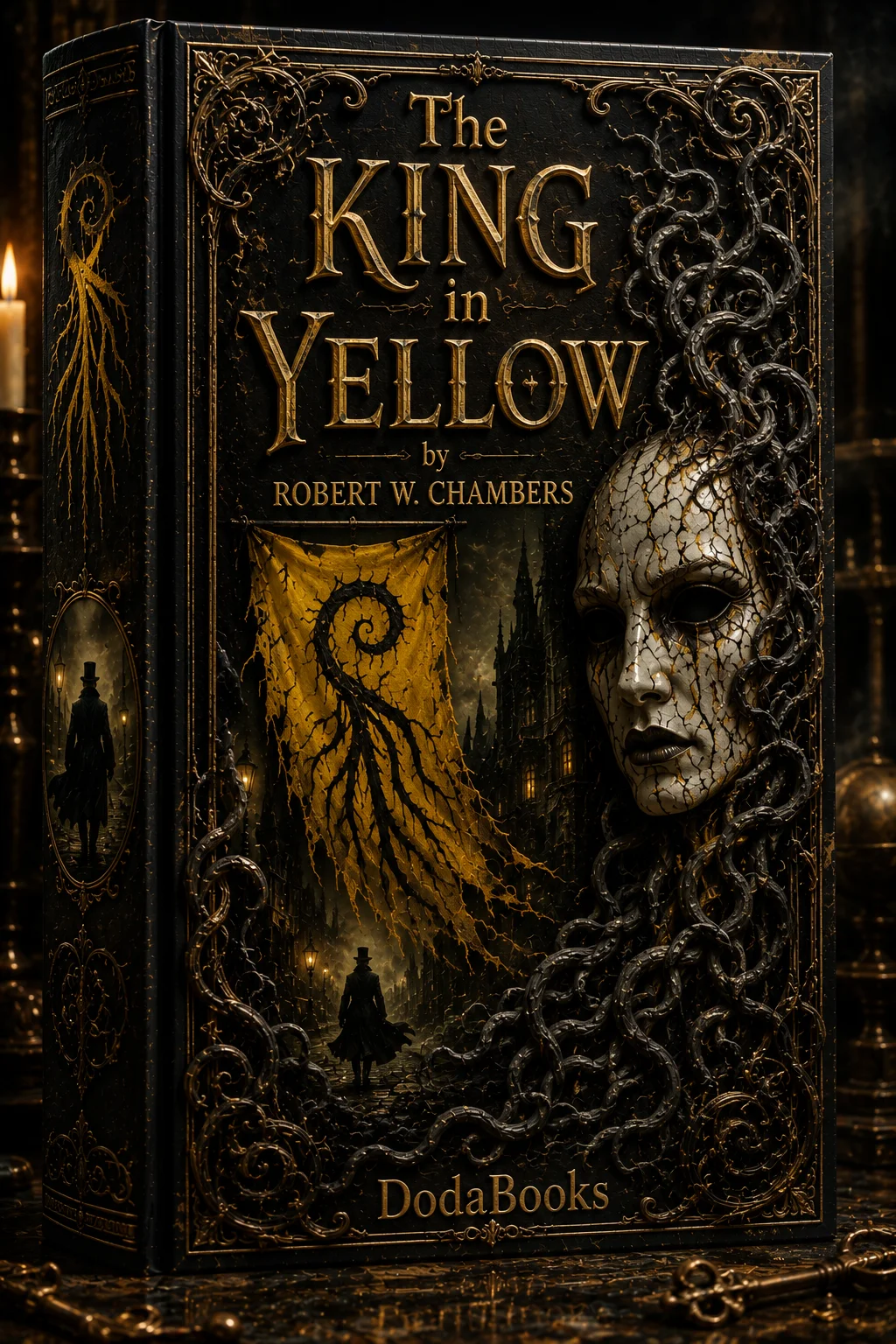
📖 Read the Definitive Annotated Edition of The King in Yellow
Experience Robert W. Chambers’s complete landmark weird fiction anthology with comprehensive cosmic horror commentary and historical notes:
- ✅ Complete Unabridged 10-Story Collection — Every word of the 1895 original first edition
- 👑 Cosmic Horror Mythology Cards — Decode Carcosa, the Lake of Hali, Cassilda’s Song, and the Pallid Mask
- 🎨 Paris Latin Quarter Historical Notes — Understand the 1870 Prussian Siege and Belle Époque artist life
- 📜 The True Detective & Lovecraft Lineage — Explore how Chambers shaped modern cosmic supernatural fiction
- 🔒 Universal DRM-Free Formats — Delivered instantly in EPUB, PDF, and AZW3/Kindle formats