The King in Yellow Characters & Mythology: Carcosa, Hastur & Castaigne
When Robert W. Chambers published The King in Yellow in 1895, he unleashed an enigmatic, sanity-shattering mythology that would permanently reshape twentieth-century horror literature. Long before H.P. Lovecraft popularized cosmic indifference, ancient alien gods, and forbidden grimoires like the Necronomicon, Chambers introduced the concept of an infectious, cursed work of art—a theatrical play whose second act tears away the comforting illusions of human reality to reveal the monstrous, alien majesty of Carcosa and the King in Yellow.
From the tragic, paranoid delusions of Hildred Castaigne and the repulsive, spider-like conspirator Mr. Wilde in “The Repairer of Reputations” to the petrifying alchemical wonders of Boris Yvain in “The Mask” and the nightmarish, rotting Hearse Driver in “The Yellow Sign,” Chambers populated his universe with unforgettable psychological portraits of individuals caught in the gravity well of cosmic doom.
Furthermore, Chambers established a rich, evocative mythology of celestial entities—the Lake of Hali, the Hyades, Aldebaran, Hastur, and the Pallid Mask—that directly inspired H.P. Lovecraft, Clark Ashton Smith, and HBO’s landmark crime series True Detective.
Whether you are preparing a literary analysis of American decadent fiction, studying the evolutionary tree of cosmic horror, or unraveling the lore of Carcosa, this comprehensive guide breaks down every major character and mythological element in Chambers’s universe.
⚡ The King in Yellow Mythology: At a Glance
- The Cosmic Entity: The King in Yellow — An alien sovereign or ambient metaphysical force who appears clad in frayed, flowing tatters of yellow silk and wears the eyeless, featureless "Pallid Mask."
- The Alien City: Carcosa — An ancient, ruined metropolis resting on the misty shores of the Lake of Hali under black stars and twin suns, first conceived by Ambrose Bierce.
- The Unreliable Megalomaniac: Hildred Castaigne — A brain-injured aristocrat whose obsession with the forbidden play convinces him he is the imperial heir to the throne of America and Carcosa.
- The Spidery Conspirator: Mr. Wilde — A grotesque, mutilated blackmailer calling himself the "Repairer of Reputations," who schemes to orchestrate a fascist dynastic coup in 1920 New York.
- The Harbinger of Decay: The Hearse Driver — A bloated, worm-fingered cemetery watchman in "The Yellow Sign" whose putrid, walking-corpse form serves as the physical agent of cosmic damnation.
- The Cthulhu Connection: How Chambers bridged Ambrose Bierce’s 1886 stories with H.P. Lovecraft’s Cthulhu Mythos and Nic Pizzolatto’s *True Detective*.
🌌 The Mythological Pantheon: Carcosa, Hastur & The Yellow Sign
Robert W. Chambers never wrote an encyclopedic sourcebook for his cosmic mythology. Instead, like a true decadent artist, he scattered tantalizing fragments across poems, dialogue, and feverish character monologues:
+---------------------------------------------------------------------------------------+
|                    THE COSMIC ENTITIES & LOCATIONS OF THE MYTHOS                      |
+-------------------+-------------------------------------------------------------------+
| MYTHIC ELEMENT    | CANONICAL LORE & LITERARY ORIGINS                                 |
+-------------------+-------------------------------------------------------------------+
| The King in       | An enigmatic, cosmic entity draped in tattered yellow robes.      |
| Yellow            | Described as the "Stranger" in the play; his face is either the   |
|                   | Pallid Mask or a featureless void of cosmic terror.               |
+-------------------+-------------------------------------------------------------------+
| Carcosa           | An ancient, decaying alien city situated beside the misty Lake    |
|                   | of Hali, beneath twin suns and black stars in the Hyades star     |
|                   | cluster near Aldebaran.                                           |
+-------------------+-------------------------------------------------------------------+
| The Yellow Sign   | An unearthly, golden hieroglyph set into black onyx. Possession of|
|                   | the sign attracts the physical harbingers of the King and marks   |
|                   | the bearer's soul for inevitable harvest.                         |
+-------------------+-------------------------------------------------------------------+
| Hastur            | Originally a benevolent god of shepherds in Ambrose Bierce; in    |
|                   | Chambers, a celestial place or person; later turned into an Old   |
|                   | One ("The Unspeakable One") by August Derleth and Lovecraft.      |
+-------------------+-------------------------------------------------------------------+
| The Pallid Mask   | A white masquerade visor that is not a mask at all. When the      |
|                   | royal court cries "No mask?", it symbolizes the horrific reality  |
|                   | that cosmic terror is naked, raw, and unvarnished.                |
+-------------------+-------------------------------------------------------------------+
The Forbidden Play: The King in Yellow
Within Chambers’s fictional reality, The King in Yellow is a dramatic verse play in two acts, published in Paris in the 1890s.
- The Deceptive Trap: Act I is deceptively lyrical, innocent, and beautiful—luring the unsuspecting reader into a false sense of security.
- The Poison of Act II: The second act introduces the terrible revelations of the Stranger, Carcosa, and the cosmic order. Anyone who reads Act II suffers immediate psychological breakdown, losing their sanity and becoming consumed by delusions of the King.
- Historical Suppression: The play was condemned by the Catholic Church, banned by the French government upon publication, and seized by customs officials across England and the United States. Only bootleg, underground copies circulate among decadent artists and occultists.
🧠 1. Hildred Castaigne: The Imperial Megalomaniac
Hildred Castaigne, the narrator of “The Repairer of Reputations,” is one of the most brilliant early examples of the unreliable narrator in American psychological horror.
+-------------------------------------------------------------------------------+
|                       THE DUAL REALITY OF HILDRED CASTAIGNE                   |
+-----------------------------------+-------------------------------------------+
| HILDRED'S INTERNAL DELUSION       | OBJECTIVE CLINICAL REALITY                |
+-----------------------------------+-------------------------------------------+
| - Imperial Prince and rightful    | - Brain-injured eccentric who suffered a  |
|   Emperor of America and Carcosa  |   severe fall from a horse in 1896        |
| - Allied with the master mind     | - Manipulated by a squalid blackmailer,   |
|   Mr. Wilde to restore the crown  |   living in filth above a stable          |
| - A diadem of Imperial Jade       | - A brass crown of worthless theatrical   |
|   and diamonds from Carcosa       |   paste and glass bought at a junk shop   |
| - A triumphant dynastic war       | - Committed to the Criminal Lunatic       |
|   about to erupt across the globe |   Asylum on Blackwell's Island after      |
|                                   |   attempted murder                        |
+-----------------------------------+-------------------------------------------+
The Anatomy of Megalomania
Hildred’s tragedy is his absolute lucidity. He does not babble or foam at the mouth; he speaks with cold, aristocratic precision.
Having read The King in Yellow during his four years of confinement in Dr. Archer’s sanitarium, Hildred’s mind seized upon the play’s cosmic hierarchy to explain his internal isolation. He genuinely believes that ordinary citizens are blind cattle and that he alone has been chosen by the cosmic stars of the Hyades to sweep away democracy and establish an authoritarian empire. When his cousin Louis refuses to bow to his delusion, Hildred’s aristocratic composure gives way to cold-blooded, patricidal violence.
🕷️ 2. Mr. Wilde: The Repairer of Reputations
Operating out of a grimy, rat-infested garret above a livery stable on Bleecker Street, Mr. Wilde is the dark, grotesque catalyst of Hildred’s doom.
A Monster of the Underworld
Chambers describes Mr. Wilde through visceral, repulsive physical details:
- Mutilation: He is a deformed, twisted dwarf whose face is scarred by disease. His ears have been sheared off, and several of his fingers have been chewed to stumps.
- The Web of Extortion: Calling himself the “Repairer of Reputations,” Wilde acts as an information broker. Through a vast network of compromised servants, valets, clerks, and telegraph operators, he compiles files of scandalous blackmail on New York’s wealthiest families.
- The Vicious Familiar: In his squalid room, Wilde keeps an untamed, feral tomcat that he maliciously torments. In a moment of macabre poetic justice, it is this very cat that ultimately leaps onto Wilde’s throat, tearing out his jugular vein just before Hildred can claim his crown.
🎨 3. Jack Scott & Tessie Reegan: The Tragic Bohemian Lovers
Featured in “The Yellow Sign,” Jack Scott and Tessie Reegan represent youth, beauty, artistic vitality, and mutual devotion—the very qualities that cosmic horror inevitably destroys.
The Artist and His Muse
Jack Scott is a painter living in Washington Square, and Tessie is his spirited, affectionate eighteen-year-old Irish-American model:
- Innocent Courtship: Unlike the predatory decadence of Hildred Castaigne, Jack and Tessie’s relationship begins with lighthearted warmth and mutual respect. Tessie poses for Jack’s canvas while they share laughter and dreams of the future.
- The Shadow of the Hearse: Their happiness is shattered by Tessie’s recurring premonition of a midnight hearse driven by the cemetery watchman. Tessie senses that the watchman is not a living man, but death itself masquerading in human skin.
- The Clasp of Onyx: When Tessie innocently buys an antique onyx talisman inscribed with the Yellow Sign, she unwittingly plants the beacon that summons their doom. Once Jack reads the play, their souls are fatally linked to Carcosa. When the watchman breaks in, neither Jack’s chivalric love nor his loaded revolver can protect them from being physically and spiritually obliterated.
🧟 4. The Hearse Driver: The Rotting Avatar
The cemetery watchman of St. Matthew’s churchyard in “The Yellow Sign” is arguably the most terrifying physical monster in pre-Lovecraftian literature.
The Anatomy of Decay
Chambers describes the watchman not as a phantom, but as an abomination of animated biological decomposition:
- The Dough-Like Visage: His face is swollen, white, and pasty like unbaked dough, with thick lips and eyes that seem clouded with cataracts.
- Worm-Like Flesh: When he speaks, his voice is a wet, guttural rasp. His fingers are short, white, and pudgy, moving like pale maggots.
- The Stench of the Grave: When Jack Scott shoots him four times at point-blank range, the bullets sink into his chest with dull thuds. No blood emerges—only a sickening, putrid fluid that smells of an opened crypt.
- The Living Corpse: The coroner discovers the following morning that the watchman had been dead in his tissues for months. He was not a living human being, but an animated puppet driven by the cosmic will of the King in Yellow to harvest the talisman.
🧪 5. Boris Yvain, Alec & Geneviève: The Alchemical Triangle
In “The Mask,” Chambers shifts from visceral horror to Parisian science-fiction decadence, exploring the dangerous intersection of art, alchemy, and repressed desire.
+---------------------------------------------------------------------------------------+
|                       THE ALCHEMICAL TRIANGLE IN "THE MASK"                           |
+-------------------+-------------------------------------------------------------------+
| CHARACTER         | ROLE & DRAMATIC ARCS                                              |
+-------------------+-------------------------------------------------------------------+
| Boris Yvain       | Russian-French sculptor and alchemical genius; invents the liquid |
|                   | that petrifies living tissue into pure marble; commits suicide.   |
+-------------------+-------------------------------------------------------------------+
| Geneviève         | Boris's radiant lover; secretly in love with Alec; plunges into   |
|                   | the marble pool out of moral guilt; revived in a miracle.         |
+-------------------+-------------------------------------------------------------------+
| Alec              | The narrator; Boris's closest friend; torn between loyalty to     |
|                   | Boris and his unspoken passion for Geneviève; reads the play.     |
+-------------------+-------------------------------------------------------------------+
Boris’s petrifying solution is the ultimate artistic metaphor: the desire of the sculptor to freeze transient, fragile beauty into immortal, unchanging stone. However, when applied to human life, art becomes lethal. Only when Boris sacrifices himself and Geneviève’s statue warms back into living flesh does Chambers allow a glimpse of redemptive grace.
🦅 6. Philip & Jeanne d’Ys: Love Across the Centuries
In “The Demoiselle d’Ys,” Chambers crafts a haunting gothic time-slip romance that contrasts beautifully with the cosmic madness of the other stories.
The Medieval Encounter
- Philip: A modern nineteenth-century American hunter who wanders into the mist-shrouded moors of Brittany and finds himself stepping five hundred years backward into the year 1573.
- Jeanne d’Ys: A noble, innocent medieval falconer maiden whose castle, hawk, and retainers welcome the strange traveler. Jeanne is pure, brave, and deeply spiritual.
- The Venom and the Vow: When Philip is bitten by a venomous viper, Jeanne saves his life by sucking the poison from his blood, sacrificing her own vitality. When Philip awakens in the modern ruins of the chapel, he discovers that Jeanne has been dead for centuries—yet his modern silk scarf rests upon her cold marble effigy, proving that love can transcend the laws of time and mortality.
🔗 The Literary Evolution: From Bierce to Chambers to Lovecraft & True Detective
+---------------------------------------------------------------------------------------+
|                       THE GENEALOGY OF THE YELLOW KING MYTHOS                         |
+---------------------------+-----------------------------------------------------------+
| AUTHOR & WORK             | CONTRIBUTIONS TO THE LORE                                 |
+---------------------------+-----------------------------------------------------------+
| Ambrose Bierce            | In "An Inhabitant of Carcosa" (1886) and "Haïta the       |
| (1886–1891)               | Shepherd" (1891), Bierce coins the names "Carcosa",       |
|                           | "Hali", "Hastur", and "Aldebaran".                        |
+---------------------------+-----------------------------------------------------------+
| Robert W. Chambers        | Adopts Bierce's names; invents the banned play, the King  |
| (1895)                    | in Yellow, the Pallid Mask, the Yellow Sign, and the      |
|                           | Imperial Dynasty of America.                              |
+---------------------------+-----------------------------------------------------------+
| H.P. Lovecraft            | Reads Chambers in 1927; incorporates "The Yellow Sign",  |
| (1927–1931)               | "Hastur", and "Carcosa" directly into *The Whisperer in   |
|                           | Darkness* and the Cthulhu Mythos.                         |
+---------------------------+-----------------------------------------------------------+
| August Derleth            | Codifies Hastur as an elemental Great Old One ("The King  |
| (1930s–1950s)             | in Yellow, Him Who Is Not to Be Named") living in Hali.   |
+---------------------------+-----------------------------------------------------------+
| Nic Pizzolatto            | Adapts the mythology for HBO's *True Detective* (2014),   |
| (True Detective)          | using Carcosa, the Yellow King, and the spiral sign as    |
|                           | metaphors for generational ritualistic corruption.        |
+---------------------------+-----------------------------------------------------------+
❓ Frequently Asked Questions (FAQ)
Is Hastur the King in Yellow?
In Robert W. Chambers’s original 1895 text, the name “Hastur” is used ambiguously—sometimes referring to a celestial place, a city, or a minor deity (borrowed from Ambrose Bierce). It was H.P. Lovecraft and later August Derleth who explicitly fused them together, establishing “Hastur” as a Great Old One whose earthly avatar is the King in Yellow.
Why is the play The King in Yellow never shown in full?
By withholding the complete text and showing only tantalizing, poetic fragments (like Cassilda’s Song and the Pallid Mask dialogue), Chambers engages the reader’s imagination. No human author could write a play that realistically drives readers mad; by leaving the second act unseen, Chambers allows its cosmic terror to remain infinite and untouchable.
What is the meaning of "The Pallid Mask"?
In the play’s masquerade scene, Queen Cassilda and Camilla urge a mysterious Stranger to unmask, crying: “It is time. All have laid aside disguise but you.” The Stranger replies: “I wear no mask.” Camilla gasps in horror: “No mask? No mask!” The Pallid Mask symbolizes the terrifying realization that behind the pleasant illusions of reality lies bare, raw, and unyielding cosmic horror.
Did Hildred Castaigne really see Carcosa or was he insane?
Chambers deliberately crafts “The Repairer of Reputations” with brilliant psychological ambiguity. Hildred had a documented head injury and spent four years in an asylum, suggesting his imperial delusions are purely the hallucinations of brain damage. However, the uncanny prescience of his 1920 timeline and the supernatural occurrences in the subsequent stories (“In the Court of the Dragon”, “The Yellow Sign”) suggest that his head injury may have stripped away the mental barriers that shield normal mortals from the cosmic reality of Carcosa.
How does the Hearse Driver represent the King in Yellow?
In “The Yellow Sign,” the hearse driver represents biological decay and the inevitability of death. Clad in pasty, rotting flesh with worm-like fingers, he is the physical manifestation of the King’s corrupting power, proving that once an individual looks upon the Yellow Sign, their physical and spiritual doom is already sealed.
📚 Related Articles & Guides
Looking for an overarching analysis of weird fiction and cosmic dread? Explore our master The King in Yellow Book Guide.
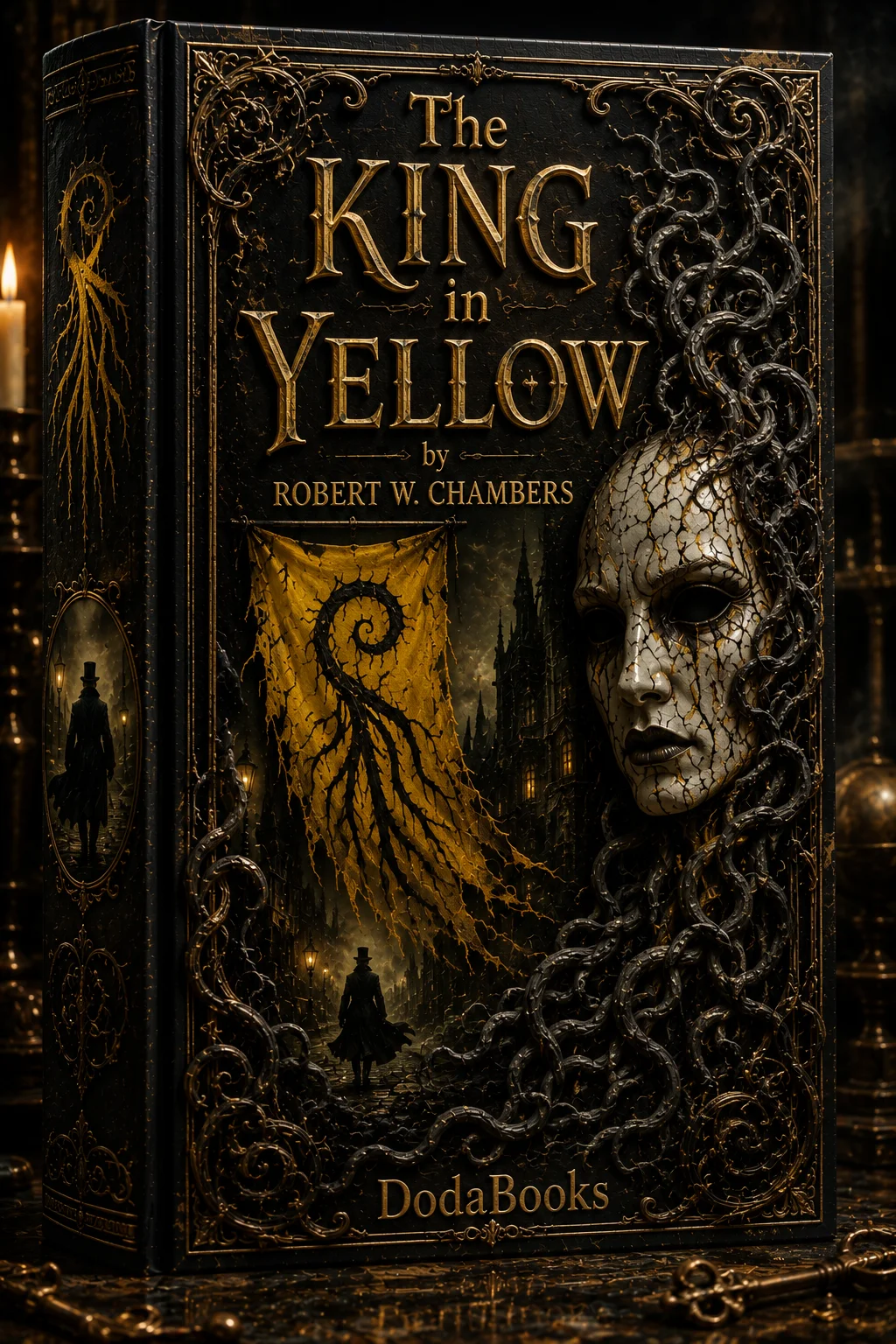
📖 Read the Definitive Annotated Edition of The King in Yellow
Experience Robert W. Chambers’s complete landmark weird fiction anthology with comprehensive cosmic horror commentary and historical notes:
- ✅ Complete Unabridged 10-Story Collection — Every word of the 1895 original first edition
- 👑 Cosmic Horror Mythology Cards — Decode Carcosa, the Lake of Hali, Cassilda’s Song, and the Pallid Mask
- 🎨 Paris Latin Quarter Historical Notes — Understand the 1870 Prussian Siege and Belle Époque artist life
- 📜 The True Detective & Lovecraft Lineage — Explore how Chambers shaped modern cosmic supernatural fiction
- 🔒 Universal DRM-Free Formats — Delivered instantly in EPUB, PDF, and AZW3/Kindle formats