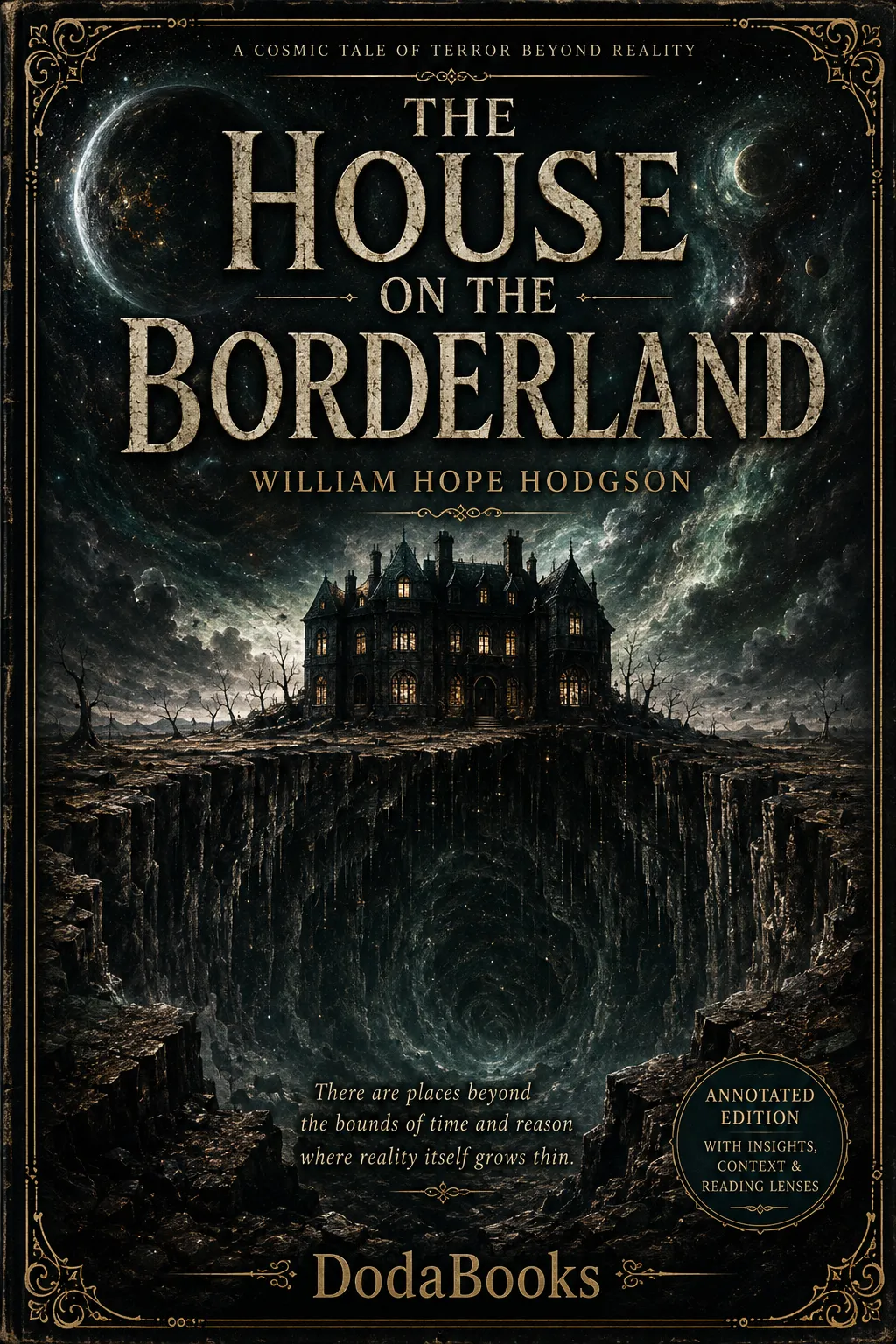
William Hope Hodgson’s The House on the Borderland is the 1908 novel that helped invent modern cosmic horror — a lonely ruined house, a pit to the center of the earth, and a narrator dragged through time itself. This guide explains the story, its influence on Lovecraft, and how the DodaBooks Annotated Edition makes this strange masterpiece readable.
👁️
The House on the Borderland
Two friends find a diary in a ruined house. What it describes is a horror older than time — a vast pig-like beast, a bottomless pit, and a journey to the end of the universe. Read the novel that terrified Lovecraft.
| Author | William Hope Hodgson |
| Published | 1908 |
| Genre | Cosmic horror, weird fiction, gothic |
| Setting | A remote house in rural Ireland; then the cosmos |
| Best For | Horror fans, Lovecraft readers, dreamers |
| Reading Time | 4–6 hours |
👁️ The Story
Two vacationing friends stumble upon the ruins of an ancient house beside a river. On the floor they find a decaying manuscript — the diary of the recluse who once lived there. What they read takes them, and us, somewhere very strange indeed.
The recluse has a garden, a dog, a sister… and a neighbor. From a pit opening beside his garden, a vast, slobbering, hog-like creature rises at intervals, ravenous and unstoppable. The attacks come in waves. And across the pit, ancient ruins guard something beneath the earth. But the true horror is time itself: the recluse’s consciousness detaches and is dragged through trillions of years, watching the solar system die and the universe wind down to a final, terrible stillness — all while the house holds against the Swine-Things below.
“My friend, there are moments that are too terrible to be borne; and it is only by some subconscious act of self-preservation that the mind is saved.”
🌌 The Book That Made Lovecraft’s Universe
H. P. Lovecraft repeatedly named The House on the Borderland as one of the greatest horror stories ever written — and you can feel its DNA in everything from The Call of Cthulhu to The Colour Out of Space. The claustrophobic house under siege, the cosmic scale that dwarfs human concerns, the sense of entities indifferent or malevolent just past the edge of vision — Hodgson got there first, in 1908.
What’s genuinely radical is the structure. Half gothic thriller (a house besieged by monsters) and half metaphysical journey (a mind flung across eons), the novel refuses to resolve its own contradictions. The book is supposed to feel unstable — the reader inherits a fragment of a fragment, a diary whose narrator may be mad.
🔍 An Annotation Layer Built for a Strange Book
This is a novel where confusion is part of the art — and where context transforms the experience. The DodaBooks edition uses visible, color-coded cards instead of hidden footnotes.
Annotation Cards
Passage-specific notes you read as the scene unfolds — no click-to-reveal.
The Cosmic Passage
The auheral time-travel section decoded section by section.
The Swine-Things
Interpretations of the pit and its inhabitants — beast, symbol, or both?
Madness & Reliability
Is the narrator insane, possessed, or seeing more than reality permits?
Occult Roots
The esoteric traditions and psychic research era the book draws on.
Reading Lenses
Chapter guides, a Themes guide, and a full Annotation Index.
📘 Annotated Insight — The Compress of the Universe
Hodgson’s most famous passage compresses the death of everything into a handful of pages: the sun gutters, the Earth freezes, the last humans fade, and the narrator is left holding on to consciousness as the void itself grows old. The annotations explain why this scene still works a century later — Hodgson understood that scale, not gore, is what cosmic horror fears most, and that the reader’s own imagination will always exceed the page.
🕯️ Reading a Fragment
The whole novel is framed as a recovered manuscript, possibly incomplete, possibly untrustworthy. That frame is the point: Hodgson deliberately leaves the story porous so that every reader must supply their own explanation. The DodaBooks edition helps you hold that experience — annotating the frame, the gaps, and the moments where reality wobbles.
You don’t read this book; you survive it. The annotations keep you anchored when the cosmos drags — and richer when it releases you.
📖 The Diary’s Opening
Like many great horror novels, The House on the Borderland is built on a frame. Two travellers fishing near a remote Irish village find the ruins of an old house, and in a hidden cellar beneath it they uncover a torn and decaying manuscript. That manuscript is the diary of a nameless recluse who once lived in the place, and reading it transports us into his world — part memory, part nightmare, and increasingly impossible to tell apart.
The diary begins almost cosily. The recluse lives with his sister in a house beside a strange circular pit, devoting himself to his garden and his beloved dog. But the pit is not ordinary. Strange lights rise from it, and across it stand the ancient ruins of a ring of buildings that hum with a faint, oppressive menace. Soon the ordinary world begins to peel away: a great hog-like beast claws its way up from the pit and attacks the house, joined by more of its kind, and the siege that follows is one of the most sustained sequences of dread Hodgson ever wrote.
🌌 Voyage Beyond Time
Where the novel becomes truly radical is in what happens next. The attacks on the house eventually recede, but the recluse’s consciousness is seized and dragged outward — away from the pit, into the stars, and then billions of years into the future. He watches the sun dim, the planets slow, the Earth freeze, and the last remnants of humanity fade away. He is present at the heat-death of the universe itself, holding on to awareness as time winds down to a final, terrifying stillness.
For its era this was astonishingly audacious. In 1908, when most supernatural fiction concerned ghosts in castles, Hodgson was already writing deep-time cosmic horror — placing a single human mind against the grand sweep of entropic decay. It is this section, more than the monster attacks, that moved Lovecraft and that gives the book its enduring reputation. Readers who have enjoyed the same sense of scale in later weird fiction will find its source here.
🕰️ A Monster Before It Had a Name
Part of the book’s fascination is historical. H. P. Lovecraft, who was eleven when the novel appeared and profoundly shaped by it, would later name it among the greatest horror stories ever written, and its imagery threads through his own work. The besieged, isolated house; the indifferent cosmos; the idea that true horror is not blood but scale — all of these became signature concepts of the weird fiction that followed.
The novel also sits at a crossroads of late-Victorian and Edwardian anxieties. Its interest in psychic phenomena, mesmerism, and the edges of consciousness reflects the era’s fascination with spiritualism and psychology, while its relish for geological and astronomical deep time echoes contemporary science. If you want to see how these threads reappear, our guide to The Call of Cthulhu shows Lovecraft pushing the same ideas further, and The King in Yellow demonstrates a different, older strain of cosmic dread.
🧭 Reading a Fragment of a Fragment
Because the novel is framed as a recovered and possibly unreliable diary, Hodgson deliberately leaves its meaning open. Who — or what — is the pit? Is the recluse mad, blessed, or cursed? Is the cosmic voyage real or the product of a collapsing mind? The book refuses to answer, and that refusal is central to its power. Every reader must supply their own interpretation, which is precisely why the same novel feels completely different on a second reading.
For a first-time reader the advice is simple: trust the atmosphere and do not fight for a tidy explanation. Let the strangeness wash over you, and read the disorienting cosmic section slowly, in one sitting if you can. The horror lives less in what is explained than in what is left unresolved.
❓ Frequently Asked Questions
Is this part of a series?
No, it’s a standalone. Hodgson’s best-known works are The House on the Borderland (1908), The Ghost Pirates (1904), and his Carnacki the Ghost-Finder stories — but this novel is his masterpiece.
Is it very scary?
It’s atmospheric dread rather than jump-scares or gore. The horror accumulates — from the siege of the house to the annihilation of time — and the final pages linger long after reading.
Did Lovecraft really love it?
Yes. In his essay “Supernatural Horror in Literature” he called it “one of the finest pieces of cosmic horror ever written.” You’ll immediately recognize the shapes of things like Cthulhu in its pages.
Is the cosmic part hard to follow?
It’s the most disorienting section — by design. The annotation cards walk through it passage by passage, so you keep the emotional force without losing the thread.
How long is it?
Roughly 120 pages of dense, strange prose — 4 to 6 hours of reading, ideal for a committed weekend or a long journey.
What exactly are the Swine-Things?
They are the vast, hog-like creatures that rise from the pit and attack the house. Hodgson never fully explains them, and the ambiguity is intentional — they work as both literal monsters and a symbol of the raw, indifferent forces pressing against civilised life.
Is the narrator reliable?
Almost certainly not, and that is the point. The whole book is a recovered diary of possible madness, so nothing can be trusted completely. Hodgson uses that uncertainty to keep the horror unresolved and to force each reader into deciding what they believe really happened.
📚 Related Articles
👁️ Descend Into the Novel That Terrified Lovecraft
Reading The House on the Borderland alone is disorienting. Reading it annotated is transformative:
- ✅ Complete 1908 text — the full journal, preserved
- 🗂️ Passage-specific annotation cards — visible, color-coded
- 🌌 The cosmic passage decoded section by section
- 🧠 Interpretations of madness, time, and the Swine-Things
- 🔒 DRM-free — read on any device
- 📥 Instant download — EPUB format