The Hound of the Baskervilles Characters: Full Analysis & Guide
While The Hound of the Baskervilles (1902) is rightfully celebrated for its eerie Devonshire moors and its glowing spectral beast, its enduring literary greatness lies in its rich ensemble of characters. Arthur Conan Doyle constructs a brilliant psychological contest between the forces of modern, rational science and the dark, atavistic impulses of human greed and ancestral madness.
Furthermore, The Hound is unique within the 60-story Sherlockian canon: for nearly half the novel, Sherlock Holmes is absent from the immediate stage, giving Dr. John H. Watson his absolute finest hour as an independent, courageous field investigator. Opposite them stands Jack Stapleton, one of the most chilling, cunning, and patient villains in Victorian crime literature.
Whether you are preparing a character study for class, analyzing Victorian foils, or diving deep into Doyle’s greatest novel, this comprehensive guide provides an exhaustive analysis of every major character, their thematic roles, and their interconnected relationships.
⚡ The Hound of the Baskervilles Character Guide: At a Glance
- The Master of Logic: Sherlock Holmes — Operating from a secret prehistoric stone hut on the tor, Holmes uses dispassionate forensic observation to dismantle an ancient supernatural superstition.
- The Field Investigator: Dr. John H. Watson — Carrying the middle third of the novel through his dispatches and diaries, Watson proves himself a courageous, observant, and formidable detective.
- The Marked Heir: Sir Henry Baskerville — The brave, open-hearted Canadian nephew of Sir Charles, caught between modern romance and an ancient ancestral death trap.
- The Psychopathic Naturalist: Jack Stapleton (Rodger Baskerville) — An entomologist chasing butterflies by day and plotting calculated familial murder by night; Hugo Baskerville’s modern living twin.
- The Reluctant Conspirator: Beryl Stapleton — Stapleton’s abused Costa Rican wife posing as his sister, whose moral defiance risks her life to save Sir Henry.
🔍 1. Sherlock Holmes: The Hidden Mastermind
In The Hound of the Baskervilles, Sherlock Holmes operates at the height of his intellectual powers. Faced with a case saturated with demonic folklore, spectral sightings, and ancient manuscripts, Holmes remains completely immune to supernatural panic:
“The devil’s agents may be of flesh and blood, may they not?… Hitherto I have investigated only crimes; but to banish the supernatural from the moor is quite a new phase.”
The Strategic Deception
Holmes’s defining tactical decision in the novel is his feigned absence. Recognizing that an adversary capable of shadowing Sir Henry through London in a hansom cab would retreat into hiding if Holmes arrived in Devonshire, Holmes pretends to remain at Baker Street.
By living in a cold, primitive Neolithic stone hut on the wind-swept moor—relying on the young messenger boy Cartwright for bread and clean collars—Holmes gains total tactical freedom to observe the suspects without their knowledge.
Rationalism vs. Superstition
Holmes embodies the triumph of the Enlightenment over medieval terror. When confronted with a gigantic hound leaping through the midnight fog with blue flames bursting from its mouth, Holmes does not cross himself or cower; he draws his revolver and fires five lethal bullets into its flank, then touches the blue fire with his finger and identifies it as a chemical preparation of phosphorus.
🩺 2. Dr. John H. Watson: The Hero of Dartmoor
For generations, film adaptations diminished Dr. Watson into an elderly comic bumble. The Hound of the Baskervilles is the definitive textual refutation of that myth.
+-------------------------------------------------------------------------------+
|                    DR. WATSON: THE FIELD COMMANDER                            |
+------------------------------------+------------------------------------------+
| MILITARY VALOR & PHYSICAL COURAGE  | FORENSIC OBSERVATION & REPORTING         |
+------------------------------------+------------------------------------------+
| - Armed with his service revolver  | - Authors Chapters 8, 9, and 10          |
| - Boldly chases the escaped        | - Meticulously interrogates Barrymore,   |
|   murderer Selden across the moor  |   Stapleton, and Laura Lyons             |
| - Stakes out midnight corridors to | - Tracks the mysterious child messenger  |
|   catch Barrymore signaling        |   to the hidden hut on the high tor      |
+------------------------------------+------------------------------------------+
Watson Takes Center Stage
From Chapter 6 through Chapter 11, Watson carries the entire narrative weight of the novel. He is not merely an assistant taking dictation; he is the active investigator on the ground.
He uncovers the secret of Barrymore’s midnight signaling, tracks down Laura Lyons in Coombe Tracey, extracts the truth about her meeting with Sir Charles, and tracks the food deliveries to the prehistoric stone hut.
When Holmes steps out of the hut in Chapter 11, he praises Watson with genuine admiration, revealing that Watson’s letters and diary reports were so thorough that Holmes needed no other intelligence to solve the crime.
🍁 3. Sir Henry Baskerville: The New World Heir
Sir Henry Baskerville is the dramatic bridge between the Old World and the New. Having spent years farming in Canada, he brings practical vigor, democratic directness, and healthy skepticism to the ancient ancestral halls of Devonshire:
“He was a small, alert, dark-eyed man about thirty years of age, very sturdily built, with thick black eyebrows and a strong, pugnacious face. He wore a ruddy-tinted tweed suit and had the weather-beaten appearance of one who had been much in the open air.”
Vulnerability and Resilience
Despite his physical courage—insisting on walking across the dark moor even when he knows a monster may be lurking—Sir Henry is profoundly human:
- Romantic Vulnerability: He falls instantly in love with Beryl Stapleton, making him blind to Jack Stapleton’s poisonous traps.
- Psychological Trauma: When the glowing, phosphorus-covered hound lunges at his throat in Chapter 14, the sheer physical and mental shock breaks him. Even after the hound is slain, Sir Henry requires a worldwide voyage with Dr. Mortimer to recover from nervous prostration.
🦋 4. Jack Stapleton: The Psychopathic Naturalist
Jack Stapleton is one of Arthur Conan Doyle’s greatest literary creations: a cold, brilliant sociopath who conceals monstrous predatory instincts beneath a mask of gentle, eccentric amateur naturalism.
The True Identity (Rodger Baskerville)
Stapleton’s genial exterior hides a dark heritage. He is actually Rodger Baskerville, the son of Sir Charles’s black-sheep younger brother who fled to Central America. Inheriting the ruthless cruelty and physical features of the wicked Hugo Baskerville, Stapleton operates with chilling patience:
“He was a small, slim, clean-shaven, prim-faced man, flaxen-haired and leant-jawed, between thirty and forty years of age, dressed in a grey suit and wearing a straw hat, with a botanical tin-case slung over his shoulder and a green butterfly-net in one of his hands.”
The Criminal Mastermind
Stapleton is an intellectual equal to Holmes:
- Psychological Exploitation: He weaponizes an ancient family myth, knowing that Sir Charles’s weak heart would fail if confronted by a spectral hound.
- Chemical Ingenuity: He formulates an odorless phosphorus preparation to paint the hound without burning its hide or killing its scenting ability.
- Double Identities: He forces his wife, Beryl, to pose as his sister so she can serve as bait for Sir Henry, while secretly courting Laura Lyons to lure Sir Charles to the midnight gate.
- Ruthless Audacity: He shadows Holmes and Watson in London, steals Sir Henry’s worn boot to train the hound, and uses his own name (“Sherlock Holmes”) when hiring cab #2704 to mock his pursuer.
Stapleton’s poetic justice is supreme: attempting to escape through the dense fog into the Great Grimpen Mire, the treacherous swamp he used to hide his hound swallows him whole, sucking him down into bottomless black mud.
🌹 5. Beryl Stapleton: The Trapped Conscience
Beryl Stapleton (originally Beryl Garcia of Costa Rica) is the tragic moral center of the moorland drama.
The Abused Captive Wife
Forced by her husband to pose as his sister under threat of violence, Beryl lives in perpetual terror. Yet, despite physical abuse, her moral conscience refuses to participate in murder:
- In Chapter 7, mistaking Watson for Sir Henry, she risks her life by frantically warning him to flee Dartmoor immediately.
- When Sir Henry courts her, she tries desperately to shield him without triggering her husband’s rage.
- When she finally refuses to help Stapleton lure Sir Henry to his death in Chapter 14, Stapleton brutally beats, gags, and ties her to a pillar in the attic of Merripit House.
Her rescue by Holmes and Watson frees her from a domestic monster far more dangerous than the hound on the moor.
🕯️ 6. Secondary Characters & Their Thematic Significance
                     +---------------------------------------+
                     |         THE BASKERVILLE ESTATE        |
                     +-------------------+-------------------+
                                         |
         +-------------------------------+-------------------------------+
         |                               |                               |
         v                               v                               v
+----------------------+        +----------------------+        +----------------------+
|    JOHN BARRYMORE    |        |   ELIZA BARRYMORE    |        |        SELDEN        |
|  (The Stoic Butler)  |        |  (The Loving Sister) |        | (The Hidden Convict) |
|                      |        |                      |        |                      |
| - Signals with light |        | - Weeps in the night |        | - Escaped murderer   |
| - Protects family    |        | - Feeds her outcast  |        | - Killed wearing     |
|   at all costs       |        |   brother on moor    |        |   Sir Henry's clothes|
+----------------------+        +----------------------+        +----------------------+
John and Eliza Barrymore
The Barrymores represent the dignity and secret burdens of the Victorian domestic servant class. For generations, the Barrymores have served Baskerville Hall. Their secretive behavior—candle signaling at 2:00 AM, hushed weeping in the corridors—creates the primary red herring of the first half of the book.
Their secret is rooted not in criminal conspiracy, but in tragic familial devotion: Eliza cannot bear to let her wayward brother, Selden, starve in the freezing bogs.
Laura Lyons (“L.L.”)
The daughter of eccentric neighbor Mr. Frankland, Laura Lyons lives in Coombe Tracey abandoned by her artist husband and disowned by her litigious father. Seduced by Stapleton’s false promises of marriage and financial support for a divorce, she unwittingly serves as his unwitting accomplice to lure Sir Charles to the gate. When Holmes exposes Stapleton’s deceit, she becomes the key witness that seals his guilt.
Mr. Frankland of Lafter Hall
An elderly, cantankerous gentleman whose sole passion is initiating expensive, petty civil lawsuits against his neighbors for minor property infractions. Perched on his roof with a powerful astronomical telescope, Frankland’s obsessive surveillance of the moor inadvertently assists Watson in discovering Holmes’s secret hideout.
📊 Character Foils and Parallels Matrix
| Character Pair | Core Contrast | Thematic Revelation |
|---|---|---|
| Sherlock Holmes vs. Jack Stapleton | Rational scientific investigator using intellect to protect humanity vs. Psychopathic naturalist using science to murder family. | Intellectual brilliance is morally neutral; without empathy and conscience, genius becomes predatory monstrosity. |
| Dr. Watson vs. Dr. Mortimer | Disciplined army physician who applies logic and physical courage vs. Eccentric country doctor fascinated by phrenology and ancestral myths. | Superstition clouds judgment, whereas grounded observation protects the vulnerable. |
| Sir Henry Baskerville vs. Hugo Baskerville | Honorable, modern, democratic Canadian heir who respects women vs. Cruel, godless 17th-century aristocratic feudal tyrant. | Bloodline does not determine character; moral choice overcomes ancestral sins. |
| Beryl Stapleton vs. Laura Lyons | Trapped wife who defies her husband to save a stranger’s life vs. Deceived lover whose desperation for independence blinds her to Stapleton’s evil. | The vulnerability of Victorian women in a legal system that denied them financial and marital autonomy. |
Uncover every character dynamic and clue in Doyle's masterpiece. The DodaBooks Annotated Edition includes exhaustive profiles, Dartmoor historical timelines, and Sidney Paget illustrations.
Get the Annotated Edition at DodaBooks❓ Frequently Asked Questions
Why does Jack Stapleton use a butterfly net and botanical case?
The butterfly net and green botanical case serve as the perfect Victorian social camouflage. By posing as an eccentric, harmless naturalist chasing rare butterflies across the bogs, Stapleton can roam the treacherous Great Grimpen Mire day and night to care for his hidden hound without raising the slightest suspicion from local neighbors or police.
How are Jack Stapleton and Sir Henry Baskerville related?
They are first cousins. Jack Stapleton is the son of Rodger Baskerville (the younger brother of Sir Charles and the uncle of Sir Henry). Rodger had fled to South America, where he fathered a son who took the name Jack Vandeleur before arriving in England as Jack Stapleton.
Why didn't Beryl Stapleton go to the police about her husband?
Beryl was trapped in an abusive relationship in an era where Victorian law gave husbands absolute authority over their wives. Stapleton physically abused and terrorized her, keeping her under constant surveillance. When she finally refused to participate in Sir Henry’s murder, Stapleton tied and gagged her in the attic.
Why was Selden killed instead of Sir Henry?
Selden was wearing Sir Henry’s cast-off tweed suit, which Barrymore had given him for warmth. Because Stapleton had trained the hound using Sir Henry’s stolen black boot from London, the hound tracked Sir Henry’s scent on the clothing, hunting Selden down and driving him over the granite cliff by mistake.
What happened to the Baskerville fortune after Stapleton died?
Sir Henry Baskerville inherited the entire estate and fortune. After recovering from his severe nervous shock on a worldwide recuperation trip with Dr. Mortimer, Sir Henry returned to Dartmoor to restore Baskerville Hall and continue the philanthropic community works of his uncle, Sir Charles.
📚 Related Reading Guides
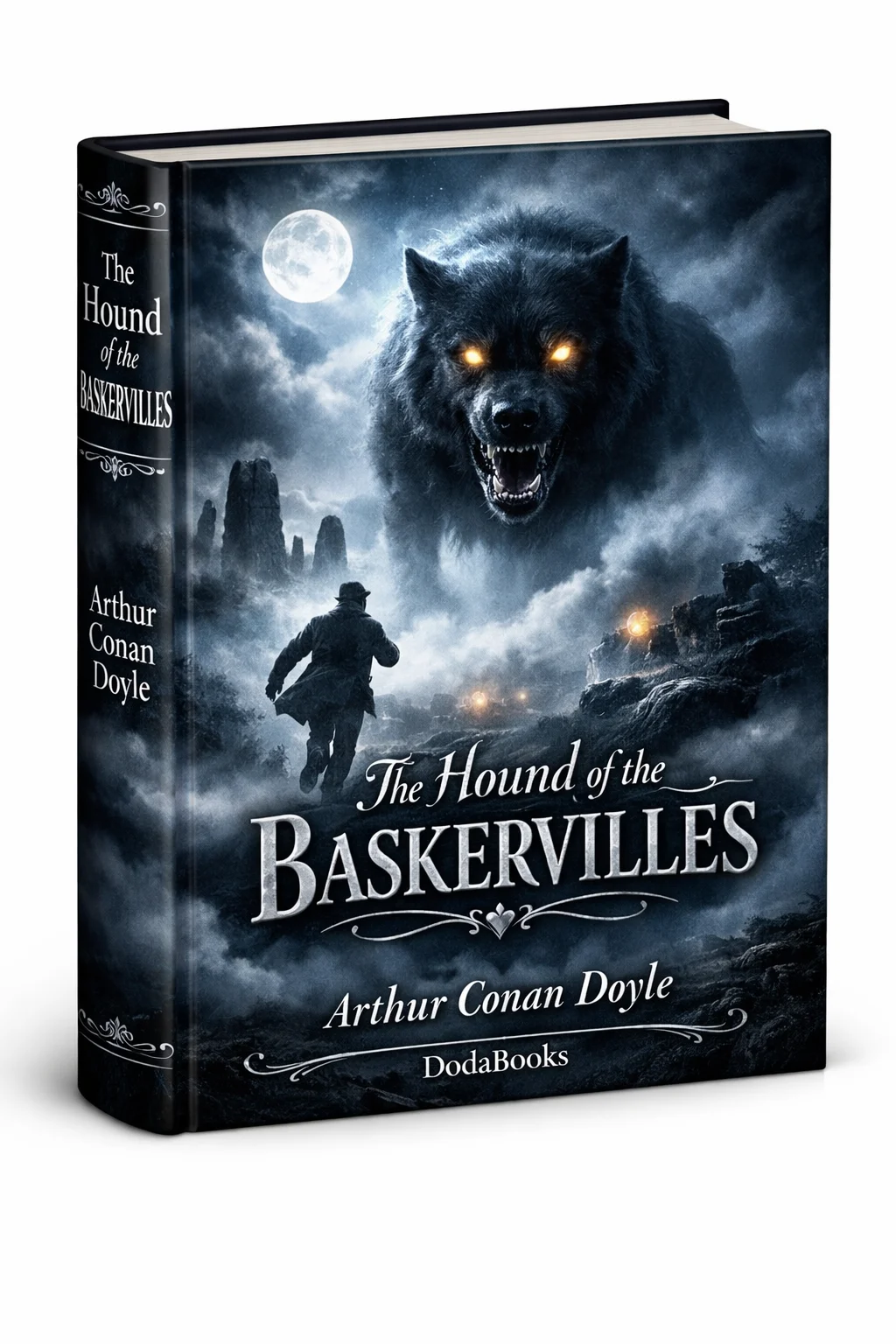
Master the Depths of Doyle's Characters
Read The Hound of the Baskervilles with comprehensive character profiles, psychological analyses, and Victorian context:
- Complete, authoritative 15-chapter authorial text
- Explanatory notes detailing Dartmoor geography, phrenology, and 1902 forensic science
- Character relationship maps and foil comparison matrices
- Instant digital delivery compatible with Kindle, Apple Books, Kobo, and Android