The Fifth Queen Crowned by Ford Madox Ford: Tragic Beauty in the Lion's Mouth
The Harrowing Climax of Ford’s Tudor Trilogy: The Fall of Katharine Howard, the Treachery of Cranmer and Cromwell’s Spies, and the Terrifying Whims of an Aging Henry VIII
In modern English historical fiction, few works rival the sensory magnificence, psychological terror, and linguistic brilliance of Ford Madox Ford’s (1873–1939) celebrated Fifth Queen Trilogy (The Fifth Queen, Privy Seal, and The Fifth Queen Crowned). Published between 1906 and 1908—years before Ford penned his celebrated modernist masterworks The Good Soldier and Parade’s End—the trilogy represents one of the supreme achievements of historical recreation in world literature, celebrated by Joseph Conrad, Henry James, and Ezra Pound.
In the climactic final volume, The Fifth Queen Crowned (1908), Ford brings the tragedy of Katharine Howard, the doomed fifth wife of King Henry VIII, to its devastating historical denouement. Reimagining Katharine not as the frivolous, empty-headed wanton depicted by hostile Protestant chroniclers, Ford presents her as a brilliant, fiercely idealistic classical scholar and devout Catholic champion who attempts to restore ancient religious peace, Latin learning, and moral integrity to a Tudor court poisoned by espionage, cynical realpolitik, and factional butchery. Yet, in walking into the private chamber of an ailing, suspicious, and bloated King Henry, Katharine steps straight into the lion’s jaw.
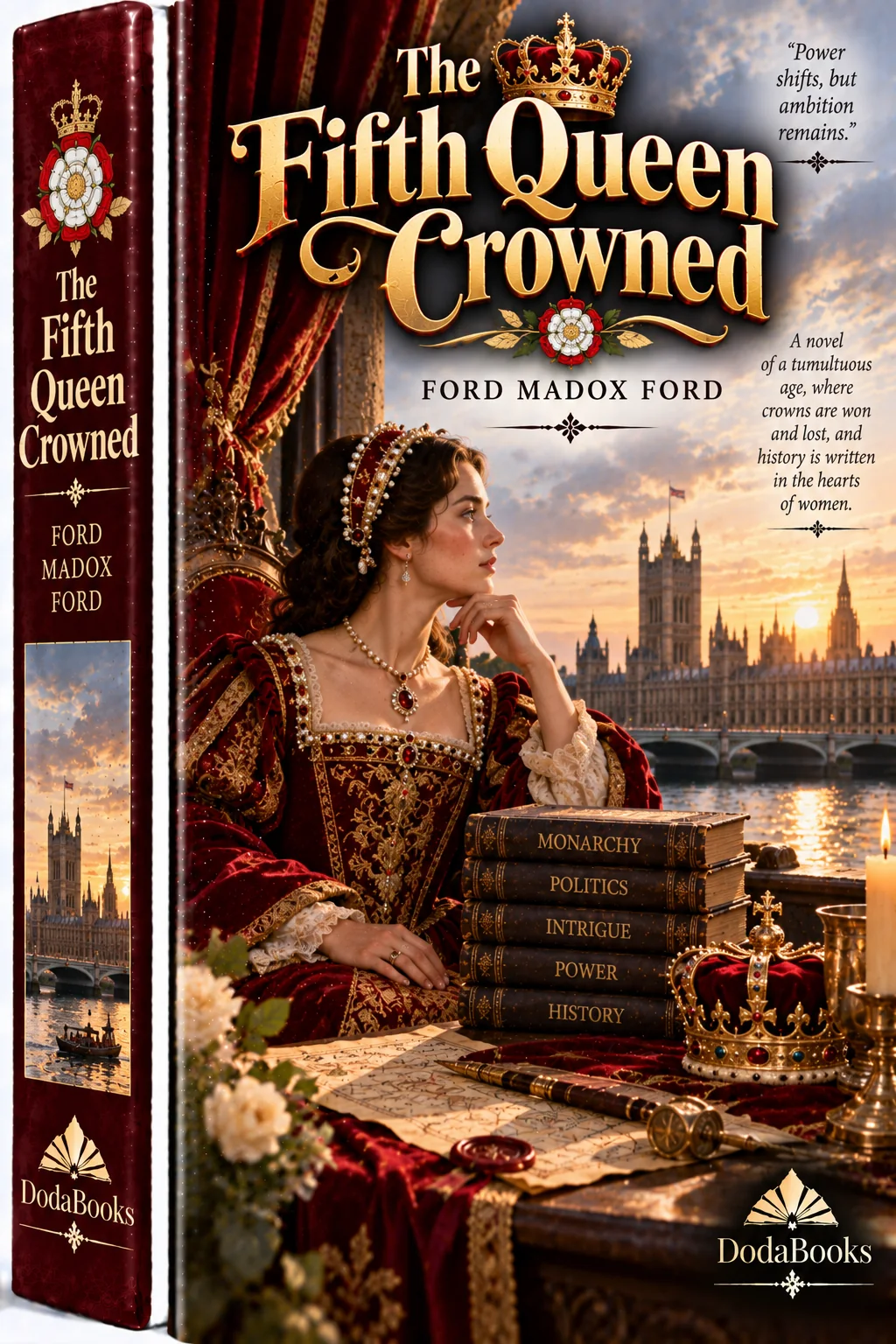
Step Inside the Shadows of the Tudor Court
Read Ford Madox Ford's complete, breathtaking historical masterpiece The Fifth Queen Crowned, enriched with historical footnotes on Henry VIII, Archbishop Cranmer, and the Tower of London.
Read Ford's Tudor Masterpiece NowThe Tragic Vision: Katharine Howard as Idealist in an Age of Wolves
Ford’s portrait of Katharine Howard is one of the most sublime character creations in twentieth-century literature. Educated in ancient Greek and Latin by the humanist scholar Nicholas Udal, Katharine embodies the radiant spirit of the Christian Renaissance:
- The Quest for Peace: Katharine genuinely believes that through moral purity and reasoned persuasion, she can persuade King Henry to heal the schism with Rome, restore the plundered monasteries to the poor, and usher in an era of theological harmony across Christendom.
- The Crowned Martyr: At her coronation, Henry is captivated by her youth, radiant beauty, and uncorrupted virtue, viewing her as his “rose without a thorn” that can restore his vanished youth and cleanse his conscience.
- The Net of Cranmer: Opposing her is the formidable machinery of the Protestant reform faction, led by Archbishop Thomas Cranmer and the cunning courtier Thomas Culpepper. Terrified that Katharine’s Catholic restoration will strip them of their newly seized monastic lands and ecclesiastical power, Cranmer’s spies dig ruthlessly into Katharine’s past, unearthing youthful romantic indiscretions in the household of the Dowager Duchess of Norfolk.
Ford renders Katharine’s fall not as a sordid sex scandal, but as a high political martyrdom: a woman whose supreme flaw is her absolute refusal to lie, flatter, or play the dirty game of courtly survival.
Ford’s Modernist Impressionism: The Sensory Re-creation of 1541
What sets The Fifth Queen Crowned apart from all other historical novels of the Tudor era is Ford Madox Ford’s revolutionary technique of Literary Impressionism:
- The Murk and Splendor of Whitehall: Ford does not describe Tudor England through dry museum exhibits; he immerses the reader directly into its pungent physical reality. We smell the river fog rolling off the Thames, the damp straw on palace stone floors, the stench of roasted meats and sweet wine masking unwashed bodies, the torchlight flickering across gold embroidery and jewel-encrusted daggers.
- The Grotesque Henry VIII: Ford’s depiction of Henry VIII is terrifying in its physical and psychological veracity. Henry is an aging, monstrous titan—swollen by dropsy, hobbling on an agonizing ulcerated leg, veering violently between sentimental tears, theological hair-splitting, and sudden outbursts of murderous rage.
- Sound, Shadow, and Whispers: Characters speak in hushed, incomplete sentences behind heavy tapestries; rumors spread like poison through riverboats and sculleries. Ford captures the pervasive, suffocating paranoia of a totalitarian court where a single careless word could send a queen, a chancellor, or an archbishop to the headsman’s block on Tower Green.
"She stood before the King like a column of white marble
in a room full of dying torches.
He was the master of all England, of its laws, its priests, and its headsmen;
yet looking into her steady eyes, he knew in his shivering heart
that she was the sovereign, and he was merely the executioner."
— Ford Madox Ford, The Fifth Queen Crowned
Explore Ford's Historical Masterwork with Scholarly Annotations
The DodaBooks annotated edition clarifies 16th-century Tudor politics, explains theological schisms, and details the true historical trial of Katharine Howard.
Get The Fifth Queen Crowned for $0.99The Climactic Confrontation: Virtue Against Tyranny
The final chapters of The Fifth Queen Crowned contain some of the most emotionally gripping dialogue in the English language. In their final private interview in Hampton Court, Henry—desperate to avoid beheading another wife—offers Katharine a dishonorable escape: if she will confess to a pre-contract of marriage and acknowledge herself a fallen woman, he will annul the marriage and spare her life.
Katharine’s refusal is magnificent. Refusing to purchase her life with a lie that would validate Cranmer’s corrupt faction, she chooses the scaffold, declaring her unwavering truth and forgiving the weeping, broken King who has condemned her. In Katharine’s martyrdom, Ford achieves true Shakespearean tragedy.
The Psychological Anatomy of King Henry VIII
Ford Madox Ford’s depiction of King Henry VIII avoids the caricature of the corpulent, roaring bluebeard common in Victorian melodrama. Instead, Ford presents a deeply tragic, psychologically fragmented monarch haunted by his own conscience, bodily infirmity, and absolute power. Henry is portrayed as a man who genuinely craves theological purity, intellectual fellowship, and moral salvation, yet is trapped in a web of bureaucratic paranoia and dynastic terror of his own creation.
Whenever Henry is near Katharine, her classical learning and moral certitude inspire his highest aspirations. Yet the moment he is isolated among his courtiers, fear poisons his mind. Archbishop Cranmer and his spies skillfully exploit Henry’s morbid fear of treason and religious rebellion. The tragedy of The Fifth Queen Crowned lies not merely in Katharine’s untimely death upon the block, but in Henry’s complete spiritual surrender to the cynical machinery of modern statecraft.
Impressionistic Prose and Auditory Texture
What sets Ford’s Tudor trilogy apart from other historical fiction is its revolutionary prose style. Influenced by his collaborative work with Joseph Conrad on The Inheritors and Romance, Ford treats language as an impressionistic brushstroke. He recreates Tudor England not through dusty antiquarian catalogues of costume and heraldry, but through immediate sensory fragments: the acrid stench of damp river mist creeping through Hampton Court’s tapestries, the dull scrape of halberds against flagstones, the sudden flicker of guttering tallow candles reflecting in Cranmer’s spectacles, and whispered council secrets overheard through heavy velvet curtains.
This intense stylistic immediacy makes the 1540s feel as urgent and visceral as the twentieth century. Ford forces the reader to inhabit the disorienting paranoia of the court, where an unguarded glance or an ambiguous Latin phrase can mean the difference between royal favor and the torture rack in the Tower.
Interlinking with Related Royal Chronicles and Tudor Documents
Readers fascinated by royal intrigue, Tudor court politics, and the private psychology of absolute monarchs will find profound companion works in our library:
- Henry VIII’s Authentic Private Voice: Experience the King’s own passionate, vulnerable courtship missives to Anne Boleyn in The Love Letters of Henry VIII Guide.
- Elizabethan Warwickshire & Shakespeare’s Lineage: Step into authentic Tudor archival records, county court rolls, and family history in Shakespeare’s Family by C. C. Stopes Guide.
- Imperial Court Intrigue & Letters of Empire: Contrast Tudor royal marriage with Napoleon Bonaparte’s strategic dynastic dilemma in Napoleon’s Letters to Josephine Guide.
- European High Diplomacy & Court Politics: Explore the backstage diplomatic maneuvers of post-Napoleonic European courts in Memoirs of the Duchesse de Dino Guide.
Why Read the DodaBooks Edition of The Fifth Queen Crowned?
The Fifth Queen Crowned is widely considered by literary scholars to be the finest historical novel written in English during the twentieth century, yet modern readers often struggle with its intricate political references. The DodaBooks Edition provides the definitive digital reading experience:
- Historical Register & Footnotes: Comprehensive annotations identify historical courtiers, Latin quotations, and Privy Council factions.
- Critical Essay on Ford’s Impressionism: Explores Ford’s collaborations with Joseph Conrad and his innovative theories of historical narrative.
- Pristine Digital Typesetting: Meticulously formatted typography, seamless navigation, and complete cross-platform reading optimization.
Witness the Climax of the Tudor Tragedy
Step inside the torchlit corridors of Hampton Court and the shadow of the Tower of London in Ford Madox Ford's magnificent historical masterpiece.
Download the Complete EbookFrequently Asked Questions
Who was Ford Madox Ford?
Ford Madox Ford (born Ford Hermann Hueffer, 1873–1939) was an eminent English modernist novelist, critic, and editor. He founded The English Review, collaborated closely with Joseph Conrad, and wrote celebrated literary masterpieces including The Good Soldier (1915), Parade's End (1924–1928), and The Fifth Queen Trilogy (1906–1908).
What is the Fifth Queen Trilogy?
The Fifth Queen Trilogy is a sequence of three historical novels—The Fifth Queen (1906), Privy Seal (1907), and The Fifth Queen Crowned (1908)—chronicling the tragic rise and fall of Katharine Howard, the fifth wife of King Henry VIII.
Can The Fifth Queen Crowned be read as a standalone novel?
Yes. While it forms the climax of the trilogy, The Fifth Queen Crowned contains a complete, self-contained dramatic arc focusing on Katharine's brief reign as Queen, Cranmer's conspiracy against her, and her final execution.
How historically accurate is Ford Madox Ford's portrayal of Katharine Howard?
While Ford departs from mainstream historical consensus by portraying Katharine as a brilliant classical scholar and devout Catholic idealist rather than an immature coquette, his portrayal of the political maneuvers, Privy Council conspiracies, and King Henry's psychological decay is remarkably faithful to Tudor court records.
Where can I purchase the complete digital edition?
The complete, annotated digital edition of The Fifth Queen Crowned by Ford Madox Ford is available for immediate download directly from DodaBooks at https://dodabooks.com/ebook/the-fifth-queen-crowned-by-ford-madox-ford/.