The Expedition of Humphry Clinker: Smollett’s Comic Tour of Britain
Published in 1771 on the eve of Tobias Smollett's death in Italy, *The Expedition of Humphry Clinker* stands as the supreme crowning masterpiece of eighteenth-century British comic fiction—a riotous, multi-perspective epistolary journey exploring gout, hypochondria, social pretensions, and the reconciliation of an empire.
Widely celebrated alongside Henry Fielding and Samuel Richardson as one of the four great founding fathers of the English novel, Scottish author Tobias Smollett (1721–1771) reached the pinnacle of his comic and observational powers in his final novel: The Expedition of Humphry Clinker. Unlike his earlier, raucous sea adventures (Roderick Random, Peregrine Pickle), which relied on raw picaresque farce, Humphry Clinker adopts a sophisticated, multi-vocal epistolary framework that transforms a family health journey into a sparkling sociological panorama of Georgian Britain.
The novel follows the eccentric family entourage of Matthew Bramble, an irascible, gout-ridden, but deeply benevolent Welsh squire who sets out from his estate in Monmouthshire accompanied by his man-crazy spinster sister Tabitha, his romantic niece Lydia, his Oxford-educated nephew Jerry Melford, and the illiterate, malaprop-prone maid Win Jenkins. Along the road, they rescue and employ a ragged, pious postilion named Humphry Clinker, whose hidden identity provides the heartwarming climax of the tour. Readers exploring our distinguished collection of classic Georgian and picaresque literature will discover in Smollett’s masterpiece an intoxicating blend of trenchant social satire and joyous human warmth.
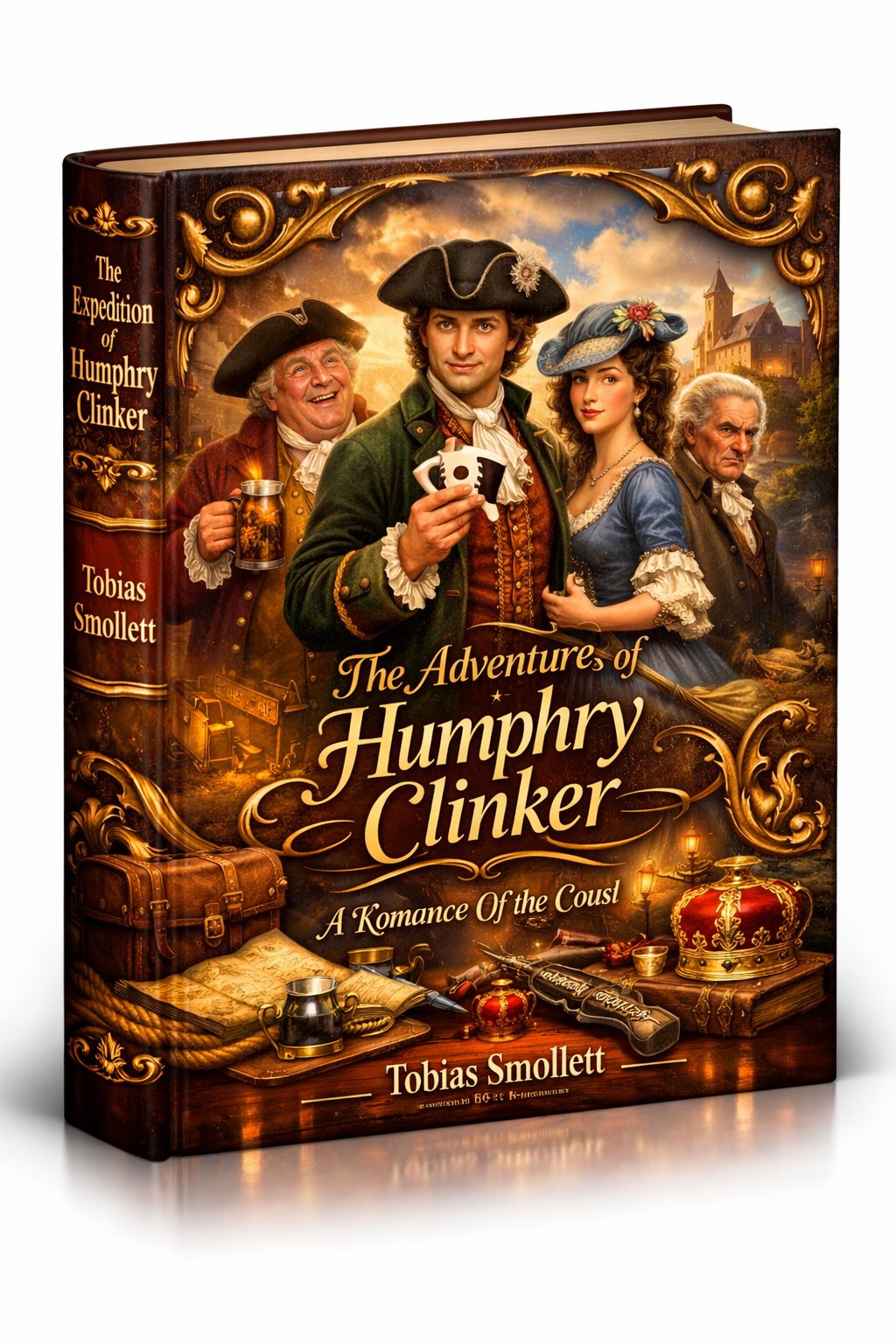
Read the Definitive Annotated Edition
Experience Tobias Smollett's comic masterpiece in this definitive annotated edition, featuring extensive historical notes on Georgian spa culture, Scottish enlightenment politics, and travel topography.
Get the Annotated eBookThe Polyphonic Epistolary Design: Five Lenses on Britain
The brilliance of Humphry Clinker lies in Smollett’s use of the epistolary form. Unlike Richardson’s Pamela, where a single voice dominates, Smollett presents the exact same events, towns, balls, and dinners through five radically different pairs of eyes:
                    THE FIVE EPISTOLARY PERSPECTIVES

       MATTHEW BRAMBLE (The Hypochondriac)          JERRY MELFORD (The Oxford Rake)
    ┌───────────────────────────────────┐        ┌───────────────────────────────────┐
    │ Cynical, olfactory disgust at mob │        │ Amused, detached young observer   │
    │ Sees dirt, noise, gout & decay    │ ◄────► │ Delights in masquerades, duels    │
    │ Deep, hidden benevolence for poor │        │ Sees vigor and sexual vitality    │
    └─────────────────┬─────────────────┘        └─────────────────┬─────────────────┘
                      │                                            │
                      ▼                                            ▼
           TABITHA BRAMBLE ──────► LYDIA MELFORD ──────► WIN JENKINS
         The Desperate Spinster   Romantic Young Girl    The Malaprop Maid
Husband-hunting & Greed Love-letters to Actor Phonetic Spells & Gossip- Squire Matthew Bramble: Writing to his physician Dr. Lewis, Bramble is hypersensitive to smells, crowds, noise, and adulterated food. He views the mineral waters of Bath and the fashionable balls of London with hilarious disgust, yet his actions constantly reveal a saintly charity toward bankrupt friends, injured coachmen, and destitute tenant farmers.
- Jerry Melford: Writing to his college friend Sir Watkin Phillips, Jerry represents youthful vitality. Where his uncle sees filth and mob vulgarity, Jerry sees a bustling, energetic modern society filled with comedic eccentrics, pretty women, and lively taverns.
- Lydia Melford: Writing to her boarding-school confidante Miss Willis, Lydia filters Britain through the sentimental, sighing lens of a teenage girl suffering from love sickness for a mysterious strolling actor named Wilson.
- Tabitha Bramble: Matthew’s sour, parsimonious sister whose letters are filled with complaints about stolen kitchen dripping, frantic attempts to entrap any unmarried gentleman into matrimony, and fierce battles with innkeepers.
- Win Jenkins: The Welsh maidservant whose letters are phonetic masterworks of comic malapropisms, confusing “grease” with “grace,” “altar” with “halter,” and delivering ribald gossip from the sculleries of the Georgian aristocracy.
The Geographic Itinerary: From Bath and London to the Scottish Highlands
The journey is an encyclopedic geographical tour of Great Britain in 1770, tracing a deliberate spiritual and physical progression from urban corruption to rural health:
- Bath (The Mineral Waters of Folly): Smollett levels some of his fiercest satire against Bath, the fashionable spa where sick aristocrats and social-climbing parvenus soaked in tepid communal baths. Bramble famously recoils from drinking the mineral waters, calculating with forensic horror that the water contains the boiled sweat and bodily waste of hundreds of diseased patients.
- London (The Monstrous Overgrown Wen): In London, Bramble is terrified by the rapid urbanization, toxic coal smog, adulterated food (chalk in bread, horse milk in tea), and the erasure of traditional class boundaries as merchants ape dukes.
- Harrogate and York: Moving northward, the air begins to clear, and the party encounters the ragged, devout youth Humphry Clinker, who is hired as a postilion after his ragged breeches accidentally scandalize Tabitha Bramble.
- Scotland (The Land of Health and Hospitality): As the entourage crosses the border into Smollett’s native Scotland—visiting Edinburgh, Glasgow, and the pristine shores of Loch Lomond—Matthew Bramble’s gout miraculously vanishes. Scotland is depicted as a land of uncorrupted nature, brilliant intellectuals (the Scottish Enlightenment), honest hospitality, and hearty outdoor labor.
                      THE THERAPEUTIC ARC OF THE EXPEDITION

          The Toxic Sickness of the City         The Restorative Health of Nature
     ┌───────────────────────────────┐   ┌───────────────────────────────┐
     │ Bath: Tepid baths & vanity    │   │ Yorkshire: Open downs & breeze│
     │ London: Smog, noise, mob riot │   │ Loch Lomond: Pure waters & fish│
     │ Adulterated food & bad odors  │   │ Highlands: Loyal, hardy clans │
     │ Gout, bile, and chronic spleen│   │ Complete physical recovery    │
     └───────────────────────────────┘   └───────────────────────────────┘
                     ▲                                   ▲
                     └─────────────────┬─────────────────┘
                                       ▼
                       The Climax of Humphry Clinker:
                       Clinker Revealed as Bramble's Son,
                       Triple Weddings & Harmonious Return
Major Themes in Smollett’s Satiric Masterpiece
1. The Satire of Luxury and Social Levelling
Smollett was a Scottish Tory who viewed the sudden flood of colonial wealth into England with profound suspicion. Through Matthew Bramble, he satirizes the “nouveaux riches”—nabobs returning from India and wealthy grocers purchasing country estates, aping aristocratic manners, and corrupting the traditional moral bonds between squire and peasantry.
2. The Body as Political and Social Metaphor
Few novelists have engaged with the physical reality of the human body as intimately as Smollett, who was himself a trained physician and naval surgeon. Bramble’s physical illnesses—gout, bile, constipation, skin eruptions—function as direct physical manifestations of social corruption. When society is diseased by greed and artificiality, the individual body rots; when society returns to honest nature, the body is restored to vigor.
3. The Union of the Kingdom
Composed half a century after the 1707 Act of Union and twenty-five years after the bloody Jacobite rebellion of 1745, Humphry Clinker was a deliberate political effort to reconcile England and Scotland. By demonstrating how English and Scottish characters overcome ancient national prejudices, appreciate each other’s virtues, and marry across national borders, Smollett forged a unified myth of British identity.
Comparative Literary Context
To appreciate Smollett’s place in the golden lineage of picaresque and comic fiction, compare Humphry Clinker with other classics:
| Work & Author | Era & Setting | Mode | Central Focus |
|---|---|---|---|
| The Expedition of Humphry Clinker (Tobias Smollett) | Georgian Britain (1771) | Epistolary Picaresque Satire | Health tour across Britain, multi-perspective humor |
| Meditations (Marcus Aurelius) | Roman Empire (180 AD) | Stoic Spiritual Journal | Inner tranquility, duty, endurance of mortality |
| The City of God, Volume I (Saint Augustine) | Late Antiquity (426 AD) | Theological Philosophy | Earthly City vs. Heavenly City following fall of Rome |
| The Letters of Franklin K. Lane (Franklin K. Lane) | Modern America (1922) | Epistolary Statesmanship | Progressive conservation, WWI cabinet politics |
Where classical philosophers like Marcus Aurelius in Meditations advocated Stoic detachment to endure the burdens of human society, Tobias Smollett used laughter and comic exaggeration to cure the spleen. And like the personal correspondence of Franklin K. Lane, Smollett’s epistolary letters offer an authentic, intimate cross-section of a nation’s geography, politics, and social spirit.
Embark on the Comic Tour of Britain
Read The Expedition of Humphry Clinker in this definitive annotated edition, featuring extensive historical notes on Georgian spas, travel itineraries, and Win Jenkins's dialect glossaries.
Read The Annotated EditionWhy Humphry Clinker Remains an Enduring Triumph
Tobias Smollett died in Livorno, Italy, in September 1771, just three months after Humphry Clinker was published in London. He had poured the accumulated wisdom, pain, and humor of his entire life into this final book. Charles Dickens, who was profoundly influenced by Smollett, kept a copy beside his desk throughout his life, modeling Mr. Pickwick upon Matthew Bramble.
The Expedition of Humphry Clinker is a glorious celebration of human comedy. It reminds us that beneath our superficial eccentricities, hypochondrias, and political disagreements, human beings are bound together by an instinctive need for companionship, laughter, and love.
Frequently Asked Questions
Who was Tobias Smollett and what was his medical background?
Tobias Smollett (1721–1771) was a Scottish novelist, poet, translator, and historian. Originally trained as a surgeon at the University of Glasgow, he served as a naval surgeon's mate in the Royal Navy during the Battle of Cartagena (1741). His intimate medical knowledge heavily informs Matthew Bramble's obsessive concerns with gout, mineral water chemistry, and hygiene.
Who is Humphry Clinker and why is the book named after him?
Humphry Clinker is an impoverished, pious, ragged young man hired as a postilion by Matthew Bramble after Clinker's former master falls ill. Despite his lowly origins and comical awkwardness, Clinker is unfailingly loyal, courageous, and devout. In the novel's climax, a discovery of old family papers reveals that Clinker is actually Matthew Bramble's natural (illegitimate) son from an early youthful romance, providing the emotional resolution of the story.
Why is Win Jenkins's language so comical and unique?
Win Jenkins is Matthew Bramble's Welsh maid whose letters are written in a riotous vernacular of phonetic spelling and unintended malapropisms. Smollett uses her naive phonetic confusion to create brilliant sexual double entendres and social satire, making her letters among the most famous comic passages in 18th-century English literature.
What was Smollett's opinion of Scotland in the novel?
Smollett was fiercely proud of his Scottish heritage. In the second half of the novel, Matthew Bramble visits Edinburgh, Glasgow, and the Highlands, depicting Scotland as an uncorrupted paradise of rugged health, intellectual brilliance (the Scottish Enlightenment), and genuine hospitality, contrasting sharply with the smog and social corruption of London.
What material is included in the DodaBooks annotated edition?
The DodaBooks annotated edition provides comprehensive notes explaining 18th-century Georgian medical practices and spa culture, detailed geographical travel maps of the Bramble family tour, complete glossaries translating Win Jenkins's comical malapropisms and Scottish dialect words, and a critical essay on Smollett's epistolary technique. You can explore and download the definitive annotated edition directly from DodaBooks at https://dodabooks.com/ebook/the-expedition-of-humphry-clinker/.
Related Classic 18th-Century and Philosophical Studies
Discover further masterworks of classical philosophy, ancient theology, and classic literature: