The Eclipse of Russia
Dr. E.J. Dillon’s Insider Account of Tsar Nicholas II, Rasputin, Count Witte, and the Fall of the Romanov Empire
When the three-hundred-year-old Romanov dynasty collapsed in the chaos of revolution and war between 1917 and 1918, Western historians and statesmen struggled to understand how the largest land empire on earth had disintegrated overnight. To comprehend that titanic catastrophe, there is no more authoritative, deeply informed, or devastating firsthand analysis than Dr. Emile Joseph Dillon’s 1918 masterwork, The Eclipse of Russia.
Unlike foreign diplomats who viewed Russia through the narrow windows of Petrograd embassies, Dr. E.J. Dillon (1854–1933) lived inside Russian society for over thirty years. Fluent in Russian and several regional dialects, Dillon held university professorships at St. Petersburg and Kharkov, edited Russian newspapers, and served as the chief foreign correspondent for The Daily Telegraph. Most importantly, Dillon was the intimate friend, advisor, and confidant of Count Sergei Witte, the brilliant Russian Prime Minister who modernized the nation’s railway network and negotiated the Treaty of Portsmouth ending the Russo-Japanese War.
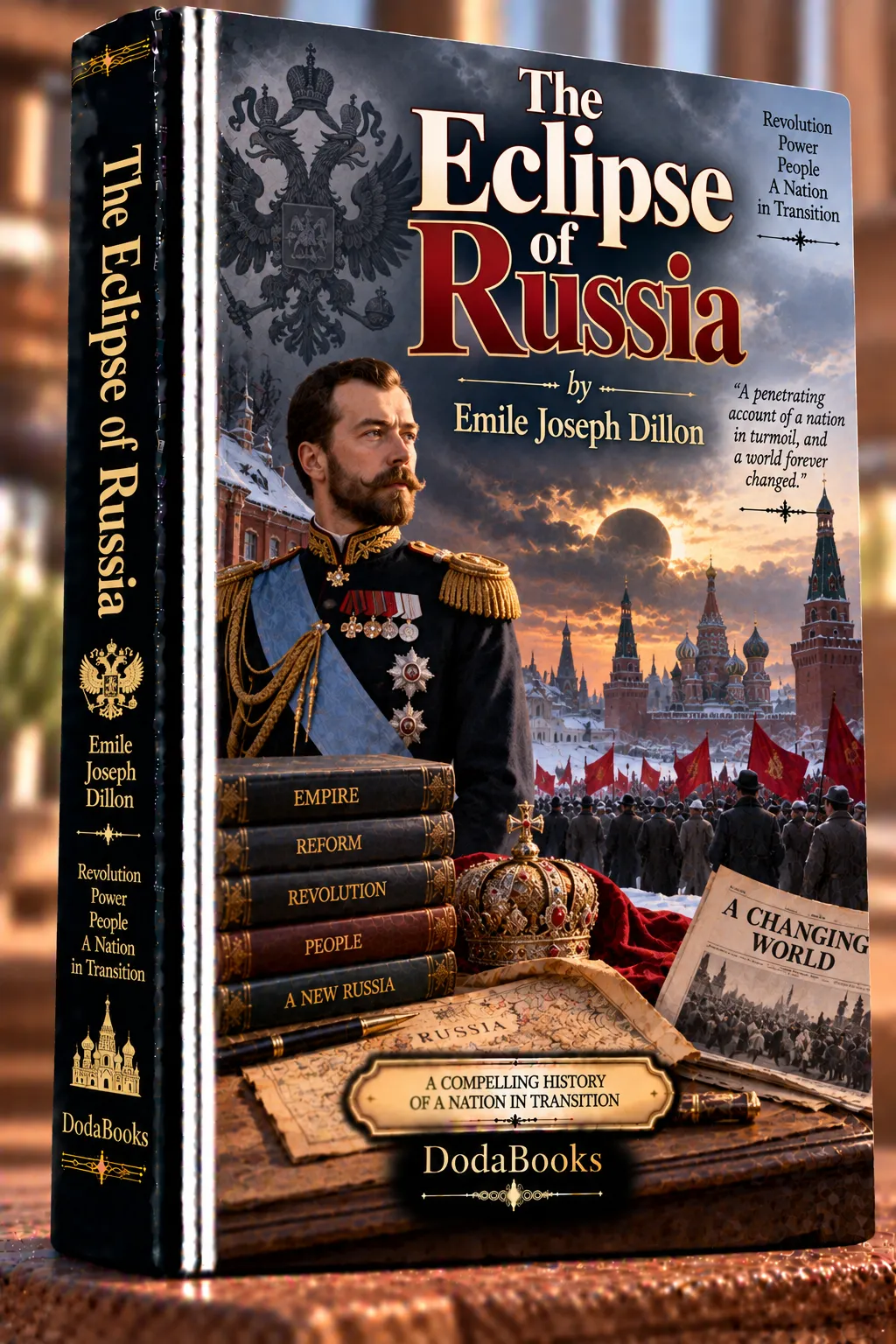
Step Inside the Doomed Court of the Last Russian Tsar
Read Dr. E.J. Dillon's 1918 geopolitical masterpiece with comprehensive annotations explaining Tsarist autocracy, the 1905 Revolution, the Björkö Treaty, and Rasputin's influence.
Get The Eclipse of RussiaThis grand tradition of Eurasian statecraft and imperial memoir has its supreme origin in Emperor Babur’s immortal autobiography.
The Tragedy of Nicholas II: Autocracy Without Will
The central psychological portrait of The Eclipse of Russia is Dillon’s unsparing autopsy of Tsar Nicholas II. Dillon rejects both the reactionary hagiography that painted the Tsar as an innocent martyr and the simplistic revolutionary propaganda that cast him as a monstrous tyrant. Dillon’s portrait is far more terrifying: Nicholas was an amiable, narrow-minded, fatally weak man who genuinely believed he held a divine mandate from God to preserve absolute autocracy, yet lacked the intellect, willpower, and character to govern a modern nation.
Dillon documents Nicholas’s pathological distrust of his most capable ministers:
- How Nicholas undermined and dismissed Count Witte, the only statesman capable of stabilizing the Russian economy.
- How the Tsar succumbed to the mystical fanaticism of Empress Alexandra and the corrupt Siberian peasant Grigori Rasputin.
- How the Emperor signed disastrous international treaties without consulting his own foreign ministry, such as the secret Treaty of Björkö of 1905, signed aboard the imperial yacht with German Kaiser Wilhelm II, which nearly destroyed the Franco-Russian alliance.
In Dillon’s memorable phrase:
“Nicholas II was a fatalist who mistook his own obstinacy for divine guidance. He possessed all the negative qualities of autocracy without any of its redeeming virtues: he was suspicious of genius, surrounded by sycophants, and utterly blind to the volcanic fires smoldering beneath his feet.”
Dillon's Diagnosis of Imperial Collapse:
[Petrified Feudal Autocracy] ➔ [Alienation of Competent Statesmen / Witte] ➔ [Disastrous Russo-Japanese War & 1905 Upheaval] ➔ [WWI Catastrophe] ➔ [Total Eclipse]
The Peasantry and the “Volcanic Soil” of Russia
Where Dillon surpasses all other Western observers is in his profound sociological understanding of the Russian peasantry (the muzhiks). Having traveled extensively across rural provinces, Dillon understood that eighty percent of the Russian population lived in conditions of quasi-medieval isolation, illiteracy, and land starvation.
Dillon warned Western readers that Tsarist Russia was not a cohesive European state, but an immense empire of disparate peoples held together solely by the fragile hoop of the Tsar’s personal authority. Once that central authority fractured under the catastrophic strain of World War I, there were no resilient democratic institutions, civic traditions, or middle-class infrastructure to hold society together:
“The Russian empire was a colossal inverted pyramid balanced upon the apex of a single man’s crown. When that crown fell, the entire pyramid collapsed in an avalanche that shook the foundations of civilization.”
Dillon predicted with chilling accuracy that the fall of the Tsardom would not lead to an orderly Western-style liberal democracy, but to a savage, totalitarian dictatorship that would remake global geopolitics.
Direct Court Insider Access
Written by a confidant of Count Sergei Witte who attended secret imperial conferences and personally negotiated international treaties.
The Secret Kaiser-Tsar Pacts
Shocking revelations regarding the clandestine 'Willy-Nicky' correspondence and the clandestine Björkö Treaty between Germany and Russia.
The 1905 Revolution Decoded
Eyewitness accounts of Bloody Sunday, the October Manifesto, the mutiny of the battleship Potemkin, and the birth of the Russian Duma.
Prophetic Geopolitical Vision
Published in 1918 as the Bolshevik Civil War began, providing the foundational historical analysis used by Versailles diplomats and modern scholars.
The Life and Legacy of Dr. E.J. Dillon
Dr. Emile Joseph Dillon was an intellectual polymath of staggering proportions. Born in Ireland, he mastered over twenty languages, studied ancient Semitic linguistics, and earned doctorates in Germany and Russia. His uncanny ability to predict international political crises made him the most trusted journalist in Europe; British Prime Ministers Gladstone and Lloyd George frequently consulted him on Russian and Balkan affairs.
The Eclipse of Russia remains Dillon’s magnum opus. Written with the urgency of a contemporary crisis yet anchored in three decades of rigorous historical immersion, it stands alongside George Kennan’s writings as one of the indispensable Western studies of Russian political power and historical inevitability.
To explore how classic literature captured the psychological and philosophical ferment of pre-revolutionary Russia, compare this work with our study of Fyodor Dostoevsky’s Crime and Punishment Guide and Friedrich Nietzsche’s dissection of European power in Beyond Good and Evil Guide.
Understand the Fall of Imperial Russia from the Inside
Read the definitive digital edition of The Eclipse of Russia on DodaBooks, featuring comprehensive historical footnotes, Russian political glossaries, and pristine digital typography.
Purchase The Eclipse of Russia on DodaBooksWhy Read the DodaBooks Annotated Edition of The Eclipse of Russia?
Because Dillon assumes his reader is conversant with late 19th-century European diplomacy, Russian ministerial rivalries, and Tsarist administrative titles, unguided readers often struggle with the dense historical tapestry.
The DodaBooks Annotated Edition provides:
- Biographical Directory of Tsarist Statesmen: Detailing Count Sergei Witte, P.A. Stolypin, K.P. Pobedonostsev, Alexander Izvolsky, and Grand Duke Nicholas.
- Glossary of Russian Political Terminology: Explaining the Okhrana (secret police), Zemstvos, the Duma, the Mir (village commune), and Autocracy.
- Chronology of Imperial Crises (1881–1918): Mapping key events from the assassination of Alexander II through the Russo-Japanese War, 1905, and the 1917 Revolutions.
- Flawless Formatting Across All Devices: Designed with elegant margins, clear chapter structures, and responsive footnote integration for Kindle, iPad, Kobo, and smartphones.
Count Sergei Witte: The Tragic Prophet of Modernization
The emotional center of The Eclipse of Russia is Dillon’s intimate biographical portrait of Count Sergei Yulyevich Witte (1849–1915). To Dillon, Witte was the colossal, tragic Prometheus of late imperial Russia—a titan of intellect, administrative willpower, and economic vision who understood that Russia’s only salvation lay in rapid industrialization, foreign capital investment, and constitutional reform.
As Minister of Finance, Witte accomplished historic feats: he placed Russia on the gold standard, secured massive French infrastructure loans, and oversaw the construction of the legendary Trans-Siberian Railway, binding the Eurasian landmass together. Yet Witte’s very genius made him hated by the reactionary court aristocracy and the narrow-minded Nicholas II. Dillon documents how the court cabals whispered lies into the Tsar’s ear, accusing Witte of republican ambitions and forcing his resignation.
Witte's Tragic Trajectory:
[Visionary Industrial Modernization] ➔ [Trans-Siberian Railway Triumph] ➔ [Court Reaction & Royal Distrust] ➔ [Dismissal & Imperial Collapse]
Dillon’s heartbreaking accounts of his private conversations with the aging, ostracized Witte in St. Petersburg reveal a statesman who watched in agonized clarity as the Russian empire steered directly toward the abyss. Witte’s downfall serves as the ultimate historical warning: when a state punishes merit and embraces sycophancy, its ruin is only a matter of time.
Frequently Asked Questions
Who was Dr. E.J. Dillon and how did he gain such deep access to the Russian court?
Dr. Emile Joseph Dillon was an Irish scholar, linguist, and foreign correspondent who lived in Russia for over 30 years, holding university professorships and serving as the intimate confidant of Russian Prime Minister Count Sergei Witte.
What is the core argument of The Eclipse of Russia?
Dillon argues that the collapse of the Romanov Empire was caused by the fatal incompetence and obstinacy of Tsar Nicholas II, who dismantled capable governance, suppressed reform, and alienated the peasantry, leaving the empire vulnerable to revolutionary upheaval.
What was the secret Treaty of Björkö revealed by Dillon?
The Björkö Treaty was a clandestine mutual defense pact signed in 1905 between Tsar Nicholas II and German Kaiser Wilhelm II on the imperial yacht, signed without the knowledge of the Russian Foreign Ministry, which almost wrecked the Franco-Russian alliance.
Did Dillon foresee the rise of the Bolshevik dictatorship?
Yes. Dillon predicted in 1918 that the collapse of central Tsarist authority would not result in Western-style democratic constitutionalism, but in a violent, centralized totalitarian regime rooted in the unanchored Russian peasantry.
Where can I purchase the complete annotated digital edition?
You can purchase and immediately download the DodaBooks annotated edition directly from the DodaBooks online bookstore for all modern e-reading devices.