The Dogaressas of Venice Summary by Era: Complete 1,000-Year Guide (Edgcumbe Staley)
Published in London in 1910 by T. Werner Laurie, John Edgcumbe Staley’s The Dogaressas of Venice (The Wives of the Doges) is one of the most richly detailed, lavishly documented chronicles of female sovereignty in European historiography. While standard political histories of the Most Serene Republic of Venice (La Serenissima) focus almost exclusively on male Doges, naval admirals, and merchant senators, Staley shifts the historical lens to the extraordinary women who shared the ducal throne across a millennium—from the founding of the lagoon capital in 804 AD to the tragic dissolution of the Republic under Napoleon Bonaparte in 1797.
The Dogaressa was neither a traditional feudal queen nor a mere decorative consort. Chosen from the elite patrician dynasties of the Golden Book (Libro d’Oro), she was crowned in elaborate civic spectacles, sworn to strict constitutional oaths (Promissione Ducale), patronized the powerful Venetian guild system, directed courtly diplomacy, and shaped the artistic, culinary, and sartorial splendors that defined the Venetian Renaissance.
This comprehensive era-by-era summary traces the one-thousand-year trajectory of the Dogaressas through four distinct historical epochs, highlighting key coronation rituals, political crises, sumptuary battles, and cultural legacies.
| Historical Epoch | Time Period | Key Dogaressas & Figures | Defining Characteristics & Milestones |
|---|---|---|---|
| The Byzantine Dawn | 804 – 1200 | Carola, Felicia Malipiero, Theodora Ducas | Settlement of the Rialto; Byzantine imperial marriages; introduction of luxury, perfumes, and the dining fork; early ducal autocracy. |
| The Medieval Merchant Empire | 1200 – 1450 | Alicia da Prata, Tommasina Morosini, Marina Nani | The Serrata of the Great Council; constitutional clipping of ducal power; guild triumphal processions; the Black Death of 1348; the tragic Foscari reign. |
| The High Renaissance Splendor | 1450 – 1650 | Zilia Dandolo, Morosina Morosini, Laura Corner | The golden age of coronation pageantry aboard the Bucintoro; papal presentation of the Golden Rose; patronage of Murano glass and Burano lace; sumptuary laws. |
| The Twilight of the Serenissima | 1650 – 1797 | Elisabetta Querini, Elena Lucrezia Corner, Margherita Dalfin | The last solemn public coronation (1694); eighteenth-century casino culture; decline of maritime empire; abdication of Doge Ludovico Manin in 1797. |
🌊 Era I: The Byzantine Dawn (804–1200)
THE FORMATION OF DUCAL AUTHORITY
Torcello & Malamocco ──► The Move to the Rialto ──► Byzantine Alliances ──► St. Mark's Basilica
(Early Island Refugees)  (811 AD Ducal Palace)     (Imperial Princesses)  (Spiritual Independence)
The Move to the Rialto
The history of the Dogaressas begins in the dark, turbulent centuries when coastal Roman and Italian refugees fled barbarian invasions (Huns, Lombards) to establish settlements in the marshy Venetian lagoons. Following the defeat of Charlemagne’s son Pepin in 810 AD, Doge Agnello Partecipazio moved the seat of government from the exposed island of Malamocco to the fortified safety of the Rialto (the modern center of Venice), where the first Ducal Palace (Palazzo Ducale) was constructed.
The early consorts of the Doges were styled Ducissas (Duchesses). Many were foreign noblewomen arranged through diplomatic marriages:
- Carola (c. 804): A Frankish noblewoman whose marriage cemented peace between the lagoon towns and the Carolingian Empire.
- Felicia Malipiero (c. 1084): Consort of Doge Vitale Falier, celebrated for her piety and public philanthropy during the rediscovery of the relics of Saint Mark in the newly consecrated basilica.
The Byzantine Revolution and the Scandal of the Fork
The most culturally transformative figure of the early era was Theodora Ducas (married to Doge Domenico Selvo in 1075), the sister of Byzantine Emperor Michael VII Parapinakes. Raised in the opulent imperial court of Constantinople, Theodora arrived in the provincial lagoon city with an army of eunuchs, perfumers, and goldsmiths, shocking Venetian patricians with her refined luxuries:
- She refused to wash in ordinary well water, insisting on bathing in sweet morning dew gathered by her maidens.
- Her bedchamber was scented with precious ambergris, frankincense, and myrrh.
- Most shocking to contemporary chroniclers, she refused to touch food with her fingers, using a tiny two-pronged golden fork (forchetta) to lift morsels to her mouth.
The Venetian clergy viewed her refinement as decadent Eastern sin. When Theodora died young of a wasting illness, the conservative chronicler Saint Peter Damian declared her agonizing demise to be divine retribution for her unholy indulgence in cleanliness and luxury. Yet Theodora’s influence permanently redirected Venetian taste toward Eastern silks, glasswork, and courtly etiquette.
⚓ Era II: The Medieval Merchant Republic (1200–1450)
CONSTITUTIONAL CONSTRAINT & REVENUE EXPANSION
Crusades & Fourth Crusade ──► The Serrata of 1297 ──► The Promissione Ducale ──► Guild Patronage
(Sack of Constantinople)     (Hereditary Aristocracy) (Constrained Powers)     (Weavers & Smiths)
The Constitutional Muzzle: The Promissione Ducale
Following the Fourth Crusade in 1204—which established Venice as a dominant Mediterranean maritime empire—the Venetian merchant aristocracy grew terrified that a charismatic Doge might overthrow the Republic and establish a hereditary royal dynasty.
In 1297, the Republic instituted the Serrata del Maggior Consiglio (the “Closure” of the Great Council), legally locking political power into a closed hereditary caste of patricians whose names were inscribed in the Golden Book. Simultaneously, the state imposed increasingly rigid legal constraints on the Doge and the Dogaressa through the Promissione Ducale (the Ducal Oath):
- The Dogaressa was strictly forbidden from receiving foreign ambassadors or letters from foreign monarchs in private.
- She could not accept gifts, jewels, or pensions from foreign powers or private citizens.
- Upon her husband’s death, the Dogaressa was required to vacate the Ducal Palace within eight days, returning all official state regalia to the Republic.
The Triumphal Guild Processions
Despite these legal handcuffs, the Dogaressa’s public ceremonial prestige expanded dramatically. She became the official patroness of the Venetian Guilds (Scuole e Arti):
- During the grand entrance procession of Dogaressa Alicia da Prata (wife of Reniero Zeno, 1253) and Dogaressa Tommasina Morosini (wife of Pietro Gradenigo, 1289), the master guildsmen paraded before her across Piazza San Marco in full ceremonial regalia:
- The Glassmakers of Murano bearing ornate crystal decanters and glass galleons.
- The Silk Weavers carrying shimmering banners of samite, damask, and gold brocade.
- The Goldsmiths presenting jewel-encrusted chalices and ceremonial crowns.
- The Furriers displaying ermine, sable, and marten cloaks.
By saluting and blessing each guild, the Dogaressa reinforced the social compact binding the working artisan classes to the patrician state.
The Tragedy of Marina Nani (The Foscari Era)
The medieval era concluded under the shadow of the tragic reign of Doge Francesco Foscari (1423–1457) and his Dogaressa, Marina Nani:
- Foscari ruled for thirty-four years of continuous military expansion on the Italian mainland.
- However, his political enemies on the Council of Ten ruthlessly persecuted his only surviving son, Jacopo Foscari, on charges of treason and bribery.
- Dogaressa Marina Nani endured the agonizing spectacle of seeing her son repeatedly tortured, banished to Crete, and dying in exile. When the Council of Ten forced the eighty-four-year-old Doge to abdicate in 1457, Foscari died of a broken heart days later; Marina Nani fiercely defended her husband’s legacy, refusing a state funeral funded by the council that had murdered him.
👑 Era III: The High Renaissance Splendor (1450–1650)
The sixteenth century represented the zenith of the Dogaressa’s ceremonial splendor. While Venice’s military supremacy began to wane following the discovery of the Cape route to India, the Republic compensated by transforming itself into the artistic and theatrical capital of the Western world.
THE ANATOMY OF A RENAISSANCE CORONATION TRIUMPH
1. The Grand Departure: The Dogaressa leaves her family palazzo in a private flotilla.
2. The Bucintoro: Boarded onto the two-deck golden state barge rowed by 168 oarsmen.
3. The Water Pageant: Escorted along the Grand Canal surrounded by thousands of gondolas.
4. Landing at Molo: Greeted by the Doge, the Signoria, and foreign ambassadors.
5. The Cathedral Blessing: Solemn Mass at Saint Mark's; receiving the Corno Ducale.
6. The Great Banquet: Three days of feasting, jousting, and theatrical masques.
The Coronation of Zilia Dandolo Priuli (1557)
In 1557, Zilia Dandolo, the aristocratic wife of Doge Lorenzo Priuli, was honored with the first full-scale independent coronation triumph of the modern era.
- Dressed in cloth of gold embroidered with pearls, wearing an ermine-lined cape and the iconic Corno Ducale (the horned bonnet of state) upon her brow, Zilia was conducted from her family palazzo aboard the magnificent golden state galley, the Bucintoro.
- The entire Grand Canal was spanned with floating triumphal arches, and theatrical floats designed by master artists depicted Venice reigning over the Mediterranean sea-gods.
The Triumph of Morosina Morosini Grimani (1597)
The most magnificent coronation in European history occurred on May 4, 1597, for Morosina Morosini, wife of the fabulously wealthy Doge Marino Grimani. Staley devotes extensive chapters to this three-day civic festival:
- The Bucintoro Pageant: Morosina sailed down the Grand Canal seated upon an ivory throne under a canopy of gold damask. She was accompanied by four hundred of Venice’s most noble dames, dressed in white silk gowns and draped in ropes of Oriental pearls.
- The Papal Golden Rose: In 1597, Pope Clement VIII conferred upon Morosina the highest spiritual honor the Vatican could bestow on a monarch: the Golden Rose (Rosa d’Oro), honoring her piety, charity, and support of Catholic religious orders.
- The Lacemakers of Burano: Morosina recognized that the traditional lace industry of the island of Burano was collapsing under foreign competition. She established a private workshop in her palace, employing over a hundred poor women and revitalizing the world-famous Venetian needlepoint lace (Punto in Aria) industry, providing sustainable livelihood for thousands of working-class Venetian families.
MOROSINA MOROSINI'S LEGACY
Patron of Burano Lace ──► The Golden Rose (Papacy) ──► 1597 Bucintoro Triumph
(Economic Revitalization)  (Highest Vatican Honor)     (Summit of Venetian Pageantry)
Sumptuary Laws and the War on Fashion
Throughout the sixteenth century, the Senate passed dozens of Sumptuary Laws designed to curb the explosive extravagance of female fashion:
- Laws restricted the length of train dresses, the weight of gold jewelry, and the height of Chopines (the towering wooden platform shoes, sometimes eighteen inches high, upon which Venetian noblewomen balanced with the help of two maidservants).
- The Dogaressas, however, stood above these sumptuary restrictions: as living symbols of the Republic’s immense wealth, they were expected to dazzle foreign ambassadors with pearls, brocades, and cloth of silver.
🎭 Era IV: The Twilight of the Serenissima (1650–1797)
By the late seventeenth and eighteenth centuries, Venice had transformed from a ruthless naval empire into the pleasure capital of Europe—the city of Casanova, Vivaldi, masked carnivals, and private gambling houses (ridotti).
The Last Public Coronation: Elisabetta Querini Valier (1694)
On March 4, 1694, Elisabetta Querini, consort of Doge Silvestro Valier, became the final Dogaressa ever to receive a public solemn coronation:
- A woman of extraordinary beauty, towering intellect, and fierce pride, Elisabetta insisted on receiving all the historical honors granted to Morosina Morosini a century earlier.
- Her coronation banquet in the Sala del Maggior Consiglio featured sculptures carved from solid sugar and a three-day regatta.
- However, the Senate was appalled by the staggering cost of the festivities (exceeding 40,000 ducats) at a time when the Republic was fighting an exhausting war against the Ottoman Turks in the Morea (Greece).
- Immediately following the coronation, the Senate passed a definitive decree: no Dogaressa would ever again be permitted a public coronation.
THE DECLINE OF THE REGAL OFFICE
1694: Elisabetta Querini ──► Senate Decree: No More ──► 1797: Fall of the Republic
(Last Grand Coronation)       Coronations Permitted      (Napoleon Abolishes Dogedom)
Elena Lucrezia Corner Piscopia (The Laureate)
While not a Dogaressa, Staley highlights the remarkable intellectual climate of the late Venetian Republic through the figure of Elena Lucrezia Corner Piscopia (1646–1684), related to several ducal families. In 1678, at the University of Padua, she became the first woman in human history to receive an academic doctoral degree (Doctor of Philosophy), demonstrating the extraordinary intellectual independence achieved by Venetian women within a patrician society.
The Fall of the Republic (1797)
The thousand-year saga concluded in sorrow in May 1797. The 120th and final Doge of Venice, Ludovico Manin, and his consort Margherita Dalfin faced the invincible armies of Napoleon Bonaparte.
Lacking the naval forces or national will to resist, the Great Council voted to abolish the ancient Republic. Doge Manin removed the sacred Corno Ducale from his head, handed it to his servant, and uttered the famous epitaph: “Take it away; we shall not need it anymore.”
The French army stripped the Ducal Palace, burned the golden state barge Bucintoro to extract its gold leaf, and dissolved the oldest constitutional republic in human history. Yet through Staley’s monumental study, the majesty, courage, and cultural genius of the Dogaressas remain immortalized in European letters.
❓ Frequently Asked Questions
What exactly was a Dogaressa?
The Dogaressa was the official crowned consort of the Doge of Venice—the elected head of state of the Venetian Republic. Chosen exclusively from the patrician families of the Golden Book, she served as the first lady of the state, the ceremonial patroness of the trade guilds, and a powerful cultural and diplomatic figure.
Did a Dogaressa hold official political voting power?
No. Under the Venetian constitution, political voting power in the Great Council and Senate was restricted entirely to male patricians. However, Dogaressas wielded immense informal political power through family dynasties, the patronage of guilds, philanthropic foundations, and private court diplomacy.
What was the Bucintoro?
The Bucintoro was the magnificent, two-deck golden state barge of the Venetian Republic. Decorated with lavish carvings of mythical sea-creatures and rowed by 168 elite shipyard arsenallotti, it was used for the annual "Marriage of the Sea" (*Sposalizio del Mare*) and the triumphal coronation water pageants of the Dogaressas along the Grand Canal.
Why did the Venetian Senate ban future coronations in 1694?
Following the breathtakingly expensive coronation of Elisabetta Querini Valier in 1694, the Senate was alarmed by the astronomical financial cost of the three-day celebrations. Because the state was running massive deficits to fund naval wars against the Ottoman Empire, the Senate decreed that public coronations of consorts would be abolished permanently to enforce fiscal restraint.
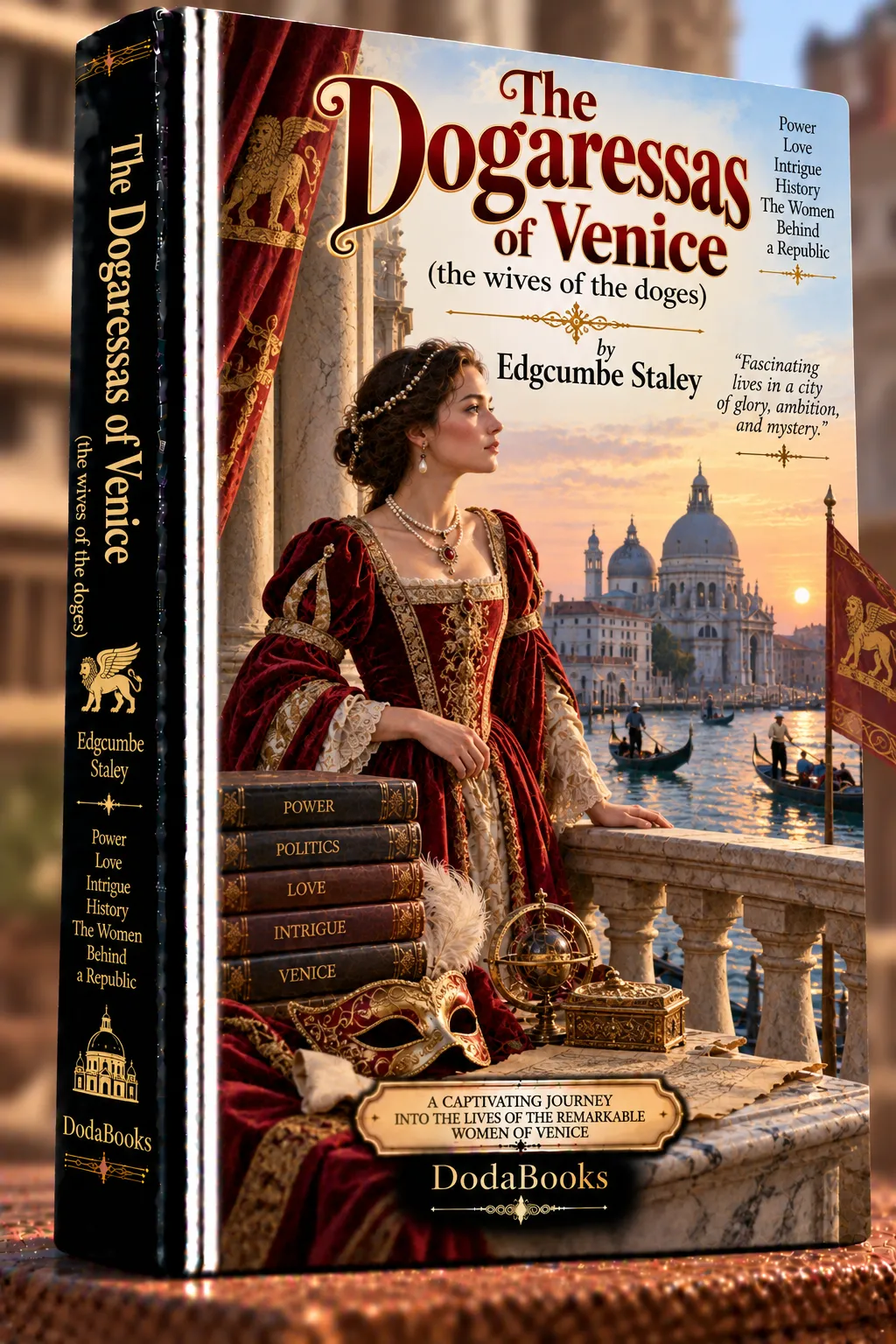
📖 Explore a Millennium of Venetian Sovereignty
Discover the lavish ceremonies, political intrigues, and cultural power of the Doges’ wives in the definitive digital edition of The Dogaressas of Venice from DodaBooks:
- 👑 Complete 1,000-Year Historical Chronicle — From the Byzantine founding in 804 AD to the fall in 1797
- 💡 Exhaustive Footnotes on Venetian Civic Institutions — Explaining the Bucintoro, the Council of Ten, and the Golden Book
- 📱 Designed for Historical Study — Clean digital typography with clear era navigation and linked bibliographies
- 🔓 100% DRM-Free — Read anywhere on Kindle, Kobo, iPad, or Android with complete freedom
👉 Get the Annotated Edition of The Dogaressas of Venice at DodaBooks →