Famous Dogaressas of Venice: Morosini, Foscari, Dandolo & Profiles of Power
For over a thousand years, the Republic of Venice operated as an intensely masculine merchant oligarchy: only male patricians could vote in the Great Council, debate in the Senate, command war galleys, or be elected to the supreme office of Doge. Yet, behind the gilded halls of the Ducal Palace and the solemn assemblies of the Signoria stood an extraordinary succession of women who shaped the political, cultural, and economic destiny of La Serenissima: The Dogaressas.
In his landmark 1910 study The Dogaressas of Venice, British historian John Edgcumbe Staley rescues these formidable women from the footnotes of Venetian archives. Chosen from the grandest patrician dynasties—such as the Morosini, Dandolo, Foscari, Querini, and Contarini—the Dogaressas were state diplomats, economic innovators, guardians of trade guilds, and champions of Renaissance art and literature.
This comprehensive biographical guide examines the lives, political crises, and lasting cultural achievements of the eight most influential Dogaressas across a millennium of Venetian history.
| Dogaressa | Reign & Era | Consort (Doge) | Primary Historical Achievement / Legacy |
|---|---|---|---|
| Theodora Ducas | 1075–1083 (Byzantine) | Domenico Selvo | Byzantine imperial princess; introduced refined court etiquette, perfumes, and the dining fork to Western Europe. |
| Felicia Malipiero | 1084–1096 (Medieval) | Vitale Falier | Embodied civic piety and charity during the rediscovery and consecration of Saint Mark’s sacred relics. |
| Alicia da Prata | 1253–1268 (Merchant Empire) | Reniero Zeno | Transformed the coronation into a grand civic festival uniting the working guild artisan classes with the state. |
| Tommasina Morosini | 1289–1311 (The Serrata) | Pietro Gradenigo | Sovereign diplomat and queen mother of King Andrew III of Hungary; bridged international royal dynastic politics. |
| Marina Nani | 1423–1457 (High Renaissance) | Francesco Foscari | The tragic matriarch of the Foscari dynasty; survived the ruthless political persecution and exile of her son Jacopo. |
| Zilia Dandolo | 1556–1559 (Sixteenth Century) | Lorenzo Priuli | Re-established the grand public coronation triumph; set High Renaissance sartorial trends and supported charitable hospitals. |
| Morosina Morosini | 1595–1605 (Golden Age) | Marino Grimani | Summit of Venetian pageantry; recipient of the Papal Golden Rose; founded lace workshops that revitalized Burano island. |
| Elisabetta Querini | 1694–1700 (Baroque Twilight) | Silvestro Valier | Fiercely independent intellectual and art patron; the final Dogaressa ever permitted a solemn public coronation. |
🏛️ 1. Theodora Ducas (c. 1075–1083): The Byzantine Pioneer of Luxury
THE BYZANTINE INVASION OF REFINEMENT
Imperial Constantinople ──► Lagoon Wedding ──► The Golden Fork ──► St. Damian's Curse
(Eastern Splendor)          (Domenico Selvo)    (Courtly Etiquette) (Clerical Backlash)
No Dogaressa in early Venetian history created as seismic an intellectual and cultural shockwave as Theodora Ducas (or Anna Selvo). The sister of the Eastern Roman (Byzantine) Emperor Michael VII, Theodora was married to Doge Domenico Selvo in 1075 to seal a crucial naval alliance against the Norman invaders of southern Italy.
When Theodora stepped off the imperial trireme onto the wooden piers of the Piazzetta, she entered a city that was still half-rustic:
- The Venetian nobility dressed in heavy, dark woolen mantles, ate coarse roasted meats with their fingers, and lived in drafty brick houses.
- Theodora brought with her an entourage of imperial chamberlains, perfumers, goldsmiths, and silk-weavers.
The Scandal of the Fork:
Contemporary chroniclers—most notably the austere monk Saint Peter Damian—were horrified by Theodora’s refined lifestyle:
- She washed her skin only in fresh morning dew distilled by her handmaidens.
- She scented her chambers with expensive frankincense and Indian spices.
- Most scandalous of all, she refused to touch her food with her fingers, commanding her eunuchs to cut her food into small morsels, which she lifted to her mouth using a small, two-pronged golden fork (forchetta).
Saint Peter Damian denounced her in his theological tracts as a monster of pagan vanity, declaring that God had given human beings fingers for eating and that using a golden fork was an insult to the Creator. When Theodora contracted a painful, wasting disease and died young, Damian triumphantly claimed that her rotting flesh was divine punishment for her unholy cleanliness.
Yet history proved Theodora right: within two centuries, her fork, her perfumes, and her Byzantine silks became standard across every royal court in Europe.
🕊️ 2. Felicia Malipiero (1084–1096): The Medieval Matriarch
Following the cultural storms of Theodora’s reign, Felicia Malipiero, wife of Doge Vitale Falier, represented the ideal medieval Christian Dogaressa:
- Deeply devoted to the welfare of the poor, Felicia transformed the private quarters of the Ducal Palace into a charitable distribution center, dispensing grain, wool cloaks, and medicinal broths to the poor fishermen and salt-workers of the lagoon.
- In 1094, during the grand re-consecration of the Basilica of Saint Mark, Felicia played a central role in the miraculous rediscovery of the Evangelist’s lost relics. When a pillar cracked open to reveal the hidden bronze chest containing the bones of Saint Mark, Felicia led the women of Venice in a tearful, three-day barefoot pilgrimage of thanksgiving.
Her humble piety established the moral prototype of the Dogaressa as the maternal protectress of the Venetian poor.
⚒️ 3. Alicia da Prata (1253–1268): The Champion of the Guilds
ALICIA DA PRATA'S CIVIC REVOLUTION
Patrician Sovereign ──► Grand Canal Pageant ──► Guild Salutations ──► Social Harmony
(Noble Birth)           (The State Galley)      (Honoring Labor)     (Binding the Classes)
By the mid-thirteenth century, Venice’s rapid commercial expansion had created a wealthy, restive class of working artisans and craftsmen organized into powerful trade guilds (Scuole e Arti). Dogaressa Alicia da Prata, consort of the crusader Doge Reniero Zeno, recognized that the stability of the Republic required binding these working guilds directly to the ducal throne.
Upon her husband’s election in 1253, Alicia instituted the Triumphal Guild Coronation:
- Instead of keeping her coronation inside the private chambers of the palace, she conducted a massive public water pageant along the Grand Canal.
- Each of the city’s major guilds paraded before her in specialized ceremonial barges:
- The Goldsmiths presented her with a gold circlet studded with lagoon pearls.
- The Furriers draped her shoulders in Siberian ermine and marten.
- The Glassmakers of Murano displayed shimmering blown-glass galleons, crystal flagons, and decorative mirrors.
- Alicia personally greeted and thanked the elected masters of each guild, elevating the dignity of manual craftsmanship to an affair of state.
👑 4. Tommasina Morosini (1289–1311): The Queen Mother of Hungary
The Morosini family was one of the most illustrious and politically dominant dynasties in Venetian history, producing four Doges, dozens of naval admirals, and several Dogaressas.
Tommasina Morosini, wife of Doge Pietro Gradenigo, stands out as one of the most internationally powerful diplomatic figures of the Middle Ages:
- Her brother, Albertino Morosini, arranged for Tommasina’s niece (also named Tommasina) to marry King Stephen V of Hungary.
- From this union was born King Andrew III of Hungary (“Andrew the Venetian”).
- During her tenure as Dogaressa, Tommasina Morosini acted as the supreme diplomatic intermediary between the Kingdom of Hungary and the Republic of Venice, securing lucrative trade treaties and naval alliances that protected Venetian merchant colonies along the Dalmatian coast.
Tommasina proved that while the Venetian constitution forbade the Dogaressa from holding an official cabinet seat, a brilliant woman operating through family kinship networks could direct European geopolitical alliances.
💔 5. Marina Nani (1423–1457): The Tragic Foscari Matriarch
No Dogaressa endured greater personal suffering or demonstrated more heroic resilience than Marina Nani, the noble consort of Doge Francesco Foscari.
THE AGONY OF THE FOSCARI DYNASTY
34 Years of Imperial Rule ──► Persecution of Jacopo ──► Torture & Exile ──► The Broken Heart
(Territorial Expansion)      (Council of Ten Feud)     (Cretan Dungeon)     (Refusing State Aid)
Francesco Foscari ruled Venice for thirty-four glorious years of imperial expansion on the Italian mainland. However, his political rivals—led by the vindictive Ermolao Donato and the Council of Ten—sought to destroy the aging Doge by targeting his only surviving son, Jacopo Foscari:
- Jacopo was arrested on trumped-up charges of treason, corruption, and receiving bribes from foreign dukes.
- Dogaressa Marina Nani was forced to witness her beloved son subjected to the horrific torture of the corda (strappado) inside the Ducal Palace.
- Despite her desperate personal pleas to the Council of Ten, Jacopo was banished to the penal colony of Crete, where he died in misery.
In October 1457, the Council of Ten ruthlessly forced the heartbroken, eighty-four-year-old Doge to abdicate. Days later, when the bells of Saint Mark rang to announce the election of his successor, Francesco Foscari burst a blood vessel and died.
When the Senate guiltily offered to pay for a lavish state funeral, Dogaressa Marina Nani stood before the council in magnificent, icy defiance, declaring:
“I will never permit that the body of my husband, whom they murdered while living, should be carried to the grave by the very men who broke his heart.”
💎 6. Morosina Morosini Grimani (1595–1605): The Summit of Venetian Splendor
If Marina Nani was the tragic heroine of the Republic, Morosina Morosini was its triumphant queen. Married to the fabulously wealthy Doge Marino Grimani, Morosina presided over the golden age of Renaissance Venetian pageantry.
The Coronation Triumph of 1597:
On May 4, 1597, Morosina was crowned in the most breathtaking civic spectacle in European history:
- She sailed along the Grand Canal aboard the golden state galley Bucintoro, seated upon an ivory throne draped in cloth of gold.
- She was accompanied by a floating court of four hundred patrician ladies dressed in silver damask and adorned with magnificent pearl necklaces.
- At the Piazzetta, she was greeted by the guilds, the foreign ambassadors of France, Spain, and the Holy Roman Empire, and thousands of cheering citizens.
MOROSINA'S TWO HISTORIC MONUMENTS
┌────────────────────────────────────────────────────────┐
│ 1. THE PAPAL GOLDEN ROSE (1597):                       │
│ Bestowed by Pope Clement VIII; highest Vatican honor.  │
├────────────────────────────────────────────────────────┤
│ 2. REVIVAL OF BURANO LACE (1595–1605):                 │
│ Established workshops in her palace; rescued industry; │
│ Created sustainable employment for 130 poor women.     │
└────────────────────────────────────────────────────────┘
The Economic Salvation of Burano:
Morosina’s greatest historical legacy was economic rather than ceremonial:
- Recognizing that the traditional needlepoint lace industry (Punto in Aria) of the island of Burano was dying out due to foreign imitators, Morosina founded a permanent lace workshop within her private palace.
- She hired master lacemakers to train over a hundred destitute women and orphans, paying them generous wages and purchasing their finest creations for her court gowns.
- Her patronage revitalized Burano lace, turning it into Venice’s most lucrative luxury export across the royal courts of France, England, and Russia for the next century.
In 1597, Pope Clement VIII honored Morosina’s extraordinary philanthropy and piety by awarding her the Golden Rose (Rosa d’Oro)—the only time in history the Vatican conferred this sacred honor upon a Venetian Dogaressa.
🏛️ 7. Elisabetta Querini Valier (1694–1700): The Last Crowned Sovereign
The final Dogaressa to wear the public crown of state was Elisabetta Querini, wife of Doge Silvestro Valier.
- A Woman of Intellect: Elisabetta was renowned throughout northern Italy for her deep learning, her patronage of composers and poets, and her razor-sharp political intelligence.
- The Defiant Coronation (1694): When her husband was elected in 1694, Elisabetta insisted on reviving the full, magnificent public coronation triumph that had honored Morosina Morosini a century earlier. Dressed in silver brocade with a diamond-studded Corno Ducale, she was rowed down the Grand Canal accompanied by lavish musical regattas.
- The Senate’s Backlash: The three-day festivities cost an astronomical sum (over 40,000 ducats) at a time when the Republic was fighting an exhausting war against the Ottoman Turks. Immediately following her triumph, the scandalized Senate passed a decree that changed history: no future Dogaressa would ever again be allowed a public coronation.
Elisabetta reigned with imperial majesty until her husband’s death in 1700, retiring to her private palazzo where she maintained an intellectual salon that attracted the greatest philosophers of early Enlightenment Europe.
❓ Frequently Asked Questions
How was a Dogaressa chosen?
A woman became Dogaressa automatically when her husband was elected Doge by the complex, forty-one-member electoral conclave of the Great Council. However, under the Venetian constitution, a Doge could only marry a woman whose name was inscribed in the Libro d'Oro (Golden Book) of hereditary Venetian patricians.
What happened to a Dogaressa when her husband died?
Under the rigid rules of the Promissione Ducale, the moment a Doge died, the Dogaressa's official reign ended instantly. She was required to vacate the private apartments of the Ducal Palace within eight days, surrender all state regalia and jewels back to the state treasury, and return to her private family palazzo as a private noblewoman.
Why is Theodora Ducas famous in the history of food etiquette?
Theodora Ducas is historically credited with introducing the dining fork to Western Europe in the late 11th century. Her two-pronged golden fork shocked medieval Venetian chroniclers, who regarded lifting food with metal utensils rather than bare hands as an act of decadent, sinful arrogance.
Did any Dogaressa rule Venice alone as a reigning monarch?
No. Venice was a constitutional republic, not a hereditary monarchy. The sovereign authority resided in the Great Council and the Signoria. The Doge was an elected magistrate for life, and upon his death, an interregnum was declared under a temporary vice-doge until a new male Doge was chosen.
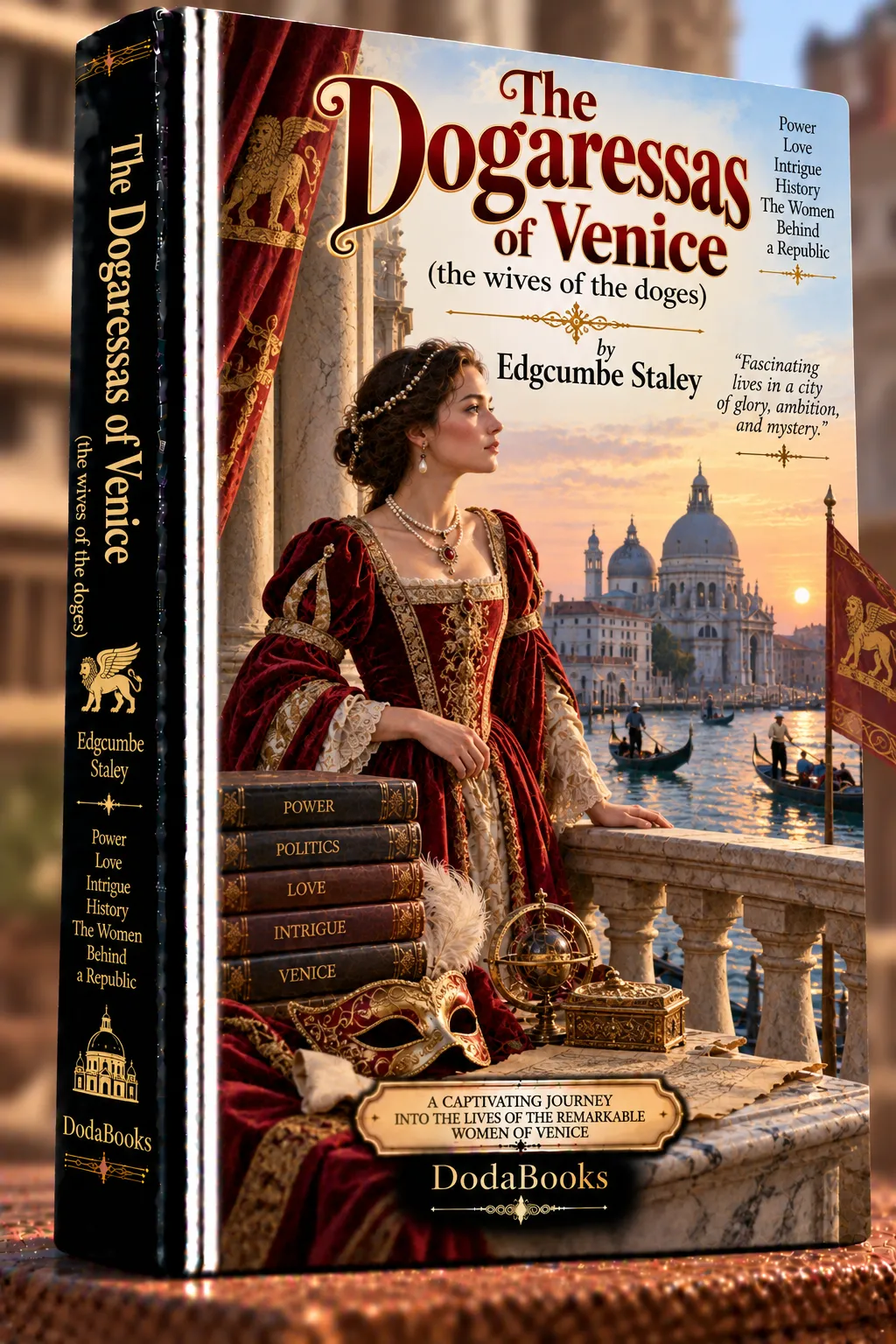
📖 Discover the Queens of the Venetian Republic
Explore the dramatic biographies, political struggles, and triumphs of the Dogaressas in the definitive digital edition from DodaBooks:
- 👑 All Major Biographies Complete & Unabridged — From Theodora Ducas to Elisabetta Querini
- 💡 Exhaustive Footnotes on Venetian Noble Dynasties — Deep dive into the Morosini, Foscari, Dandolo, and Querini families
- 📱 Pristine Digital Layout — Fully indexed and linked for smooth reading across e-readers and tablets
- 🔓 100% DRM-Free — Yours to keep, read, and explore permanently with zero restrictions
👉 Get the Annotated Edition of The Dogaressas of Venice at DodaBooks →