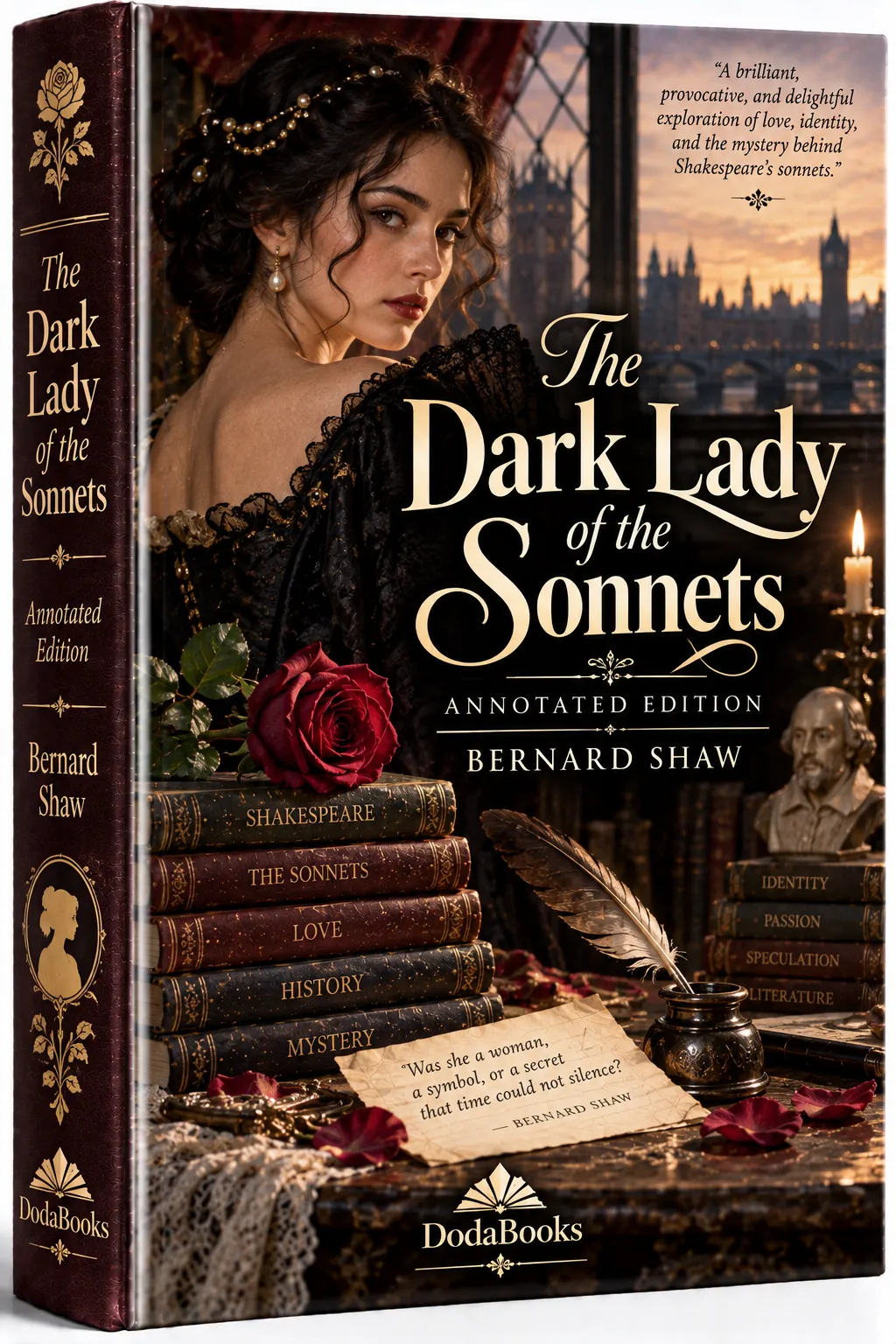
George Bernard Shaw’s The Dark Lady of the Sonnets (1910) is a brilliant, razor-sharp one-act comedy that brings together William Shakespeare, Queen Elizabeth I, and the mysterious Dark Lady on the moonlit terrace of Whitehall Palace. Combining Shavian satire with affectionate literary tribute, this sparkling play examines the nature of dramatic genius, artistic patronage, and the urgent national need for subsidized theatre.
🎭
The Dark Lady of the Sonnets
Shaw's sparkling Elizabethan comedy of theatrical genius, mistaken identities, and royal wit. Discover how William Shakespeare, Queen Elizabeth I, and Mary Fitton clash beneath the stars at Whitehall Palace.
| Author | George Bernard Shaw |
| Published | 1910 (First Performed at Haymarket Theatre, London) |
| Genre | Satirical Comedy, Historical Fantasy, One-Act Play |
| Setting | The Palace of Whitehall, London (Midsummer Night, c. 1595) |
| Central Themes | The Nature of Genius, Artistic Plagiarism, State Patronage of Art, Elizabethan Identity |
| Reading Time | 1–2 hours |
| Summary Time | 15 minutes |
🏰 Context and Origin: A Play for a National Theatre
The Dark Lady of the Sonnets was written by George Bernard Shaw for a very specific, practical cause: to support the fundraising campaign for a British National Theatre. Premiering at the Theatre Royal, Haymarket on November 24, 1910, with a stellar cast that included Granville Barker as Shakespeare and Suzanne Sheldon as Queen Elizabeth, the play was conceived as both an entertaining theatrical divertissement and an impassioned political manifesto.
At the heart of the play lies Shaw’s complex, career-long relationship with William Shakespeare—a phenomenon Shaw famously christened “Bardolatry.” Shaw was fiercely critical of Victorian critics and actor-managers (such as Henry Irving) who treated Shakespeare as an infallible, godlike deity while performing heavily cut, bowdlerized versions of his plays drowning in Victorian sentimentality.
Instead of an untouchable demigod, Shaw wanted to portray Shakespeare as a living, breathing Elizabethan working playwright: a man of boundless linguistic appetite, flawed moral judgment, professional anxieties, and an shameless habit of jotting down overheard street dialogue in his notebook to reuse in his plays.
📜 Complete Plot Breakdown & Midnight Dialogue
The play is set on a moonlit terrace overlooking the Thames at the Palace of Whitehall on a warm Midsummer night in the late 1590s.
The Snoozing Warder and the Note-Taking Bard
The play opens with a palace warder standing guard, struggling against exhaustion. William Shakespeare arrives silently, having arranged a secret midnight assignation with Mary Fitton, a maid of honour to Queen Elizabeth who is popularly identified as the “Dark Lady” of Shakespeare’s sonnets. To secure admission onto the royal terrace, Shakespeare bribes the reluctant warder with gold coins.
Throughout their conversation, whenever the warder utters a colorful colloquial phrase—such as “angels and ministers of grace defend us!” or “a fit of the ague”—Shakespeare immediately whips out his pocket tablet and scribbles the phrase down, delightedly marveling at his own “invention.” Shaw portrays Shakespeare not as a solitary mystic generating poetry out of thin air, but as an eagle-eyed conversational sponge who steals brilliant turns of phrase from soldiers, sailors, and drunken gravediggers.
The Cloaked Lady in the Dark
A cloaked woman approaches through the palace gardens, sleepwalking and whispering sorrowful, poetic laments into the night: “All the perfumes of Arabia will not sweeten this little hand.” Shakespeare, mistaking her for Mary Fitton, steps forward and wraps his arms around her with passionate romantic declarations.
Before the lady can fully react, the actual Mary Fitton arrives on the terrace, cloaked and furiously jealous. Discovering Shakespeare in the arms of another woman, the hot-tempered Mary rushes forward, strikes Shakespeare to the ground with a furious blow, and demands to know who her rival is. When the stranger throws back her hood, both are paralyzed with terror: the sleepwalker is none other than Queen Elizabeth I herself.
The Clash of Wills and the Plea for Art
Rather than ordering their immediate execution for treason, the Virgin Queen is amused and intrigued by the situation. Mary Fitton furiously berates Shakespeare for writing sonnets mocking her dark complexion and fickle temperament, while Shakespeare passionately defends his devotion to art.
When Mary is dismissed back to her bedchamber, Shakespeare and Elizabeth are left alone under the stars. Here, the comedy deepens into profound political debate. Shakespeare makes an eloquent, impassioned appeal to the Queen: he begs her to establish and endow a National Theatre. He explains that working playwrights are currently forced to write vulgar potboilers and flatter the crude tastes of groundlings simply to stay solvent.
Elizabeth listens with deep sympathy, lamenting that while she personally loves great drama and appreciates Shakespeare’s genius, the puritanical, penny-pinching English Parliament will never consent to spending public funds on actors and playwrights. The Queen prophesies that perhaps in three hundred years, an enlightened generation of Britons will finally build the theatre Shakespeare dreams of. The play ends on a note of poignant mutual respect between England’s greatest monarch and England’s greatest poet.
👥 Character Breakdown & Theatrical Dynamics
✒️ WILLIAM SHAKESPEARE
The Linguistic Opportunist
“I am not a god, madam; I am a poet. Everything that passes between the teeth of men is grist to my mill!”
Shaw’s Shakespeare is charming, vain, financially ambitious, and perpetually alert. He combines soaring linguistic genius with shameless commercial opportunism, eagerly copying down the vernacular speech of ordinary folk.
Why He Matters
Shaw rescues Shakespeare from sterile academic idolatry, humanizing him as an energetic working craftsman who understands the grueling economic realities of the stage.
👑 QUEEN ELIZABETH I
The Pragmatic Sovereign
“I am Elizabeth; and I know the people of England. They will pay taxes for a battleship, but for a playhouse they will not give one brass farthing.”
Elizabeth is sharp-witted, regal, surprisingly tolerant, and burdened by the crushing realities of governance. She recognizes Shakespeare’s transcendent talent but knows the political limitations of her crown.
Why She Matters
Elizabeth represents political realism confronting artistic idealism. Her banter with Shakespeare showcases Shaw’s mastery of intellectual clash and statecraft philosophy.
🖤 MARY FITTON (THE DARK LADY)
The Fiery Muse
“You make sonnets of my black hair and my bad temper, and then you dare swear you love me!”
Mary is passionate, proud, quick with her fists, and utterly unimpressed by Shakespeare’s poetic pretenses. She sees right through artistic vanity and refuses to be reduced to a decorative muse.
Why She Matters
Mary Fitton provides the comic engine of the play, exposing the comedic gap between idealized Petrarchan sonnet conventions and messy human reality.
📘 Annotated Insight — Shaw attached a famous 40-page preface to The Dark Lady of the Sonnets, delivering a blistering critique of Victorian theatre manager Henry Irving and praising pioneering Shakespearean scholar Thomas Tyler. The preface remains one of the most brilliant and provocative essays on English drama ever written.
🔍 Central Themes & Critical Significance
1. The Reality of Artistic Creation
Shaw demystifies the romantic myth of inspiration. Shakespeare does not channel divine muses; he listens, observes, borrows, and recombines. By showing Shakespeare eagerly writing down lines from a common sentry, Shaw argues that genuine literature is rooted in the living language of the common people rather than in elite ivory towers.
2. State Endowment of Culture
The core political message of the play is that great art cannot survive solely on free-market commercialism. Left to private profit, theatre inevitably degenerates into sensation, melodrama, and spectacle designed to satisfy the lowest common denominator. Shaw argues that national cultural health requires state-subsidized institutions that protect serious drama from commercial tyranny.
3. Satire of Bardolatry
Shaw simultaneously honors Shakespeare’s linguistic brilliance while puncturing the absurd reverence that treated his texts as holy scripture. By presenting Shakespeare as a man who gets punched in the face by his mistress and grovels for royal favor, Shaw restores Shakespeare to life.
📖 Explore the Annotated Edition at DodaBooks →
✨ What Makes the DodaBooks Annotated Edition Essential
Reading The Dark Lady of the Sonnets without annotations causes modern readers to miss half the humor. The dialogue is packed with subtle parodies and direct quotations from Hamlet, Macbeth, Othello, Richard III, and Twelfth Night.
The DodaBooks Annotated Edition unlocks the full brilliance of Shaw’s wit:
Shakespeare Quote Tracker
Every single line stolen or quoted by Shakespeare in the play is identified with its original source in the Shakespeare canon.
Elizabethan Historical Context
Detailed notes on the Palace of Whitehall, Mary Fitton's real scandalous life at court, and Queen Elizabeth's patronage.
Shaw's Complete Preface Included
Includes Shaw's unabridged, famous introductory essay on Bardolatry, theatre history, and dramatic criticism.
Theatrical Production History
Full staging notes and performance history from the 1910 Haymarket premiere to modern West End revivals.
DRM-Free Freedom
Keep your digital edition permanently. Compatible with Kindle, Kobo, Apple Books, and all mobile reading platforms.
Elegant Play Script Formatting
Typeset specifically for stage play readability, with distinct character headings, clear stage directions, and smart typography.
❓ Frequently Asked Questions
Who was the real Dark Lady of Shakespeare's sonnets?
The identity of the Dark Lady remains one of literature's greatest mysteries. In Shakespeare's sonnets (numbers 127–152), she is described as having dark hair, dark eyes, and a passionate, faithless nature. Leading historical candidates include Mary Fitton (a maid of honour to Queen Elizabeth), Emilia Bassano Lanier (an Anglo-Italian poet and musician), and Lucy Negro (a London brothel-keeper). Shaw specifically chose Mary Fitton following the theories of scholar Thomas Tyler.
What does Shaw mean by "Bardolatry"?
Shaw coined the term "Bardolatry" in 1901 to describe the uncritical, dogmatic worship of William Shakespeare. Shaw argued that treating Shakespeare as a flawless, divine idol discouraged modern audiences from critically evaluating the plays and hindered the development of contemporary drama.
Did Britain ever build the National Theatre Shaw campaigned for?
Yes, though it took decades. The Royal National Theatre was finally established in 1963 under the artistic directorship of Laurence Olivier, initially performing at the Old Vic before moving to its permanent South Bank complex in 1976—fulfilling the dream Shaw championed in 1910.
How long does it take to read the play?
The play itself is a concise one-act piece taking about 45 minutes to read, while Shaw's extensive preface requires roughly an hour. With the DodaBooks annotations explaining the myriad Shakespeare quotations, the entire reading experience takes about two hours.
Why should I get the DodaBooks edition instead of a free scan?
Play scripts formatted as raw text or poorly converted scans are notoriously difficult to read, with stage directions running into spoken dialogue and character names indistinguishable from text. DodaBooks provides professional script typesetting, Shaw's complete preface, and comprehensive footnote annotations tracking every Shakespearean allusion.
🎭 Laugh with Shaw and Shakespeare at Midnight
Enjoy the wittiest Elizabethan comedy ever written. The DodaBooks Annotated Edition of The Dark Lady of the Sonnets provides:
- ✅ Complete Unabridged Text — The full one-act comedy plus Shaw’s essential introductory essay
- 📜 Line-by-Line Shakespeare Identifiers — Every hidden sonnet and play quotation mapped
- ✒️ Professional Script Typesetting — Beautiful stage layout, drop caps, and clean typography
- 🔒 100% DRM-Free Ownership — Yours forever across Kindle, Kobo, and iPad
- 📥 Instant Download — Immediate delivery in pristine EPUB format