The Cruise of the Nona
Hilaire Belloc’s 1925 Odyssey of Coastal Sailing, Tides, Faith, and the Fate of Civilization
In the vast canon of maritime literature, Joseph Conrad and Herman Melville dominate our vision of the deep ocean. But for the intimate, treacherous art of coastal seamanship—where rocky headlands, crushing tidal races, sudden channel fogs, and shifting sandbanks threaten disaster at every tack—no book in the English language surpasses Hilaire Belloc’s 1925 masterpiece, The Cruise of the Nona.
Written in the twilight of his prolific career, The Cruise of the Nona chronicles a solitary, meandering voyage aboard the Nona, an aged, thirty-foot, nine-ton cutter yawl. Sailing from Holyhead through the Irish Sea, around the wild granite bastions of Land’s End, through the English Channel, and home to Sussex, Belloc uses the physical perils of sailing as an extended meditative canvas. Between fighting fierce rip tides and navigating pitch-black harbors, Belloc pours forth his soul on history, religion, politics, memory, landscape, and the tragic drift of European civilization after the Great War.
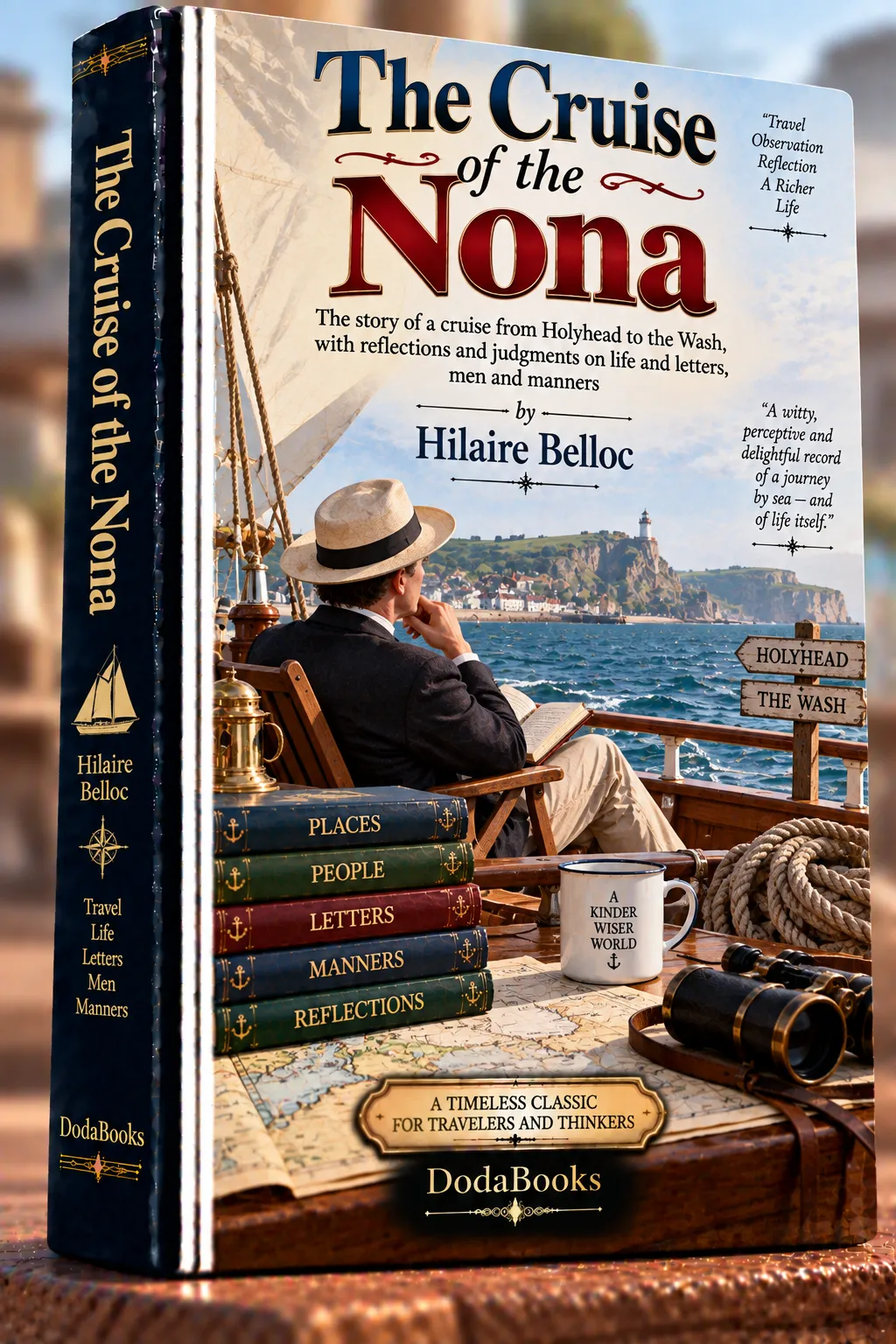
Set Sail with One of England's Greatest Prose Stylists
Read Hilaire Belloc's poetic masterpiece with nautical annotations explaining Welsh and Cornish tidal races, coastal seamanship, historical landmarks, and philosophical debates.
Get The Cruise of the NonaThe Reality of the Sea: No Romantic Sentimentalism
What strikes every reader of The Cruise of the Nona is Belloc’s profound realism regarding the sea. He has no patience for sentimental parlor poets who romanticize the ocean from the safety of an upholstered drawing room. To Belloc, the sea is an ancient, indifferent, and lethal majesty that demands rigorous humility, physical stamina, and vigilant seamanship.
In one of the most famous passages in modern English prose, Belloc writes:
“The sea is the matrix of creation, the mother of all things, and her salt is in our blood. But she is also a harsh mistress who gives no quarter. Upon the sea there is no excuse. If you blunder, you drown. The sea does not accept apologies, nor does she compromise with the incompetent.”
Belloc describes navigating the infamous Bitches of Ramsey Island off Pembrokeshire—a savage line of jagged rocks where the Atlantic tide rushes at eight knots with the roaring ferocity of a cataract. Trapped in a failing breeze as the roaring waters drag the little Nona toward the granite teeth, Belloc conveys the primal, icy clarity that only an impending shipwreck can produce in the human heart. Seamanship, he argues, is the ultimate school of moral character because it instantly strips away human pretense.
Belloc's Dialectic of Coastal Seamanship:
[Savage Tidal Peril & Fog] ➔ [Absolute Physical Humility] ➔ [Sudden Safe Anchorage] ➔ [Profound Philosophical Illumination]
An Odyssey of History, Tides, and Civilization
Unlike conventional travel memoirs that follow a rigid itinerary, The Cruise of the Nona flows like the tidal currents that dictate its progress. When the Nona is caught in a calm or anchored in a quiet estuary waiting for the tide to turn, Belloc lets his expansive, idiosyncratic intellect roam freely.
The book is structured around unforgettable thematic meditations:
- The Tragedy of Modern Industrialism: Viewing the smoking chimney stacks of industrial ports from the deck of his sailing craft, Belloc laments the alienation of the urban working class, separated from the rhythms of the earth, craft guilds, and spiritual tradition.
- The Ghost of the Roman Empire: Sailing past ancient Celtic headlands and Roman ports, Belloc meditates on the enduring cultural unity of Europe (“The Faith is Europe, and Europe is the Faith”), mourning how the catastrophe of the First World War shattered the continent’s collective soul.
- The Nature of Memory and Aging: As the voyage nears Sussex, Belloc reflects on the friends and comrades who have fallen along the way. The physical act of entering a familiar harbor at sunset becomes an exquisite, heartbreaking metaphor for approaching death and the final surrender of the soul to its Creator.
Masterclass in English Prose
Celebrated by Evelyn Waugh, Graham Greene, and C.S. Lewis as one of the most sublime examples of 20th-century English rhythm and style.
Authentic Coastal Seamanship
Detailed accounts of handling gaff rig sails, negotiating treacherous tidal races, lead line sounding, and dead reckoning without modern GPS.
Nautical Glossary & Maps
Comprehensive annotations decoding archaic sailing terminology and tracing the Nona's exact historical course along the English coast.
Post-WWI Historical Context
Explanatory notes clarifying Belloc's political critiques of parliamentarianism, the League of Nations, and distributism in post-war Britain.
The Literary Architecture of The Cruise of the Nona
To understand Belloc’s technique is to appreciate how he mirrors the natural rhythm of sailing in his sentence structure. In heavy weather, his prose becomes short, staccato, and muscular, mimicking the snap of canvas and the crash of green water over the bowsprit. In harbor, his sentences unfurl with majestic, rolling Latinate cadence, matching the gentle swell of a sheltered anchorage beneath the evening stars.
This extraordinary stylistic versatility made The Cruise of the Nona a foundational touchstone for subsequent generations of travel writers, including Patrick Leigh Fermor, Bruce Chatwin, and Jonathan Raban. It demonstrated that a travel book could simultaneously serve as a technical sailing log, a philosophical confession, and an enduring work of lyrical art.
For readers drawn to sea narratives of danger, discipline, and maritime philosophy, explore our guides to Herman Melville’s maritime epic in Moby-Dick Analysis: Great American Novel Decoded and the raw maritime realism of Blow the Man Down Guide.
Experience the Great Classic of Coastal Navigation
Read the definitive digital edition of The Cruise of the Nona on DodaBooks, with complete sailing glossaries, historical notes, and flawless digital typography.
Purchase The Cruise of the Nona on DodaBooksWhy Read the DodaBooks Annotated Edition of The Cruise of the Nona?
Because Belloc assumes his reader understands traditional British coastal topography, gaff-cutter rig mechanics, and Catholic historical theology, unguided readers often find themselves reaching for specialized references.
The DodaBooks Annotated Edition resolves these obstacles:
- Coastal Seamanship Glossaries: Explaining period nautical terms like running free, sheets, halyards, gaff jaws, lee helm, kedging, and slack water.
- Geographical Navigation Maps: Clear references pinpointing Holyhead, Cardigan Bay, St. David’s Head, Ramsey Sound, Land’s End, Portland Race, and the Sussex coast.
- Biographical and Theological Commentary: Contextual notes illuminating Belloc’s close friendships with G.K. Chesterton and Maurice Baring, and his philosophy of Distributism.
- Enhanced E-Reader Typography: Designed with responsive layout that respects Belloc’s poetic paragraph breaks and delicate typography across all modern reading screens.
The Philosophy of the Channel and the Contemplation of Silence
A central theme running through The Cruise of the Nona is Belloc’s deep suspicion of noise and speed in modern technological civilization. Out on the water, aboard a wooden craft propelled solely by canvas and the pressure of the wind, human life regains its natural scale. Belloc argues that modern urban humans are driven mad by constant artificial stimulation, sensory bombardment, and the illusion of instantaneous mastery over time.
In contrast, navigating a sailing cutter forces the mind to accept the rhythmic sovereignty of the tides. A sailor cannot rush high water; one must wait with quiet patience in the estuary until the sea decides to lift the keel. This enforced stillness creates a sanctuary for contemplative thought that has almost entirely vanished from contemporary life.
Belloc's Contemplative Axiom:
[Urban Cacophony & Speed] ➔ [Neurotic Alienation] vs. [Tidal Rhythm & Sail] ➔ [Spiritual Peace & Moral Perspective]
When Belloc drops anchor in a silent Cornish cove at twilight, watching the masthead lantern sway gently against the constellations, he experiences a state of spiritual grace that city life cannot provide. The Nona becomes an floating monastery where the soul is cleansed of modern trivialities and grounded once more in eternal verities.
To walk the ancient chalk ridges and carrier cart tracks of Sussex, explore Alfred Ollivant’s lyrical masterpiece in One Woman Guide.
Frequently Asked Questions
What kind of boat was the Nona in real life?
The Nona was an aged, 30-foot cutter-rigged yacht with nine tons displacement, built with heavy wooden timbers and lacking an auxiliary engine, requiring Belloc to rely entirely on sail and oar.
Is The Cruise of the Nona purely about sailing or is it a memoir?
It is both: while the narrative framework is a real coastal sailing voyage around England and Wales, the book functions as Belloc's spiritual and intellectual autobiography, exploring history, faith, and philosophy.
What is the famous Ramsey Sound passage about?
Ramsey Sound contains a notorious tidal hazard known as 'The Bitches.' Belloc's account of narrowly escaping shipwreck against the rocks when the wind dropped is regarded as one of the finest descriptions of maritime suspense in literature.
How does Hilaire Belloc's sailing writing compare to Joseph Conrad's?
While Conrad focused on deep-sea commercial sailing ships and psychological isolation, Belloc focused on intimate coastal cruising, local English landscape, historical memory, and theological reflection.
Where can I download the annotated digital edition?
You can purchase and immediately download the DodaBooks annotated edition directly from DodaBooks for Kindle, Apple Books, and Android reading devices.