The City of God, Volume I: Augustine’s Defense of Eternity
When Alaric’s Visigoths sacked Rome in 410 AD, pagan intellectuals blamed the abandonment of the ancient gods. In response, Saint Augustine of Hippo penned *De Civitate Dei*—a towering twenty-two-book philosophy of history that redefined Western thought.
The year 410 AD sent an apocalyptic shockwave through the Mediterranean world. For the first time in eight hundred years, the Eternal City—Rome, the capital of world civilization and imperial dominion—had been breached and plundered by Germanic Visigoths under Alaric. In the bitter refugee camps of North Africa, pagan Roman elites openly accused the newly legalized Christian religion of bringing divine wrath upon the empire by neglecting the ancient sacrificial rites of Jupiter, Mars, and the Caesars.
From his bishopric in Hippo Regius, Saint Augustine (354–430 AD) took up his stylus to author what would become the supreme intellectual synthesis of Late Antiquity: The City of God (De Civitate Dei contra Paganos). Published over thirteen years (413–426 AD), Volume I (encompassing Books I through X) constitutes Augustine’s devastating, forensic polemic against classical paganism and the imperial cult. Readers exploring our distinguished collection of classical philosophy and theological masterworks will discover in Augustine’s treatise a revolutionary philosophy of human history that dismantled the myth of secular empire.
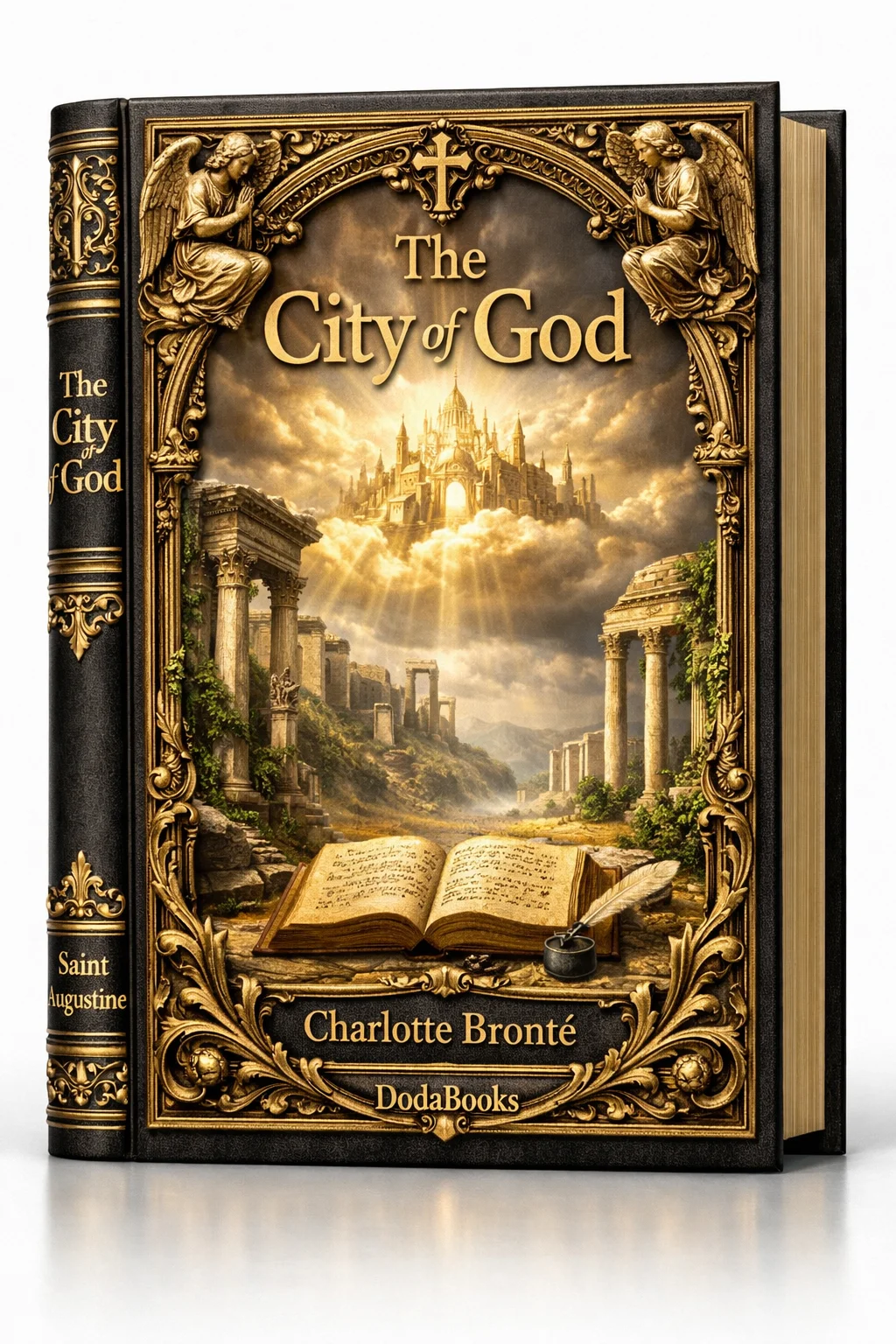
Read the Definitive Annotated Edition
Experience Saint Augustine's theological masterwork in this definitive annotated edition, complete with comprehensive notes on Roman polytheism, late antique history, and Latin patristic theology.
Get the Annotated eBookThe Historical Crucible: The 410 AD Sack of Rome
To grasp the revolutionary force of Augustine’s argument, modern readers must understand the psychic weight of Rome’s fall. For centuries, Rome was viewed not merely as a political state, but as the cosmic anchor of human civilization (Roma Aeterna). Virgil’s Aeneid had prophesied an empire without end (imperium sine fine). When the city fell, even Christian saints like Jerome in Bethlehem wept, lamenting: “The city which had taken the whole world was itself taken.”
Augustine refused to panic or despair. In Book I of The City of God, he delivered a calm, shocking reassessment of the catastrophe:
                    THE AUGUSTINIAN DECONSTRUCTION OF ROME

       PAGAN ROMAN MYTHOLOGY                      AUGUSTINE'S HISTORICAL REALISM
    ┌───────────────────────────┐              ┌───────────────────────────┐
    │ Roma Aeterna: Divine city │              │ Rome is a mortal, secular │
    │ Pax Deorum: Sacrifices to │ ◄──────────► │ political empire built on │
    │ gods guarantee prosperity │              │ fratricide, slavery & war │
    │ 410 Sack is Christ's fault│              │ The pagan gods never saved│
    └─────────────┬─────────────┘              └─────────────┬─────────────┘
                  │                                          │
                  ▼                                          ▼
       THE EARTHLY CITY (Civitas Terrena) ──► THE HEAVENLY CITY (Civitas Dei)
       Love of self to contempt of God        Love of God to contempt of self
       Founded on violence & pride            Pilgrim people bound for eternity
Augustine pointed out that during the sack, Alaric’s Christian Visigoths spared thousands of citizens who sought sanctuary inside the Christian basilicas of Saint Peter and Saint Paul—a mercy never granted by pagan conquerors in Troy, Carthage, or Gaul. He systematically dismantled the claim that Rome’s ancient gods had protected the republic, cataloging centuries of pre-Christian Roman disasters, civil wars, and plagues recorded by pagan historians like Livy and Sallust.
Structure of Volume I: Refuting Pagan Polytheism
Volume I of The City of God is divided into two distinct, forensic phases comprising the first ten books:
Books I–V: Refuting Polytheism for Earthly Prosperity
In the first five books, Augustine addresses those who worshiped pagan gods for material wealth, military victory, and earthly security:
- The Delusion of Divine Protection: Augustine demonstrates that the gods of Troy could not protect Troy from Greek fire; why should Rome expect those same defeated gods to preserve the Capitoline Hill?
- The Moral Corruption of the Republic: Quoting Sallust, Cicero, and Seneca, Augustine reveals that long before the birth of Christ, the Roman Republic had rotted from within through avarice, civil butcheries under Sulla and Marius, and moral decadence.
- The Problem of Fate vs. Providence: He refutes astrology and blind fate, arguing that the expansion of the Roman Empire was not due to Mars or Jupiter, but to the sovereign Providence of the true God, who rewarded the early Romans’ civic self-discipline while exposing their ultimate spiritual bankruptcy.
Books VI–X: Refuting Polytheism for Eternal Life
In the second five books, Augustine turns his intellect upon the sophisticated philosophical pagans, particularly the Neoplatonists who followed Porphyry and Plotinus:
- Varro’s Three Theologies: Augustine examines Roman scholar Varro’s division of religion into mythical (the poets), civil (the state priests), and natural (the philosophers), proving that state religion was a cynical political theatricality designed to keep the populace obedient.
- The Limits of Neoplatonism: While praising Plato and the Neoplatonists for recognizing the transcendent, immaterial Creator, Augustine argues that philosophy alone cannot bridge the chasm between fallen humanity and God. Only the divine incarnation and sacrifice of Jesus Christ offers a true mediator for eternal life.
                      THE TWO CITIES CONTRASTED

          The Earthly City (Civitas Terrena)     The City of God (Civitas Dei)
     ┌───────────────────────────────────┐    ┌───────────────────────────────────┐
     │ Founded by Romulus & Cain (Murder)│    │ Founded by Christ (Redemption)    │
     │ Governed by Libido Dominandi      │    │ Governed by Caritas (Selfless     │
     │ (Lust for domination & conquest)  │    │  love and mutual service)         │
     │ Seeks temporary, fragile peace    │    │ Enjoys eternal heavenly peace     │
     │ Destined for destruction          │    │ Endures as an eternal kingdom     │
     └───────────────────────────────────┘    └───────────────────────────────────┘
Major Themes in Augustine’s Masterpiece
1. The Two Loves: Amor Sui vs. Amor Dei
In the climax of Volume I, Augustine articulates his famous definition of the two rival societies that intermingle across human history:
“Two loves have made two cities: love of self, even to the contempt of God, a terrestrial one; and love of God, even to the contempt of self, a heavenly one. The former glorieth in itself, the latter in the Lord.”
Human beings do not belong to the City of God through biological race, civic citizenship, or political party, but through what they love.
2. Libido Dominandi: The Lust for Domination
Augustine was the first political theorist to diagnose the psychological pathology of imperial expansion. He coined the term libido dominandi—the insatiable lust to dominate, rule, and enslave others. He famously compared imperial empires to massive criminal cartels, recounting the ancient anecdote of the pirate captured by Alexander the Great: when Alexander asked why he infested the seas, the pirate replied, “Because I do it with a small ship, I am called a thief; because you do it with a great fleet, you are called an emperor.”
3. The Christian Pilgrim in a Fallen World
Augustine redefined the Christian’s relationship to secular government. Christians are not utopian revolutionaries seeking to build heaven on earth, nor are they indifferent hermits. They are resident aliens—pilgrims (peregrini) traveling through the Earthly City, utilizing its temporary civil peace, obeying just laws, but refusing to worship its Caesar or mistake an earthly nation for the kingdom of God.
Comparative Philosophical Context
To appreciate Augustine’s monumental place in Western thought, compare his vision with other classical and modern philosophical treatises:
| Work & Author | Era & Milieu | Philosophy | Central Focus |
|---|---|---|---|
| The City of God (Saint Augustine) | Late Roman Empire (426 AD) | Christian Theology & Providence | The Earthly City vs. the eternal Heavenly City |
| Meditations (Marcus Aurelius) | Roman Empire (180 AD) | Stoic Ethics & Duty | Inner harmony, virtue, and cosmic logos |
| The Ballad of the White Horse (G. K. Chesterton) | Wessex, England (1911) | Christian Mythopoeia | King Alfred’s defense of Christian civilization |
| The Letters of Franklin K. Lane (Franklin K. Lane) | Modern America (1922) | Civic Democratic Reform | Progressive statecraft and conservation ethics |
Where Roman Emperor Marcus Aurelius in Meditations sought solace in Stoic duty while attempting to uphold the fragile machinery of the pagan empire on the Danube, Saint Augustine recognized that all secular empires are inherently mortal and destined to crumble. And just as G. K. Chesterton in The Ballad of the White Horse celebrated the paradoxical courage of Christian hope amidst pagan invasion, Augustine laid the spiritual foundations that enabled Western civilization to survive the collapse of the Roman world.
Explore Augustine's Foundational Masterpiece
Immerse yourself in Saint Augustine's The City of God, Volume I, in this definitive annotated edition featuring extensive historical commentary on Roman religion and late antiquity.
Read The Annotated EditionWhy Augustine’s City of God Remains Vital Today
The City of God is not merely an ancient historical apology; it is an enduring handbook for navigating times of civilizational crisis. Whenever modern societies experience political polarization, institutional collapse, and cultural anxiety, Augustine’s clear-eyed realism reminds us to detach our ultimate hopes from political regimes.
Augustine teaches us that while earthly institutions are necessary to preserve civic order, they can never satisfy the restless hunger of the human heart. In an age filled with ideological extremes and secular disillusionment, Saint Augustine’s vision of a transcendent community bound together by love, humility, and eternal hope remains as radical, challenging, and illuminating as when it was first penned.
Frequently Asked Questions
Who was Saint Augustine and what was his historical context?
Saint Augustine of Hippo (354–430 AD) was a Christian theologian, philosopher, and Bishop of Hippo Regius in Roman North Africa (modern-day Annaba, Algeria). Born to a pagan father and Christian mother (Saint Monica), he was a master of classical rhetoric in Milan before his conversion in 386 AD. He is universally recognized as one of the most influential Doctors of the Church and founders of Western philosophy.
What was the direct cause for writing The City of God?
The immediate catalyst was the Sack of Rome by Alaric's Visigoths in 410 AD. Pagan Roman refugees fleeing to North Africa blamed the disaster on the empire's adoption of Christianity and the abandonment of the ancient Roman gods. Augustine wrote 'The City of God' over thirteen years to refute these accusations and provide an overarching Christian philosophy of history.
What is covered in Volume I versus Volume II?
Volume I (Books I through X) constitutes Augustine's negative or polemical defense, refuting the claims that pagan polytheism brought earthly prosperity (Books I–V) or eternal salvation (Books VI–X). Volume II (Books XI through XXII) constitutes his positive constructive theology, tracing the origin, historical progression, and ultimate eternal destinies of the Two Cities.
What does Augustine mean by "libido dominandi"?
'Libido dominandi' translates to the 'lust for domination.' Augustine identified this as the governing spiritual vice of the Earthly City, in contrast to the City of God. It describes humanity's fallen, sinful drive to exercise violent mastery and control over other human beings rather than living in mutual love and service under God.
What enhancements are provided in the DodaBooks annotated edition?
The DodaBooks annotated edition includes comprehensive historical notes explaining Roman pagan religious rites and festivals, detailed biographical sketches of classical historians like Sallust, Livy, and Varro, philosophical commentary on Neoplatonism, and an extensive introduction analyzing Augustine's influence on Western political theory. You can explore and download the definitive annotated edition directly from DodaBooks at https://dodabooks.com/ebook/the-city-of-god-volume-i/.
Related Classical and Philosophical Literature Studies
Explore further masterworks of classical philosophy, ancient Stoicism, and epic literature in our library: