The Black Hawk War
Frank Everett Stevens’ Monumental 1903 Archival History of the 1832 Illinois-Wisconsin Conflict, the Tragic Stand of the British Band, and the Early Military Service of Abraham Lincoln and Jefferson Davis
In the spring of 1832, across the oak savannas, prairie marshes, and rocky riverbeds of northern Illinois and southern Wisconsin, the final armed conflict between Native American nations and the United States east of the Mississippi River erupted. Led by the defiant sixty-five-year-old war chief Makataimeshekiakiak (Black Hawk), a desperate band of over a thousand Sauk, Meskwaki (Fox), and Kickapoo men, women, and children crossed eastward over the Mississippi into their ancestral homeland along the Rock River to plant corn—setting off months of panic, military mobilization, and tragic bloodshed.
Published in 1903 after decades of tireless archival investigation, interview gathering, and battlefield mapping, The Black Hawk War Including a Review of Black Hawk’s Life by Illinois historian Frank Everett Stevens (1856–1939) remains the definitive documentary benchmark on the conflict. Containing over three hundred rare portraits, official military orders, letters, and firsthand accounts, Stevens’ work is not merely a military history; it is an indispensable primary source record of the frontier world that shaped the young leaders of nineteenth-century America.
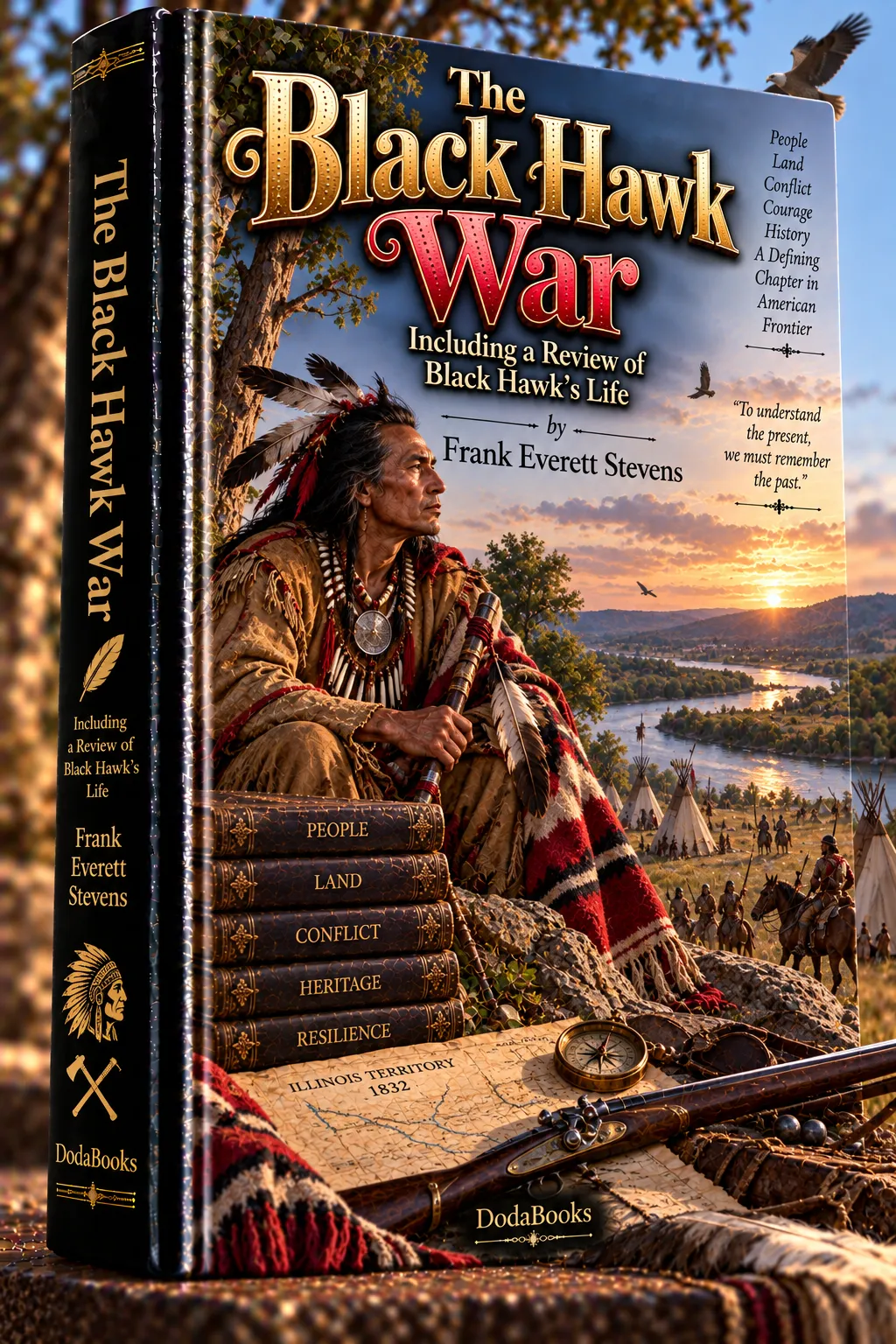
Explore the Complete Archive of the 1832 Conflict
Read Frank Everett Stevens' monumental history in an annotated edition featuring campaign maps, muster rolls, Sauk tribal histories, and Lincoln's militia service records.
Get The Black Hawk WarThe Tragic Genesis: The Disputed 1804 Treaty
Stevens opens his narrative with a forensic legal dissection of the root cause of the war: the fraudulent Treaty of St. Louis of 1804. Under this agreement, negotiated by William Henry Harrison with four intoxicated Sauk chiefs who possessed no tribal authorization to cede land, the Sauk and Meskwaki surrendered fifty million acres comprising most of western Illinois, southern Wisconsin, and northeastern Missouri in exchange for a paltry annual annuity of one thousand dollars.
For nearly three decades, tensions simmered:
- Saukenuk: The ancient capital of the Sauk nation at the mouth of the Rock River (modern Rock Island, Illinois)—a thriving agricultural town with vast cornfields, ancestral burial mounds, and hundreds of bark lodges.
- The Squatter Invasion: In the late 1820s, white squatters illegally plowed up Native cornfields, vandalized ancestral graves, and burned tribal lodges while Sauk families were away on winter hunts.
- The British Band: Rejecting the accommodationist stance of Chief Keokuk, who agreed to move west of the Mississippi into Iowa territory, Black Hawk formed the “British Band”—maintaining diplomatic ties with British posts in Canada and refusing to surrender his ancestral birthplace.
The Clash of Arms: From Stillman’s Run to the Bad Axe
Stevens provides an exhaustive, day-by-day military analysis of the campaign, stripping away romantic frontier myths to reveal the chaotic reality of volunteer militia operations:
1. The Fiasco at Stillman’s Run (May 14, 1832)
When Black Hawk sent three unarmed warriors carrying a white flag of truce to parley with an advance detachment of Illinois volunteer militia commanded by Major Isaiah Stillman, the panicked, undisciplined militiamen murdered the emissaries. Enraged, Black Hawk and forty warriors ambushed the 275-man militia column, routing them in total disorder and sending them fleeing forty miles back to Dixon’s Ferry—a humiliating defeat that inflamed nationwide frontier hysteria.
2. The Desperate Flight and Battle of Wisconsin Heights
Realizing that expected reinforcements from the Potawatomi, Winnebago, and British would not arrive, Black Hawk executed a brilliant rearguard retreat across the flooded swamps of southern Wisconsin, shielding starving women and children from pursuing federal cavalry. At the Battle of Wisconsin Heights (July 21), Black Hawk held off superior forces until darkness, allowing his people to raft across the Wisconsin River.
3. The Tragedy at Bad Axe (August 1–2, 1832)
The war ended in a horrific massacre on the banks of the Mississippi River. Trapped against the river as they attempted to cross back into Iowa, Black Hawk’s starving people were shelled by the federal armed river steamer Warrior and attacked from the rear by General Henry Atkinson’s regular infantry. Hundreds of Native women and children were shot in the water, bringing a tragic, brutal end to the conflict.
Exhaustive Archival Scholarship
Compiled from official War Department files, state archives, governor dispatches, and eyewitness journals, representing the definitive documentary record.
The Crucible of Future Leaders
Documents the military service of future historical giants who served in the campaign: Abraham Lincoln, Jefferson Davis, Zachary Taylor, and Winfield Scott.
Over 300 Historic Portraits & Maps
Detailed battlefield tactical maps, fort diagrams, and rare portraits of Native chiefs, frontier scouts, and pioneer officers.
Balanced Historical Judgment
Stevens combines rigorous documentary history with deep respect for the tragic dignity, military brilliance, and moral courage of Black Hawk.
The Young Abraham Lincoln and Future Civil War Generals
A remarkable aspect of the Black Hawk War documented by Stevens is the astonishing roll call of historic figures who participated in the campaign. Foremost among them was a twenty-three-year-old railsplitter named Abraham Lincoln:
- Captain of the New Salem Volunteers: Lincoln was elected captain of his militia company by his frontier neighbors—an honor he later described as the greatest success of his life.
- Lincoln’s War Experience: While Lincoln humorously noted in later years that his only casualties were charges against wild onions and mosquito bites, Stevens shows that Lincoln witnessed the grim aftermath of Stillman’s Run and Kellogg’s Grove, helping to bury mutilated comrades under the prairie turf.
- Future Opponents in Arms: In an astonishing historical coincidence, the young Regular Army lieutenant who administered the oath of service to Illinois militia volunteers was Jefferson Davis; the colonel commanding federal troops was future President Zachary Taylor; and the supreme commander was General Winfield Scott.
“On the prairies of Illinois in 1832 walked side by side the young men who thirty years later would command the armies of the Union and the Confederacy in the bloodiest civil war in human history.”
Study the Defining Conflict of the Old Northwest
Read Frank Everett Stevens' complete historical masterwork in an expertly curated digital edition with battle maps, officer rosters, and scholarly introductions.
Get The Black Hawk WarThe Legacy and Dignity of Black Hawk
Following his capture, Black Hawk was taken as a prisoner of war to Washington, D.C., where he met President Andrew Jackson. In 1833, he dictated his celebrated autobiography—the first Native American autobiography published in the United States—which earned him international respect for his eloquence, military honor, and love for his homeland.
Stevens’ 1903 monument ensures that neither Black Hawk’s tragic stand nor the sacrifices of frontier pioneers are forgotten. It stands as an enduring, honest testament to one of the most poignant chapters in North American history.
Why Stevens' History Remains Indispensable
Unlike popularized myths, Stevens relied on cold, verifiable primary evidence: company muster rolls, court-martial transcripts, and official letters. It is the premier reference for military historians, genealogists, and students of Native American history.
Frontier Legacies: From Prairie Outposts to Cattle Country
The conflicts of the American frontier evolved over the century from early militia campaigns to range wars between independent cattlemen and corporate syndicates. To explore this later stage of frontier struggle in classic American Western literature, visit our Firebrand Trevison by Charles Alden Seltzer Guide.
The Annotations in the DodaBooks Edition
The DodaBooks curated edition provides an indispensable reading companion:
- Complete Illinois Militia Muster Rolls: Detailed indexes of companies and volunteer soldiers, invaluable for family genealogists.
- Topographical Campaign Maps: Charting the route of the British Band from Rock Island to the Wisconsin Heights and Bad Axe.
- Sauk and Meskwaki Cultural Glossary: Contextual explanations of tribal governance, clan divisions, and religious ceremonies.
Download the Monumental Historical Work Today
Explore the complete primary documentation of the 1832 Black Hawk War in an impeccably formatted digital edition.
Download the Edition NowFrequently Asked Questions
Who was Black Hawk?
Makataimeshekiakiak, known as Black Hawk (1767–1838), was a prominent war chief of the Sauk nation in the Mississippi Valley. In 1832, he led the 'British Band' across the Mississippi to reclaim ancestral tribal lands along the Rock River, initiating the Black Hawk War.
What was Abraham Lincoln's role in the Black Hawk War?
A 23-year-old Abraham Lincoln enlisted as a volunteer in the Illinois militia and was elected Captain of the New Salem company. He served for three months, reenlisting twice as a private in scout units, though he did not see direct combat.
What was the main cause of the Black Hawk War?
The conflict arose from the disputed 1804 Treaty of St. Louis, which ceded 50 million acres of Sauk and Meskwaki land to the U.S. government under dubious legal circumstances, culminating in white squatter incursions into the tribal village of Saukenuk in Illinois.
Why is Frank Everett Stevens' book considered the definitive history?
Published in 1903, Stevens' work was based on decades of primary archival research in state and military records, containing verbatim muster rolls, battle orders, eyewitness correspondence, and over 300 rare historic photographs and maps.
Where can I get the complete digital book?
The complete, annotated digital edition of Stevens' masterwork is available for immediate download at DodaBooks at https://dodabooks.com/ebook/the-black-hawk-war-including-a-review-of-black-hawks-life-by-frank-everett-stevens/.