The Ballad of the White Horse: Chesterton’s Hymn to Civilized Hope
Hailed by C.S. Lewis and J.R.R. Tolkien as a masterpiece of modern mythopoetic literature, G. K. Chesterton’s *The Ballad of the White Horse* (1911) transforms King Alfred the Great’s ninth-century resistance against pagan Viking hordes into a timeless epic of spiritual courage and cultural preservation.
Published in 1911 during the sunset of the Edwardian era, The Ballad of the White Horse represents the crowning poetic achievement of G. K. Chesterton (1874–1936). Renowned primarily for his witty paradoxes, cultural criticism, and the Father Brown detective stories, Chesterton poured his deepest historical imagination and theological convictions into this stirring, eight-book narrative poem.
Set in the dark crucible of late ninth-century Britain, when Danish Viking invaders led by Guthrum systematically burned monasteries, shattered kingdoms, and reduced Christian civilization to a solitary marshland redoubt in Somerset, the epic chronicles King Alfred the Great. Yet unlike classical pagan epics that glory in conquest, Chesterton framed Alfred’s victory at Ethandune as a triumph of Christian humility, communal solidarity, and the paradoxical glory of fighting for a cause when earthly victory appears impossible. Readers exploring our distinguished collection of classic poetry and historical epics will discover in Chesterton’s verse an unforgettable, ringing anthem of courage.
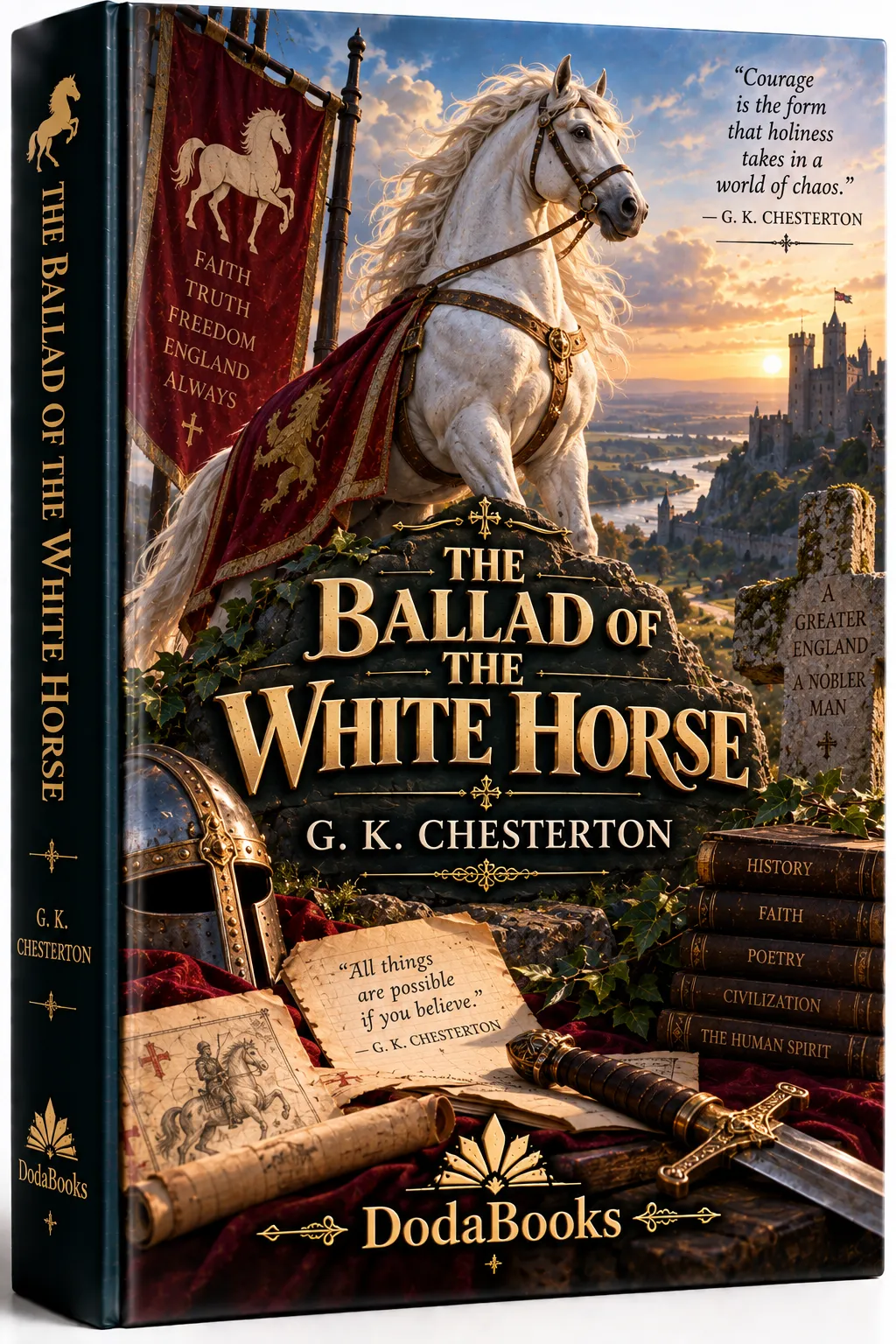
Read the Definitive Annotated Edition
Experience G. K. Chesterton's epic poem with extensive historical annotations on Anglo-Saxon warfare, the White Horse of Uffington, and Chestertonian Christian philosophy.
Get the Annotated eBookPlot Architecture: The Eight Books of the Ballad
Chesterton structured The Ballad of the White Horse into eight dramatic books composed in traditional English ballad meter, echoing the direct oral energy of ancient folk poetry:
- Book I: The Vision of the King: Alfred sits in the desolate marshes of Athelney, completely defeated. The Virgin Mary appears to him in a vision, offering not a promise of earthly victory, but the stirring paradox of Christian hope: “I tell you naught for your comfort, / Yea, naught for your desire, / Save that the sky grows darker yet / And the sea rises higher.”
- Book II: The Gathering of the Chiefs: Fired by this rugged faith, Alfred gathers the surviving chieftains of Britain: Eldred the Saxon farmer, Mark the Romanized Briton, and Colan of the Celtic West—uniting the divided tribes of the island against the common invader.
- Book III: The Harp of Alfred: Disguised as a wandering minstrel with a Saxon harp, Alfred infiltrates the Danish camp on the Berkshire downs.
- Book IV: The White Horses: Inside the Danish pavilion, Alfred engages in a famous singing contest with King Guthrum and his pagan jarls, contrasting the fatalistic, nihilistic despair of Norse mythology with Christian joy.
- Books V–VII: The Battle of Ethandune: The epic clash of shields and axes on the chalk hills, marked by tragic losses, divine intervention, and Alfred’s miraculous counter-charge that breaks the Danish line.
- Book VIII: The Scouring of the Horse: Guthrum accepts Christian baptism, peace is established, and Alfred teaches his people that the chalk White Horse cut into the hillside must be perpetually scoured of weeds—symbolizing that civilization is not a self-sustaining machine, but an inheritance that requires vigilant, loving defense.
                    THE NINE-CENTURY ALFREDIAN CRUCIBLE

       THE VIKING INVASION                     THE GATHERING AT ATHELNEY
    ┌───────────────────────────┐           ┌───────────────────────────┐
    │ Guthrum & Pagan Jarls     │           │ King Alfred (Wessex King) │
    │ Destruction of Monasteries│ ◄───────► │ Eldred the Saxon Yeoman   │
    │ Fatalism & Cult of Death  │           │ Mark the Roman Citizen    │
    │ The Darkening of the Sky  │           │ Colan the Celtic Gael     │
    └─────────────┬─────────────┘           └─────────────┬─────────────┘
                  │                                       │
                  ▼                                       ▼
       THE BATTLE OF ETHANDUNE (878) ──► The Baptism of Guthrum & Peace
       The Triumph of Humility & Faith   The Perpetual Scouring of the Horse
The Four Singing Warriors: Philosophies of Life and Death
The dramatic and intellectual centerpiece of the epic occurs in Book IV, where Alfred sits among the Danish chieftains around the campfire. Chesterton turns this confrontation into a magnificent debate between four distinct worldviews:
- Earl Harold: The young materialist who sings of sensual pleasure, wine, and gold, treating existence as an ephemeral banquet to be pillaged before death.
- Elf the Minstrel: The northern mystic who sings of the cold sea and cosmic tragedy, declaring that all gods and men are doomed to be devoured by the Wolf Fenrir in Ragnarok.
- Ogier the Old: The brutal nihilist who revels in pure violence and destruction, singing that smashing things is the only honest joy in a meaningless cosmos.
- King Guthrum: The weary philosophical pessimist who recognizes that victory turns to ash in the mouth, sensing the tragic futility of endless conquest.
When Alfred takes up the harp, he answers them with Chesterton’s supreme theological paradox: while pagans are sad because their gods are cruel and finite, Christians are joyful precisely because they know this fallen world is not their final home.
                      THE CONTEST OF THE FOUR SONGS

          The Pagan Despair                      The Christian Joy
     ┌───────────────────────────────┐   ┌───────────────────────────────┐
     │ Harold: Fleeting sensual greed│   │ Alfred: Gratitude for creation│
     │ Elf: Tragic cosmic doom       │   │ Mary's Promise: Spiritual fire│
     │ Ogier: Bloodlust & nihilism   │   │ Humility: True earthly strength│
     │ Guthrum: Weariness of victory │   │ Hope: Fighting when all is lost│
     └───────────────────────────────┘   └───────────────────────────────┘
                     ▲                                   ▲
                     └─────────────────┬─────────────────┘
                                       ▼
                       The Defeat of Pagan Nihilism:
                       Alfred's Anthem of the Resurrected
Major Themes: Paradox, Tradition, and the White Horse
1. The Symbol of the White Horse
Cut into the chalk limestone of the Berkshire Downs stands the prehistoric White Horse of Uffington. In Chesterton’s allegory, the White Horse represents the ancient heritage of human civilization and memory. If left untended, the wild weeds and grass quickly swallow the white chalk outline. Chesterton warns that civilization is an unnatural miracle; if men do not actively “scour the horse”—preserving their cultural, spiritual, and moral traditions through deliberate devotion—the wilderness of barbarism will reclaim the land.
2. Christian Paradox and Courage
Chesterton’s signature literary weapon was the paradox. In The Ballad, courage is not the arrogant confidence of the mighty; it is the stubborn determination of the weak who fight because they love what is behind them rather than hating what is before them. As Alfred reflects before the charge at Ethandune, the Christian warrior is invincible because he has already surrendered his life to God and therefore has nothing left to fear.
3. Prophecy of Modern Barbarism
In the final book, written in 1911, Alfred looks across the centuries and issues a chilling prophetic warning. He foresees that the Danes will return to England—not in wooden longships with raven banners, but in the modern guise of godless intellectuals, bureaucratic materialists, and totalitarian technocrats who will subtly dismantle Christian civilization from within. This prophetic passage deeply influenced writers like C.S. Lewis and T.S. Eliot during the dark days of the London Blitz in World War II.
Comparative Literary Context
To contextualize Chesterton’s epic within world literature, classic drama, and historical chronicles, consider these connections:
| Work & Author | Genre & Milieu | Mode | Central Focus |
|---|---|---|---|
| The Ballad of the White Horse (G. K. Chesterton) | Epic Ballad (1911) | Christian Mythopoeia | King Alfred’s stand against Viking darkness |
| Hamlet (William Shakespeare) | Elizabethan Tragedy (1601) | Renaissance Philosophy | Existential doubt, corruption, filial revenge |
| A Midsummer Night’s Dream (William Shakespeare) | Elizabethan Comedy (1595) | Pastoral Fantasy | Metamorphosis, fairy magic, woodland love |
| The Secret of the Night (Gaston Leroux) | Detective Thriller (1914) | Pre-Revolutionary Mystery | Rouletabille in St. Petersburg, nihilist plots |
Where William Shakespeare in Hamlet examined the paralyzing weight of intellectual doubt and moral corruption at the royal court of Denmark, Chesterton depicted a Christian king whose faith liberated him from hesitation. And alongside Shakespeare’s pastoral enchantment in A Midsummer Night’s Dream, Chesterton rooted his mythology in the living soil, ancient chalk hills, and oak forests of rural England.
Experience Chesterton's Epic Masterpiece
Read The Ballad of the White Horse in this definitive annotated edition, complete with historical maps of Wessex, Anglo-Saxon military glossaries, and critical essays on Christian mythopoeia.
Read The Annotated EditionWhy Chesterton’s Ballad Endures Today
The Ballad of the White Horse is widely considered by poets and scholars to be the greatest long narrative ballad in modern English literature. Its rhythmic drive is intoxicating, sweeping the reader along like the thundering hoofbeats of ancient cavalry.
During the darkest hours of 1940, as Britain stood alone against Nazi tyranny, The Ballad of the White Horse was widely recited in bomb shelters and quoted by Winston Churchill in national radio broadcasts to stiffen British resolve. Chesterton’s message—that darkness is never permanent, that hope is born from defeat, and that the beauty of civilization is always worth defending—remains an eternal, blazing light in our modern world.
Frequently Asked Questions
Who was King Alfred the Great and why did Chesterton write about him?
King Alfred the Great (849–899) was the King of Wessex who successfully defended southern England against the Danish Viking invasion and laid the foundations for a unified English nation, educational system, and legal code. Chesterton revered Alfred as the ideal Christian ruler—a warrior who fought only in self-defense, a scholar who translated Latin classics into English, and a humble man devoted to the common people.
What is the White Horse of Uffington?
The White Horse of Uffington is a monumental, 360-foot prehistoric hill figure cut into the chalk downs of Oxfordshire (historically Berkshire). Created by exposing the white chalk bedrock beneath turf, it dates back to the late Bronze Age or Iron Age. Folk tradition associated it with King Alfred's victory over the Danes at the nearby Battle of Ashdown.
How did The Ballad of the White Horse influence J.R.R. Tolkien and C.S. Lewis?
Both Tolkien and Lewis deeply admired Chesterton's poem. Tolkien was heavily influenced by Chesterton's depiction of northern courage and the battle scenes when composing 'The Lord of the Rings' (particularly the charge of the Rohirrim at the Battle of the Pelennor Fields). C.S. Lewis frequently quoted the ballad in his theological essays and historical reflections.
What does Chesterton mean by "scouring the horse"?
'Scouring the horse' refers to the ancient communal English custom of weeding and re-chalking the Uffington White Horse to prevent grass from overgrowing it. For Chesterton, this serves as a central philosophical metaphor: civilization, virtue, and faith are not permanent automated gains; they require constant, active maintenance and spiritual renewal by each generation.
What makes the DodaBooks annotated edition unique?
The DodaBooks annotated edition includes detailed historical notes on Anglo-Saxon geography and Viking history, poetic analyses of Chesterton's ballad metrics and stanza forms, comprehensive biographical dossiers on King Alfred and Guthrum, and essays exploring the poem's profound impact on 20th-century Christian literature. You can explore and download the definitive annotated edition directly from DodaBooks at https://dodabooks.com/ebook/the-ballad-of-the-white-horse-by-g-k-chesterton/.
Related Epic Poetry and Classic Literature Studies
Explore further masterworks of epic poetry, Renaissance drama, and classic French fiction: