The Babur-nama in English
Zahir-ud-din Muhammad Babur’s Intimate, Lyrical, and Epic Memoirs of Fergana Gardens, Silk Road Warfare, Kabul Vineyards, and the Founding of the Mughal Empire in 1526
In the entire canon of world literature, few historical documents match the breathtaking intimacy, emotional honesty, poetic genius, and geopolitical grandeur of The Babur-nama (Memoirs of Babur). Composed in Chagatai Turkic—the native literary tongue of the Timurid steppes—by Zahir-ud-din Muhammad Babur (1483–1530), the direct descendant of Timur (Tamerlane) on his father’s side and Genghis Khan on his mother’s, this monumental autobiography is unique in human history: the personal diary of a conquering world emperor who wrote not as a pompous propagandist, but as a passionate naturalist, poet, soldier, and vulnerable human being.
Translated definitively into English from original manuscripts by the brilliant Orientalist Annette Susannah Beveridge (1842–1929), The Babur-nama carries the reader across forty turbulent years: from Babur’s sudden accession as a twelve-year-old prince in the fertile valley of Fergana (modern Uzbekistan), through harrowing winters in the snowbound mountain passes of the Hindu Kush, to his capture of Kabul and his decisive victory at the Battle of Panipat in 1526, which founded the Mughal Empire of India.
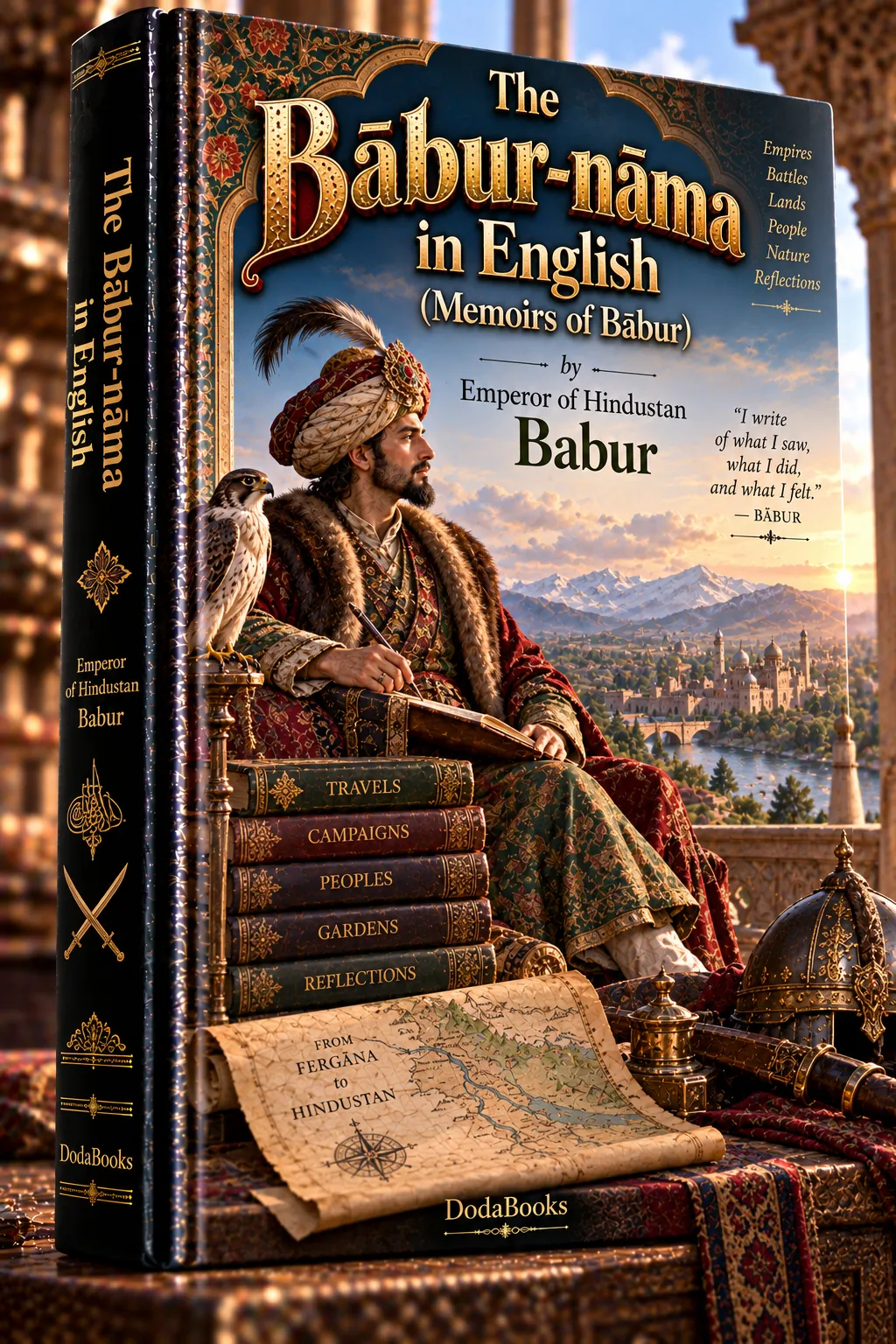
Journey Across Central Asia and Hindustan with Babur
Read Emperor Babur's immortal memoirs in Annette Beveridge's definitive translation, enriched with historical maps of the Silk Road, botanical indices, and Timurid dynastic genealogies.
Get The Babur-nama in EnglishThe Three Great Movements of Babur’s Life
Babur structures his memoirs with astonishing chronological and topographical clarity across three vast geographical arenas:
1. Fergana and Transoxiana (1494–1504): The Lost Steppes
Inheriting the tiny principality of Fergana at age twelve following his father’s accidental fall from a pigeon tower, Babur is thrust into the ruthless dynastic civil wars of the Timurid princes. He captures and loses the glittering Silk Road capital of Samarkand three times, enduring mountain blizzards, treachery from Uzbek warlord Muhammad Shaybani Khan, and desperate exile where he wanders with only a handful of loyal companions, barefoot and penniless.
2. Kabul and Badakhshan (1504–1525): The Mountain Sanctuary
Crossing the snowy Hindu Kush, Babur seizes Kabul by a bloodless coup, creating an independent mountain kingdom in Afghanistan. Here, Babur finds his true spiritual home. He lays out famous terraced formal gardens (charbagh), channels mountain streams, plants sweet melons and pomegranate groves, and writes exquisite Turkic poetry while drinking wine with his loyal amirs under the autumn moon.
3. Hindustan and the Panipat Triumph (1526–1530): The Imperial Climax
Realizing that Central Asia is permanently lost to the Uzbeks, Babur turns his gaze south toward the wealthy plains of northern India. At the historic Battle of Panipat in April 1526, Babur employs Ottoman tactical innovations—combining matchlock firearms (tufang), field cannons, and the deadly nomad flanking charge (tulughma)—to shatter the massive army and war elephants of Sultan Ibrahim Lodi, seizing Delhi and Agra and establishing the Mughal dynasty that would rule India for three centuries.
The Emperor as Naturalist, Poet, and Confessor
What makes The Babur-nama immortal is not its battlefield victories, but Babur’s astonishing self-portrait. In an age when European and Asian monarchs published only stylized hagiographies, Babur records his life with disarming, naked candor:
- The Acute Naturalist: Babur devotes hundreds of pages to detailed botanical and zoological observations. He describes the scent of flowering orange trees in Ningnahar, the exact flavor of sweet melons in Bukhara, and provides meticulous descriptions of Indian peacocks, rhinoceroses, elephants, and mangoes.
- Vulnerability and Tears: Babur weeps openly in his memoirs: when remembering his beloved mother, when an apple from his native Central Asia is brought to him in the heat of Delhi, or when recalling the tragic deaths of comrades in battle.
- The Battle with Conscience: Babur candidly chronicles his lifelong struggle with alcohol and opium. In 1527, on the eve of his critical battle against the Rajput confederacy led by Rana Sanga at Khanwa, Babur dramatically renounces wine forever, breaking his gold and silver drinking cups and distributing the fragments to the poor in an act of religious repentance.
“In the whole world there is not a fruit so delicious as the melon of Fergana. When I peeled the melon that was brought to me in Hindustan, tears of longing for my native home fell upon my hands, and I could not eat for weeping.”
First Autobiography in Islamic Letters
The earliest major prose autobiography in Islamic and Asian history, composed in expressive Chagatai Turkic by an active sovereign.
Unmatched Military & Tactical Detail
Eyewitness descriptions of early gunpowder warfare in Asia, the Ottoman wagon-laager tactic, cavalry maneuvers, and the conquest of Delhi.
Encyclopedic Botanical & Cultural Scope
Vivid descriptions of Central Asian horticulture, Persian garden design, Afghan mountain flora, and the wildlife of northern India.
Annette Beveridge's Monumental Translation
Translated directly from the original Turkic Hyderabad Codex with exhaustive philological, geographical, and genealogical annotations.
Annette Beveridge: The Victorian Scholar Who Rescued Babur
The English version of The Babur-nama is itself a monumental achievement in the history of scholarship. For centuries, English readers only knew Babur through John Leyden and William Erskine’s 1826 translation, which had been translated second-hand from a late Persian court translation rather than Babur’s original Turkic.
In the late nineteenth century, the pioneering English scholar Annette Susannah Beveridge tracked down the definitive Chagatai Turkic manuscript (the Hyderabad Codex) and spent over two decades translating it directly into English. Published between 1912 and 1922, Beveridge’s translation preserved the earthy vigor, direct phrasing, and colloquial intimacy of Babur’s original tongue, establishing the standard scholarly edition used across the globe today.
Experience the Grand Autobiography of Mughal India
Read Emperor Babur's complete memoirs in Annette Beveridge's unabridged English translation with comprehensive historical footnotes and maps.
Get The Babur-nama in EnglishThe Sacred Self-Sacrifice: The Death of Babur
The final legend of Babur’s life, recorded in contemporary court chronicles, matches the poetic nobility of his memoirs. In 1530, when his beloved eldest son and heir, Humayun, fell mortally ill in Agra with a fever that baffled court physicians, Babur performed an ancient ritual of self-sacrifice:
- Walking three times around his dying son’s bed in prayer, Babur declared that he offered his own life in exchange for his son’s recovery.
- Immediately afterward, Babur was heard to exclaim: “I have borne it away! I have borne it away!”
- Humayun recovered his health, while Babur fell ill and passed away shortly thereafter at the age of forty-seven. In accordance with his wishes, Babur’s body was taken from Agra across the passes of Afghanistan to be buried in his beloved hillside garden in Kabul (Bagh-e Babur), open to the sky and mountain rain.
Why The Babur-nama Is Essential for Every Reader
Babur does not speak to us from behind a mask of imperial majesty; he talks to us as a fellow human traveler through a turbulent world. His memoirs are an unforgettable testament to courage, love of nature, resilience in defeat, and the creative power of art.
The Annotations in the DodaBooks Edition
The DodaBooks curated edition provides an indispensable reading companion:
- Central Asian & Indian Geographical Gazettes: Explaining historic Silk Road trade routes, mountain passes, and rivers across Uzbekistan, Afghanistan, and India.
- Timurid & Genghisid Dynastic Genealogies: Charting the complex family relationships of the princes of Transoxiana and Khorasan.
- Glossary of Chagatai & Persian Terms: Defining court titles, military ranks, musical instruments, and traditional weights and measures.
Download the Complete Unabridged Memoirs Today
Discover the greatest royal autobiography ever written in an impeccably formatted digital edition.
Download the Edition NowFrequently Asked Questions
Who was Emperor Babur?
Zahir-ud-din Muhammad Babur (1483–1530) was a Central Asian prince descended from both Timur (Tamerlane) and Genghis Khan who conquered Kabul and founded the Mughal Empire of India after winning the Battle of Panipat in 1526.
In what language was The Babur-nama originally written?
The memoirs were written in Chagatai Turkic (the Eastern Turkic literary language of Central Asia), which was Babur's native tongue, rather than Persian, which was the conventional court language of Islamic empires.
Why is The Babur-nama unique among royal autobiographies?
Unlike standard propaganda or imperial chronicles, Babur writes with extraordinary personal candor, recording his military defeats, personal griefs, love of poetry and wine, and detailed scientific observations of flowers, melons, and Indian wildlife.
Who translated this edition into English?
The definitive translation was completed by the eminent British Orientalist Annette Susannah Beveridge (1842–1929), who translated directly from the original Chagatai Turkic Hyderabad Codex with extensive historical and philological notes.
Where can I get the complete digital book?
The complete, annotated digital edition of The Babur-nama in English is available for immediate download at DodaBooks at https://dodabooks.com/ebook/the-babur-nama-in-english-memoirs-of-babur-by-emperor-babur/.